That’s not the kind of plain talk you hear from a lot of boatbuilders, and the same kind of common sense thinking struck me as I made my way through Evviva. As Edson and his wife showed me around, it became clear that many of the intelligent design features that went into their 164—and that serve as the starting point for all 164s—are based on the couple’s extensive cruising experience.
“We’re on the boat about six months a year for the past 20 years,” she explains. “So you get to know what you need and what you don’t need.”
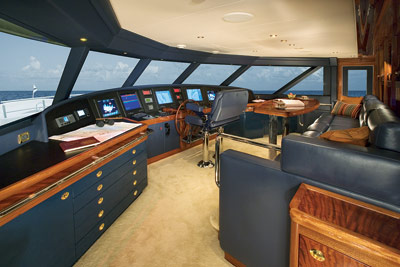
Take special note of the double-wide helm chair in the pilothouse. The owners are both licensed captains who enjoy skippering Evviva themselves.
For instance, the mirror above the sink in the bridge-deck cabin (which they use as the master) retracts into the wall almost like a pocket door, revealing a window. “So you can stand here brushing your teeth and looking out,” she continues. Down on the aft deck, she shows me a spacious wet locker just up the stairs from the swim platform. “Because where are you going to put your rain gear in Alaska?” she asks, as would anyone who has cruised the Inside Passage.
The Edsons turned Evviva‘s starboard forward guest cabin into a gym, though others might use it as a study or stateroom. And they hung a lot less artwork onboard than Vango‘s owner, preferring to let Evviva’s unique flamed mahogany stand out. “Every 164 comes with an art allowance of $100,000,” Edson says as we admire a guest-cabin wall. “We didn’t even use ours. The wood is so gorgeous.”
In the end, I realized that with the Westport 164, it’s the construction cycle that’s production, not necessarily the owner’s choices. And if the yard can already offer this much at this size, I wondered aloud, what will it strive for next?
“I don’t think we’ll go any larger,” Edson answers, “but we’ll do some filling in. From 130 to 164 is a big spread. A 145 would be appropriate for us. We’d insert it in the line at around $20 million. Maybe in a few years.
“It takes us a little longer to get started and make the molds,” Edson adds, “but once we get going, boy, watch out.”
For more information on Wesport Yachts, including contact information, click here.
Specifications
- Boat Type: Megayacht (> 80′)
- LOA: 163’10”
- Draft: 7’3″
- Beam: 30’10”
- Fuel Capacity: 20,000 gal.
- Water Capacity: 2,000 gal.
- Construction: fiberglass
- Classification: ABS; MCA certificate
- Engines: 2/3
- Gensets: 2/99-kW and 1/55-kW Northern Lights
- Watermakers: 2/3
- Windlass: Maxwell
- Air Conditioning: Frigit
- Stabilizers: Naiad
- Electronics: Furuno S-band radar; Leica DGPS; Furuno AIS system; Furuno GPS/VHF combo; Furuno sonar; Furuno DSC VHF/FM radio; Icom GMDSS VHF; Northern Airborne GPIRB; 2/Northern Airborne portable SARTs; Anschutz autopilot; Furuno blackbox sounder
- Exterior Paint: Awlgrip
- Interior Design: Donald Starkey Design
- Exterior Styling: Donald Starkey Design
- Naval Architecture: William Garden
- Builder: Westport Shipyard
This article originally appeared in the May 2007 issue of Power & Motoryacht magazine.
The dining room chairs were Donald Starkey’s second attempt, as the owners felt the first set wasn’t comfortable enough for a two-hour dinner party.
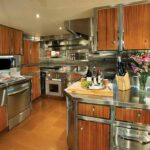
The galley-like the other crew spaces-is finished to a high standard.
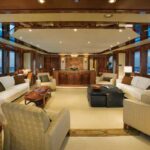
The saloon decor is meant to let the woodwork stand out.
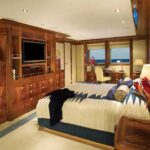
The master suite is on the main deck.
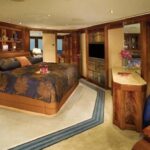
The owners use the VIP on the bridge deck as their cabin.
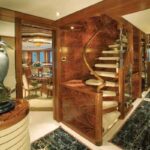
Interior designer Donald Starkey placed a floor-to-ceiling mirror at the end of the black marble in the foyer to make the passageway seem longer.
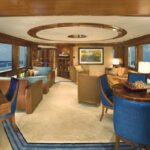
Notice the scale model of the first Evviva that is mounted amidships in the bridge-deck VIP suite.
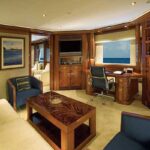
Donald Starkey incorporated wood grains into various loose furnishings to match the paneling veneers used throughout the yacht.
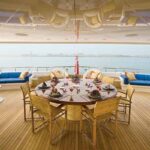
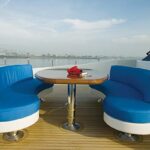
The Edsons like to take some of their meals aft on the bridge deck.
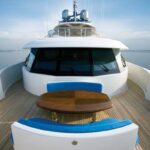
Small dining nooks seem to be everywhere onboard Evviva. As Edson’s wife said during our tour, “I guess we’re people who like to eat with a good view.”