
Old photographs are a low-tech vehicle for time travel. They jog our memories and take us back to people, places, and events that meant something to us at the time. In my office, on the wall behind my desk, hangs a collection of old black and whites, which chronicle my family’s long career in boat building. To say that I am constantly aware of the legacy resting on my shoulders is an understatement. Some days when I look at that iconic picture, taken of my grandfather with my dad and his brothers for Life magazine in the early 1960s, there appears to be a smile on each of their faces. Other days, when I look at that same picture, uh, not so much. It all depends on how things are going in the yard. When we turn out good work, those smiles are undeniable. When we make mistakes or allow our give-a-damn to slip, the four of them appear to stare at me with a stern look that is all too familiar from my childhood and as a young apprentice. I wouldn’t call it a haunting. It’s more like a long-distance thumbs-up or thumbs-down from the men I have loved and respected my entire life. A simple atta-boy or an order from the brass to go fix the problem. I realize that it’s all in my head but, when we are fortunate enough in this life to have good teachers and good role models, they remain an inspiration long after they depart. God knows, we need more of them in this decadent, free-for-all world today.
On that same wall, there is a picture of Dad, my brother Marty, and me, taken for another magazine article, some 40 years ago. The first thing you’ll notice is Marty and I both had hair, before the stress of starting and running a business demanded its pound of flesh or follicle. If you look a little closer, you’ll see that Marty and I each have a pencil wedged behind our right ear, and Dad is holding one in his right hand. A pencil. The primary tool in the creative arsenal. It is a mystery to me how some guys can get through the day without a pencil. Many of them ask to borrow mine when discussing a fabrication or styling question. “Get your own, dude, they’re free in the stockroom” is my reply. Your phone cannot draw a cut line or mark a router stop. Your phone cannot mark a twisting bevel on a long rail. It is possible for your phone to give you the math tools needed for a project, but you will have to transfer that information to the piece of wood, fiberglass, metal, or plastic on which you are working, with a pencil. Yes, of course, digital files can be transferred to CNC devices in cyberspace but there will be a pencil required somewhere in the assembly. I’m pretty sure the pencil will be around for a while.
These days, I see many of our employees using a fine line marker instead of a lead pencil. I could never get away with that. My need to erase and re-draw or re-write, during the course of a day, makes ink the enemy. In fact, if you look at the pencil in my pocket on any given day, you’ll see that the eraser is worn down to almost nothing. The eraser on my pencil is the single most important tool in my toolbox. I make mistakes. I get a better idea and better ideas evolve. That eraser performs the same function as the delete command on your computer. It is there to facilitate improvement. People with pencil erasers that show no sign of wear are not improving. People with an unmutilated eraser haven’t done a thing all day.
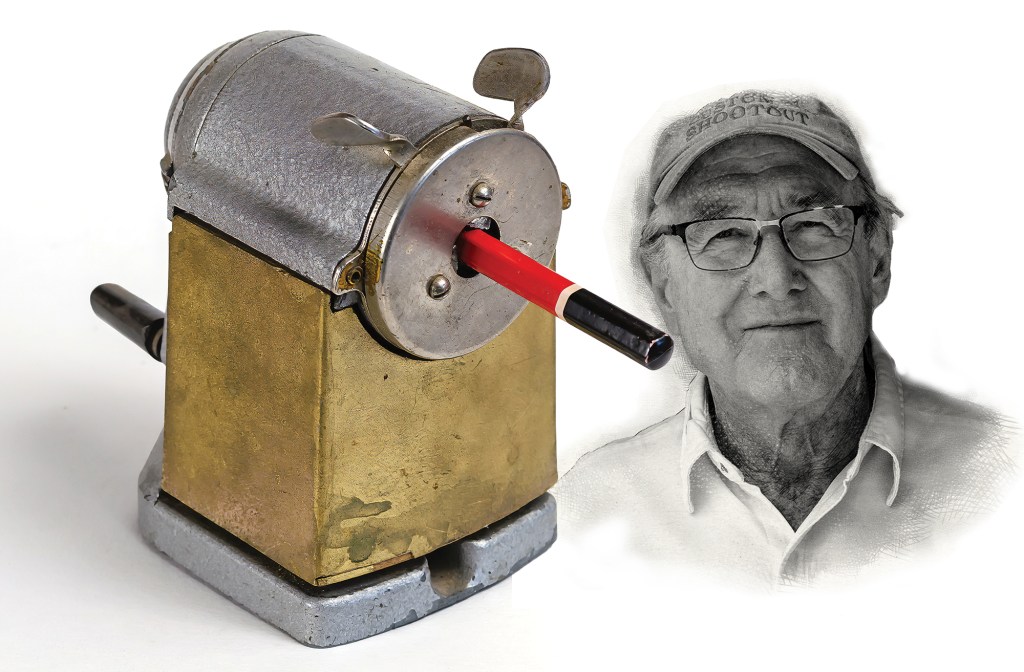
Boat building requires the marking of many long pencil lines. In the analog days of lofting, I used colored pencils to draw the faired body plan full scale so that we could differentiate between the station intersections. Keeping your pencil sharp from beginning to end on these lines is a challenge. Regular, run-of-the-mill #2 pencils can’t get the job done. Marty and I used a #4 and learned to roll the pencil in our fingers as we marked a long line, keeping an even wear around the point for consistency. This was a valuable technique when patterning or marking a long rail from a story board. Old, simple, hand crank sharpeners that were screwed to the wall in our school days are now all half-made Chinese junk. They grind un-evenly, break the lead, and aggravate the hell out of you. These days, mechanically sharpening a pencil must be done with an electric sharpener or, for the more intrepid among us, a disc sander. And stay away from the battery powered models. Just more cheap-ass, rinky-dinky stuff.
The pencil pocket on a work shirt is a dead give-away as to the accuracy of any craftsman. If a guy’s or gal’s shirt has graphite marks above the pencil slot, or there are pencil marks on his or her temples, you know that person is a craftsman who gives a damn. Some guys keep their pencils in a rolled-up sleeve on their upper arm. I see some with a pencil stuck in their adjustable ball cap strap. I know one guy who keeps them in his high-top socks. As long as you have one on you and it is easily accessible, you are informing the world that you are ready for work and part of the solution. I love the guys and gals with the all-time tradesman favorite, “pocket protector,” with multiple writing and repair implements aboard. These multi-tasking geeks are prepared for anything you can throw at them. They can pull lumber and mark it as charged with a boat name and job number, using their Sharpie. They can draw a cut line or sketch an assigned project with their Ticonderoga. Their miniature, eyeglass screwdriver is a handy tool for wire terminals. They can sign their timecard at the end of the day with their ballpoint pen. They can sanitarily pull a screw out of the men’s room urinal with their telescoping magnet. Before they leave work, they can whip out their tire gauge and check pressure. They can then check tread depth using their 6-inch stainless rule with slide. Hell, you could probably build an entire boat with pocket protector tools. Come to think of it, a pocket protector should be standard issue in all yards.
Sea trials require the use of good old-fashioned pencils. Trying to enter RPM, load, fuel burn, and SOG into a phone or laptop while we’re flying and bouncing across the ocean is damn near impossible. I end up unintentionally deleting my entire inbox or calling 911. A pencil and paper are still the safest way to record the event. We can transfer that information to the digital world after we come back through the inlet. Of course, once we’re back in the slip and plugged into shore power, I’ll be asked to sign off on the commissioning report. Is it me, or does anyone else out there feel like a demented politician with an autopen when they hand you a screen and tell you to sign your name with your finger? It doesn’t look anything like my signature. How is that legally binding? I feel like it’s about as legitimate as signing the FedEx screen when they deliver a case of paper towels to the parts room. You can’t possibly prove that it was my signature. Give me a pen and paper, please!
Yeah, it looks like the pencil will still be around for the near future. I’ll keep right on grabbing it up off my desk every morning and shoving it into my work shirt’s pencil pocket. At the end of the day, the graphite lines above it are an indication of how much we accomplished in the workday. OK, let’s see. Before I head for the barn, I had better check to see if I have enough eraser left to remove that line about a demented politician. Some of our readers may be offended by that. Uh, never mind. Pencil me in for that tolerance seminar and workshop instead. And while you’re at it, that registration fee seems a little stiff. See if you can get them to sharpen their pencil!
This article originally appeared in the May 2026 issue of Power & Motoryacht magazine.