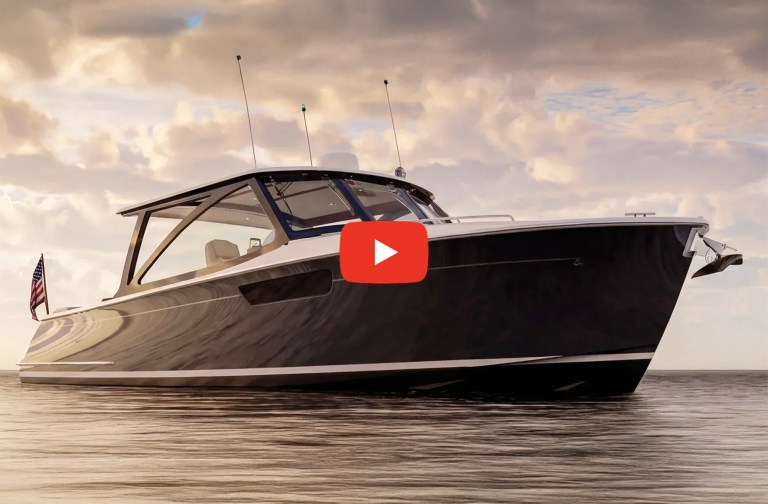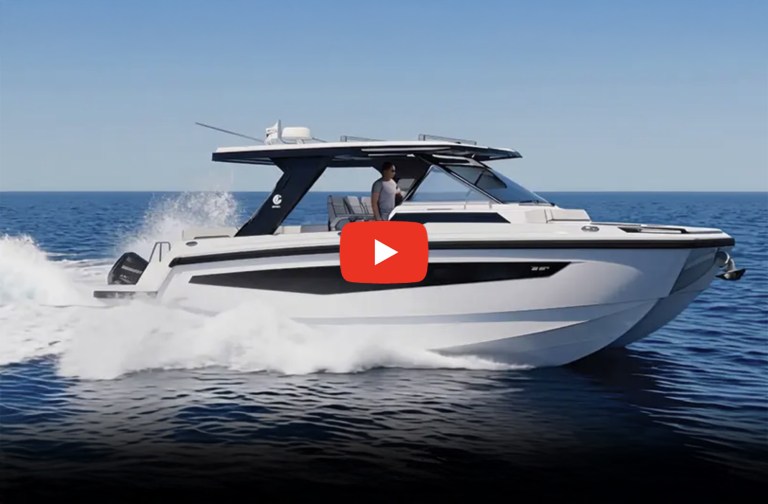
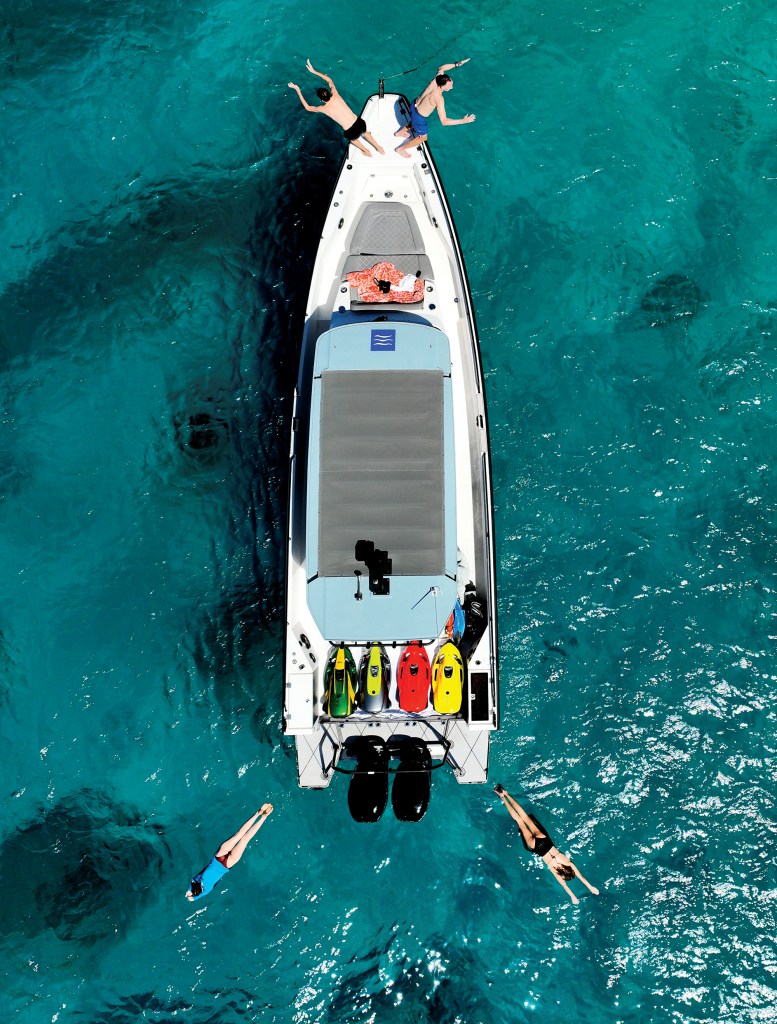
Consider the plumb bow, the beamy transom, the stark, modern lines, the light weight, and the resultant quick hop with twin 350-horsepower Racing series Mercury outboards slung on the back, and Axopar’s 37 Sun Top center console suits a lot of geography as a fjord or bay boat. For the casual weekender, the small day-charter market, a private water taxi, and even for light-duty fishing, the boat makes wonderful sense. But, as we’ve come to learn at Power & Motoryacht, the vessels seem to inspire owners beyond even Axopar co-founder and Innovation Director Jan-Erik Viitala and Head Designer Jarkko Jämsén’s wildest imaginations.
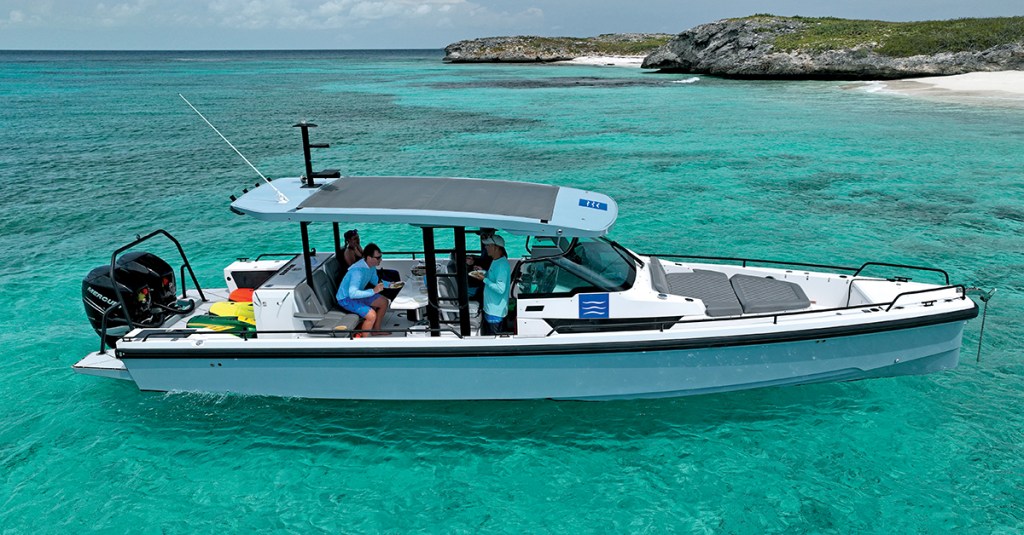
It is also no small wonder that such a new boat from a new builder should make its way so swiftly into Caribbean waters—where there is a notorious dearth of new vessels. Hardly a decade into existence, Axopar has sent more than 7,500 boats across the world. The Finnish-designed, Poland-built center consoles and cabin boats have created a prompt diaspora that, at times, is hard to comprehend. They seem to be strewn as far and wide as Boston Whalers and Bertrams, but with only a fraction of those builders’ tenure in the business.
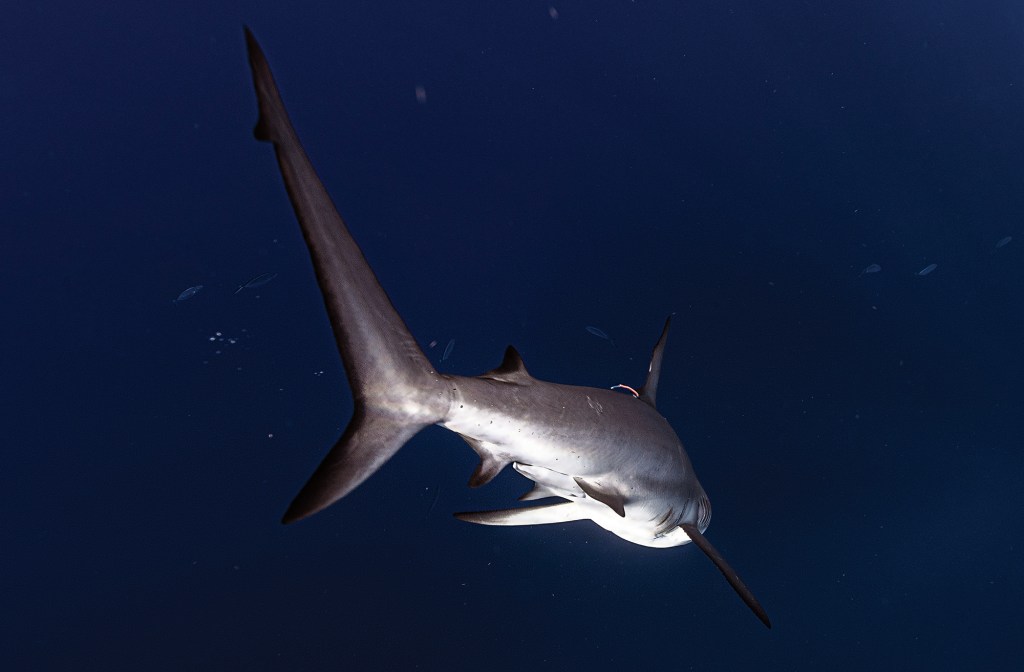
Well now, in Turks and Caicos, the Finnish builder can add “shark-tagging vessel” to its résumé.
“From the very first day, it was obvious,” Philip Shearer, the Providenciales-based co-founder, guide, and captain of Big Blue Collective says. “This was the boat.”
An eco-adventure and charter operation based in Providenciales, Big Blue Collective has quietly shaped how Turks and Caicos thinks about boats, reefs, mangroves, and what it means to guide people through a place rather than simply transport them across it. Shearer is British by heritage, Bermudian by upbringing, and thoroughly island-made by experience. “I consider myself an island boy with European roots,” he says, without irony.
Big Blue has been operating since 1997, back when GPS units were rare, cell phones were bricks, and ecotourism in much of the Caribbean was either a marketing term or an afterthought. In Turks and Caicos, it was barely a concept at all.
The company did not begin as a business plan. It began, like many enduring maritime enterprises, as a way to fund obsession.
“Initially, it was two of us who wanted to find a way to have our own addiction of exploring the underwater world financed,” Shearer says. “And the easiest way to do that was to coax unsuspecting visitors to allow us to take them to cool places and do cool stuff.”
They were in their early twenties. The pitch was simple and disarming: If we’re having the best day we can imagine, you probably will too. Don’t ask too many questions—let’s see how the day unfolds.
The first Big Blue boat was a late-1960s, 23-foot Chris-Craft—Shearer’s fishing boat in adolescence, repurposed for small-group diving. “In those days, that boat was the best riding hull on the island,” Shearer recalls. They cut into it to install a makeshift tank rack, loaded it with scuba cylinders, and promptly discovered the limits of improvisation.
“We basically punched a hole through that boat and sunk it,” he says, laughing now. “Luckily we sunk it on the backside in about 12 feet of water instead of off the wall in 7,000.”
The irony was complete: one of their competitors—whom they openly mocked for running “cattle boats”—rescued them. “We had to eat humble pie as we were handing over our BCDs (Buoyancy Compensator Devices) and whatever we could salvage.”
It was an early lesson in humility, redundancy, and the difference between romantic seamanship and sustainable operations.
After the Chris-Craft came a 17-foot Boston Whaler Montauk, chosen not for speed or glamour but for draft. It could reach the mangroves. At the time, few people cared about mangroves. Fly fishermen understood their value, but tourists largely did not. “Nobody was interested in the mangroves,” Shearer says. “So we went in there and discovered them for ourselves.”
What they found was not novelty but foundation. Mangroves, together with reefs, are the literal architecture of the Bahamian archipelago. Without them, the islands would simply wash away. “The whole of the Bahamian archipelago would not exist without the mangrove forests and the reefs,” Shearer says. “Between the two of them, we have islands that aren’t being swept out to sea.”
Kayaks followed. Education followed naturally and Big Blue’s identity shifted quickly. “We became an eco-adventure company,” Shearer says. “For a very long time—twenty-odd years—we were the spearhead of all things eco and adventure in Turks and Caicos.”
The guiding principle remains unchanged: “We’re guides first, captains second.”
Even today, every Big Blue crew member is expected to understand flora, fauna, geology, history, and current ocean conditions. Guests don’t just snorkel mangrove creeks—they learn why juvenile turtles shelter there, why lemon sharks nursery there, why upside-down jellyfish pulse beneath the surface like alien lanterns. Turks and Caicos is no longer sleepy. The US dollar is king. COVID accelerated development and demand. The clientele is wealthier, expectations are higher, and the hardware has followed suit. Today, Big Blue operates a fleet that includes Leopard power cats, World Cats, a HammerCat, an Intrepid, and—somewhat unexpectedly—a 37-foot Axopar Sun Top. “The Axopar kind of fell into our lap,” Shearer says.
Through a long-standing relationship with neighboring resort COMO Parrot Cay, Big Blue manages several guest vessels, including the (nameless) Axopar.
“They just number their boats,” Shearer says. “We call her Axo. She’s the only Axopar in our fleet.”
Photogenic and instantly recognizable, the Axopar is a favorite among guests. “A photograph does the job,” Shearer says. “People see it and say: that’s the boat I want.”
But it wasn’t charter guests who unlocked the boat’s most unexpected role. Big Blue has long been involved in conservation—turtle tagging, bird studies, geological research and cave exploration. Shark science—starting with the Beneath The Waves NGO in 2021—was a natural progression. Before COVID, the partnership installed dozens of acoustic receivers around the islands and tagged nearly fifty sharks across multiple species. Later came Project Lemon Aid, focused on juvenile lemon sharks in mangrove nurseries.
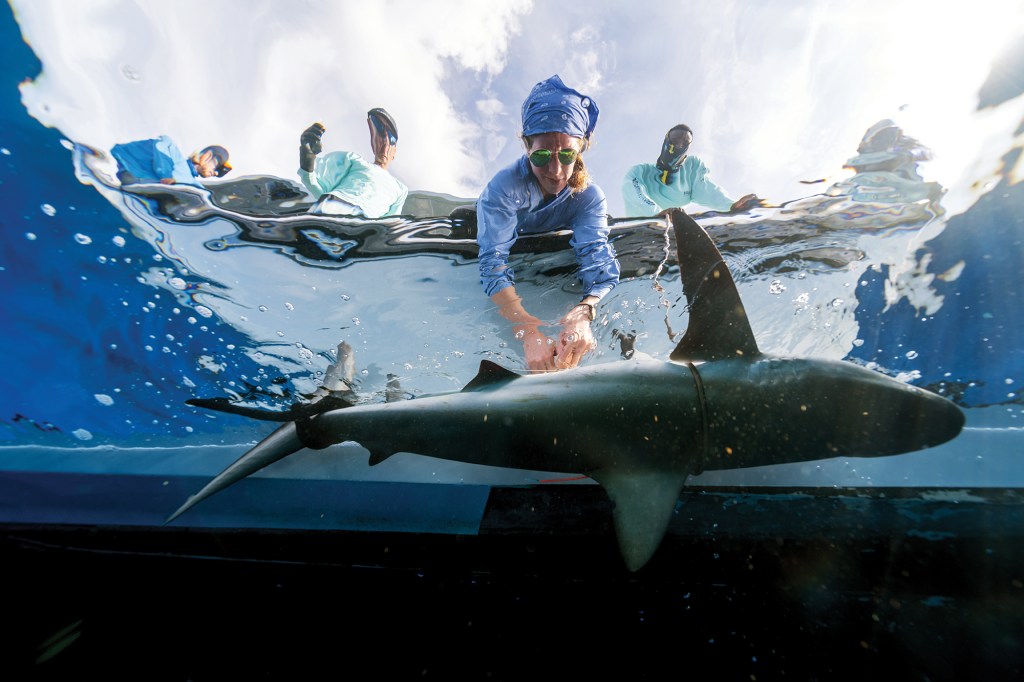
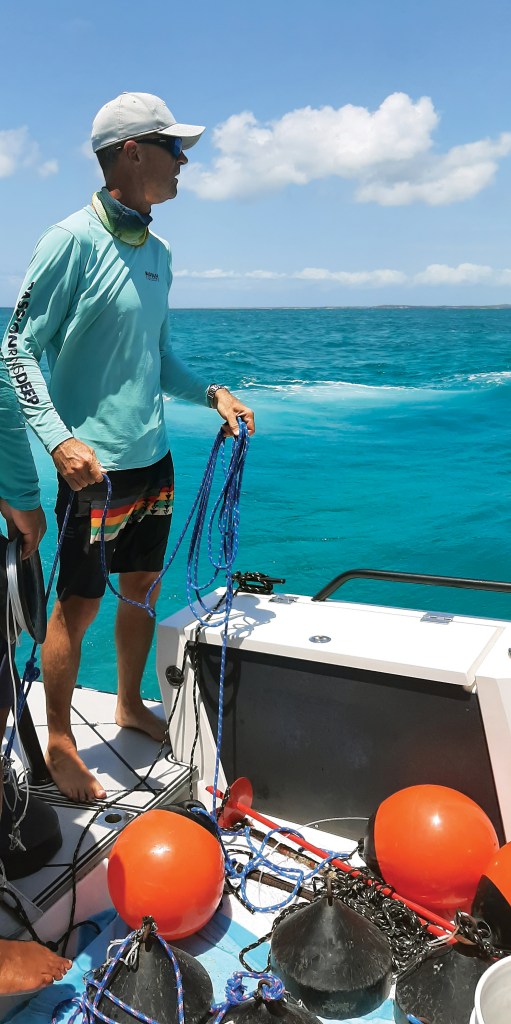
Shark tagging is not cinematic. It is procedural, physical, time-sensitive work. Tagging days involve six or seven crew, multiple drum lines, constant movement, and tight spacing. The Axopar’s speed matters. Its maneuverability matters. Its simplicity matters.
“It ticks a lot of boxes,” Shearer says. “Ease. Speed. Access.”
The goal is to minimize stress on the animal, move fast, and make no mistakes. Originally, the work was done from a large aluminum BellCraft—a formidable platform with a massive beam and a dive platform just inches off the water. Ideal for film crews. Less ideal for speed. When the BellCraft went in for a long-overdue overhaul, the team improvised. They tried other boats. Then, almost as an experiment, they tried the Axopar. “From the very first day,” Shearer says, “it was like, ‘Oh my God. This is the boat.’”
The revelation wasn’t horsepower or layout—it was proximity. The Axopar’s low freeboard allowed scientists to work alongside the shark without hauling it aboard. The solution was delightfully inelegant. “We just take the big cushion off the front—the same sunpad guests use—and hang it over the side,” Shearer says. Scientists can lean out, tag, measure, and release with minimal stress to the animal and no unnecessary handling. “You lie over the sponge instead of the rail. The animal is right there. You can do everything.”
Towels cover the deck. Scalpels, PIT tags, acoustic transmitters, measuring tapes—all laid out with surgical intent. “And the dirty part nobody tells you about is the bait.”
Barracuda. Always barracuda. Lots of bait and chum makes its way aboard and over the rail on any shark-fishing outing, even if it’s a research mission setting only a handful of drum lines. As a result, there’s also slop. Then there’s terminal tackle—swivels, snaps, wire leaders, 10/0 hooks—set out and sliding across the deck on any such outing, too.
It worked—spectacularly.
The Axopar’s twin-stepped hull and sharp entry also matter. In the short, confused chop of the Caicos Banks, the boat maintains speed and control without excessive slamming—an essential trait when running drum lines, relocating quickly between receivers, or adjusting position around live animals. With twin outboards mounted well aft, the working deck remains clear, predictable, and easy to manage. Speed, however, is only part of the equation. Simplicity is equally critical. The 37 Sun Top’s systems are straightforward and accessible by modern standards. There is no unnecessary complexity, no labyrinthine systems are hidden behind decorative joinery. When something needs attention—electrical, mechanical, or structural—it can be reached, understood and addressed quickly. In an operation running hundreds of days per year, that practicality matters more than polish. They’ve since tagged dozens of sharks from the Axopar, including a twelve-foot tiger. “If you can handle a twelve-foot tiger,” Shearer says, “you can handle anything in the Caribbean.”
Shearer is clear-eyed about the boat’s limitations. Like most production vessels, the Axo was not designed for continuous commercial use. Hardware, access panels, and certain fittings reveal their recreational intent under sustained load. But those compromises are understood—and managed. “I haven’t come across a boat yet that’s built for commercial use,” Shearer says. “They’re all built for weekenders. The real question when it comes time to boat is: Which problems do you want to have?”
What the Axopar delivers, consistently, is speed, access, predictability, and adaptability. It allows Big Blue to move fast when necessary, slow down when required, and work at the waterline with precision. In an environment that quickly exposes weaknesses—of boats, crews, and ideas—the Axopar 37 Sun Top has proven itself not as a luxury accessory, but as a highly capable tool.
And as for that shark-accessing sunpad? Well, that’s a testament to Axopar’s upholstery: No worse for wear, and not one Gucci-clad guest has ever been any the wiser.
This article originally appeared in the May 2026 issue of Power & Motoryacht magazine.