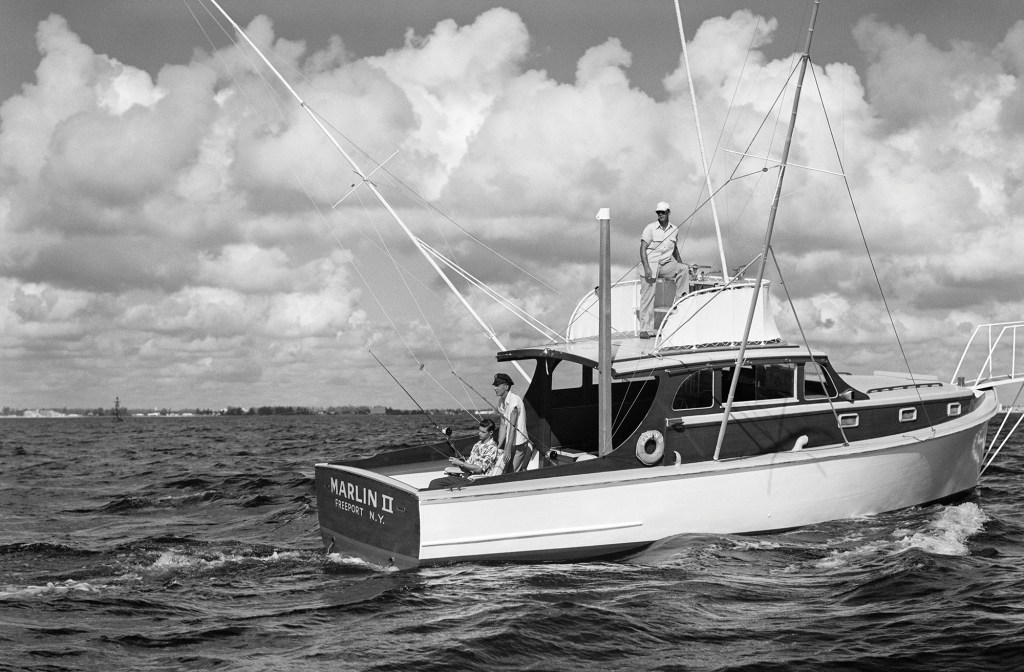
Here are three guys aboard a typical sportfishing boat of the late 1940s/early 1950s. Despite the Marlin II’s hailing port of Freeport, NY, that’s Fort Lauderdale on the horizon, at the start of the city’s postwar growth as a sportfishing and yachting mecca. The Gulf Stream runs parallel to the shore here, and so do the fish that live in its warm, fecund waters. Anglers call the stretch of water off Fort Lauderdale “Sailfish Alley,” and almost anyone can catch a sail, often only a few miles from the beach.
But this crew isn’t “anyone.” The Marlin II’s captain during the early 1950s was Bill Staros (1924-2000), a postwar transplant to Florida from Freeport, NY, where he grew up near the Freeport Tuna Club. Freeport was a good place for a kid to learn how to fish. It was called the “Boating and Fishing Capital of the East,” and there were more than 100 charter boats in and around the port. The rich fishing grounds of the New York Bight were an easy run. During the winter, many of the charter boats relocated to Florida to chase sailfish.
Bill Staros’ younger brother George (1927-2009) joined Bill in the fishing business. Together, they were nicknamed “The Greeks.” That’s likely Bill on the flying bridge in the photo, and maybe George working as mate. The Staros brothers became legendary captains. They were especially adept at landing tuna, according to sources from back in the day. While sailfish swim just off the Florida coast, to catch tuna one has to travel farther offshore; the best fishing is all the way across the Stream at the edge of the Bimini Bank.
Tuna aren’t the easiest fish to catch, but The Greeks knew the tricks, knew how to place their baits in front of the fish and get them to bite. “When the Staros brothers talked, fish listened,” according to George Staros’ obituary. (Reportedly, George once jumped overboard to gaff a 439-pound tuna.) Folks who knew them said both brothers were not only great fishermen, but also all-around good guys, willing to help out newcomers and give fledgling fishermen a chance to learn. Maybe they’re showing the young guy in the chair in this picture how to hook and land a sailfish; there’s a later photo, taken during the same trip, with a sail being hauled aboard by the mate.
Notice how rudimentary is Marlin II’s bridge: It’s just a wheel, controls, and a wooden seat enclosed by a canvas dodger. No electronics back then—the “fishfinder” was the captain’s skill and experience. Note also the lack of a ladder leading to the bridge, both to keep the cockpit clear and dissuade charter guests from climbing onto the bridge. The captain would scramble aloft using strategically located footholds. There’s no tackle rigged on the gin pole, so they don’t expect to catch anything big. A sailfish or two would make the trip worthwhile.
This article originally appeared in the June/July 2026 issue of Power & Motoryacht magazine.