Like a Fine Wine
The Azimut 80 offered distinctive lines, thanks to Stefano Righini, but she still looks good to many—a testament to her timeless design.
There’s not a whole lot you can’t do with an 80-foot boat. More than large enough to live aboard or to host multiple couples on overnights, while also just small enough to fit well into most anchorages, an 80-foot cruising yacht can just about do it all. What’s more, 80 feet is big enough to impress. If these all sound like things you’d like to do with your boat, might I point you towards the 2002-era Azimut 80.
By today’s standards, this boat’s Stefano Righini-designed lines may seem pedestrian at first glance. She’s not going to jump out at anyone for any other reason than perhaps her size in some marinas. However she is pleasantly sleek and nicely understated, and her Italian design has held up well over time. What’s more, the particular vessel I checked out this past fall in Ft. Lauderdale had shipshape gelcoat, owing to the fact that she had lived most of her life in the dry environs of San Diego.
The boat also has a rugged construction that makes her not only durable but helps keep her safe in rough waters. Her hull was hand laid using vinylester resin below the waterline, while the main deck and superstructure were PVC-foam cored. Internal bulkheads were made using composite materials.
Stepping onboard, the first thing I noticed were wide side decks leading to a pleasing amount of work space on the foredeck, as well as high and sturdy bowrails. Check and check. Safety always come first.
Up top, the flying bridge is expansive, and a favorite spot for many owners. There’s plenty of space for lounging in the sun, and also an area for a tender aft—one of three if you include the twin garages for PWCs that came on many of these boats.
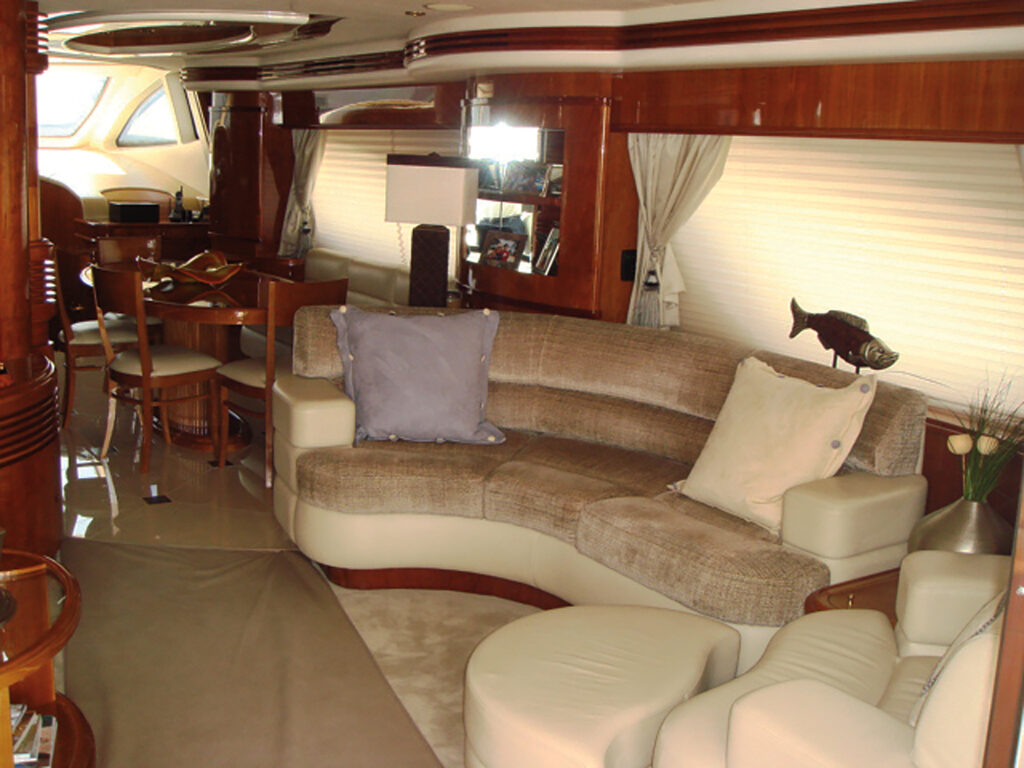
The interior was designed by Carlo Galeazzi, the elegant Italian who now does much work for Chris-Craft as well as several other European brands. In the saloon, you’ll want to keep an eye out for a milky look in the joinery, as this boat has lots and lots of interior wood, in either satin or high-gloss finish. Over time boats of this vintage can develop whitish patches under the finish, particularly if kept in humid conditions. The boat I looked over, again thanks to those deferential California climes, had none.
The standard layout for the 2002 Azimut 80 had a large galley to port on the main deck. That area comes with a standard-sized refrigerator big enough for stowing enough food for a good, long cruise.
Down below the 80 came standard with four staterooms. At the time, the airy, amidships, full-beam master was considered forward thinking, if you can imagine that. Obviously, it was a pretty good idea as it’s since become the standard on boats this size. The VIP stateroom also enjoys good space up in the forepeak. Two other staterooms in between the VIP and master came standard as mirror images of each other. However the original owner of the boat I was touring made a major tweak here. He had Azimut convert the starboard guest stateroom into a large, fully outfitted office so that he could get work done on his boat. That’s a feature that keeps this boat’s broker, Tommy Thompson of Allied Marine in Ft. Lauderdale, on his toes.
“That’s definitely held some people up from buying this boat,” he says. “But eventually it will also be the thing that sells it. There’s a guy out there that doesn’t cruise with a ton of people and needs to have a place to work. He’ll walk up one day and be like ‘Wow I gotta have that.’” Thompson also mentioned that the cost to convert the office back to a stateroom, would be a price most deal-savvy people in the brokerage market simply aren’t willing to pay.
Another option this owner chose to forego were those twin PWC garages on either side of the swim platform. He liked to cruise from California down to Cabo San Lucas, and needed the space for extra fuel tanks to increase his range. That decision opens up a lot of space in the engine room, a real highlight on this boat. Access is key in any ER, and this boat has it in spades. Both the generators and the 1,400-horsepower Caterpillar 3412s are reachable from a variety of angles. (Obviously, make sure to check for yourself on any boat you’re looking at. The twin garages came standard, and if history is any precedent, that can lead to a tighter engine room—perhaps too tight for some.) Another nice thing about the engine room is that there is direct access from it to the sizable crew’s quarters. The key word there is ‘sizable.’ That’s a notable trait on Azimuts from this time period as not all of them were designed with particular concern for the crew’s comfort. But the Azimut 80’s space has both a captain’s quarters to port and a crew’s quarters with two pullman berths to starboard. And since it’s connected to the engine room, your captain or mate/s can remain as discreet as possible if something in the ER goes bump in the night.
Oh yeah, and those engines? They work. The boat I was on had twin 1,400-horsepower Caterpillar 3412s, a relatively burly power package for its day. The 80 is notable for being able to crest 30 knots, with top speeds of 31 or 32 knots depending on the vessel. Thompson also maintains that she is a dry and overall very seakindly build, a trait helped by a relatively fine entry for a cruiser of this type.
Azimut built a lots these boats, and used a very similar hull to the 2002’s up until a few years ago. One thing to watch out for, particularly if you cruise in skinny waters is this: The first 15 hulls had a draft of almost 7 feet. After that, Azimut used some creative design, including propeller pockets to winnow the draft down to around 6 feet. In the Florida market, the standard for Carribean cruising is considered to be 6 feet.
Currently the market for these boats is pretty soft, and you can find them valued as low as just over a million dollars. At that price, this is a lot of boat: And she just might be the right one for you.
Azimut 80 Specifications:
LOA: 80’0″
Beam: 18’0″
Draft: 5’11” – 7’0″
Engines: 2/1,400-hp Caterpillar 3412s
Fuel: 1,252 gal.
Water: 397 gal.
Cruising Speed: 27 knots
Max Speed: 32 knots
Price: about $1,100,000 – $1,800,000
Years built: 2001 to 2009