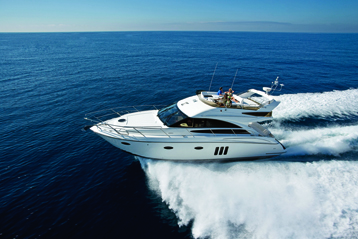
I felt slightly flummoxed after boarding Viking
Sport Cruiser’s new 50 Flybridge in the storied
old harbor of Plymouth, England. Certainly, the
source of my perplexity had nothing to do with
the vessel’s appearance. While shapes and style
lines were indeed bold and aggressive, the overall
profile was attractive yet undeniably mainstream.
And I experienced no confusion concerning
the topside layout either. All the
sun-and-fun-loving essentials were there in all
the appropriate places, from chock locks for the dinghy on the
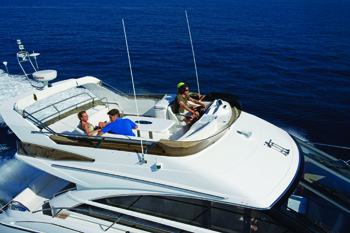
expansive teak-paved swim platform to the barbecue grill surmounting
the wet bar on the flying bridge, just abaft the double
helmseat to port.
Nope. What had me scratching my head while I descended
the stairway from the saloon to the lower deck was why Viking
had described the 50 as “the cruising family’s favorite weekend
retreat.” I’d read that in a brochure while flying over to Plymouth
for a few seal trials and a tour of Princess Yachts, the
immense facility—or rather assortment of facilities—where
Sport Cruisers like the 50 are built for New Jersey-based Viking
Yachts, with Viking’s considerable input, of course. “What’s this
baby got,” I wondered, “that’s gonna make her so darn attractive
to a cruising family?”
The first big hint came as technical sales manager for Princess,
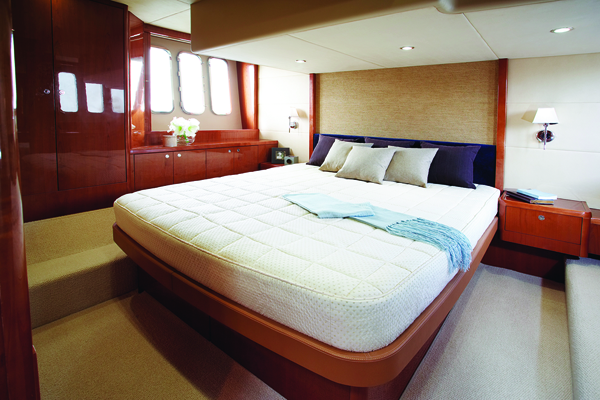
Clive Brooks, and I examined the 50’s master stateroom. As I
approvingly squished my hand into the soft but supportive
innerspring mattress on the island-type, queen-size berth, a
sense of the unusual size of the place began to slowly dawn. At
first, I figured that just standing in the midst of a full-beam
stateroom was the reason for my feeling. But then an aside from
Brooks clarified things: The 50’s beam is a fulsome 15’3″, a
measurement that makes her roughly a foot wider than many
competitors. And just in case you’re pooh-poohing such a
seemingly modest enhancement, don’t forget that a foot more
beam on a 50-footer translates into a lot more accommodation
space. For example, a master that’s ten feet long, like the 50’s,
gets an extra ten square feet. Popular with a family? Heck yes,
particularly with Mom and Dad.
Brooks pointed out another family-friendly detail before we
moved on: All joinery here—and indeed throughout the boat—
had been assembled by Princess carpenters using special veneers
from Dutch manufacturer Leeuwenburgh Fineer, thus engendering
several advantages exclusive to Princess and Viking Sport
Cruisers. First, because Leeuwenburgh veneers are backed with
stability-promoting phenolic materials, they resist shifting
beneath varnish and other coatings due to contraction or expansion,
a virtue that obviates moisture intrusion and whitening or
“blooming” of finishes that results. Second, proprietary treatments
make the veneers more UV-resistant than most other
veneer products, which precludes fading over the long term.
And third, the Leeuwenburgh veneers make repairs both simple
and easy. If someone scratches a cabinet door or credenza top,
Herculean repair efforts are not called for and a weekend’s serenity is not threatened. The polyurethane top coat in the
immediate vicinity is simply removed with sandpaper and a
new layer of top coat is sprayed on from an aerosol can (part of
a joinery-repair kit Viking supplies to its dealers). After a quick
buffing, the job’s done.
As I continued to scrutinize the 50’s interior with Brooks,
many more family-friendly qualities began to reveal themselves.
Our test boat, for example, offered an eminently sensible,
comfortable layout with three ample staterooms and a
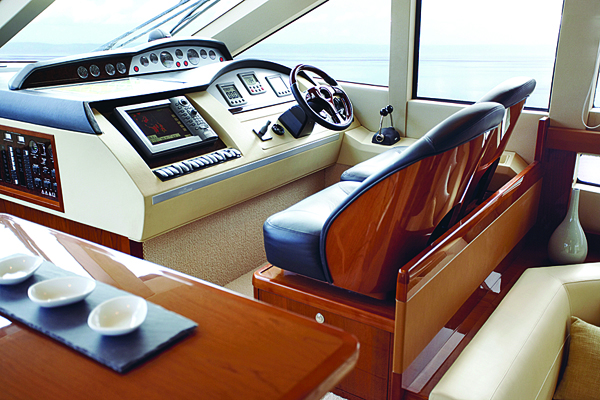
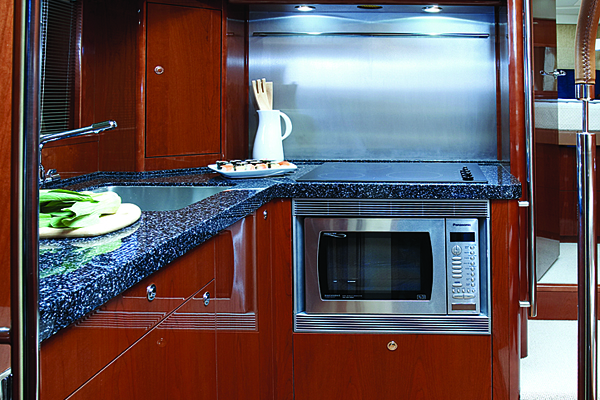
galley on the lower deck plus a seagoing “great room”
(saloon/dinette/lower helm station) on the main one. While
checking out the condo-style appliances, dovetailed drawers,
and other domestic highlights of the galley, a question came to
mind: Might the 50’s galley-down setup relegate the cook to a
black hole, socially speaking? Not with the lower helm station
and dinette within easy conversational range, the windshield
above greenhousing the Avonite countertops with a flood of
light, and the best stability onboard (both transverse and longitudinal) residing directly underfoot.
,
A feature I particularly liked was the generous use of glass.
There’s an array of elliptical Trend Marine opening ports that
are refreshingly oversize—at roughly 2’2″x 10″, some of the
largest I’ve seen on a 50-something-foot cruiser. There is a
threesome of big vertical windows on either side of the master
stateroom, two fixed and one hinged to open for cross-ventilation.
And an assortment of big side windows and windshield
panels on the main deck offer great visibility while seated,
whether in the saloon, at the lower helm, or in the dinette area.
Headroom is at least 6’8″ virtually everywhere.
Once we’d completed a quick tour of our 50’s engine room, a
cockpit-hatch-accessed spot boasting a couple of 670-hp Volvo
Penta D11-670s, a profusion of top-notch, schematically
installed ancillary equipment, and more than enough room to
swing a wrench (I measured 1’8″ between the two expansion
tanks on the mains and 4’2″ of headroom), Brooks hit the
starter switches at the upper station and we were off for a sea
trial on what Plymouth folks call “The Sound,” a rocky little
bay that edges the English Channel. While the seas were hardly
rowdy enough to gauge rough-water handling characteristics,
the boat did cut the two-foot chop with true, deep-V verve
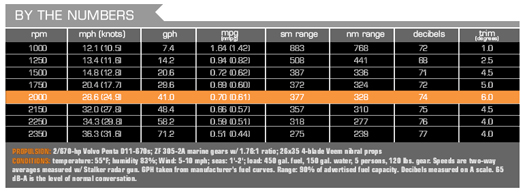
(transom deadrise: 19 degrees), produced a brisk average top
speed of 36.3 mph, and manifested running attitudes that were
for the most part optimum. Even the angles I recorded between
1750 and 2000 rpm (5 and 6 degrees, respectively) were not
steep enough to affect over-the-bow visibility from either the
upper or lower helms, although I’m no fan of the venturi windshield
at the former spot—it’s too dark for my taste.
Tracking was steady and cornering fast and exciting, not least
of all because of the 50’s fly-by-wire, electro-hydraulic steering
from Sleipner (see “Noteworthy: Fly By Wire,” this story).
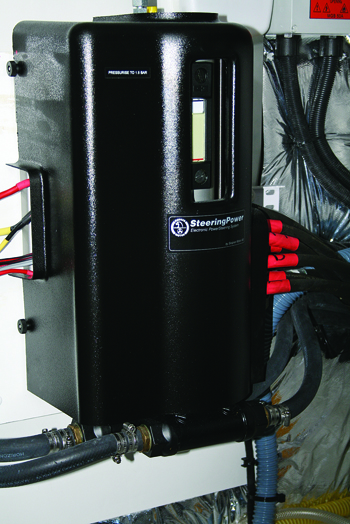
Not only did the SteeringPower system produce a tight, superresponsive
driving experience, it seemed to virtually lock the
rudders on straightaways, with no discernable drift or wobble.
“Driving this thing’s effortless,” I yelped, as we whooshed past
a big, gray warship headed for Her Majesty’s naval base at
Devonport.
And just in case you think such joyful declarations have little
to do with making a family favorite of a boat like Viking Sport
Cruiser’s 50 Flybridge, think back to the last time you hunkered
over a flying-bridge wheel on a Sunday evening, after an
enjoyable weekend, with everybody onboard tired and just a
little bit cranky. Family favorite indeed!
Notworthy: Fly By Wire
Our test boat had Sleipner’s
SteeringPower electro-hydraulic
steering at both her upper and lower
helm stations. How did it differ from
the more conventional mechanicalover-
hydraulic systems I see on most
boats these days? For one thing, the
system is quick and even—I counted
just four turns lock-to-lock at each of
the 50’s steering stations and there
was no feeling of compression or
heaviness as I spun the wheel one way
or the other. Moreover, Sleipner’s built
a comfortable amount of resistance
into the system’s software. And there’s
a hydraulic override built in as well; in
the event of an electrical glitch, the
lower helm station goes to straight
mechanical-over-hydraulic with 12
turns lock-to-lock. —B.P.
Contact: VIKING SPORT CRUISERS (609) 296-6000.
www.powerandmotoryacht.com/viking-sport-cruisers/.
The Boat
Standard Equipment
2/670-hp Volvo Penta D11-670 diesel
inboards; Trend Marine opening ports w/
screens; FRP radar arch; Side-Power
electric bow thruster; SteeringPower
electro-hydraulic steering; Volvo Penta
electronic engine controls; Raymarine
electronics package (depthsounder,
speed/distance log, autopilot); ACR
spotlight; 2/Icom VHFs; Avonite
countertops; Neff 4-burner cooktop; Waco
refrigerator-freezer; Sharp convection/
microwave oven; leather upholstery;
innerspring mattresses (master and VIP);
2/VacuFlush MSDs; flying bridge wet bar
w/ sink, top-loading refrigerated cool
box, and electric barbecue; 7-kW Onan
genset; 7/GP 31 maintenance-free
batteries (2 engine start, 4 house, 1
genset); 58,000-Btu Cruisair A/C; Separ
fuel-water separators for mains and genset;
proprietary air intakes w/ eductors and
emergency shutdowns; Fireboy auto. fireextinguishing
system; welded-aluminum
fuel tanks; polypropylene water tanks;
Halyard mufflers; Tides Marine dripless
shaft logs; Lenco electric trim tabs; teak
decking (cockpit, swim platform, flyingbridge
stairway and steps to side decks);
5/auto. bilge pumps
Optional Equipment
Furuno NavNet GPS radar/chartplotter w/ repeater display at upper and lower helms; Splendide combo washer/dryer; entertainment package (including Bose Home Theater System)
Specifications
- Optional Power: 2/715-mhp Caterpillar C12 ACERTs
- Water Capacity: 155
- Overall Length: 50’5″
- Beam: 15’3″
- Fuel Capacity: 600
- Year: 2009
- Type: Product+boattest
- Standard Power: 2/670-hp Volvo Penta D11-670s
The Test
Test Boat Specifications
- Price as Tested: Not Available
The Numbers
This article originally appeared in the October 2009 issue of Power & Motoryacht magazine.
The Photos