Keys to The West
The Lancia Aprea 52, the first in a new line from 135-year-old builder Fratelli Aprea, takes hints from American yachting history while holding firm to its own.
When a 135-year-old boatyard decides to take on a new-world design, the approach has to be a departure from the foreign and familiar alike, arriving at something if not entirely novel, then decidedly unto itself. Marrying gilded age stateliness with Amalfi coast glamour, and perhaps picking up a dash of Roger Moore-era James Bond, the first of Fratelli Aprea’s Lancia Aprea line, a powder-blue (or “azzurro recommone”) 52-footer, is a classic interpretation very much its own—and with legs to boot.
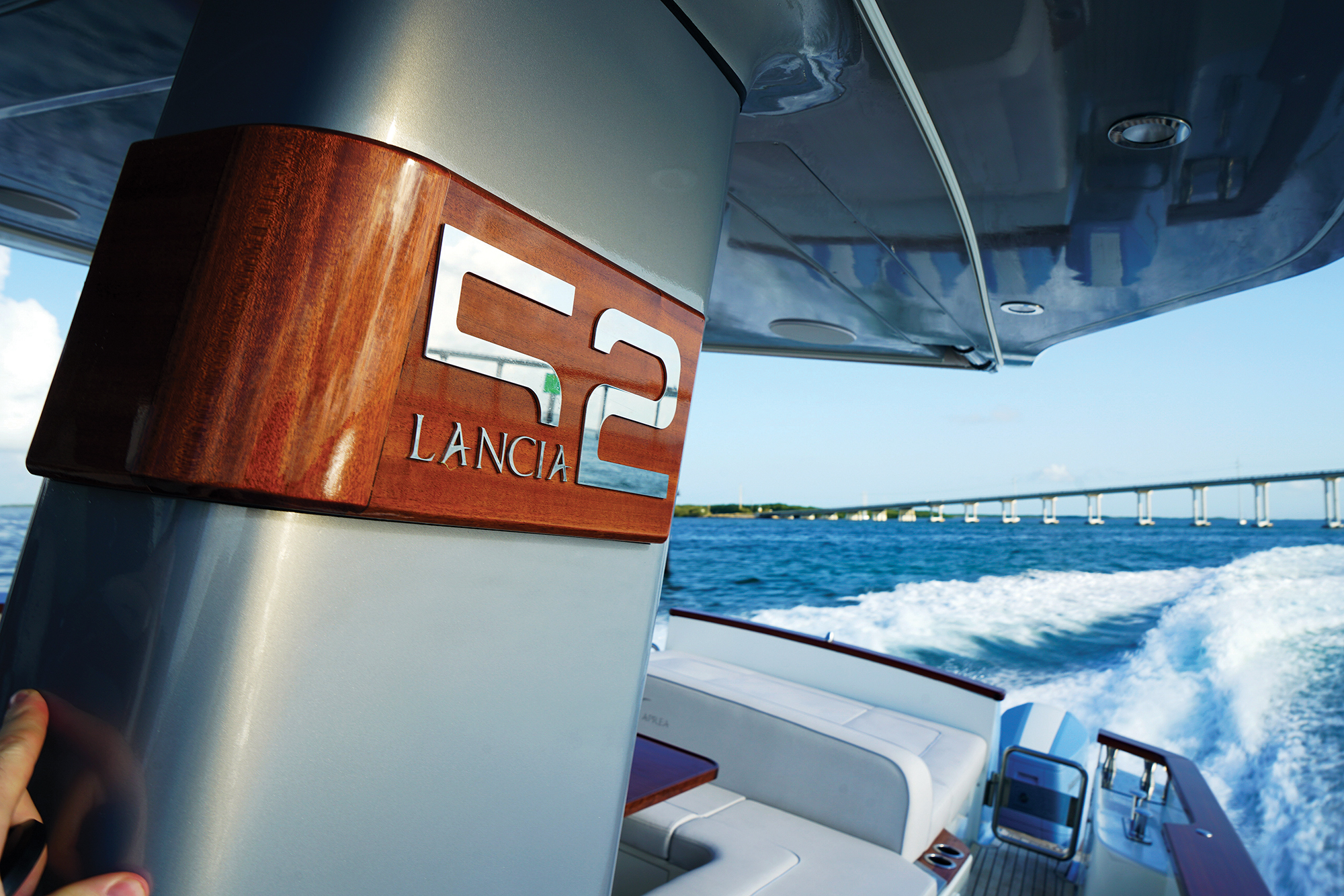
I’m aboard the first of these models to arrive stateside, bound for Key West at the propitious end of a quad set of 600-horsepower V12 Mercury Verados and no homeport yet painted upon her richly varnished mahogany stern. This boat—and the entire proposed line spanning 32 to 72 feet—will mostly be built traditionally for inboard engines (Volvo Penta IPS 800s, MAN i6-800s, inline diesels, if you so choose), but a large, teak-festooned swim platform and shallow (2-foot, 9-inch) draft just begged for an outboard option in the U.S.
I’ve seen Fratelli Aprea’s more traditional gozzos throughout the Mediterranean. They are in a sense simple but evolved fishing boats (commissioned by the U.S. Navy during World War II), but they’re built with a level of care and detail that leaves them hard to miss in almost any port. Still, I am flummoxed by the builder’s relatively recent and sudden appearance stateside. What gives? And further, why bother? For a yard that still does everything by hand, how many more hulls can this sixth-going-on-seventh-generation family business possibly turn out in a given year?
It turns out that a chance encounter with an American entrepreneur with Italian roots and an affinity for classic wooden boats might have set a spark.
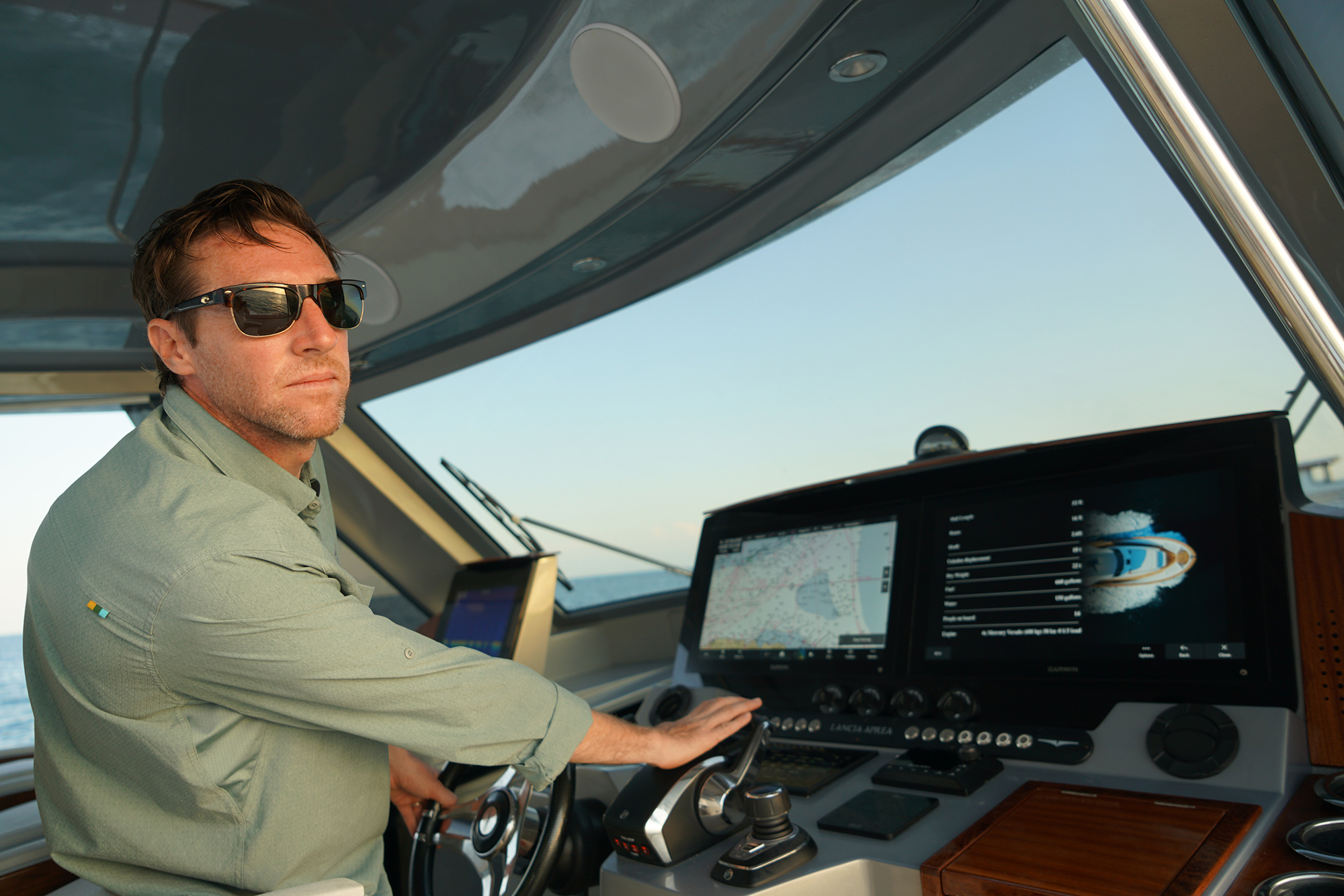
“We’d always go back and forth to the same area in Italy where my family’s from,” Michael Sinacola, Fratelli Aprea’s United States broker, regales me as we depart from the Miami River at daybreak. “And I had always seen these boats, the Fratelli Apreas—the traditional boats. So when I could finally buy some toys, I wanted to buy one of those boats and take it to my house in Michigan.”
Years later, Sinacola was running a successful medical export business, and in short, the money was there when the stars finally aligned themselves, but not exactly in the way he’d imagined. While chartering a yacht in Sorrento, Sinacola got to speaking with the captain. He mentioned that he’d had his heart set on a Fratelli Aprea, and the captain, who owned a small fleet of them, offered to bring him to the yard for a tour. “I was like, ‘This is cool and all, but I want one of those boats.’” Sinacola recalls. “And he says, ‘I have six in our charter fleet. If you want, we’ll go whenever you come back to Sorrento, call me and we’ll go to the shipyard.’”
Sinacola took him up, ooh-ing and ogling his way through the legacy outfit. A born gearhead and builder himself, he ended up chatting with Antonino and Francesco Aprea, sorry only that he’d missed the chance to meet their father, Giovanni Aprea. A couple of days afterward, “After dinner I went to take my stroll down in the little fishing village by the original shipyard, which they still own,” says Sinacola. “I saw the dad that I had seen in the shipyard and acknowledged him, but we didn’t speak then as he was working. He was out there cleaning something. And so I went and talked to the guy, and he’s speaking to me in Napolitano, and I’m speaking to him in Italian … I say, ‘I’m really interested in buying one of your traditional boats.’ And he says, ‘Yeah, I’d like for you to meet my wife.’” Meeting the matriarch, it would seem, is a requisite for purchasing a boat from Fratelli Aprea. “And I was like, yeah, that’d be great.’”
The next thing Sinacola knew, he was being taken by the hand and being led up the stairs of an old building just shy of midnight. Signor Aprea brought him to his house and, as is perfectly acceptable in this particular part of the world, simultaneously introduced Sinacola to his wife while having her draw up coffee, of which they partook until 3:00 in the morning.
Signor Aprea was curious, but maybe a bit skeptical of Sinacola. What, after all, does an American want with an Italian boat when there’s every type of builder and boat imaginable—save for his—back in the States? Little did he know, Sinacola hailed from Michigan, where classic wooden boats are esteemed and revered. Aprea was ultimately impressed with Sincacola’s appreciation of the old world and his new-world, entrepreneurial mind. He became the builder’s lone in-house broker and CEO of its Americas division.
Sinacola spent another month in Sorrento, commissioning a 32-foot cruiser, and, ultimately, forming a business plan to bring the first five Fratelli Aprea hulls stateside for sale. Partly out of intrigue and curiosity, but to also to hopefully show some prowess around the yard, Sinacola also spent time tinkering in the shop with the Aprea family. You might say they cautiously but optimistically drew one another in: “I’m geeking out because it’s a hundred something year old shipyard, these people are building stuff by hand,” Sinacola tells me as we both plop down on what I note are decidedly firm yet seriously comfortable aft settee cushions—and I sit on a lot of marine-grade cushions.
“This is right up my alley … these work wrenches that are 150 years old and old hand planes that were their grandfather’s. These boats are not just widgets that are being pumped out of a factory. These little jewels are being created by craftsmen.” Contrary to his predominantly American upbringing, Sinacola found himself astounded at the glacial pace at which tasks—and ultimately boats—were completed at the yard. “These guys aren’t worried about ‘How can we build a hundred boats a year?’ It’s like, ‘No, we’re building this one and it’s going to take as long as it takes, and when it’s ready, then we’ll build the next one.’ It’s very old school, almost to a detriment.”

The operation certainly pulls out all the stops. Case in point: One family member spends much of his time traversing the globe hand-selecting each and every piece of wood that goes into every single boat.
Further to that end, no two boats are likely to be alike. Fratelli Aprea offers enough wood and Loro Piana fabric options to make any land-based interior designer blush; the topside of this boat is decked in a mature, tight-grained teak, and to say that the mahogany that covers nearly every other surface is thoroughly varnished drastically understates the blinding sheen.
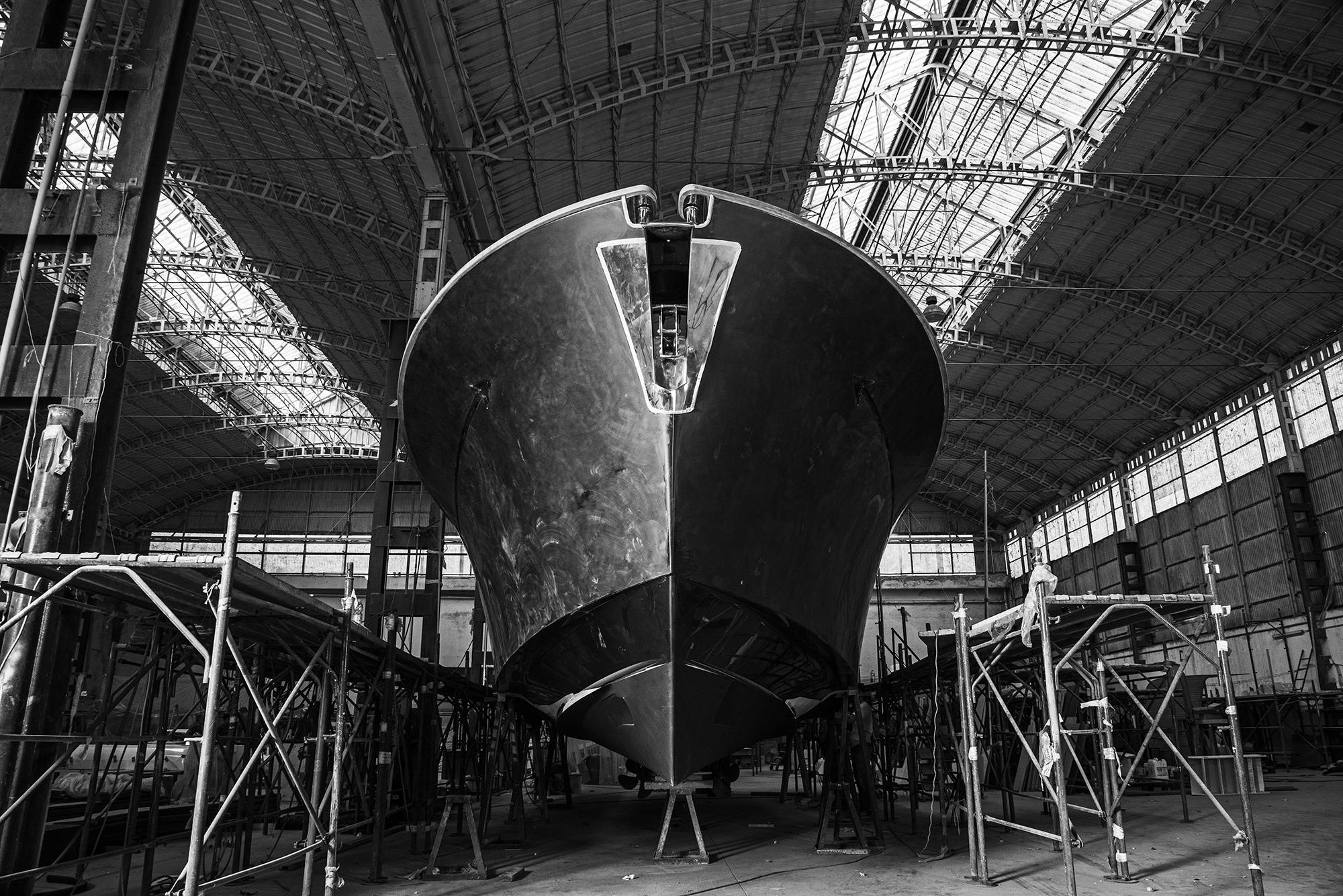
Fratelli Aprea as a whole halted all-wood construction in the 1980s, though they can still be built to order. And while their hulls are now hand-laid fiberglass, acheived with relatively excruciating precision in contrast to the quicker, vacuum-infused molding that many higher-volume yards employ. There’s high tech here, too, though—the superstructure is laid up in carbon fiber.
Envisioning ownership of one of these semi-displacement hulls, I get the feeling I’d have enough woodwork to keep me busy and keep my pockets lightening. No, this is not a light-upkeep vessel by any stretch, but at 52 feet with a 16-foot beam and joystick control, it’s not entirely unreasonable for an owner-operator to manage. And neither is running the boat. I’m told Europeans would be more likely to hire a captain for this sort of machine than Americans. I’m not here to pontificate upon reasons why that might be, but I see my fair share of folks with plenty of means campaigning similar vessels on their lonesome in and around New York.
With bow thrusters and quad engines, turning is as easy as it gets on any boat of this size, which is to say simple compared to a 30- to 40-foot diesel from yesteryear. And I’ve come far enough without mentioning the helm. There is an upwelling of 50-plus-foot “center consoles” hitting the water these days and this one doesn’t short-change the term. The 52 is a modern take on the Lancia Sorrentina, an iconic yacht from the 1950s that often ferried movie stars between Sorrento and Capri. The console is, indeed, centered, and the deck is single-level, stem to stern. Negotiating it by foot is a Sunday stroll, thanks to the beam and deck layout. Even on some 50-foot center consoles, there still often seems to be a lack of seating options. Not so, here. And the boat’s two outsize sunpads might seem excessive—at first, they certainly seemed so to me, because I tend to look at boats from a fisherman’s perspective—but that was before spending 16-plus hours aboard. There’s not so much as a hint of fisher-friendliness on this one—not even one lone rod holder. But that’s with good reason, it’d take a serious fool or someone with some seriously silly money to consider hauling fish let alone cutting bait over the rail of this luxe beast.
The use of space on the 52’s topside is a near stroke of genius. An aft-facing sunpad fit for three (or a cozy four) runs straight to the stern where it meets an ample swim platform, and is abutted by a U-shaped settee with a dinette, offered with custom inlay. Beneath that sunpad, on this hull, at least, there’s a toy chest where you’d otherwise find a tight but impressive en suite captain’s quarters.
Forward of that garage are twin engine compartments, however on this outboard model, those serve as more storage space. Cabin options abound as well, from layout to number of berths—you name it. Up to three staterooms and two heads (one en suite) are possible, though that 3/2 layout comes at the cost of a cabin salon and galley. It’s a concession worth making in temperate locations like the Med. Where it’s hot or cold, more interior climate controlled space might dictate the 3/2.
This hull (number two), in any case, has mahogany walls and doors with white-linen hullside window and porthole treatments. A small but functional galley rests to port of the gangway, which leads directly into the salon, where an L-shaped settee and dinette can seat a dinner party of at least six. The dinette folds out to offer more service area and, if need be, recesses at the touch of a button to create a spare berth. The master suite lies in the V-berth with a hatch overhead and hullside windows and portholes for plenty of light and air to filter through, along with his and hers mahogany cabinets. A touch I always appreciate is just enough of a footpath on either edge of the bed so as to allow for easier entry and exit, and/or personal effects.
There are four adjustable helm seats, with the helm itself situated to starboard, facing more mahogany paneling and a pair of 22-inch Garmin MFDs, among various other screens (options, options, options…). And, should a passenger or crew find themselves wanting a screen, another 17-incher can be placed to port with the same capabilities. It’s as stacked with technology as any non-fishing vessel could want to be. That said, we are navigating inside the Florida Keys, where average depths are shy of 10 feet, and where two sets of eyes on the depthfinder are surely a good idea. It is an almost dead-still day with no sea state to speak of beyond the faint hint of corduroy imprinting the surface every so often, but I notice that just infrequently enough to catch a skipper off guard. Tight channel markers suggest that it would be unwise not to honor them.
Capt. Brian Reyes grew up on these waters, chuckling that he learned their hazards through his father’s trial and error. More than a couple of times throughout our jaunt, he points out a shallow area where his father had run aground “at least once.” It goes without saying that colorful characters abound in these parts. Thankfully, the captain has clearly learned from his father’s many misadventures and I gather we’re in good hands. Again, knowing that we draw a scant four feet with the engines in doesn’t hurt.
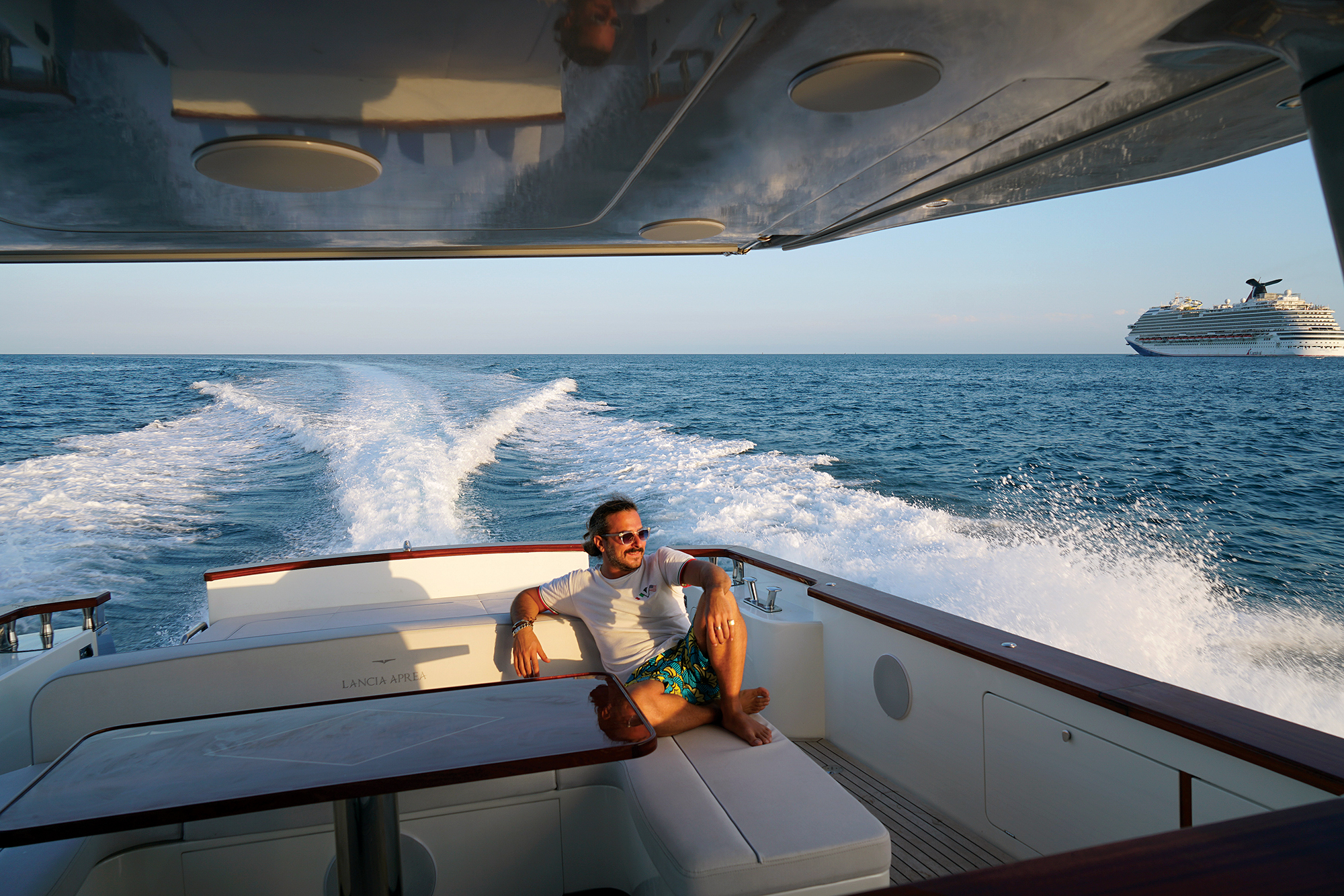
I pace the single-level deck on several occasions throughout the first half of our run, musing that handholds are where they need to be—and they’re mahogany, at that. It would take a real fumble to take a spill aboard this boat. There is hardly a snag to be found, and in contrast with the express launches of yore, there’s no tip-toeing, crawling, or scrambling to circle the console. And thanks to the swim platform and its pair of swim ladders, boarding and deboarding by dock or sea is also a cinch, if somewhat shy of handicap-friendly.
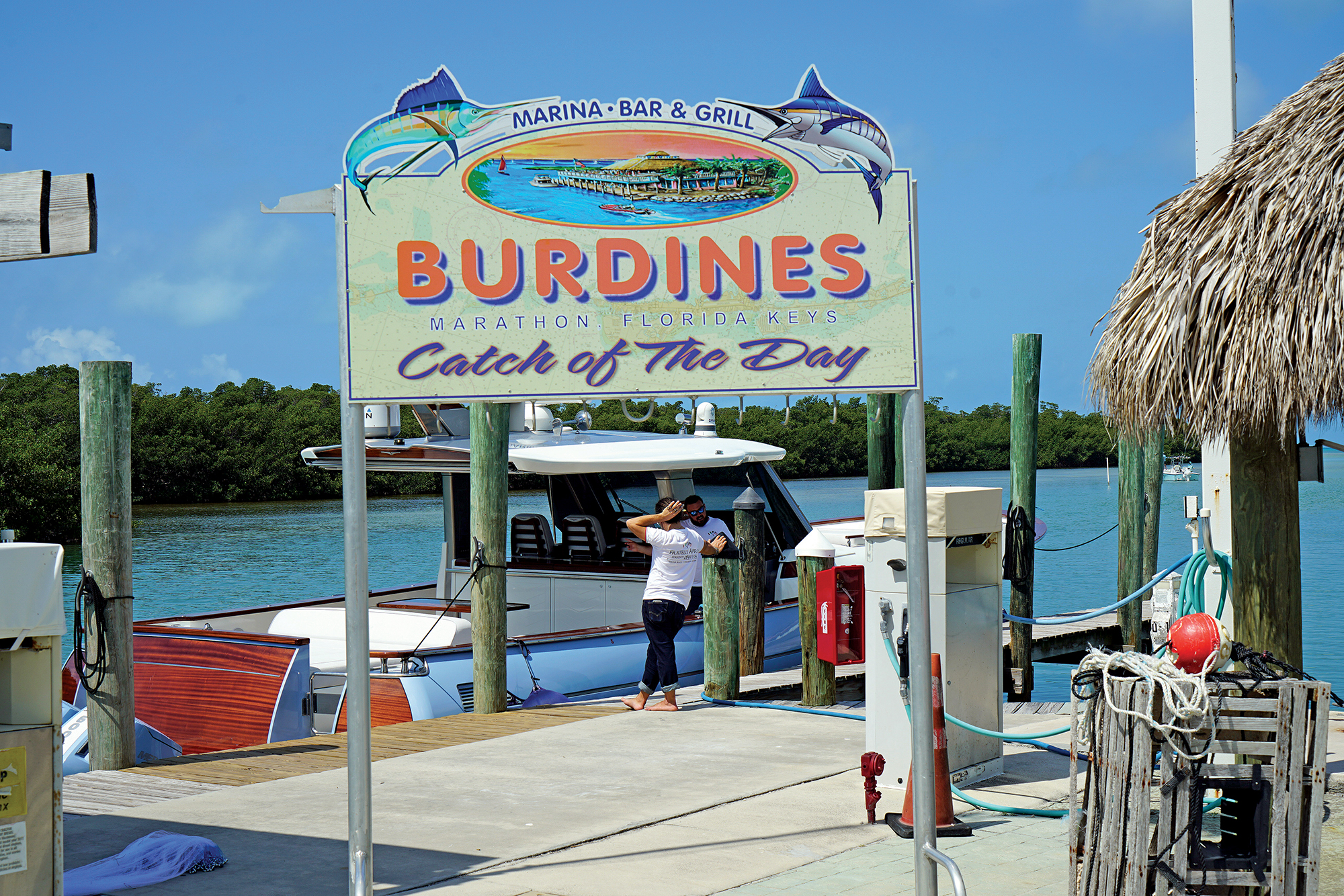
We pull into Burdine’s Waterfront Grill and Marina, a somewhat rickety but beloved old marina on Marathon. A gentleman of Cuban descent welcomes us, exchanges a few pleasantries with Capt. Reyes, and offers us free ice and a variety of auxiliary services, allowing us to remain at the gas dock while we order and dine at the restaurant upstairs. “You can stay here ‘til Friday if you like!” I gathered he was happy to see such a gleaming hull at his dock.
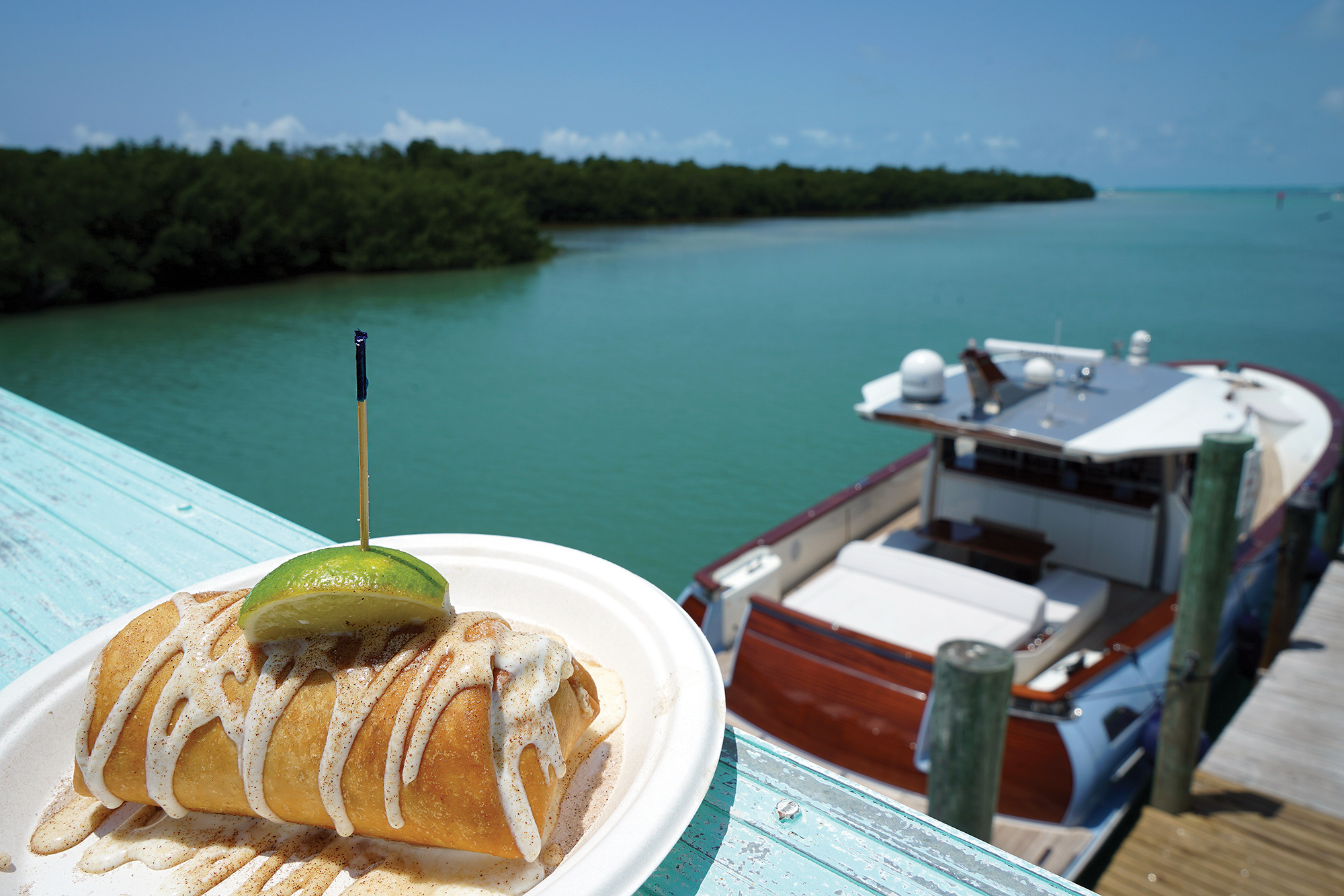
Upstairs, the food didn’t disappoint. Nothing dazzling, but effortless seafood and black-bean-and-rice perfection that anyone who visits the real Florida Keys comes to know, love, and expect. To finish things off, a fried key lime pie resembling a glazed chimichanga landed with an audible thump atop the table. We did our best with it. On the way out, cocktails were suggested by a non-helming member of our party, to which an all too accustomed wavering finger responded with a gesture at a sign reading “no booze.” We all nodded that it was just as well.
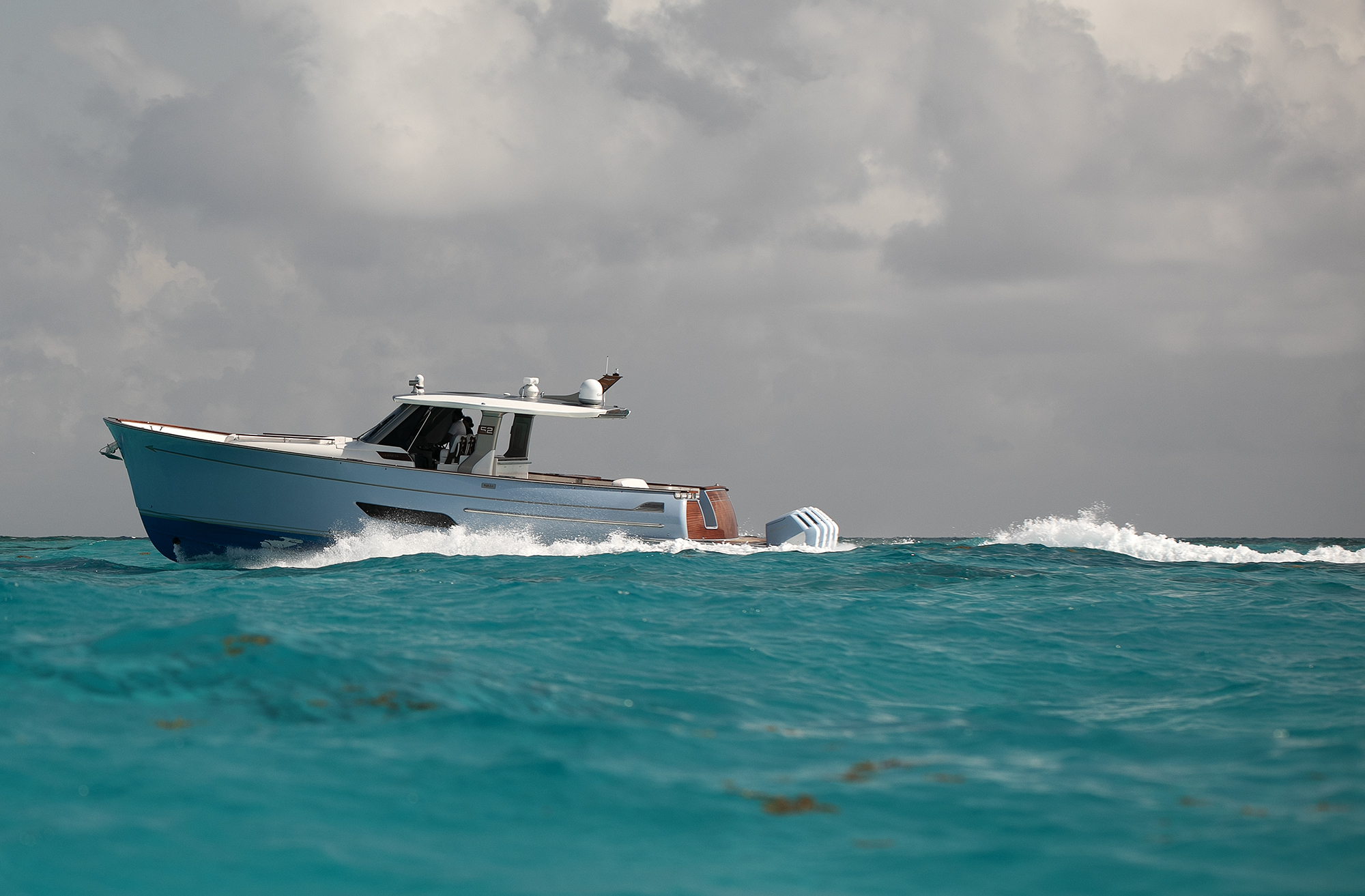
The rest of our trek south took place in Hawk Channel where nary a swell could be felt. The conditions registered more like midsummer doldrums than the customary howling trade winds and associated chop that punctuate and plague my fly casting—my regular reason for visiting the Keys. The procession of fish turning and blowing up at the startling imposition of our large but curiously quiet movement through the water infuriates my inner angler.
Lounging on the sunpad and watching the wake wash away, though, I slowly lose my fixation on opening up this transom and allowing for a bit of a dance floor and a few rod holders. I stroll up to the bow, making use of those formidable mahogany handrails and can’t decide just where to plop down. The soft lines of the hull push easily through light but lumpy seas, and it’s hard to keep my eyes open between fish sightings. Running speed tests and trying to forge a sea state with our own wake isn’t very telling, but we run them anyhow, and this much I can say: We ate through the steepest of our own chop with what felt like a cushioned entry, and not a drop of water made the coaming or the deck. This is a gentleman’s cruiser if there ever were one.
Lancia Aprea 52 Test Numbers:
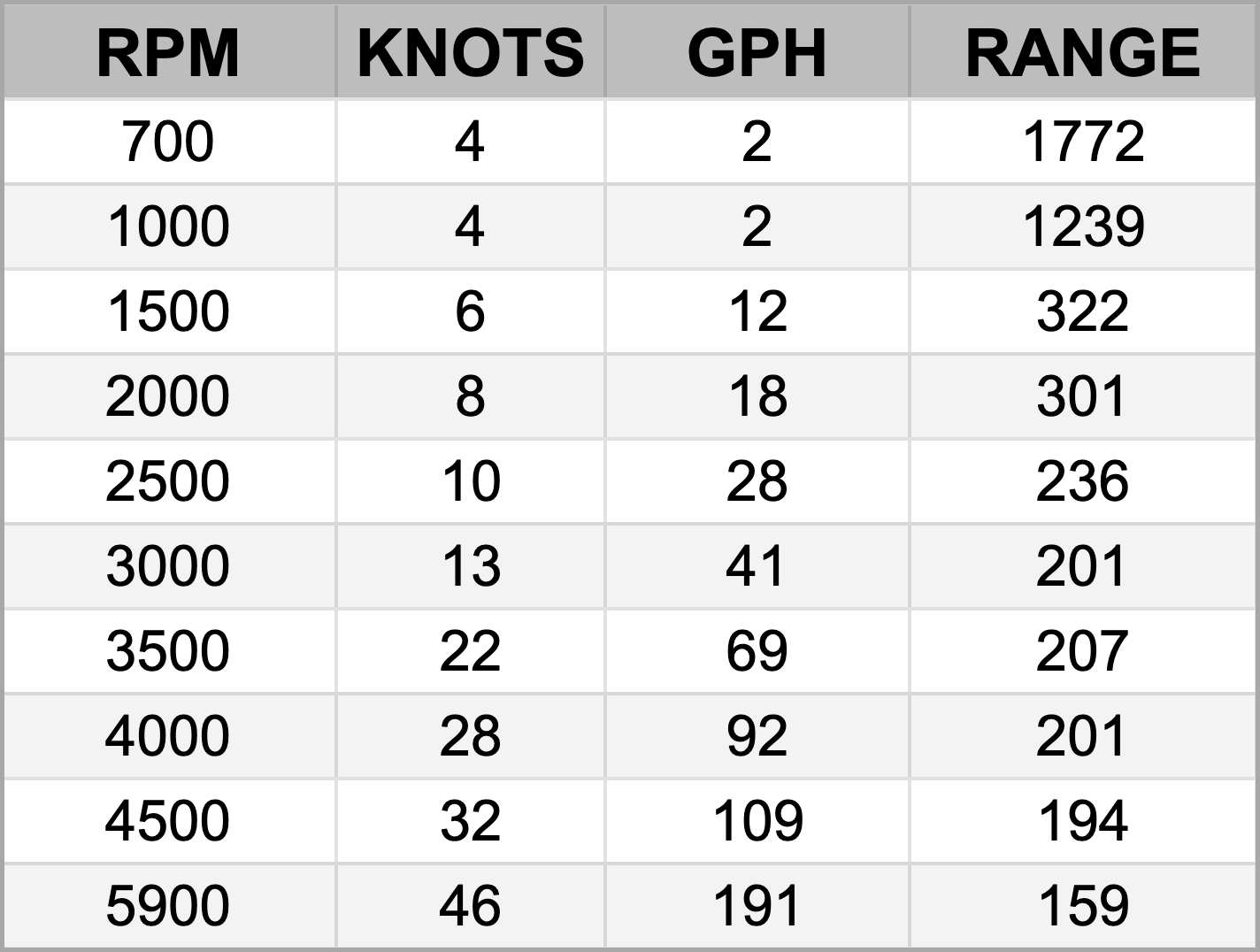
Lancia Aprea 52 Specifications:
LOA: 52’2”
Beam: 16’
Displ.: 46,297 lb.
Fuel: 660 gal.
Water: 150 gal.
Cruise: 21.5 knots
Power: 4/600-hp Mercury Verado; 2/Volvo Penta IPS 800 or 950; 2/MAN 850; 2/CAT C18 1150-hp with Arneson surface drives
Price: $2.6 million with outboards/starting at $2.4 with inboards
This article originally appeared in the August/September 2025 issue of Power & Motoryacht magazine.