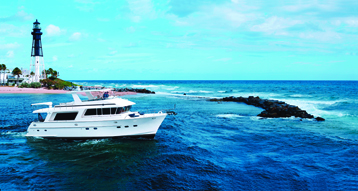
I’m crankin’ up this test report with something
that’s gonna sound a little strange, at least at first.
My sea trial of Hampton Yacht’s Endurance 650
LRC (Long Range Cruiser) took place in two,
totally different, geographically discrete installments.
The first occurred on Lake Washington
on a cool Seattle afternoon and the second on the
Intracoastal Waterway on a steamy morning in
Destin, Florida. Let me explain. The 650 in
Seattle, although a fine specimen, had a small but
significant problem I discovered only shortly after jumping
aboard: her digital fuel-burn readouts had not yet been calibrated
by Caterpillar, the manufacturer of her twin commercially
rated, 873-bhp C-18 diesels. So, since Hampton is touting
the 650’s efficiencies in both the slow-mo mode and the herecomes-
a-thunderstorm-let’s-run realm, it was critical that I
either get Caterpillar to make a short-notice house call or
somehow come up with another test vessel in order to do a sea
trial worth writing about.
The first option fizzled, but the second flourished. Only a
few weeks after I’d recorded everything but fuel burn on the
Seattle 650, I encountered a brand-new sistership, owned by
Cathy and Ray Masker, in my own, North Florida backyard.
And while the data I subsequently collected on the Maskers’
boat (Hull No. 2) was solid and complete (as well as virtually
identical to what I’d got from Hull No. 3 in Seattle), a confidentiality
issue obtruded, dictating that I report only performancerelated
info from Destin, and stick with the Seattle vessel for
everything else.
But before delving into performance, let’s first consider
Hampton’s Hybrid Hull, drawn by West Coast naval architect
Howard Apollonio. It undergirds not only the 650 but two
larger members of the Endurance Series, the 700 LRC and 720
LRC. Thanks to what Apollonio calls “split chines,” the Hybrid
Hull attempts to synergize two totally different approaches to
seafaring: the planing hull form and the displacement hull form.
Hampton’s take on the idea brings a lower-chine segment
forward from the transom and then lets it fade out in the forward
third of the vessel. An upper chine begins subtly in the mid-sections
and becomes increasingly pronounced as it sweeps
forward, all the way to the stem. In tandem, says Hampton,
these two elements, in league with some relatively large, draftreducing
propeller pockets and a significant keel, produce “high
efficiency across a range of speeds.”
This particular generality can be broken down as follows: At
displacement speeds, the 650’s lower chine remains underwater,
lending transverse stability to the boat’s progress but not otherwise
interfering with it. The upper chine, meanwhile, serves as a
spray knocker, while rounded, trawlerish sections forward
whoosh along with slippery, displacement-type efficiency. At
faster speeds, things change. The upper chine continues in its
spray-knocker capacity but the lower one begins to work in
conjunction with somewhat flat aftersections to generate lift,
ultimately producing the ride and speeds of a planing boat.
How does the Hybrid Hull work in the real world? The first
feature I picked up on, right after I’d finished chortling about
the cool comfort of the Maskers’ optional air-conditioned skylounge,
was the 650’s predilection for leaning outboard in turns, a characteristic that’s often related to the amount of surface area
inherent in a vessel’s keel and rudders. Big keels and rudders
encounter considerable lateral-resistance or drag when a boat
begins a turn by sliding her stern sideways. Ultimately, they
begin to lag behind the rest of the vessel as the turn continues,
thus causing a slight outboard lean. Reducing the surface area
will reduce the effect, of course. But in any case, while the phenomenon’s
disconcerting to some novices, I’ve encountered it
several times on big boats over the years.
,
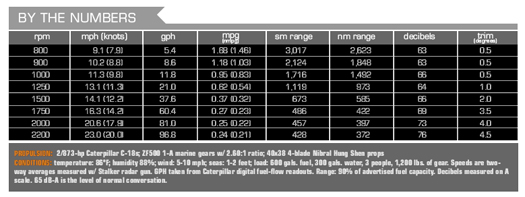
The sea trial revealed more. At lower speeds (up to a theoretical
hull speed of 10.2 knots or 11.7 mph) the 650’s operating
efficiencies (measured in nmpg) were excellent, although
not radically better than some I’ve recorded for twin-engine
cruisers with more conventional hulls. Moreover, at higher
speeds, some more conventional cruisers have actually posted
better efficiencies and top hops. Nevertheless, the 650 is far
more versatile than your typical single-engine, displacementtype
bluewater trawler. Indeed, I believe she’ll leave most of
these in her wake, although she surely won’t match their efficiencies
in the displacement realm.
Driving was pure enjoyment, though. Most likely due to
the 650’s ample rudders and keel, she tracks like a train, and her
stability characteristics underway are solid as well, although
mellifluous sea conditions in both Seattle and Destin hardly
matched the open-oceans conditions Apollonio says the 650
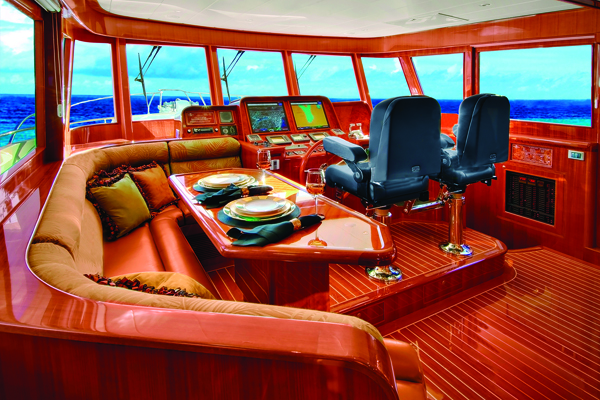
was designed to thrive in. Sightlines forward and to the side
from both the upper and lower stations are excellent, thanks to
expansive windows and windshield panels, and any dockingrelated
visibility concerns astern are addressed by a couple of
extra control stations. Indeed, when it came time to spin our test
boat in front of her slip and back down, Masker simply began
the process at the upper helm, descended the port-side ladder to
the cockpit, flipped up the lid on the control station at the
bottom of the stairs (with Caterpillar electronic engine-control
and joysticks for bow and stern thrusters), and slid ‘er home
with an unobstructed view.
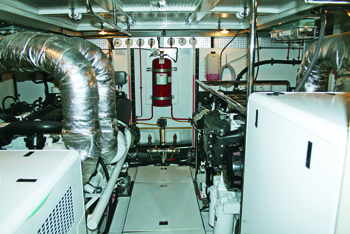
The engineering on the Seattle boat—and on the Maskers’
boat, for that matter—was tops all the way ‘round. I
accessed the engine room via a stairway at the rear of the
saloon, although there’s a transom door as well. Maximum
headroom inside is 6’2″ and there is plenty of wrench-turning
space on either side of each main engine, as well as plenty of
serious sound- and vibration-reduction measures, including
numerous isolation mounts under ancillaries and lots of
acoustical insulation on the overhead and bulkheads.
Redundancy was an obvious biggie. There are two PTOs on
each main. One is forward and the other at the rear, on the
transmission. The forward set power-assists the Teleflex SeaStar
steering system, while the oversize set on the gears powers up
her Wesmar bow and stern thrusters, Naiad stabilizers, and
Steelhead crane. Thus, all hydraulics onboard will continue to
function, even with one engine down, a very cool feature. Other
notable redundancies include two Northern Lights gensets, two
seawater pumps for the Marine Air chilled-water air conditioning
system, two temperature probes on the main engines’
exhaust elbows (see “Noteworthy: Safety Sensor,” this story),
two engine-driven emergency bilge pumps, and two freshwater
pumps.
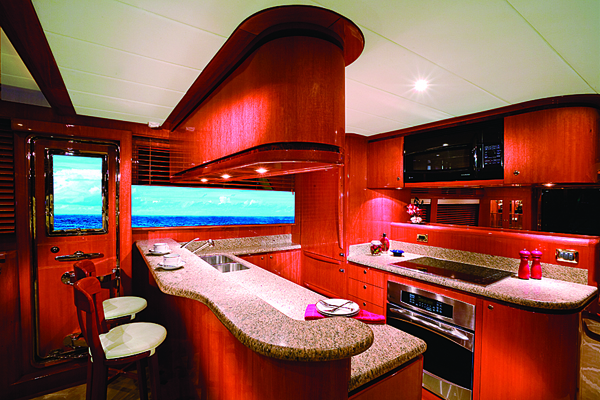
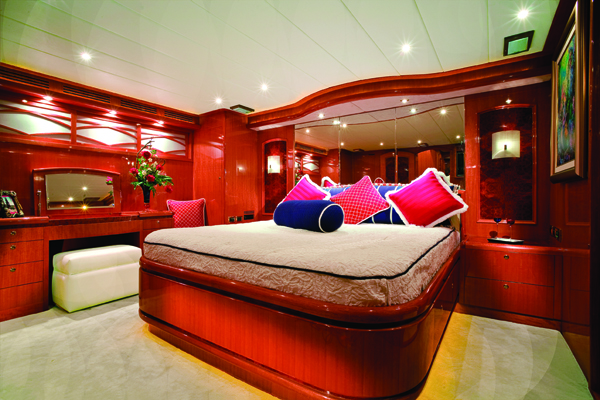
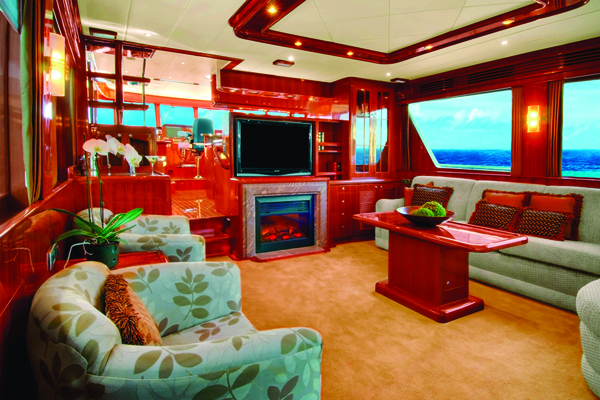
One last point: The makore (African cherry) interior is beautiful,
whether in the standard lower-deck layout (with en suiteequipped
full-beam master, VIP forward, and port-side guest
stateroom), the main deck (with centerline helm station and
port-side dinette forward, saloon aft, and starboard-side galley
in between), or the optional crew quarters aft.
And such was the case, whether the boat was floating on the cool
waters of Seattle or the sunshiny depths of Destin’s ICW.
Noteworthy:
Safety Sensor
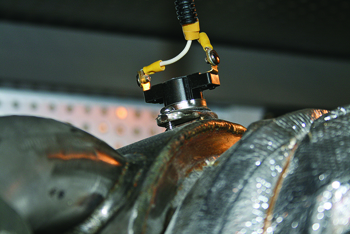
My test boat was equipped with
temperature sensors in two critical
locations: at each main engine’s
exhaust elbow. And although Hampton’s
been installing these nifty devices on its
boats for quite some time now, the
feature is still not totally mainstream.
Why are exhaust-elbow sensors such a
good idea? Let’s say you lose a couple
of fins from the raw-water impeller on
one of your main engines or you suck a
plastic bag or other debris into the sea
strainer plumbing. Most likely, well
before the engine itself shows a
temperature spike, the elbow sensor
will pick up on the reduction in cooling
water (via a temperature change) and
signal you with a blinking light and/or a
buzzer. With added forewarning, you’re
more likely to be able to reduce rpm
and baby your problematic main back to
the dock for repairs. —B.P.
Contact: Hampton Yacht Group (206) 623-5200.
www.powerandmotoryacht.com/hampton/.
The Boat
Standard Equipment
2/873-bhp Caterpillar C-18s; Caterpillar
electronic engine controls; Teleflex Sea-
Star hydraulic (w/ two-engine powerassist);
Wesmar 25-hp hydraulic bow
and stern thrusters; Naiad Marine
stabilizers; Maxwell HWC 3500 hydraulic
windlass; Exalto windshield
wipers; Raymarine electronics; port and
starboard boarding gates; fiberglass
hardtop; flying-bridge wet bar w/ Gaggenau
BBQ, sink, and Norcold ‘fridge/ice
maker; 2/Pompanette Platinum-Series
helm chairs (upper and lower stations);
Optiflame electric fireplace; cherry- andholly
sole; granite countertops; heatedgranite
flooring in galley; Sub-Zero
‘fridge/freezer drawers; GE Profile
cooktop, oven/microwave; In-Sink-Erator
garbage disposal; Broan trash compactor;
Fisher & Paykel dishwasher; Durabilt
L-shape sofa and barrel chairs;
Hunter-Douglas blinds; electric fireplace;
2/Tecma Quiet Flush MSDs; heatedmarble
sole in the heads; 2/Glendinning
Cable-Masters; 2/Northern Lights gensets
(10-kW and 20-kW); 108,000-Btu
Marine Air A/C system; 4,000-watt
Magnum inverter; 2/IsoBoost transformers;
duplex Racor 751000 Max
fuel/water separators; Steelhead
2,000-lb. capacity davit
Optional Equipment
Kabola heating system, satellite TV, and custom, retractable boarding ladder
Other Specification
Cabins:1 master, 2 guest
Specifications
- Optional Power: 2/1,001-bhp Caterpillar C-18 ACERT diesel inboards
- Water Capacity: 400
- Overall Length: 66’2″
- Beam: 18’8″
- Fuel Capacity: 2000
- Draft: 4’10”
- Year: 2009
- Type: Product+boattest
- Standard Power: 2/873-bhp Caterpillar C-18s
The Test
Test Boat Specifications
- Price as Tested: $2,495,000
The Numbers
This article originally appeared in the October 2009 issue of Power & Motoryacht magazine.
The Photos