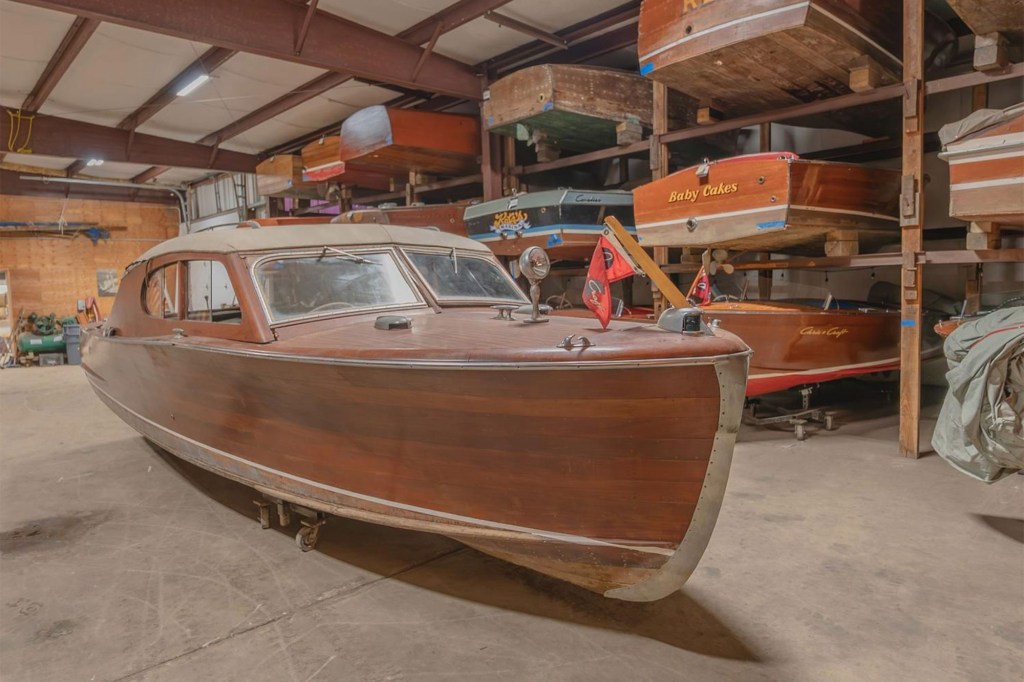
I sat in the helm seat and felt a rush similar to that of heading down the stairs on Christmas morning as a kid. It was an out-of-time experience. Memories of the past collided with hopes for the future creating a powerful emotion that I cannot name.
Boats can be like that.
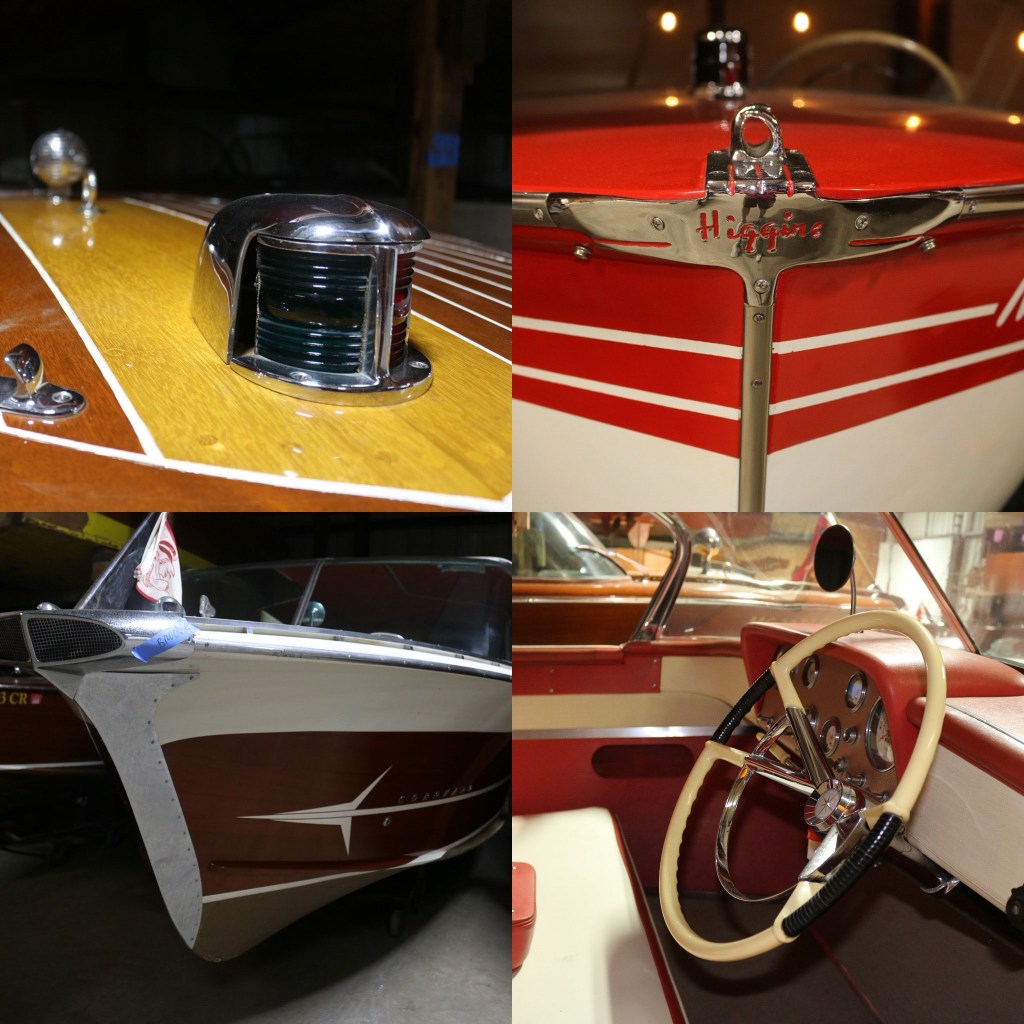
Certainly this 1956 Chris-Craft Sportsman provided plenty of mojo. It was built the same year that Boating Magazine was founded, and was just like the one skippered by Henry Fonda to chase the fish, Walter, in the hit film, On Golden Pond. Sitting in it was transformative. I was in brightwork bliss, feeling mahoganiffic, aglow with rampant and rhapsodic runaboutism.
Really.
Want some of this classic boat feel-good for yourself? The owners of a New Jersey marina are helping to make that possible for a wider variety of people than the typical super-affluent collector.
The Wow Factor
Ray Fernandez wears a wry grin as he steers the boat carrying me, and Power and Motoryacht Editor-in-Chief Dan Harding under the Brady Bridge that bisects Lake Hopatcong
Ray, along with his wife Becca own Bridge Marina, on Lake Hopatcong, New Jersey, about 45 miles northwest of midtown Manhattan. We are headed to another location on the lake owned by second-generation boatyard operator, Henderson Bridge Marina, a facility that Ray and Becca recently bought to help expand their business and better serve the lake’s boaters.
Passing under the bridge which bisects Lake Hopatcong, I swung my camera and snapped a pic of a unique sign. It didn’t read what you’d expect: “No Wake” or give the clearance. Emplaced by Ray, and emblazoned over the center span, it reads: Lower Bimini. That tells you something about Ray Fernandez.
“I imagine we’re gonna see some wows from you guys when you see what I have to show you,” he says.
Harding and I exchanged glances. As journalists with decades of experience each, we’ve heard such pronouncements before. Still, we were out on a boat in the middle of the week, which is, and has been, the main driver for most of us employed in marine media. What the job lacks in pay it makes up for in time afloat.
We rounded a point and Fernandez nosed the boat into some covered slips jutting from a tan and brown, 1960’s era building crammed between the lakeshore and the hills behind. We tied-up, hopped off and clomped down the dock. Ray paused at the door. He didn’t say much. He didn’t have to. His wide grin and springy movements betrayed the excitement and enthusiasm emanating from his very being as he leaned into the sliding door, its rollers rumbling in their track.
The door opened and the space inside glowed with a radiance that only wooden boats produce. The organic quality of oil-based varnish or paint just hits different than gelcoat or modern two-pack coatings. It was like that moment in The Wizard of Oz where the film goes from black and white to color. Everything changed.
Before us was possibly the largest collection of classic wooden runabouts in the world. This fleet of mostly Chris-Crafts, stacked three high, also included a few Centurys and other makes. Some were show pieces, some were well-loved family boats still in regular service and others were project boats.
As he promised, Ray Fernandez had wowed us.
The collection numbers some 80 boats, ranging from a plank-on-frame 1928 triple cockpit to mahogany plywood boats built in the 1960s.
Vroom!
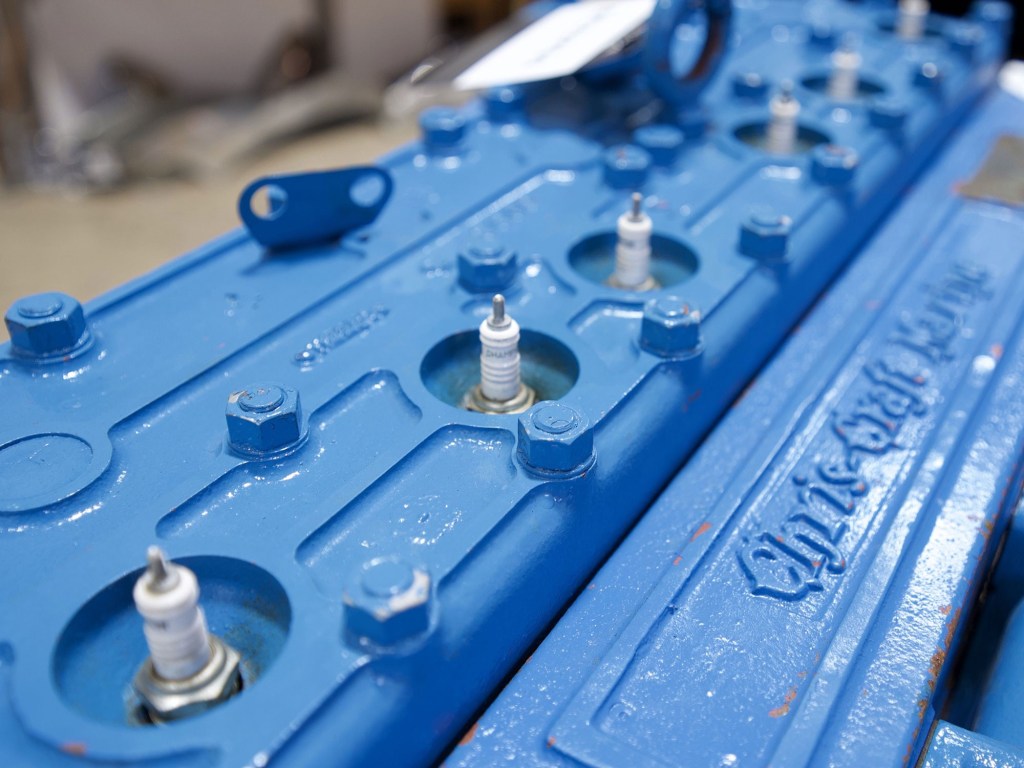
And the boats weren’t the only thing. Another barn was full of engines, original Chris-Craft engines, in many cases, those painted blue and with the storied logo embossed in hyphenated script onto the valve covers.
Some history. Early Chris-Crafts from the 1920’s-1930’s used surplus aircraft engines, such as the Curtiss OX-5 before partnering with companies like Scripps and Chrysler. Between the 1930’s and 1960’s Chris-Craft partnered with the Hercules Engine Company to produce their famous K-Series and M-Series inline engines. These industrial truck motors were robust, reliable, and well-suited for marine life. Chris-Craft introduced the famous “flywheel forward” 283 V8 (based on the Chevy 283). This shifted engine weight distribution and offered higher speeds for classic utilities and runabouts.
Parts is Parts
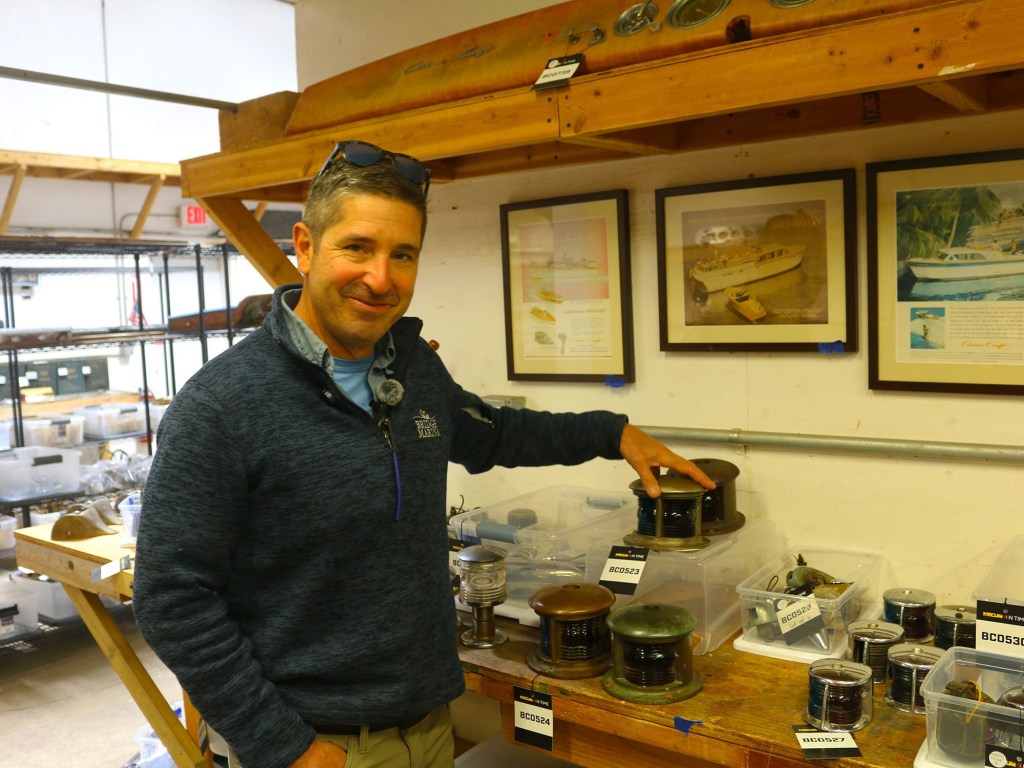
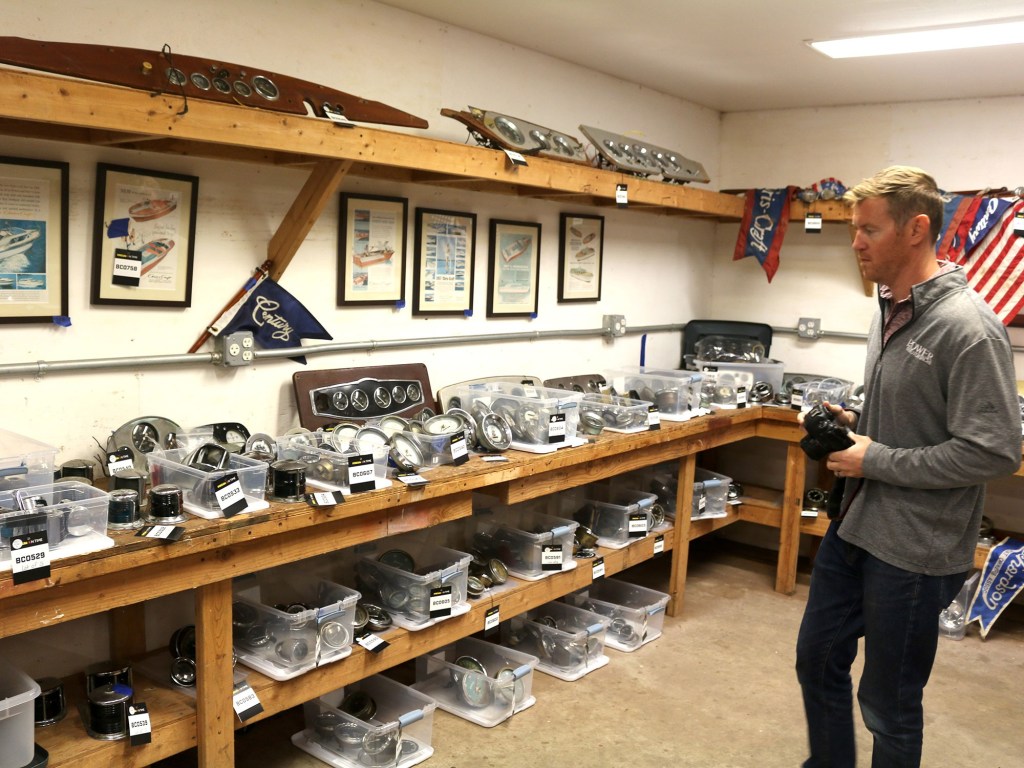
Still another room was filled with parts. Four thousand parts, actually, each one identified and tagged by Bridge Marina’s team in preparation for auction.
There are banks of gauges, a company of compasses, a forest of flagstaffs, stacks of steering wheels, a treasure of nuts and bolts, a trove of bits and bobs, and more. I could have happily spent a day poring through this superabundance of maritime history and miscellany.
And here’s a thing. If you think they no longer build them like they used to, the proof lies in perusal of the Bridge Marina parts collection.
For example, an old Chris-Craft fuel fill cap caught my eye. Over 70 years old, three inches in diameter and an inch in height, it was made of chromed-bronze. It reflected light with a liquid-like quality and was engraved with the Chris-Craft burgee logo and a part number on its underside and the word Fuel on its topside. Precision machining was evident in the grippy checkerboard knurling round its perimeter and in the clean crests, flanks and roots of its deep threads. My guess? It weighed about a pound.
Hammer Down
All of this would be interesting enough simply as a spectacle. Bridge Marina’s collection rivals that of some maritime museums for sheer number. But unlike those in many museums, these boats are for sale. Moreover, they can be purchased via a no-reserve online auction. That presents a special opportunity for a wider-than-normal range of boat buyers. We’ll get to that in just a bit.
“I didn’t want to part it out,” says Fernandez in response to a question about the selling the boats individually. After all, Bridge Marina is a full-service marina and boat dealership, with yet another location in coastal Highlands, NJ, offering Four Winns, Starcraft, and Wellcraft, and where it operates its own boat club.
Instead of selling these classic boats, engines and parts individually, Ray and Becca aligned with Mecum On Time. Mecum On Time is hosting three separate auctions for this collection, each with bidding conducted entirely online. You can explore the entire collection online – and register to bid here: go.mecum.com/wooden-boats.
With over 500 lots of boats, rare parts, memorabilia, lights, burgees, signs, vintage hardware, and décor, there truly is an opportunity for everyone to own a piece of boating history through this auction:
- Boats & Select Parts: Auction closes Thursday, June 11
- Engines, Outboards & Parts: Auction closes Friday, June 12
- Parts & Accessories: Auction closes Saturday, June 13
Boats For All
Notably, this is a no-reserve auction. A no-reserve auction (or absolute auction) is a sale where the item is guaranteed to go to the highest bidder, regardless of how low the final price is. There are no minimum bids or hidden price thresholds that the seller can use to cancel the sale.
What this means is that “everyman” can bid right along with wealthier collectors, trusts and corporations. In fact, if you are seeking a wooden boat, and select one of the less collectible models, you may be the only bidder. Who knows.
On the ride back to Bridge Marina’s Brady Road location, Ray Fernandez talked about a life lived on Lake Hopatcong and about the generations of families tied to the lake and to each other by waterskiing, by fishing, by anchoring out at Liffy Island or Byram Cove, by being together on a boat.
Passing under the bridge, I read Ray’s “Lower Bimini” sign and thought: Boats aren’t really what this auction is all about.