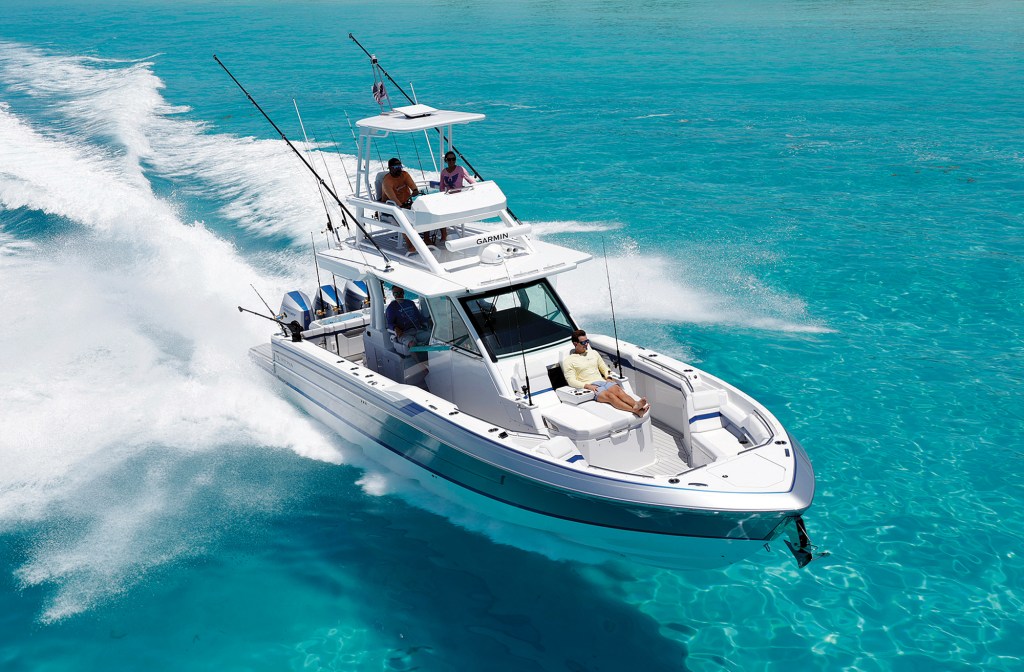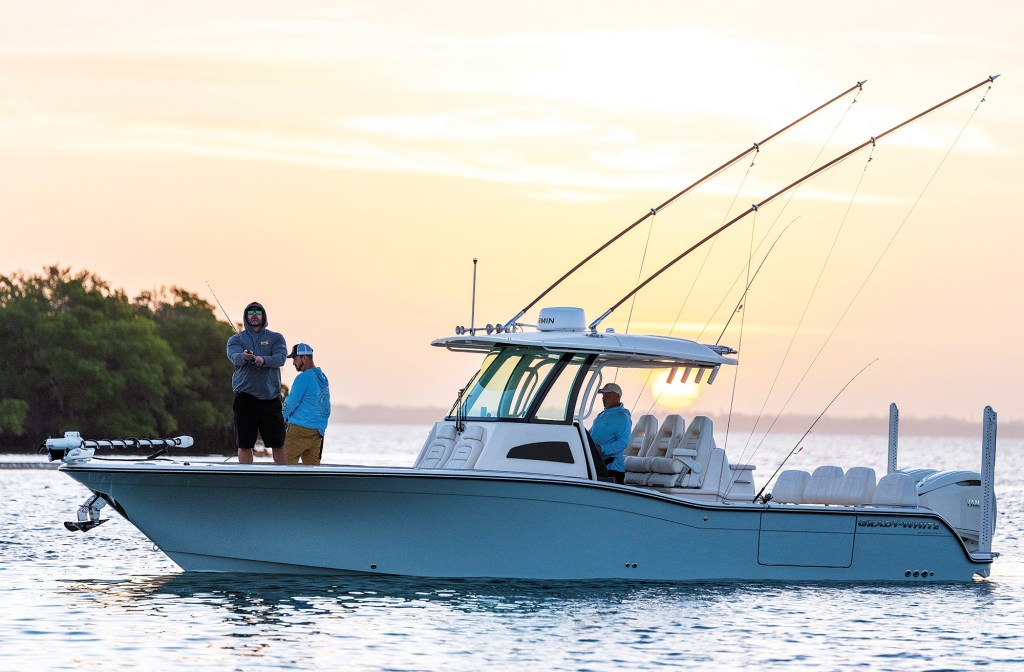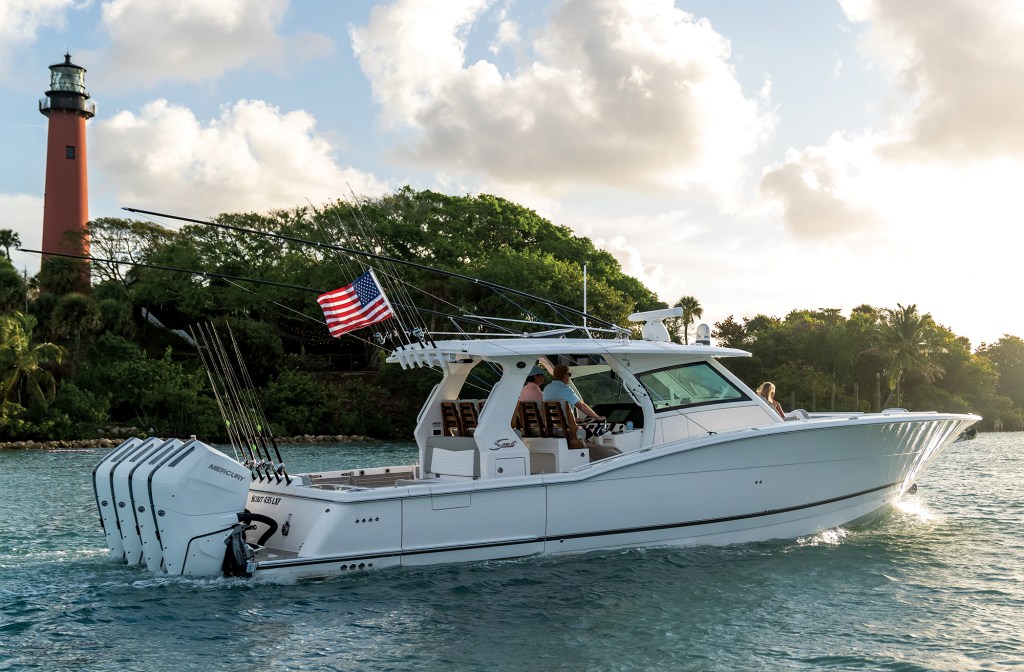
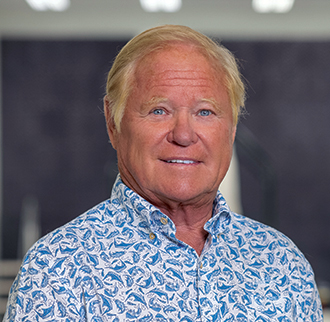
On February 15, 2023, I found myself amidst a gathering of marine journos at the Miami boat show display for Scout Boats. A big reveal was reportedly hidden beneath a small, shrouded box. Soon enough, hale and hearty Scout Founder Steve Potts appeared in a blue blazer and running shoes. Flanked by his son and Lead Designer Stevie, the cover was pulled back to reveal a boat that looked unique—even to this jaded crew.
The Potts called their “little” model the 670 LXS. She would, they promised, be the longest outboard-powered yacht ever built. She’d been devised through a collaboration with Harrison Eidsgaard, a U.K. design studio. “In our world they’re not as well-known,” Steve Potts said of the studio. “But in the yacht yards, especially in Europe, they’re very well known.” The 670 had the swooping, downswept lines of a Scout, but this model bore a quintet of 600-horsepower Mercury outboards and a high, flared sportfish-evoking bow. With walkways from cockpit to foredeck, she was ostensibly an “outboard-powered center console,” but with a huge, enclosed salon, she clearly had much more inside living space than, say, the HCB 65 Estrella or Scout’s flagship at the time, the 530 LXF.
She was strange, but beautiful. Potts hoped to display hull number one the following year. He explained that Scout’s quint 400-horsepower 530 LXF was already a success—70 hulls of the open-cockpit, two-stateroom center console sold in its first three years. The 670 definitely shared the 530’s DNA but Potts promised even more space and unique versatility in a boat its size. “With an inboard boat, you have a running angle and a shaft angle that prevent you from making such a low-profile boat,” he said. “Imagine going to a Destin sandbar, stepping off in waist-deep water and walking ashore. You can’t do that with any yacht with running gear, because if you touch bottom, you’ll ruin your wallet—and two weeks of your life.”
Potts said an experienced owner could pilot the 670 solo. Thanks to the two-speed gearbox Verados and an efficient twin-stepped hull, with 1,500 gallons of fuel and 500NM range at a 40-knot fast cruise, Charleston to Miami could be run in a day. Maintenance (and fuel) wouldn’t necessarily be cheap, but the outboards could be closely spaced since only the lower units turned. The Verados also allowed for a shallow, three-foot, five-inch draft and a low rear profile. Diving, swimming, shallow-water angling, deep-water angling, Potts said: “This boat will do it all.”
• • •
Born in Groton, Connecticut in 1952, Steve Potts was the son of a disciplinarian Navy torpedo engineer. As a little kid, Steve lashed floating drums together to create Huck Finn-style rafts. “I would be mesmerized when I would see boats,” he said. “Any size boats. Any type of boats.”
The family transferred to Key West when Steve was eight. Living across from Mile Marker Zero, “was paradise,” he recalled. “Just every morning, I would get up as soon as the sun came up and I was out the door … I spent all my time there on the docks.”
A Charleston deployment came next. There, Navy officers could rent jon boats and Steve’s dad bought a three-horsepower Elgin outboard for fishing and oystering. One day, Steve and a buddy cobbled together their very first boat from scavenged wood and took it to a nearby creek. “As soon as I put it in gear, the transom fell off,” he said. “Motor fell in the water … quit running and locked up. I cleaned it all up, polished it up and put it back in the garage. Up until my father was probably 90, he never knew that.”
You can also find this video–and hundreds of our other reviews–here ▶
Eventually, the family squeaked into a middle class neighborhood closer to the Navy Base. As Potts walked to school, one house always smelled like glue. “Then one day, the garage was open, and there was an elderly guy. He was building this little 12-foot fiberglass jon boat.”
Potts became a shop rat. Leaning over the gunwales doing layups, he infuriated his mother because he ruined so many shirts. “I put duct tape all around my t-shirt and that protected me from getting my stomach burned,” he said.
In 1967, his boss helped Potts land a job at a North Charleston outboard shop that sold Whalers, Bertram Moppies, and a house-built 13-footer they called a Scout. They shipped them with a 9.9-horsepower Evinrude, a trailer and a lifetime warranty for $295. Potts and a buddy would work overtime laying up the exactly 100 Scouts the shop sold every year and Potts became a student of hullforms. Speedy bass boats were becoming a thing, but the boats still needed to run very shallow. So local owners of flat-bottomed Rangers started hitting up Potts for modifications. “I flipped them up on the side, I would sand the hook out and then I put wedges on the outside of the chines. So, I made them go fast and settle down. That’s kind of where I learned the characteristics and what the give and take is for running surfaces.”
One day the owner of a Charleston factory that built AquaCat sailboats called. He was having serious problems with his minimally trained builders and offered Potts a job overseeing the layups—at age 19. “At the time there were like, 16, 17 ladies,” Potts chuckled. “They’re old enough to be my mother. Three or four months later, my wife and I got engaged … and these women would run me ragged. They scolded me like I was a little kid. I treated them with respect, but I was I wasn’t getting anywhere. So, one day—this is where I learned how to deal with people and push the right buttons—I got them all together. I said, ‘Look, I was hired to turn this around. I’m not going to fail at this, and none of you are doing what I’m asking you to do. This is my livelihood. It’s my life. You might have a husband, you might have other things you could do, but this is all I know how to do, and I’m gonna be successful with or without you. The first time somebody says ‘no’ to me I’m going to terminate you.’ And they just kind of all—well, within the next two weeks, I fired three of them, and after that, things changed, because they knew I was serious. And so, it turned around. After then I had a bunch of people that respected me and listened to what I said.”
By 25, Potts was overseeing 110 employees. Eventually, corporate raiders came calling. The plant would be shut down and he’d have to move to Connecticut, facing a 30-mile I-95 commute each way. “A tough time in my life,” he said. “I never realized what common courtesy and southern charm was like. Outside the city of New York, it’s dog-eat-dog…I was flipped off, cut off, cussed out. When I got to work, I was ready to kill somebody.”
Potts disagreed with new management on nearly everything. When he was eventually asked to forge signatures of prospective boat buyers for a round of company financing, Potts balked. When the company was raided by the state and shut down, the auditors hired Potts to help make sense of it all. Then, life came full circle. An ex-colleague was looking to bring outsourced AquaSport production in-house. Steve and his wife Dianne returned to Charleston.
By 1989, the Potts had three kids: Stevie, Sherrie and Stephanie. Dianne was an admin at Charleston’s Roper Hospital. Steve worked on the side repairing fiberglass bathtubs. They saved $50,000 to start their own company and that February, they quit their jobs and began laying up simple 14- and 15-footers in a 100-year-old brick barn with no windows. Potts trailered the boats up from Florida to North Carolina, tearing pages out of phone books in local phone booths to cover every dealer. “And then September 22 of 1989, hurricane Hugo came through and completely destroyed our business,” said Potts. “We had no insurance. It leveled the building.”
Miraculously most of the molds were salvageable. They moved into a nearby galvanized building, then on December 23, an unprecedented Lowcountry blizzard collapsed that building’s roof. “I’ve never been a real strong religious guy,” said Potts. “But I looked up, I said, ‘Somebody’s trying to tell me something…’ If you’re going to make it, you’re going to make it the hard way, right?”
With acres of plastic sheeting, Potts returned to building the 141 and 151 and developed a 17-footer: “…a trend-setting design. Kind of a hybrid bay boat-center console.” Potts trailered his lineup to the Atlanta Boat Show at the start of the 1990 recession. To his astonishment, he landed 25 new dealers.
Through the decades, Scout grew—and grew. Boats ratcheted up in size and innovation, and Potts always encouraged novel but functional features: a tough, bonded “reverse shoebox” hull design and patents for T-tops, engine mounting systems, articulated rocket launchers, convertible entertainment stations and some of the first lithium-powered climate-control systems. “What I’ve known about the iconic brands out there, is there’s something distinctive about the way they look; the way they’re built; the way they behave—and that’s been sort of our mantra,” he said. “And I’ve been very fortunate and very proud of the fact that I surround myself with some very, very good people.”
Today with 433 employees turning out around 625 boats a year, all three of Potts’ children also work on the Scout team. “Stevie is now VP of Product Development, so all of the later models from the last 10 years is his baby,” said Potts. “He’s got a very good eye for detail and styling.”
• • •
You can also find this video–and hundreds of our other reviews–here ▶
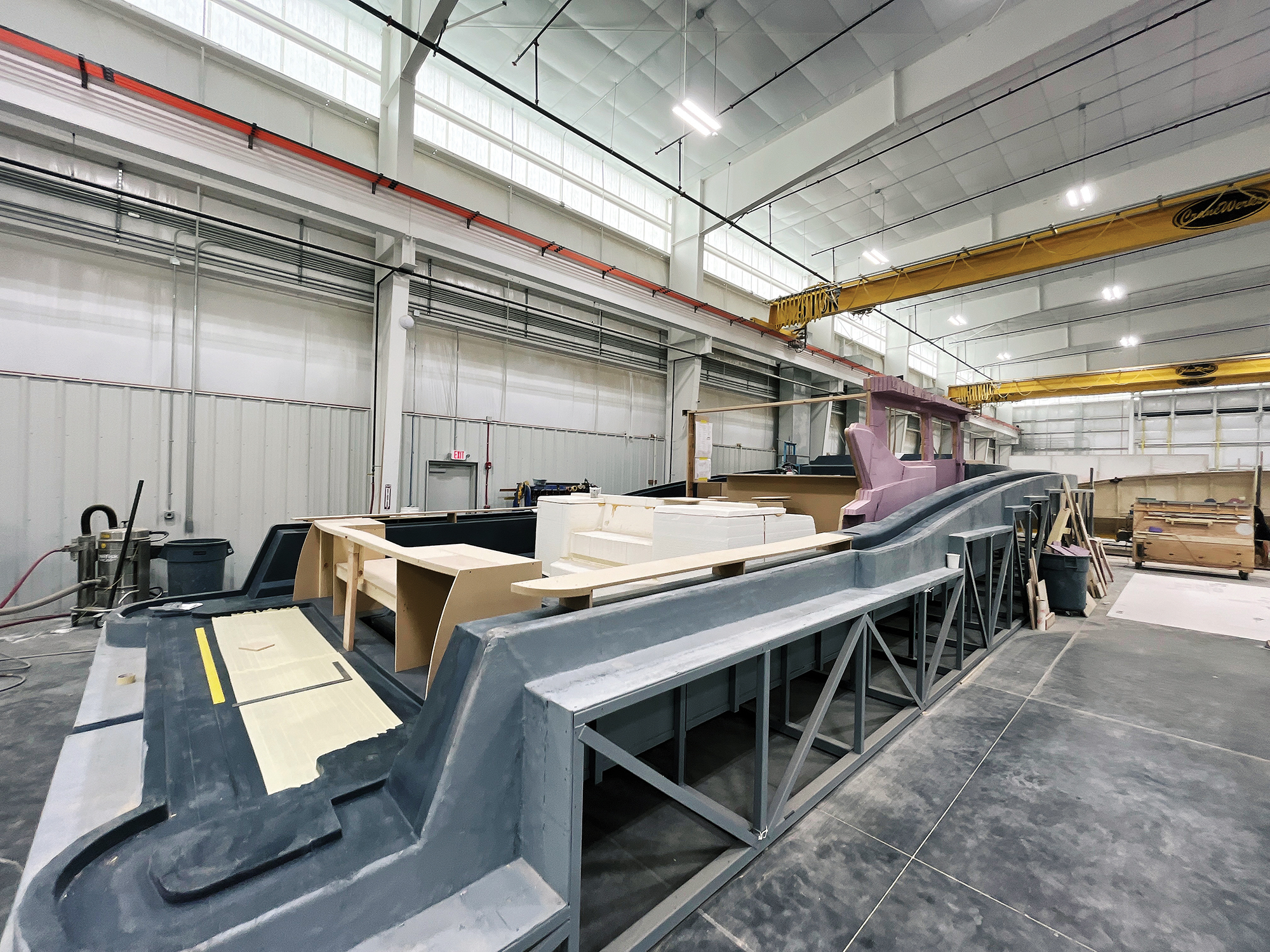
In the wake of the ’23 Miami boat show announcement, I started pestering Scout’s marketing folks to let me come up the road to see Project Everest in person. A couple of months later, a huge deck plug arrived. Stevie Potts and Senior Designer Jeff Summers invited me up for a closer look.
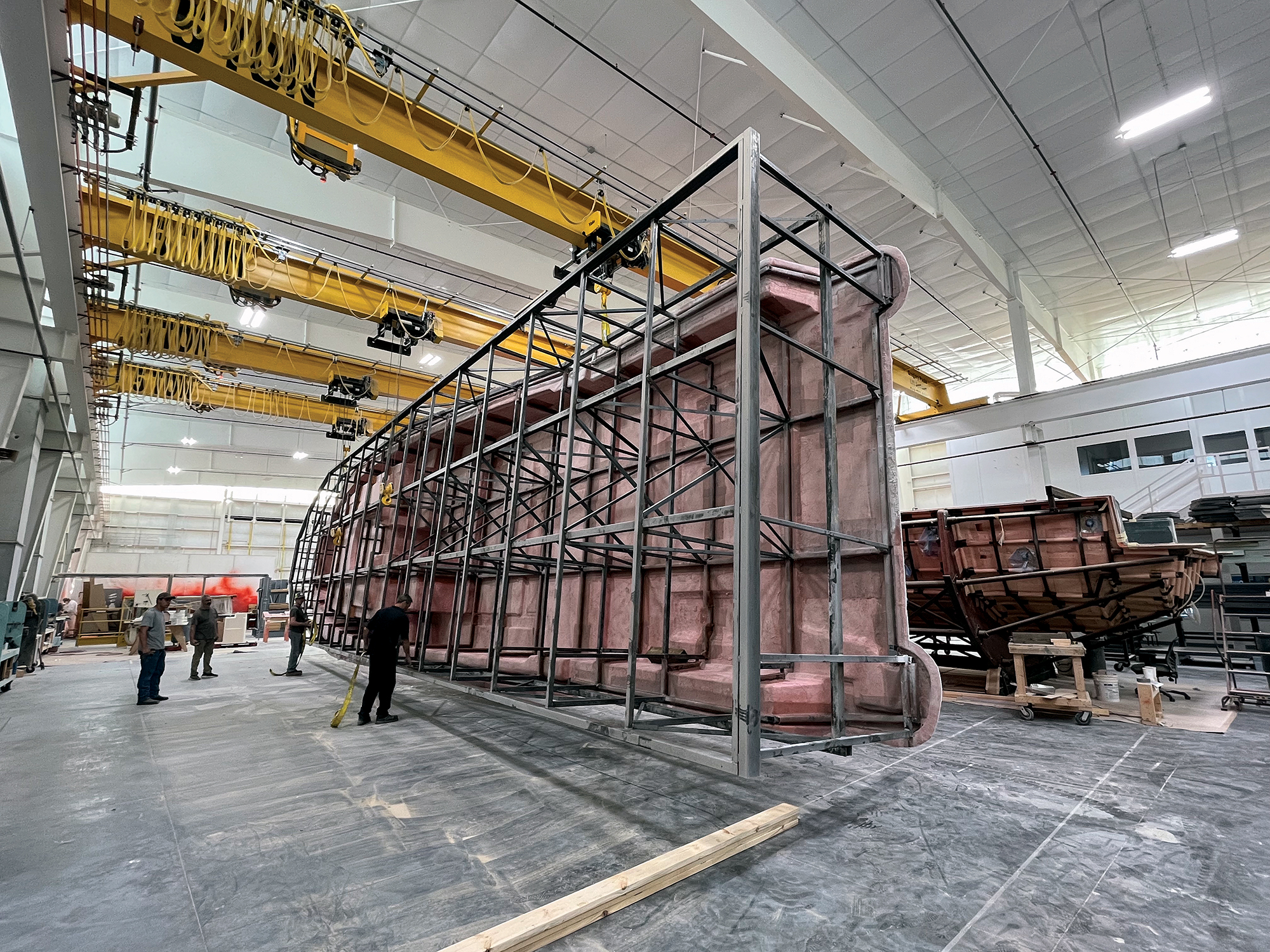
The 67-foot-long plug was built by North Carolina composite design specialist, Symmetrix. It rested alongside a huge router that was sculpting a life-sized stern-seat setup out of EPS foam. The mold had to be completely level. So Symmetrix brought in a machine that rolled a small steel ball across the factory floor, scanning its passage. “It’s taking thousands of measurements to see how far things are off,” said Summers. “Once they bolt the plug in and level it, we’re within, like thousandths of an inch.”
It was impossible to trial and error a “super console” of this scale, so extensive fluid dynamics modeling led a two-step, three-strake configuration. To prevent the boat from having its center engine lower than the others, an upward-sloped transom notch would direct water over the propeller. For the stringer to be strong enough for the beach platforms, Potts and Summers consulted with a company called Vectorply. Some 30 layers of carbon fiber cloth would be laid.
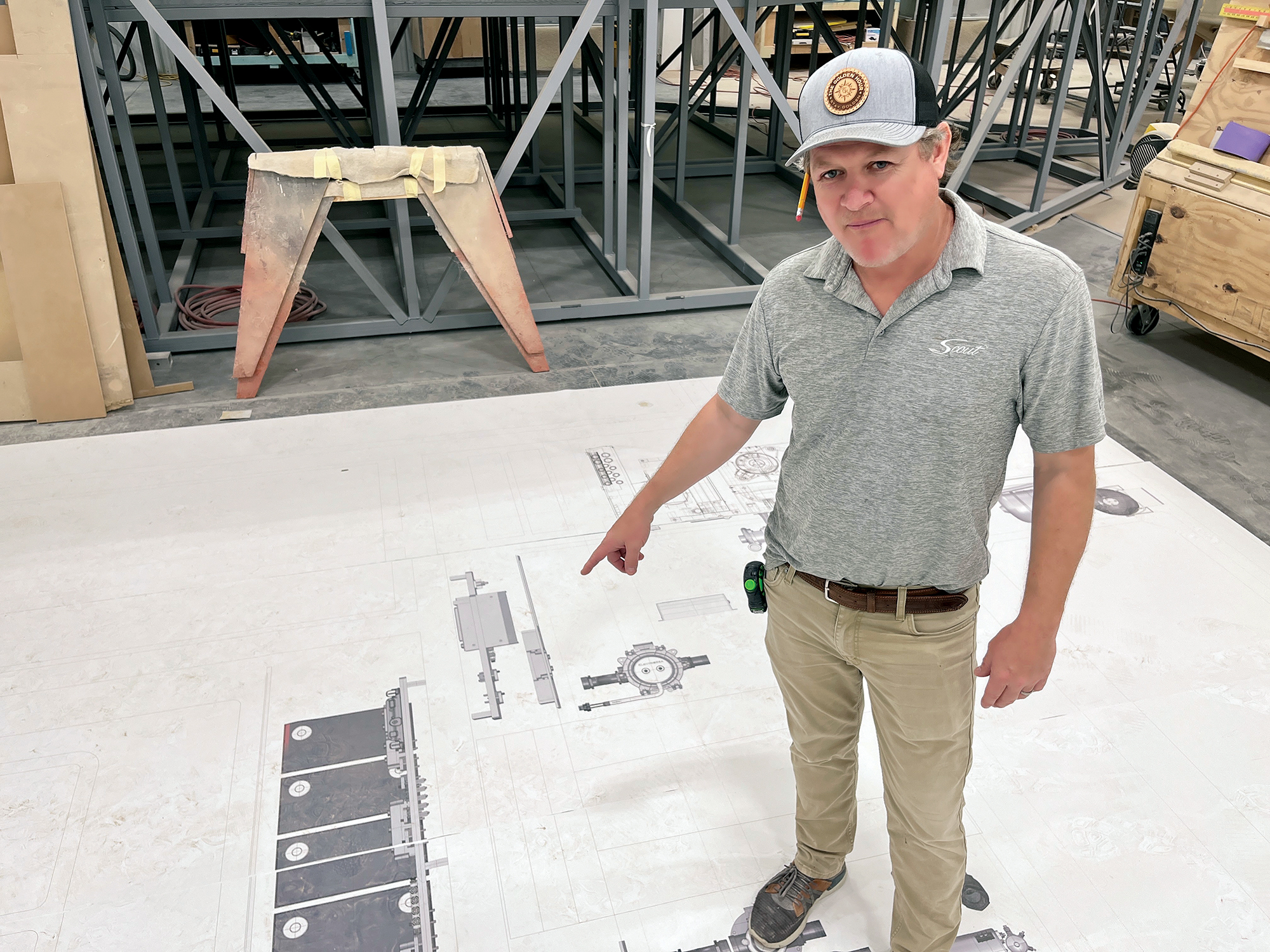
Huge CAD files and virtual layouts were tweaked and argued over. Summers showed the evolution of the cabin layout and seating configurations—occupied by virtual humans. VR goggle walk-throughs presented a surprise. “The cabin kind of opens to a big sunroof on top of the console,” said Summers. “So, when you sit down on the couch, you can look all the way up to the sky.”
“Mocking it up and walking through it and making sure it all works,” Stevie said of the VR approach, “you can’t look at another boat and see what somebody else did in a certain situation. There’s not another boat like this. You just kind of figure it all out on your own.”
Assembly was a fascinating mix of old and new. While the CNC router cut the bar, counters and rear station, those test components were covered with pencil notes and erasure marks; measurements and scribbles to indicate small changes, or a new location for hinges, latches or hydraulics. Levering hinges were cut, ground and sanded by hand—completely custom. The fold-down gunwale doors were CNC’d and test-fitted—eventually becoming the molds. Interior walls were a combination of balsa, foam and epoxy laminate. I hefted a featherlight piece and tried to bend it. Nope.
You can also find this video–and hundreds of our other reviews–here ▶
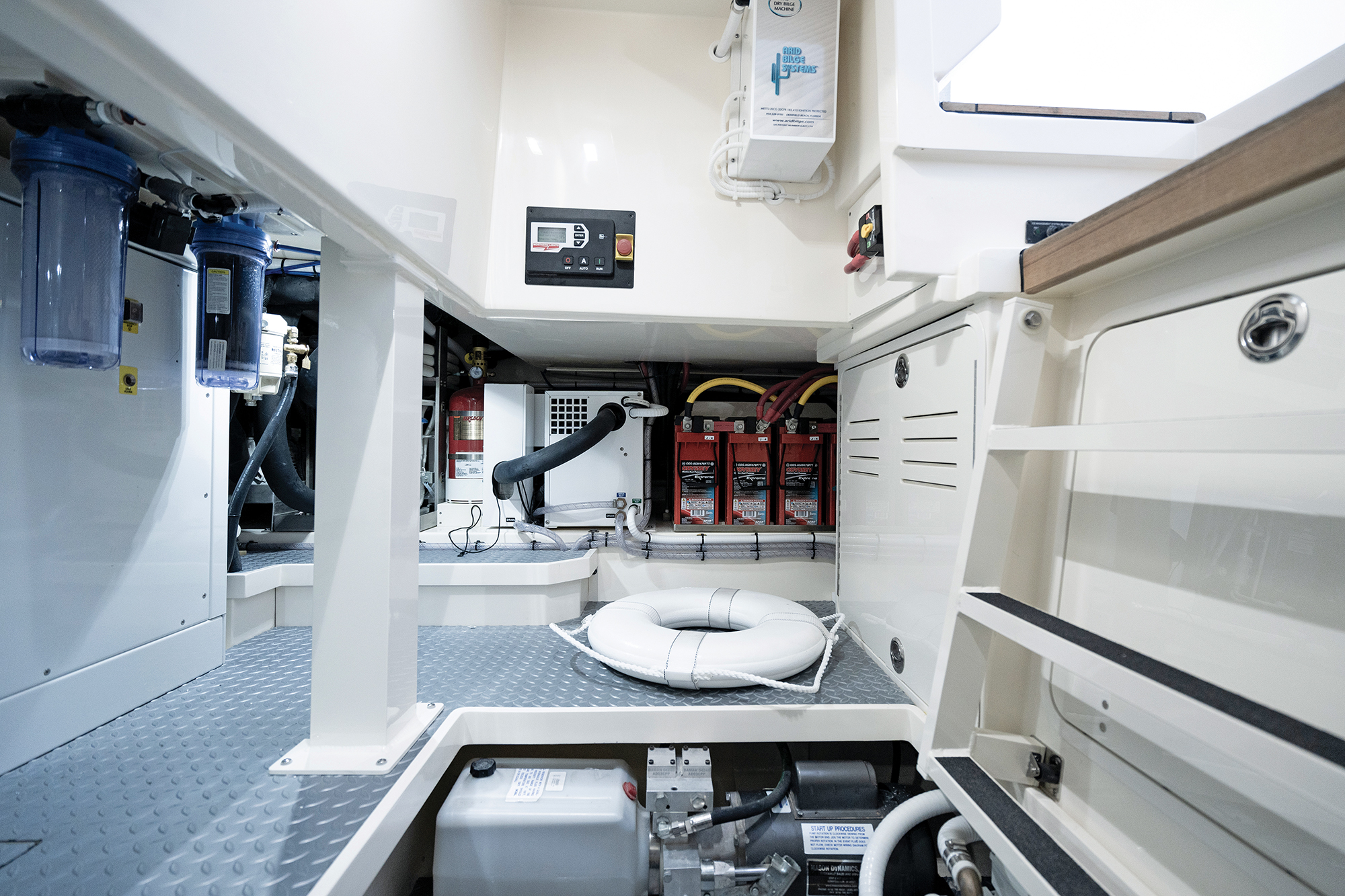
Unless you could see the half-assembled 670, I’m not sure you can appreciate the challenge of not only figuring out how to route wires and pipes, but installing Seakeeper, tanks, batteries, genset, desalinator and climate control—not only for easy access but also ensuring the boat would float level.
Ultimately, the big Scout took longer than the Potts had planned. But on the night of January 16, 2025, the Scout factory welcomed VIPs that included South Carolina’s lieutenant governor. When the curtain dropped to AC/DC’s “Thunderstruck,” the applause was sustained—and warranted.
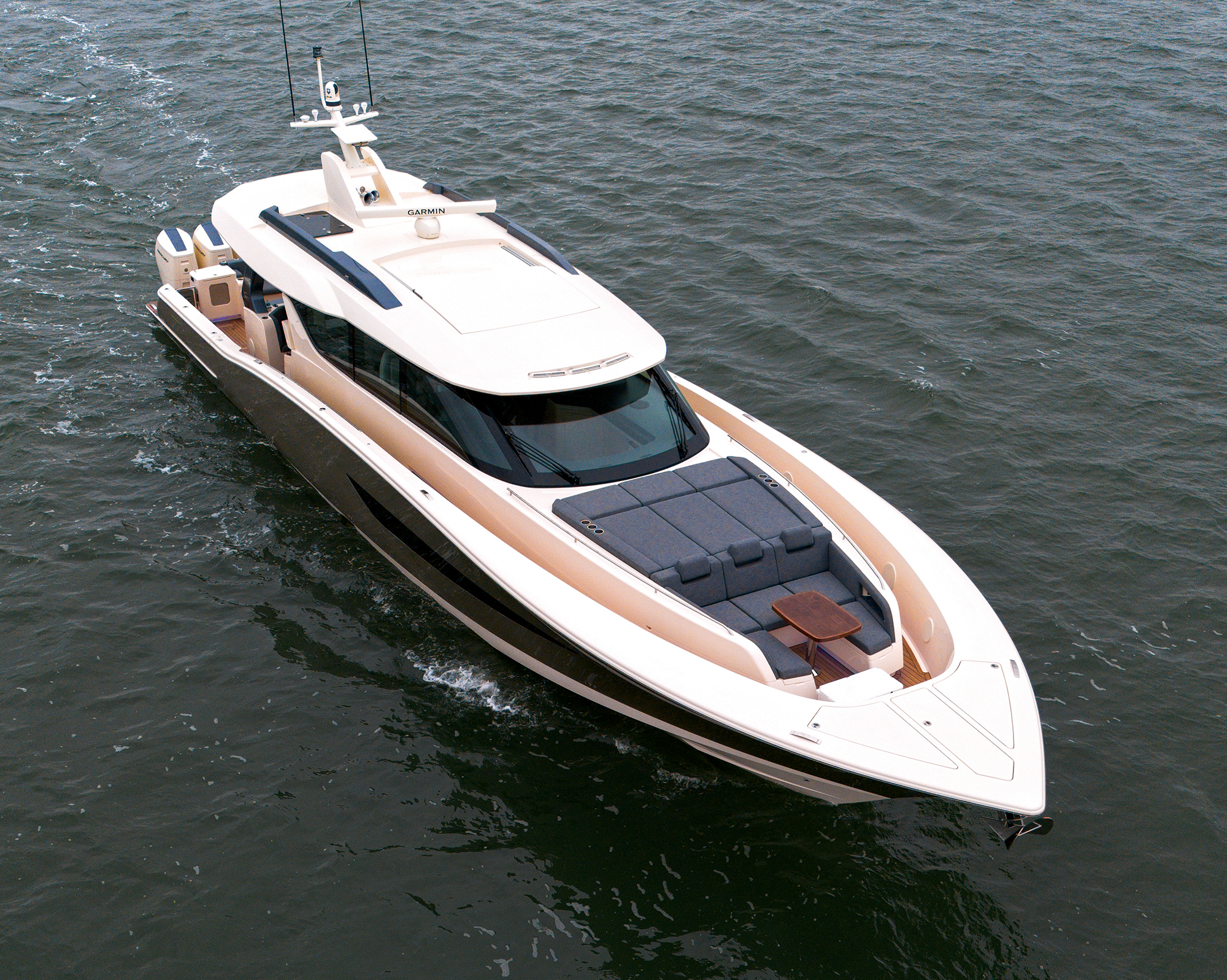
Hull number one is a dashing, muted beige-gold with a pair of huge hull side windows, her mammoth forward windshield and a burly, angled column behind the salon clearly lending some real structural support via the roof. Her beach platform gunwales offer a nifty trick in the form of a hydraulic cut-out step that folds inwards—making boarding from the dock that much easier. Stepping aboard, you see that although the 670 somewhat resembles a sportfisherman, most sportfishermen don’t offer walkways on both sides, functional railings and a nice forward lounge. If you’re going to fish with the 670, it’s actually a pretty angler-friendly design—particularly if you opt for an upcoming model with a tower. Backing down on a billfish with all those outboards churning behind the relatively low stern could be an issue, but this boat isn’t really designed for that. Still, those fold-downs would work well for hauling aboard a good sized wahoo. The stern will be very customizable, but hull number one offers dual-locking stern gates that allow you to walk clear around a rear station, which includes a comfy forward-facing sofa, rod holders and dual livewells. This boat is so nice, though, you might just opt to just use them as aquariums.
Forward of the rear station, a rear-facing sofa sits just under a cockpit roof that not only holds a retractable awning, but a rocket launcher that folds out of that awning’s way. The sofa is air-conditioned, and Scout sourced Mercedes AMG G-Wagen vents to duct the air. That sofa also lifts to reveal a big access to the belowdeck systems. Overhead’s low, but you don’t need to be a contortionist to reach the batteries, watermaker, generator or air conditioners.
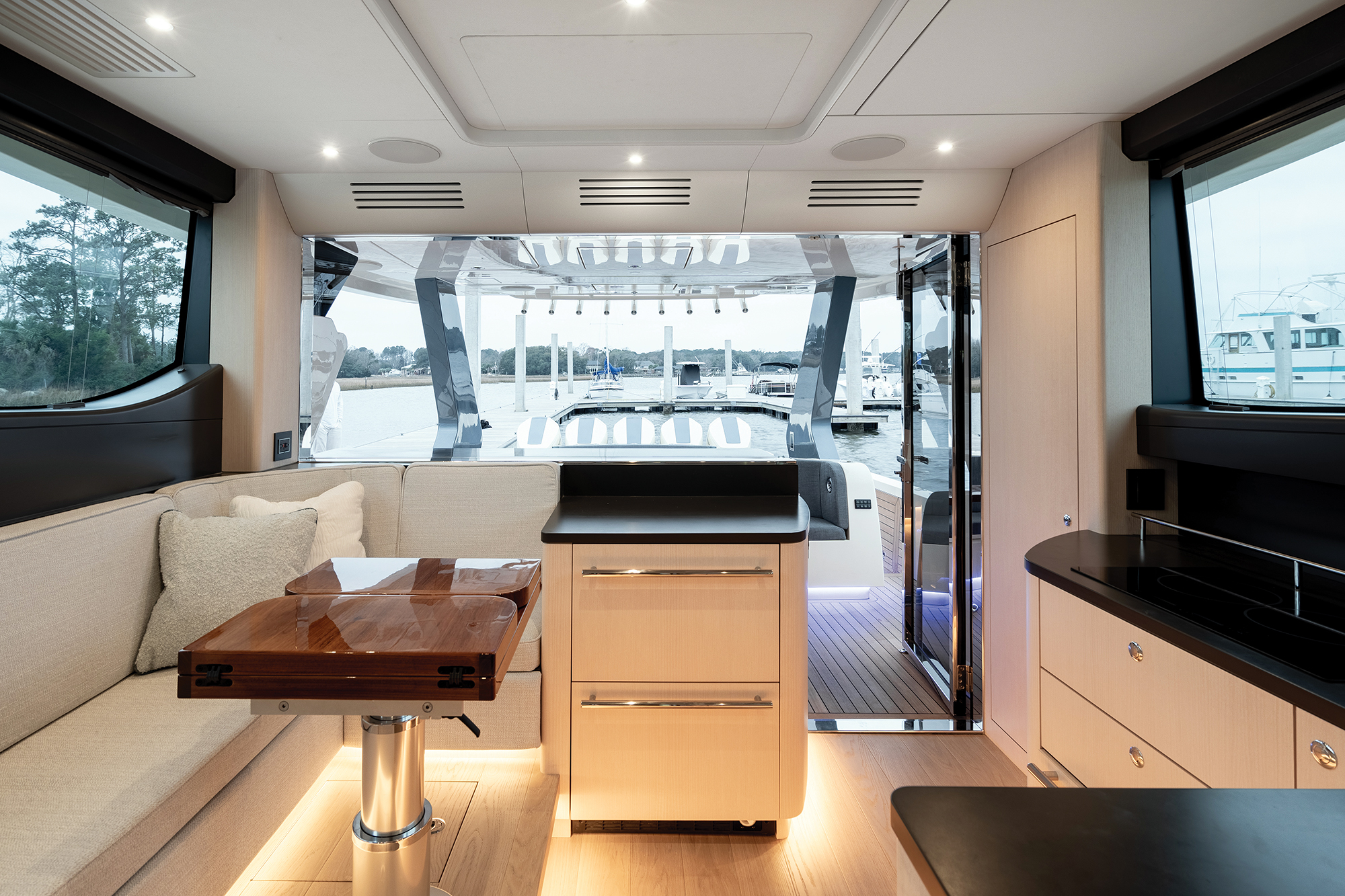
Above the sofa, a switch lowers a Garmin MFD that allows control of most systems without returning to the helm. Opposite that sofa, the center station holds a forward-facing lounge served by a pair of beautiful wooden tables—and forward of those, three forward-facing barstools nestle up against a salon bar. Overall, it’s just a fantastical, almost ridiculous space for comfortably entertaining outdoors—at 40 knots.
The forward lounge is reached by narrow but safe walkways to starboard and port. The recessed gunwale railing keeps it free of angling gear and cockpit-to-bow rails handle safety duty. Though the windshield is steeply raked and could let in lots of heat, it’s also partially shaded by the roof. And then inside the salon, a nifty retractable sunshade shields the whole lower cabin.
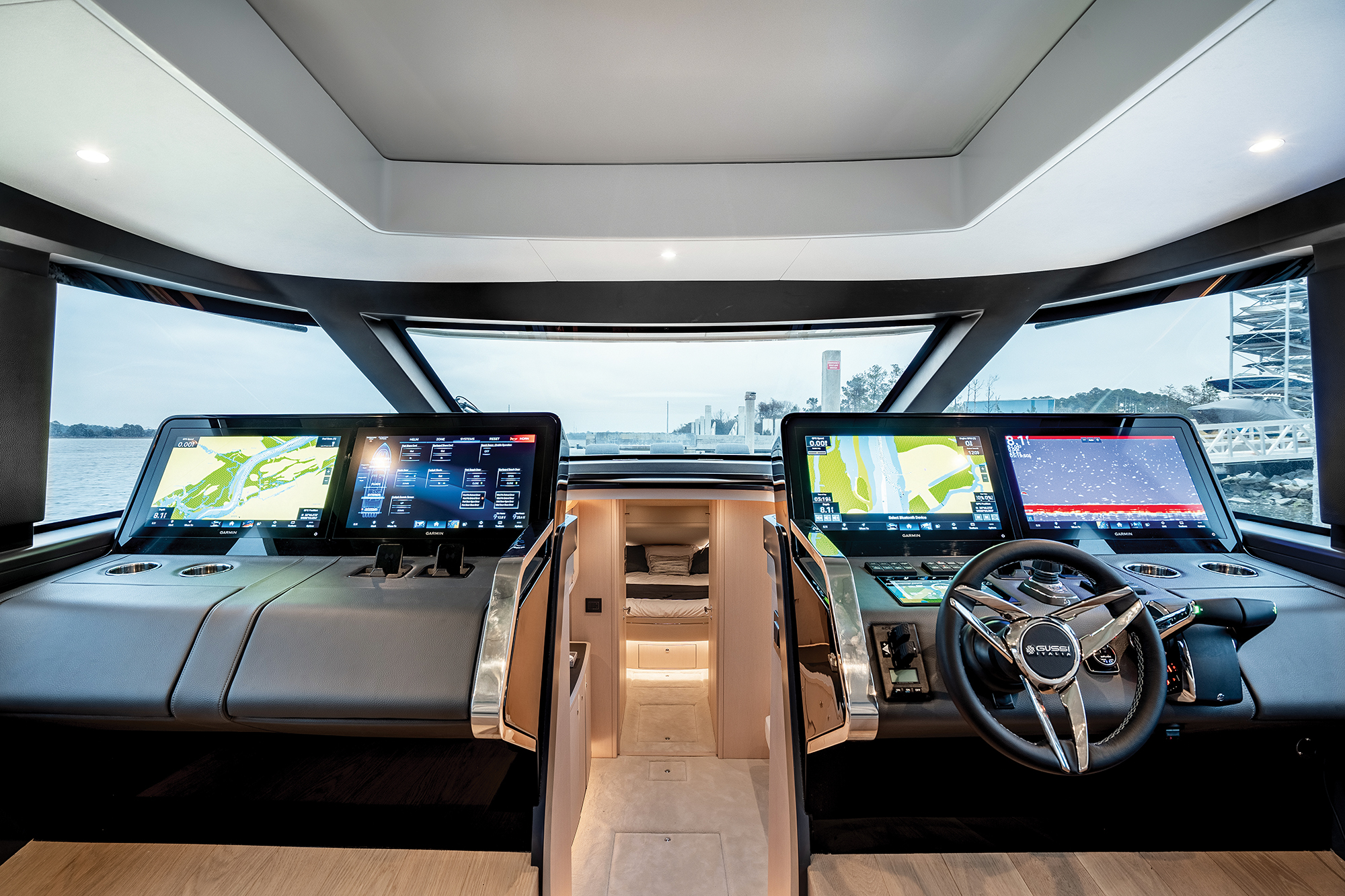
In that salon, the galley, as you’d expect, is full-service and just beautifully accented. A big TV folds down from the ceiling to face a six-plus seating U-shaped dinette and the bar. The whole area can be dramatically “outdoor-ized” via the burly glass rear door, the huge, motorized window at the bar, the sliding sunroof and a pair of massive automotive-style power windows on either side of the helm.
• • •
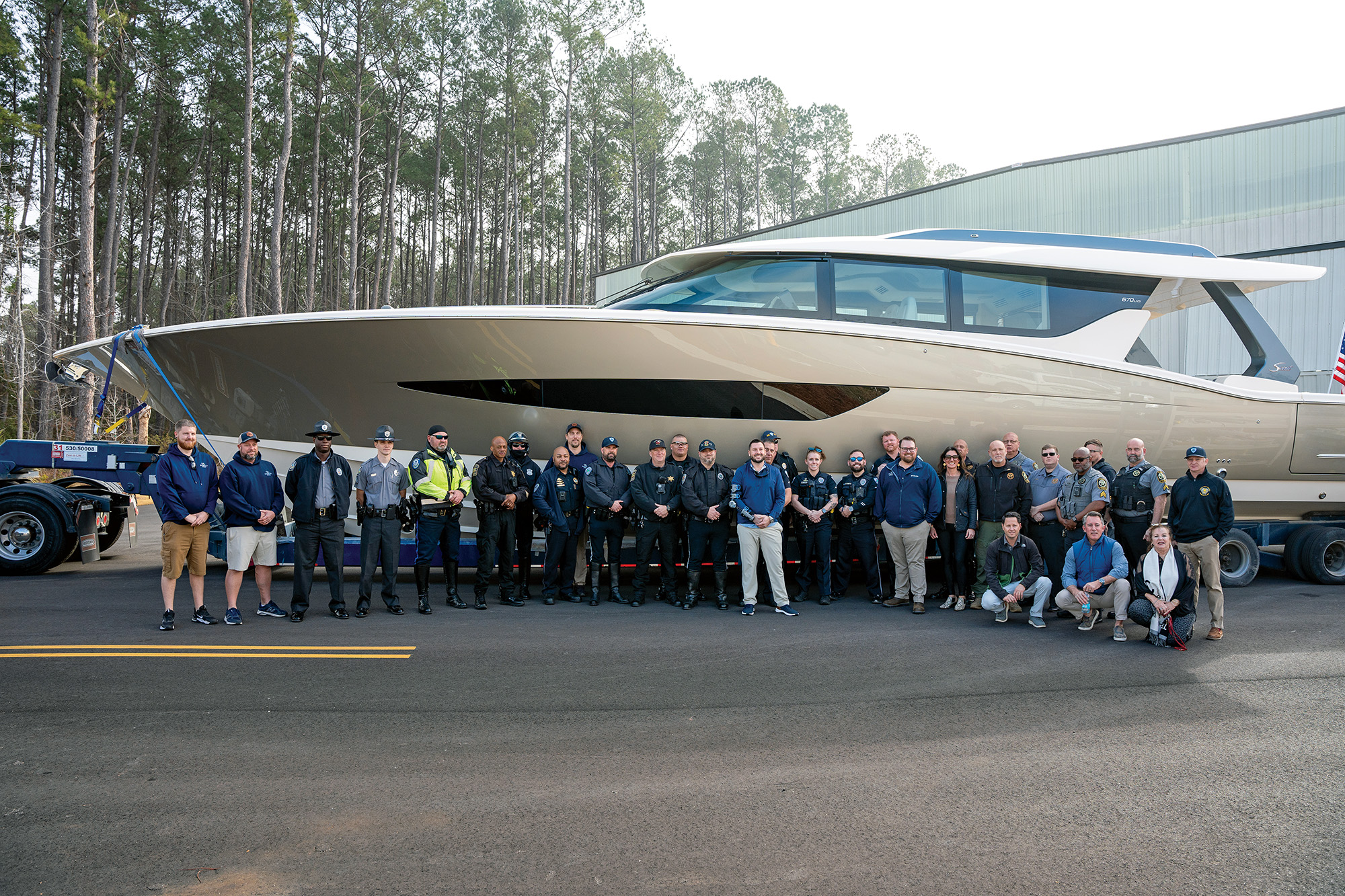
On February 13, Chris Hanna and his team from Myrtle Beach’s Palmetto Yacht Management had mounted the 670 atop an alarmingly low-slung trailer—which Scout had sent off to Canada to be lengthened. It wore six puny tires. Hanna was smiling, but the planning had taken two months. Navigating corners would be a challenge. They’d removed mast and radar, but the 60,000-pound yacht was still 15 feet tall, barely low enough to clear bridges and powerlines and a foot and a half above legal travel height. “Fortunately, this is being done in South Carolina, where we build everything a little taller,” Hanna said.
The cruise down Interstate 26, with the police parting the lanes like the Red Sea, literally stopped road traffic, especially when a trailer tire blew out. But soon, the 670 had rolled the 23 miles to the landing. The trailer was scraping concrete, but hydraulic controls let the operator raise individual axles just enough to ease her down. The Potts crew and a small crowd held collective breaths as she inched backwards. With a loud and scary thunk, the stern floated. Mercurys were fired. The plugs had not been forgotten. The 670 was free.
• • •
A week later, I met Scout captains Casey Collias and Josh Slayton at a little-known landing off Johns Island. Slayton let me practice keeping this multimillion dollar machine steady using a very effective joystick and bow thruster. A ripping current and a stiff breeze pushed us right towards the dock, but I had no trouble maintaining her position.
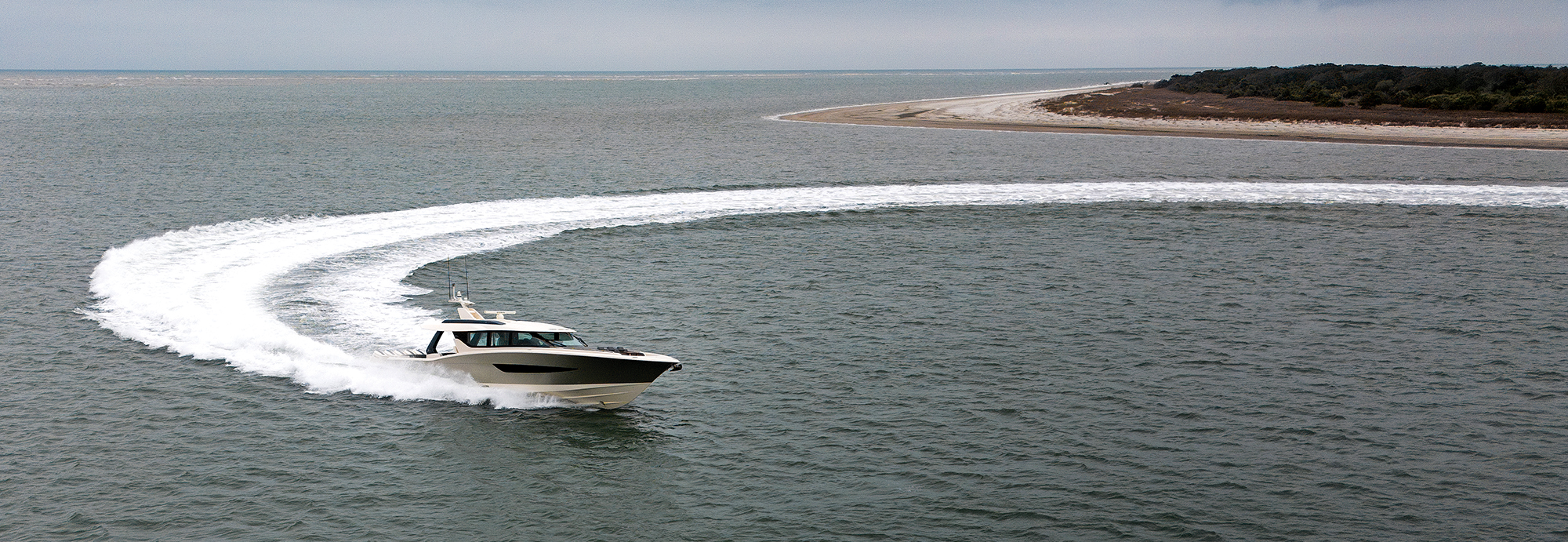
Capt. Josh let me fully unleash 3,000 ponies along the Stono River. With doors and windows hermetically sealing the interior, the 670 was incredibly quiet. Acceleration was both out of this world and remarkably controlled. The twin-stepped hull planed out at around 14 knots. She took eight seconds to reach 18 knots, 13 to reach 26 and 21 to hit a 35 knot fast cruise. Reaching 50 knots running against a 5- to 10-knot breeze took just over a minute. The chop off the Atlantic was only 1- to 2-feet, but aside from some fairly noisy hull slap, ride-wise, it wasn’t noticeable. Consumption-wise, Josh was careful to point out that they were still experimenting with propellers and engine heights, and the boat was still experiencing some slip from props that needed sizing up. At a 35-knot cruise, with about 500 gallons of gasoline on board, we were seeing around .3 miles per gallon. Flat out: .2. Those numbers should improve a bit once a max prop efficiency is reached, but for a 60,000-pound boat traveling highway speeds against wind and chop, those numbers seemed reasonable. Further to that point: You’re not buying her for fuel economy.
Josh suggested I turn full to port—at 50 knots. I’ve never turned a $7 million boat hard in shallow water before, but heeled over at 40 degrees, she was locked in. She lost maybe 8 or 9 knots through the turn, but quickly regained that speed straightening out. Turning to intersect her 3 feet of chop we heard—and felt—the waves, but she still gripped like a sports car. Slowing, we made for one of Charleston’s most popular hangouts, Sandy Point at Kiawah’s north end. Was this truly a “sandbar boat?” Well, she didn’t have her hull paint yet, so we kept her a few feet off the beach, maintaining position in the skinny, current-stirred water with the joystick. You would never, ever, be here in a boat with shafts or IPS. With a capable co-pilot, I’d be tempted to raise the motors, drop anchor and give it a go.
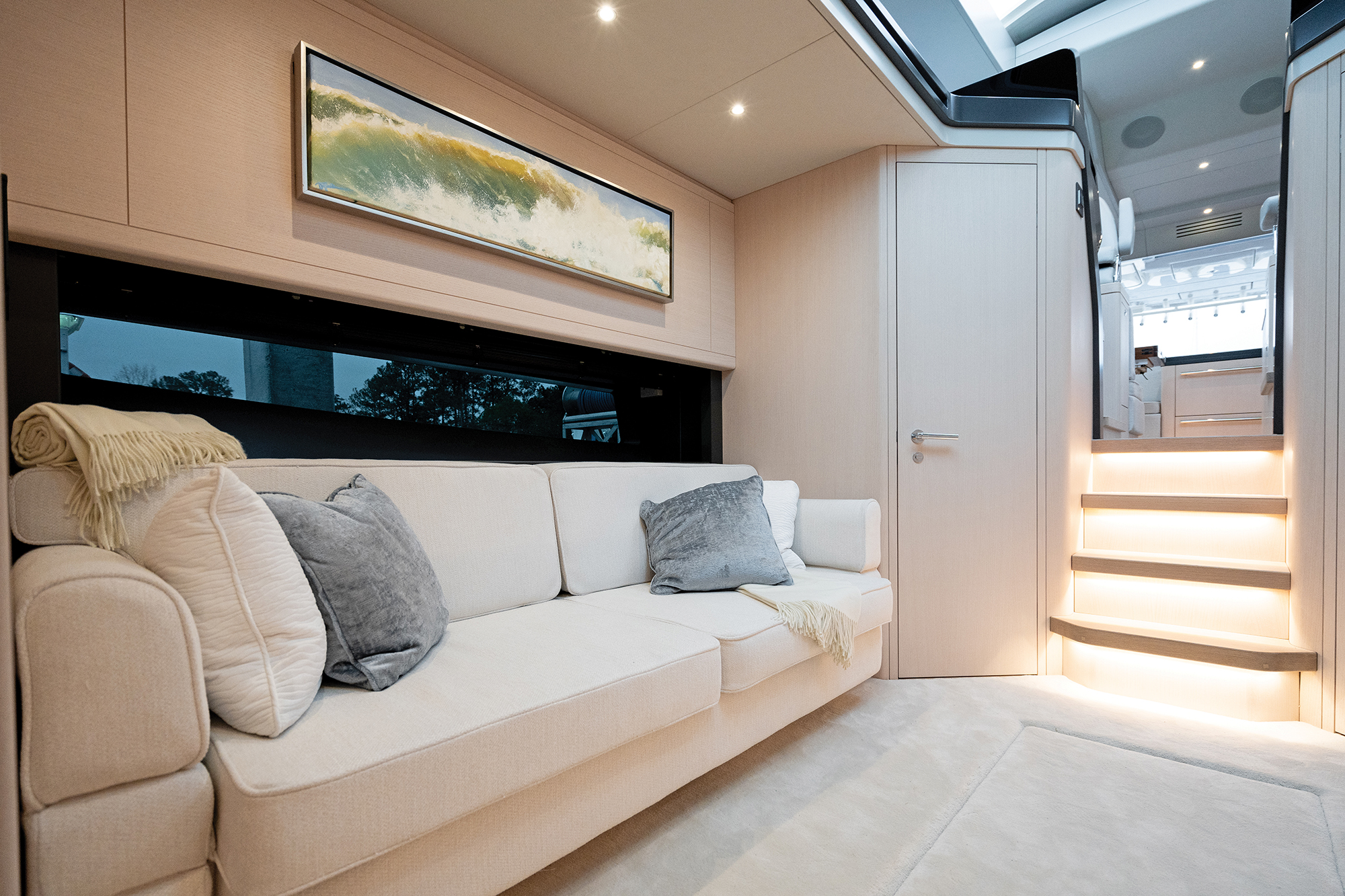
Throttling back upriver, Capt. Josh again pegged the throttles. The speed inched upwards until the 670’s design team’s magic number appeared on the Garmin: 60.7 miles per hour, or 52.7 knots. Then, lolling back along the Intracoastal at displacement speed, I stepped down into the forward lounge and cabins. Beiges, greys and soft lighting; the space was jarringly soothing after the feats we’d just accomplished. The cabins—a double-sized en suite berth up front, a double en suite/dayhead cabin to port and a dual-twin to port, were all quiet enough for a nap. I closed the door and stretched out on the bow berth. I could have been asleep in a matter of minutes, but we’d soon be sidling up to the dock so 1,000 gallons of petrol could be pumped on board, more tests could be run and this 670 could head south to make her debut at The Ocean Reef Club.
Driving back home across Johns Island as darkness fell, I realized this was the same road Steve Potts once walked along to school as a kid. His journey since that time has been, frankly, amazing. Will his family’s new flagship be as successful as they’re hoping? Who can say? I will say this though: The 670 LXS is a boat that can do it all.
Scout 670 LXS Specifications:
LOA: 66’9”
Beam: 16’2”
Draft: 3’5”
Displ.: 60,000 lb.
Fuel: 1,500 gal.
Water: 118 gal.
Power: 5/600-hp Mercury Verado
Price: Approx $7 million
This article originally appeared in the May 2025 issue of Power & Motoryacht magazine.