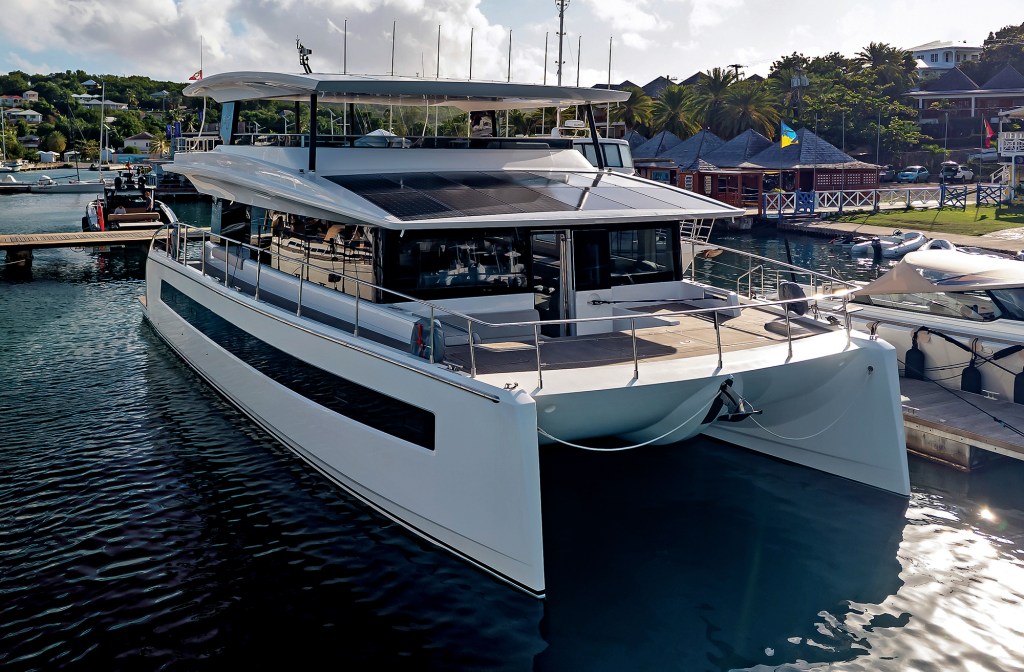
Sailing transatlantic is no easy feat. Doing it on an untested 62-foot solar-electric catamaran raises the stakes even higher. For Jay Dollries, owner of the Silent 62 three-deck yacht “100%,” such a trip has been a lifelong dream that he happily grabbed with both hands in the closing months of 2025.
Tesla-driving Dollries is familiar with “electric-powered stuff” and after years of tacking back and forth in sailing yachts, he and his wife Rebecca were looking forward to cruising in a straight line. Curious, forward-thinking, and drawn to a more independent way of navigating, they both felt switching to solar-electric was the natural next step.
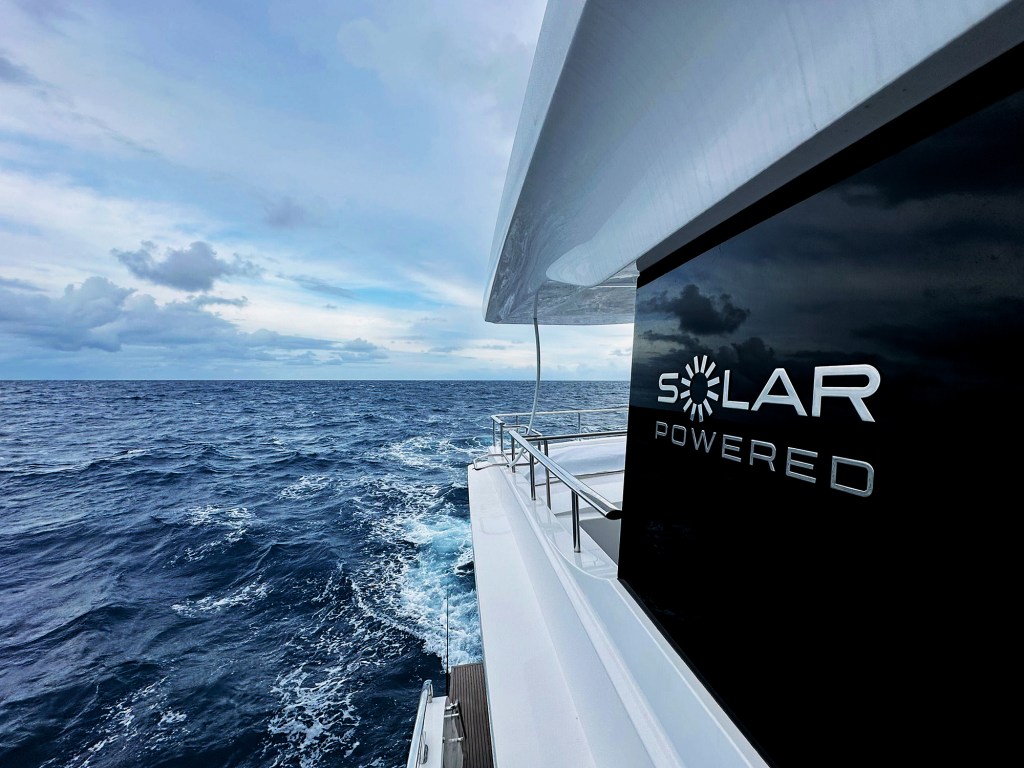
The size of the Silent 62’s open decks was another draw for the pair who like to invite their friends along for adventures, as were the 360-degree unimpeded views that the multihull’s open flybridge allows.
“The technological side of the boat was really the main driver of purchasing a Silent yacht. I love technology,” says Dollries. “I think having this type of ability to run on solar power and enjoy the surroundings quietly when you’re motoring around is something that is intriguing and really an enjoyable thing to do.”
You’d be forgiven for assuming the yacht’s name derives from her renewable energy systems. The truth is far more whimsical, instead referencing a South African skipper, whom Dollries once met, a man whose only affirmative response to a comment was, “Yeah, a hundred percent.” Dollries vowed to name his yacht after him.

After taking delivery of the boat last summer, the couple embarked on a European shakedown tour taking in Italy’s Amalfi coast, Sardinia, Corsica, cruising to the south of France and down to Mallorca before anchoring in Gibraltar, from where the transatlantic trip commenced. “We’ve never had the opportunity to cruise the Mediterranean, so it gave us a great opportunity to enjoy some new places,” says Rebecca.
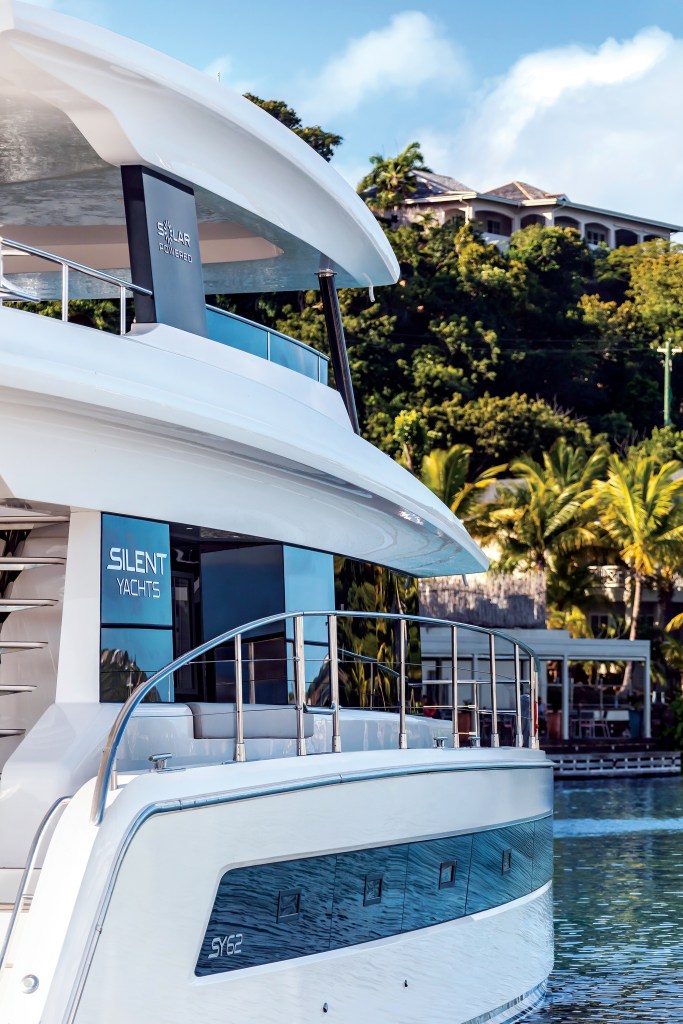
Like all Silent yachts, the SY62 delivers near-zero-emission navigation that is quiet, smooth, and with no vibrations. It’s engineered for long stays on board, with low maintenance and maximum freedom on the water; ideal for the husband-and-wife teams that make up around half of Silent 62 owners. It’s a setup that earned the model the ‘Most Efficient Yacht’ award at the World Yachts Trophies following its launch in 2024, but one that remained untested when crossing the Atlantic, until now.
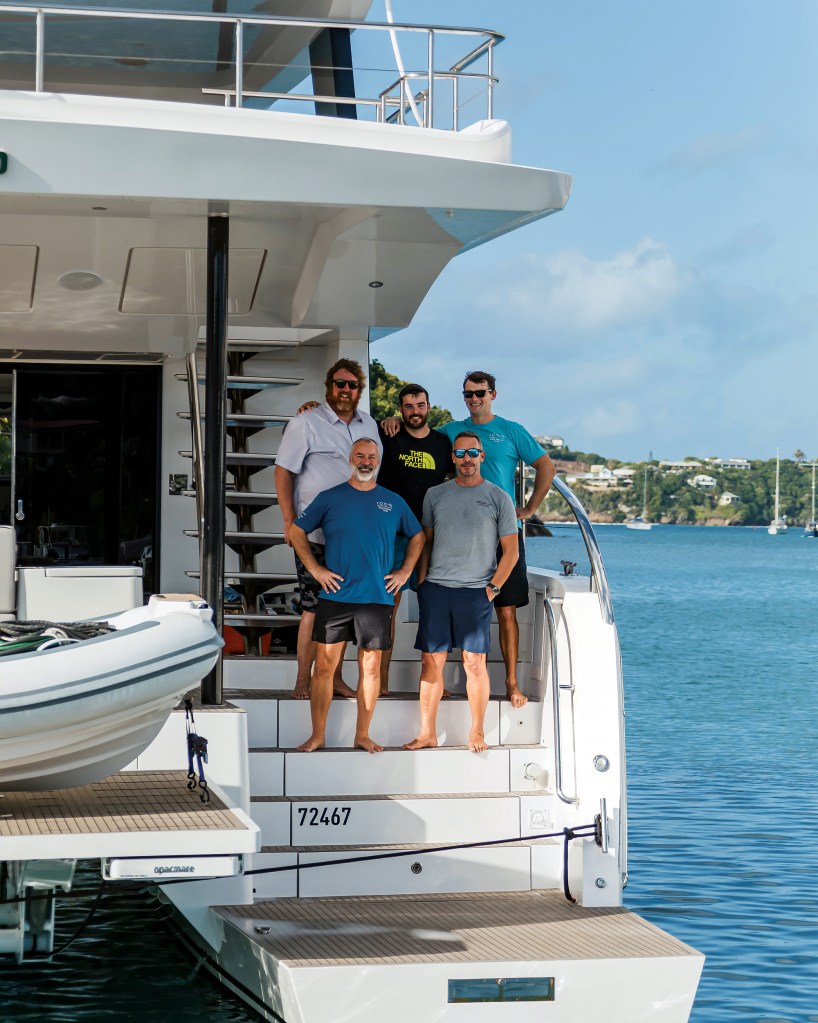
Rebecca abstained from the 25 days it would take to cover 3,800 nautical miles, however, Dollries was joined on the voyage by his friend and long-time adventure companion Randy Lane who paid his way by cooking most of the meals on board. The remainder of the owner-led crew comprised mechanical engineer and expert in kite systems Michael Scherdel as well as 100%’s captain Will Mitchell, and former captain and CEO of Silent Yachts, Steve Bell, “the only one that could get insurance to take her across.”
This was Bell’s third transatlantic crossing, though his first aboard a Silent yacht; his first two trips were done on sailing yachts. In 2018, the Silent 64 became the world’s first serially produced solar-powered catamaran to complete an Atlantic crossing, yet there have been some considerable improvements in technology in the 7 years since, including the management and production of the yacht’s high-voltage battery bank. It’s made of 30 lithium battery sets that together deliver 354 kWh at 800 volts and allow long stretches of quiet electric cruising. A separate low-voltage bank with 30 kWh at 24 volts powers navigation and safety systems, giving the yacht a lot of independence.
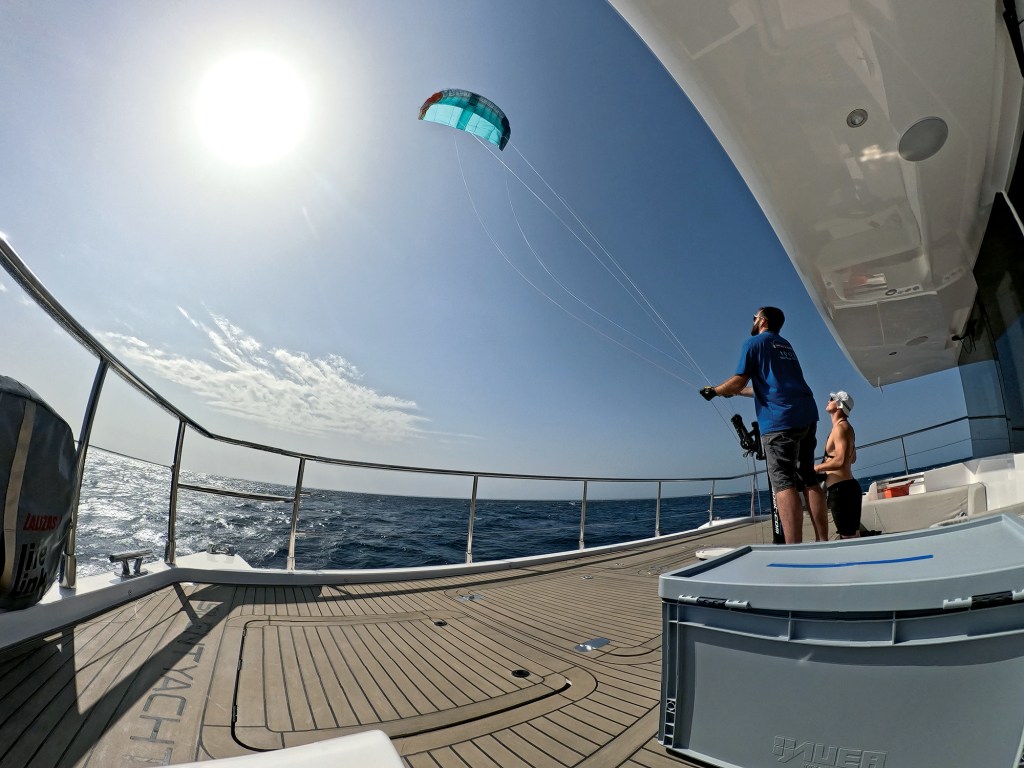
The battery bank stores the energy captured by the yacht’s 42 rigid solar panels, which is used to power the electric motors. The diesel range extender recharges the batteries when the sun isn’t out, though it never powers propulsion directly, so the yacht remains fully electric while navigating. Perhaps the most notable difference is the addition of an automated towing kite made by Hamburg-based SkySails, It was first seen on the Silent 60, but according to Bell, had yet to fulfill its true potential. Requiring at least four crew to launch, they had tried and trashed all three kites by the halfway point of the journey.
“The kite is only a prototype, but it was hugely disappointing,” says Bell. “I hope the company takes the feedback we’ve given them and make it work, because if they did you can bring the throttles back and save 30 percent of the energy use with the kite up.”
Despite having their kite-flying hopes dashed, not to mention the risks of crossing the ocean without a support team boat, the trip largely ran without hiccups, something that Bell puts down to meticulous planning. “The yacht was in exceptional condition, but I double-checked all the systems, and we probably had enough spare parts to build another yacht.” Throughout the voyage their only obstacle was a burnt impeller on the generator—“I don’t think it was changed before the voyage”—and they had to weld a relay on one of the drive motors. “My concern was the HVAC or the water maker breaking, but it didn’t, which was surprising because there’s always something that breaks on a yacht,” says Bell.
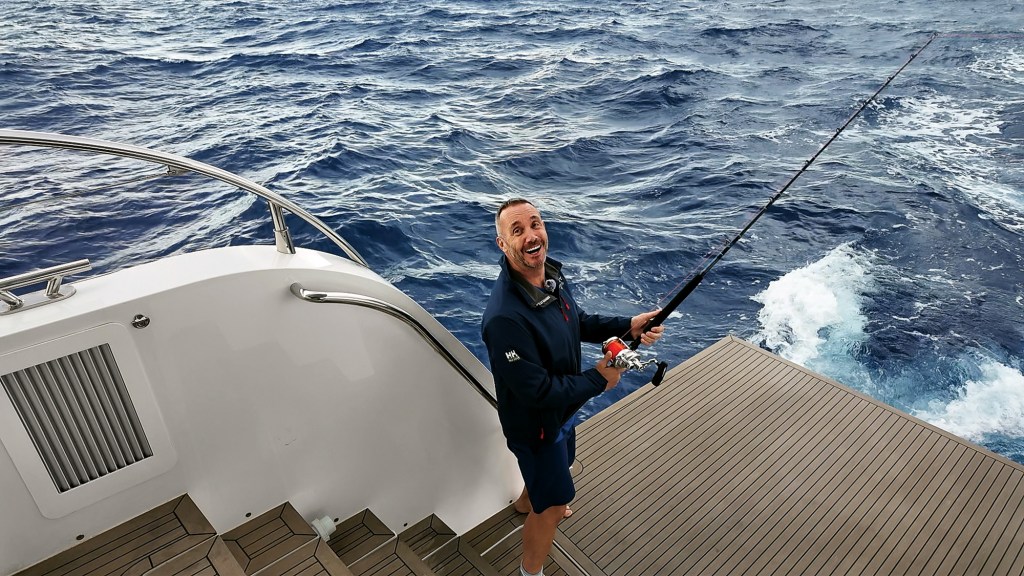
Life on board “unfolded quietly” and they soon settled into a regular pattern of fishing each day for tuna and mahi mahi, which Lane transformed into delicious meals each night. Dollries took responsibility for logging the yacht’s data, while Bell and Mitchell took turns on night watch. There was little in the way of boat traffic or views other than the calm big blue, and even wildlife sightings were in short supply with only dolphins spotted regularly off the bow. Thanks to the yacht’s Starlink, they never missed a Grand Prix race or soccer match, and the addition of a rowing machine and free weights on the flybridge even allowed for regular exercise (swell permitting).
A highlight was when they reached the midway point in the Atlantic, which Bell and Dollries celebrated with a bracing oceanic swim. It was the only time the yacht paused, other than when docked in port, successfully maintaining a steady pace of around six knots and completing 72-percent of the trip on batteries.
A perk of cruising a solar-electric catamaran is not having to plan around refueling stops. Then, there’s the absence of noise, which changes the onboard ambiance. “People buy a Silent yacht to sit at the helm, click the throttles forward, and start cruising without noise, vibrations or even the sensation of movement,” says Bell. “It’s such a different feeling to tearing around at 35 knots in a Sunseeker or Fairline. This was more like sailing with just the sound of the sea.”
When they weren’t attending to 16-foot swells that came up the stern steps and into the cockpit area, they spent their time on the flybridge “which we used as a chill-out area to relax or listen to music.”
Another contributor to the trip’s success was their choice of route, which was completed in four legs. Departing Gibraltar in early November, the intention was to make a direct passage to Lanzarote, but they were soon faced with a changing weather forecast as the low pressure of the Atlantic moved in, pointing them headlong into 30 knots of wind and 10-foot waves. They diverted to Agadir on the southwest coast of Morocco where, having crossed palms with whiskey and gin, managed to bag a berth amid the scramble in port as many other vessels sought shelter. They hunkered down for three days—“the yacht was more than capable of handling the weather, but we weren’t”—and took the opportunity to clean the solar panels and check systems before braving the strong headwinds and swell en route to Lanzarote. They met more gusts en route to Cape Verde where they spent Thanksgiving, before pulling into Antigua in early December.
Battling along just north of the equator in November not only meant they avoided hurricane season, but they picked up 16 knots of trade winds on their last leg, providing some good assistance as they headed west towards Antigua, as well as half a knot from the northern equatorial current. The flipside of crossing the northern hemisphere during the region’s shortest days meant a drastic reduction of their daily solar gain, averaging 55 kWh, almost half the 100 kWh gained during the summer months in Croatia.
For Bell, the opportunity to monitor efficiency over thousands of nautical miles in real ocean conditions made the concessions worthwhile. Their total fuel consumption for the entire crossing was around 1,453 gallons, a little over their estimated 792 gallons, though this was largely down to Dollries wanting to push the throttle as they neared Antigua. Considering they continued through the nights relying only on stored solar energy in the batteries and the generator, and with onboard systems, such as lights and HVAC remaining active, the results are impressive. “If you took a 60-foot motor catamaran on diesel engines transatlantic at the same speed, you would burn double the amount of fuel,” he says.
With the transatlantic box ticked, Dollries and his wife are now focused on enjoying 100% in The Bahamas and Caribbean, as well as keeping her docked outside their home on the west coast of Florida.
“Very few owners will ever cross an ocean, but knowing that their yacht can do it sustainably, reliably, and with minimal fuel, offers unmatched peace of mind,” says Bell. “This voyage showcases the future of cruising: comfortable, responsible, and free.”
This article originally appeared in the May 2026 issue of Power & Motoryacht magazine.