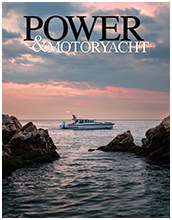
By Air and Sea
In a record time of just 36 hours, the recently launched Mach 4, built in Tauranga, New Zealand, covered 1,170 nautical miles traveling from the Bay of Islands, New Zealand, to Gold Coast, Australia (where her new owners have taken delivery), averaging a speed of 32.5 knots and clocking a 50.9-knot top hop. She’s arguably the fastest motoryacht ever to cross “the ditch,” amazing even the customs agents who were tracking her voyage. In a league of her own, the XF75 outpaces, outperforms, and outclasses, well, just about everything.
The Voodoo XF75 is a story in three parts, and I was fortunate enough to be aboard the craft for the first part in early May of this year while she was still in Tauranga, undergoing her final commissioning and sea trials, before setting off across the Tasman Sea a few days later.
The Voodoo XF75 catamaran is built to span oceans at high speed—while looking damn good doing it. At the same time, if you want to make slow and fuel-efficient long passage, this is your boat too. There’s nothing else on the water like her.
After 38 years building luxury boats and superyachts for international clients, Voodoo Yachts Co-Founder Dave Pachoud knew exactly what he wanted when the time came to build his own boat. At the time, his mix of demands left him with some seemingly insurmountable design challenges.
As an experienced seaman with thousands of ocean miles under his belt, Pachoud wanted a boat capable of crossing oceans. Trips to Australia and the Pacific Islands were on the agenda from his home port in New Zealand. This meant the boat had to be safe, capable, and stable. That seemed simple enough, but there were a few other demands that made the design project a bit more difficult. Dave wanted his new boat to not only cocoon his family in luxury, he wanted her to be fast. Not just fast-fast, but blisteringly fast. And to top it off, he wanted the boat to set new standards in fuel efficiency.
Often, Pachoud had been on a passage in fair weather, thinking that he could do any speed at all if only the boat had the performance and range to take advantage of the weather window. Thus, the design team was faced with creating an expedition-capable vessel that looked like a sports car, performed like a race car, was as sturdy as a rock-crawling 4×4, and had the luxury of a five-star hotel. He invited naval architect and long-time collaborator Roger Hill to team up with him on the design. They were quick to settle on a power cat, knowing from decades of building cats that no other hull configuration could possibly deliver on the brief. Within a very short time they realized that their impossible brief was actually possible—if they mounted a foil between the hulls.
Although the performance of foils is indisputable, the boat still had to safely withstand open-ocean conditions. The solution was to create a foiling wing as a separate composite structure so that in the event of a foil strike, it would break away from the boat, leaving the hull intact.
Within a year of being penned, the “Xpedition Wing” foil was a reality—and proving itself under the hull of the original Voodoo 1. What the team had achieved with the first Voodoo was thought to be impossible, but now it inhabits its own place—however niche—within the market. Voodoo owners aren’t typical boaters, it might go without saying; they’re genuine adventurers, and they shop with different demands. What sets Voodoo’s range of expedition cruisers apart is their ability to cover huge, open-ocean distances at high speeds in remarkable comfort. The Xpedition Wing, which carries around 50 percent of the vessel’s displacement weight at cruising speed, is responsible for the boat’s efficiency. Raising the hull about 31.5 inches when the yacht is underway at speed, it provides exceptional dynamic wing-deck clearance and lowers the vessel’s wetted surface area, allowing the powertrain to propel the hull at speeds of up to 50 knots with a fuel consumption of a vessel half the weight.
Voodoo’s new XF75 is equipped with the latest generation of Xpedition Wing and hull design—the results of 15 years of R&D and testing in the open ocean—which gives it outstanding handling characteristics and cuts through chop effortlessly.
Witnessing this firsthand while out at sea off Tauranga Harbor—where Pachoud and his son, Mitch, along with over a dozen boat-building professionals were finalizing things aboard—I was impressed with the way the XF75 banked slightly into corners at high speed—a unique trait found in foiling cats that makes them feel more like traditional boats and lends both security and sportiness. She was no slouch in tight quarters, either: Slow speed maneuverability was outstanding with the widely spaced Hamilton HTX42 jets allowing the helmsman to spin the boat around almost on the spot.
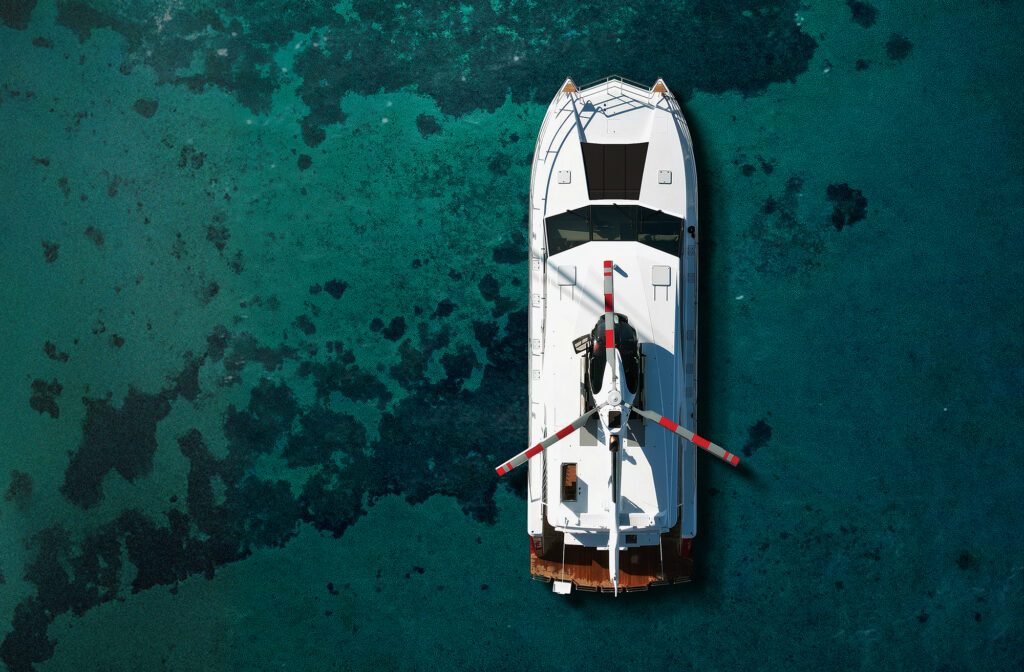
One standout feature—should you be so inclined—is the fully functional helideck. Built to accommodate a light turbine helicopter, the deck includes refueling capability for extended remote operations. This is a feature usually only seen on expedition-style yachts over 130 feet. It’s a sign of the sort of use the XF75 is built for: long-range adventures, remote anchorages, off-grid independence, and should the need arise, even medical evacuations.
Propulsion-wise, Mach 4 is powered by twin MTU 10v2000 series diesel engines rated at 1,600 horsepower each. Transferring power from the engines to the water was no problem, thanks to the team at Driveline, who designed and manufactured the Turret 35 marine cardan shaft system connecting the engines, ZF gearboxes, and Hamilton Jet drive units. Operating as one, they deliver a sprint speed of 50 knots while offering a 1200-nautical-mile range at an optimal 35-knot cruising speed. Her standard fuel tanks have a 3,963-gallon capacity. The 793-gallon JetA1 helicopter fuel tank can also be used for diesel to increase the range of the XF75 still yet. Her cruising speed varies from 20 to 40 knots, and with the optional fuel tank she has a range of 3,500 nautical miles at a speed of 8 knots in displacement mode. That’s a capability usually reserved for displacement passagemakers—not vessels that can crack 40 knots at the drop of a hat.
The relatively small powerplant for a vessel of this size also offers the benefit of a dramatically lessened energy footprint. Then there are the significant savings on engine consumables, enabling much longer travel distances per engine hour. This was proven on the recent inaugural voyage from New Zealand to Australia, which took just 36 hours. So, let’s break that down: For the average 20-knot displacement cruiser that would make this crossing, the passage would represent 150 hours of engine run time. Extrapolating, this means that within a normal 500-hour engine service interval, the XF75 could conceivably travel 17,500 nautical miles compared to that cruiser with the same service interval, only achieving 10,000 nautical miles. Meanwhile, an 8-knot trawler would only travel 4,000 nautical miles within its 500-hour service interval. Translation: A significant cost reduction along with environmental savings, as the 8-knot conventional vessel would have been serviced four times before a Voodoo’s first service was even due.
Although the sea was quite calm during the time we were out, Pachoud explained that in a more significant seaway, Voodoo’s refined Xpedition Wing negates the porpoise, or pitch tendencies often associated with foil boats and that the boat’s running angle thus feels “locked in.” He added that in a following sea the boat keeps its nose up, tending to accelerate and surf down waves rather than drive down them into the troughs, and the XF75 isn’t prone to bow steering or burying its nose heading down sea.
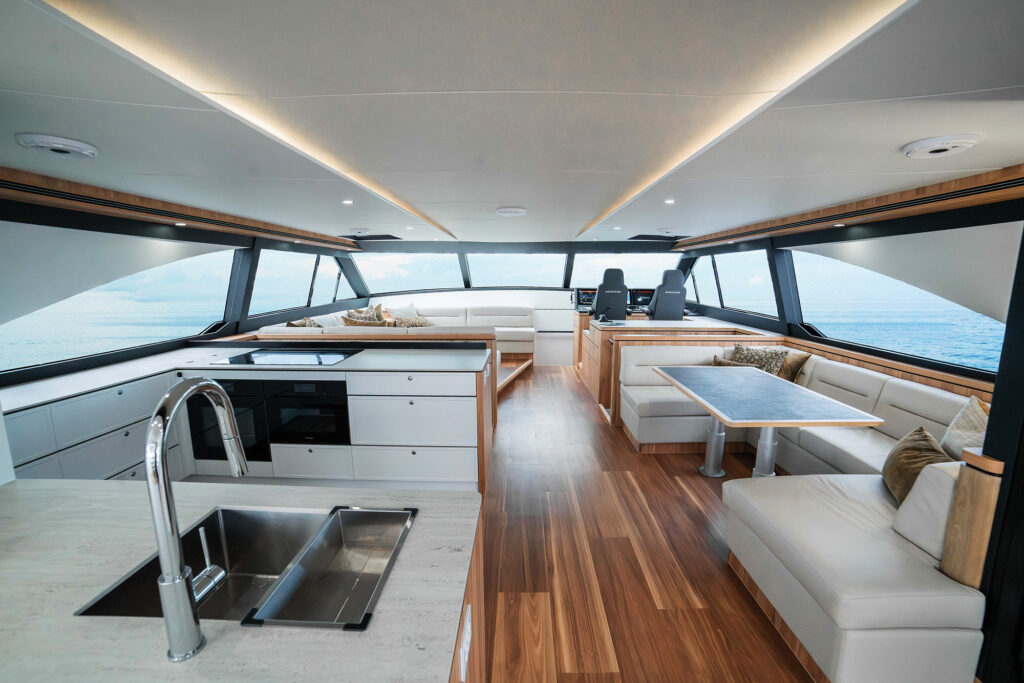
The XF75’s interior platform was designed from the outset to break the mold, too. A 25-foot beam offers no shortage of deck space: There’s nearly 3,000 square feet of usable area on board, cleverly designed to create a yacht that feels much bigger than its waterline length suggests. In addition, it is capable of being handled by two people, with shallow-draft options opening up destination options. A draft of just 3 feet for jet models and about 4.5 feet for inboard models opens access to bays and anchorages that traditional motoryachts of this size can’t approach.
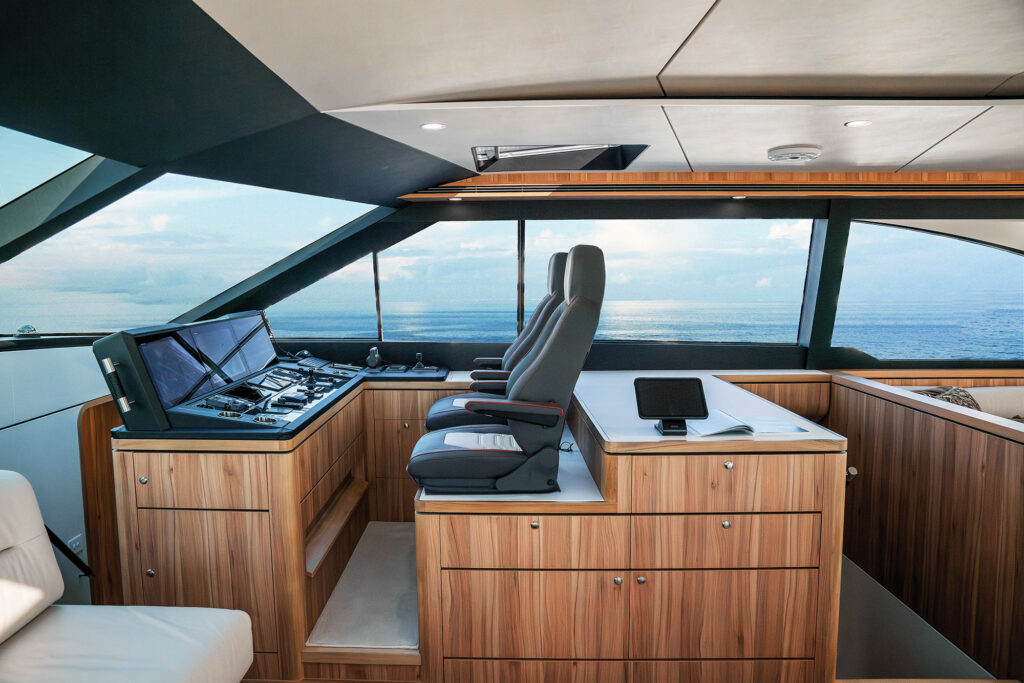
The XF75 sleeps eight guests across four cabins, with additional space for crew. Layouts are customizable, but all versions include a generous full-beam owner’s suite, multiple heads (four or five, depending on owner preference), expansive social areas aft and forward, and a large galley optimized for extended cruising. The single-level main-deck floor incorporates the cockpit, galley, salon, and helm areas, merging seamlessly to lend a uniquely light and spacious feel that enables guests to move about the boat with ease. And for those who like their toys, there’s space for a large tender, a jet ski, dedicated surf or SUP storage, and all the usual water sports gear. The wide cockpit and open aft deck are ideal for entertaining, while the foredeck lounge is a perfect spot for sundowners after a fast passage.
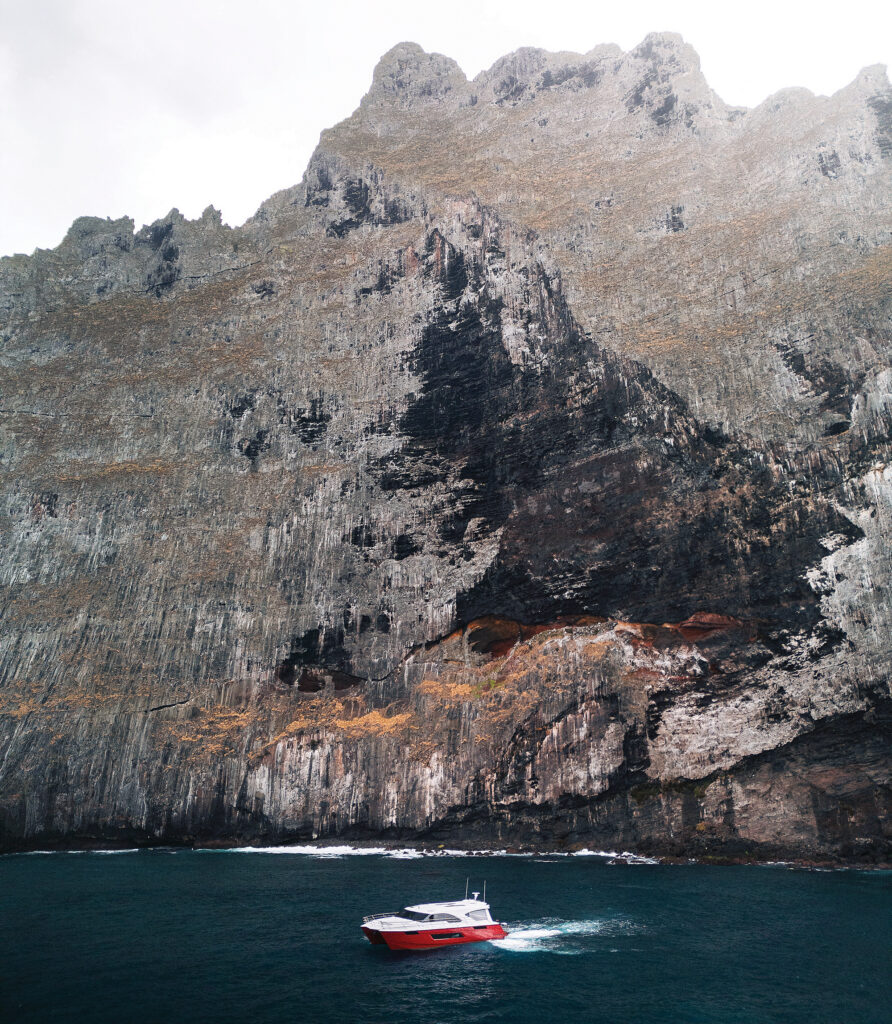
Serious comfort, performance and luxury in seriously remote—and even inhospitable—locations is the hallmark of the XF75.
To a soundtrack of Led Zeppelin, AC/DC, and an assortment of other rock classics, Mitch and Dave Pachoud departed from Northland’s Bay of Islands for Australia on Thursday morning, May 15th along with the new owner and a couple of his mates, making brief open-water stops at Ball’s Pyramid and Lord Howe Island.
After steadily traveling at 36 knots, the Pyramid’s jagged monolith came into sight, rising like a stone fang from the middle of the Tasman Sea. Ball’s Pyramid is no island in the traditional sense. There is no welcoming shore, no friendly cove, only a 615-foot-tall spear of basalt thrusting from the depths. Weathered and totally exposed, the Pyramid’s base is home to any number of coveted denizens of the deep for those who can get close and haul them up.
Carrying on to Australia, the XF75 and her crew arrived at Southport Yacht Club Customs on Friday night and were cleared on Saturday morning by Australia’s Border Force, some of whom had been excitedly following the trip: A potential record crossing of just under 1,200 nautical miles in 36 hours. After securing a berth at The Boat Works, finishing touches were administered in preparation for the Sanctuary Cove International Boat Show, where the XF75 had her global debut, showing up with an Airbus H130, 7-seat helicopter on deck. “We’ve made fast passages before, but this one was unique!” said Mitch.
In the end, I found the Voodoo XF75 Mach 4 to be a striking 75-foot catamaran built for adventurous owners who expect speed, comfort, range, and heavy-sea capability. Before the boat left New Zealand, I asked Mitch about her range at speed. “I believe we can average about 3- to 3-and-a-half gallons per nautical mile at our optimal cruising speed of 35 knots,” he said. At the time, I felt that was a somewhat staggering claim, but the XF75’s voyage to Australia proved my incredulity ill-founded. From the first moments of sea trials, it was clear Mach 4 has already begun redefining expectations of what a performance luxury motoryacht can be.
Voodoo XF75 Specifications:
LOA: 75’
Beam: 25’
Draft: 4’8”
Displ.: 104,000 lb.
Fuel: 3,300 gal.
Water: 396 gal.
Power: 2/1250-1800-hp MTU or MAN w/shafts; 2/1,550-1,800-hp MTU or MAN w/jets
This article originally appeared in the February 2026 issue of Power & Motoryacht magazine.