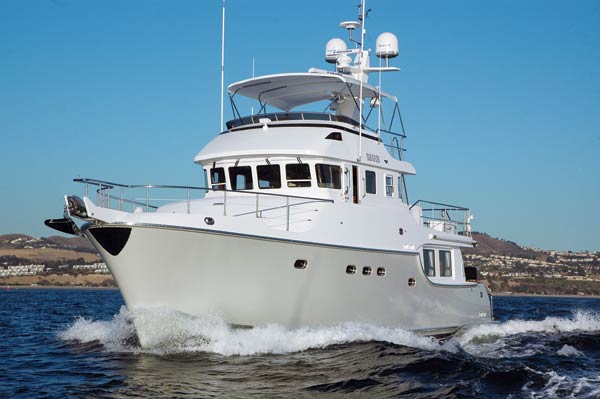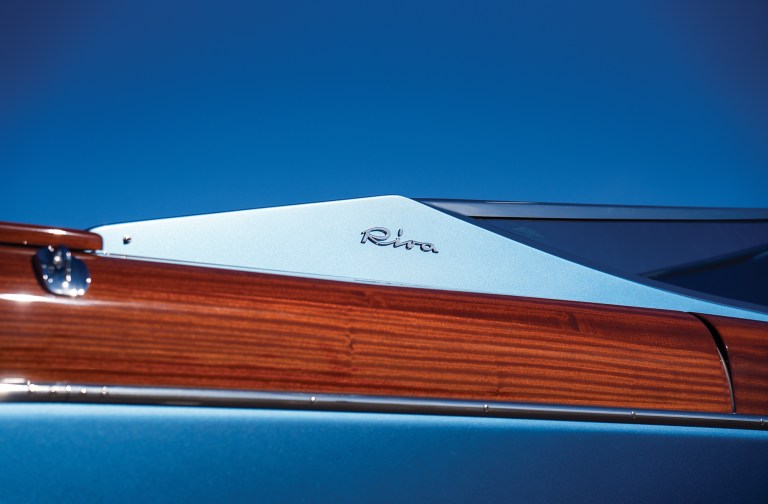
When we took delivery of our trawler Liberdade, shipped to us along with the owner’s manuals and commissioning paperwork was a gift we hadn’t expected: a pristine 4-by-8-foot sheet of the same wood veneer used throughout the boat’s interior. It was finely grained with a warm finish, the same high quality as the boat’s interior. One of the things that drew us to Ocean Alexander was precisely that attention to detail. Their interiors aren’t just assembled; they’re crafted. This sheet of veneer felt like an extension of that philosophy, a quiet assurance that if something were ever damaged or we made modifications, we could match the original finishes.
We treated it accordingly. Sandwiched carefully between two sheets of smooth plywood. Clamped flat to prevent warping. Moved from storage space to storage space as the years went by. Fourteen years later, we still have it—protected, preserved, and never used.
That alone might be unremarkable. Boaters are by necessity planners. We carry spares because the sea is indifferent to convenience. Things fail when they want to, usually far from parts suppliers or boatyards. Preparedness is part of seamanship, and most of us wear it as a point of pride.
Up until now, the monetary cost of keeping that veneer has been small. It hasn’t required maintenance. It’s been stored for the last several years in a building we own in Baltimore, so it hasn’t even taken up precious space on the boat. But with the pending sale of that building, I now have to consider the real time and cost of getting it down to our home in St. Petersburg. Cost isn’t always measured in dollars or even in pounds or cubic feet. Sometimes it’s measured in attention or intention, in the mental energy required to justify why a material thing still deserves a place in our life.
But the irony of that sheet of veneer has become hard to ignore. As I contemplated the effort to retrieve it, it occurred to me that even if we needed it one day—it wouldn’t match. Despite solar film on the windows and a lifetime of carefully managing our blinds, the interior finishes on Liberdade have aged. Not in a bad way, but beautifully. The sun has done what the sun always does, softening tones, deepening color, giving the wood a gentle patina that no factory finish can replicate. That untouched sheet of veneer, frozen in time, represents not preservation but stasis. It’s a snapshot of who the boat once was, not who she is today.
This is where the idea of carrying cost quietly enters the conversation.
Living on a boat sharpens this awareness. Space is finite. Every item aboard is there because we chose it, or because we never chose to let it go. Over time, that distinction matters. There’s a fine line between prudent preparedness and carrying an entire parts department with you. Most experienced cruisers have crossed it at least once. Extra hoses “just in case.” Redundant tools for systems we no longer have. Boxes of spares for gear that’s been upgraded or replaced. Each individual decision makes sense in isolation. Together, they accumulate into something heavier.
What’s changed in recent years is the equation used to calculate the need for those spares. With online ordering, overnight shipping, and marine suppliers who can reach most cruising grounds in days rather than weeks, the old logic of total self-sufficiency has softened. That doesn’t mean we stop carrying critical spares—far from it. Filters, belts, impellers, and failure-prone components still earn their keep. But it does invite a more thoughtful question: Is this something I’m realistically going to need, or is it something I can’t bring myself to let go of?
Fear is rarely dramatic. More often it’s quiet and reasonable. What if we need it? What if we can’t get another one? What if this is the one thing that saves the day?
Those questions apply just as easily to life ashore.
Closets filled with clothes that no longer fit the life we live. Garages holding projects we’ll “get back to someday.” Commitments, habits, even beliefs that once served us well but now require constant effort to maintain. Like that sheet of veneer, they’re carefully protected against change, even as everything around them is evolving.
The emotional and psychological carrying cost of these things is real. Every object we keep asks something of us. It needs to be stored, remembered, justified. It occupies not just physical space in our lives, but emotional space in our psyche. Over time, that awareness becomes an increasingly louder background noise—until we pause long enough to hear it.
One of the quieter gifts of life aboard is that pause. Boats have a way of forcing conversations we might otherwise avoid. When lockers won’t close, when weight creeps up, when access panels become obstacle courses, the boat is gently telling us something: This is too much.
Letting go isn’t about austerity. It’s about alignment. About making room—physically and mentally—for what actually supports the life we’re living now, not the one we imagined years ago, or the ones we might imagine in the future.
So I’ve kept that veneer sheet. But as I weigh the cost of moving it, it has become something different to me. Less a spare part, and more of a reminder. A tangible example of how easy it is to protect a future that never arrives, while missing the subtle beauty of the present one aging gracefully around us.
Carrying cost doesn’t just play itself out on boats. It’s about recognizing the point when preparedness quietly turns into a burden. When safeguarding possibility starts to weigh more than the problem it was meant to solve.
Sometimes the most practical seamanship decision we can make isn’t adding one more spare part, but asking with honesty and intention, what is the cost of keeping the ones we have?
This article originally appeared in the May 2026 issue of Power & Motoryacht magazine.