
Yes, we design a fair number of custom wooden motoryachts in my yacht design offices in the US, Argentina, and Italy. No, I am not writing this on an IBM Selectric typewriter. New wooden boats don’t leak, sweat, or swell the way old wooden boats did. They’re built nothing like that old wooden cruiser rotting away in the corner of your local boatyard. Modern wood boat construction is as divorced from your grandfather’s 1930 Chris-Craft as Tiger Woods is from Elin Nordegren.
With essentially no seams, the old chore of swelling a boat during spring launch is a thing of the past with a new wooden boat. Are modern wood boats high-maintenance? Nothing like grandpa’s Chris-Craft. I know what you’re thinking. But speculating whether the same is true about Tiger or Elin is fodder for a Golf Digest column, not this one.
Over the past 8 years, my yacht design firm has engineered a handful of noteworthy, fast yachts born from trees and built in the States. In 2018 we designed the first new Wheeler yacht in a half century, a modern replica of Ernest Hemingway’s famous 38-foot Wheeler Pilar. A year later we designed a new wooden 48-footer in place of the classic 1931 Huckins Avocette, rebuilt by Yachting Solutions in Rockport, Maine. Their talented crew disassembled the old plank-on-frame vessel piece by piece, and built a modern wood boat in her place.
In 2020 we designed the 24-foot Van Dam gentleman’s racer, a 50-knot double-seater. A Van Dam is not cheap. The owner jokes that when bystanders ask, “What did you pay for that?” the reply is simply, “United States currency.”
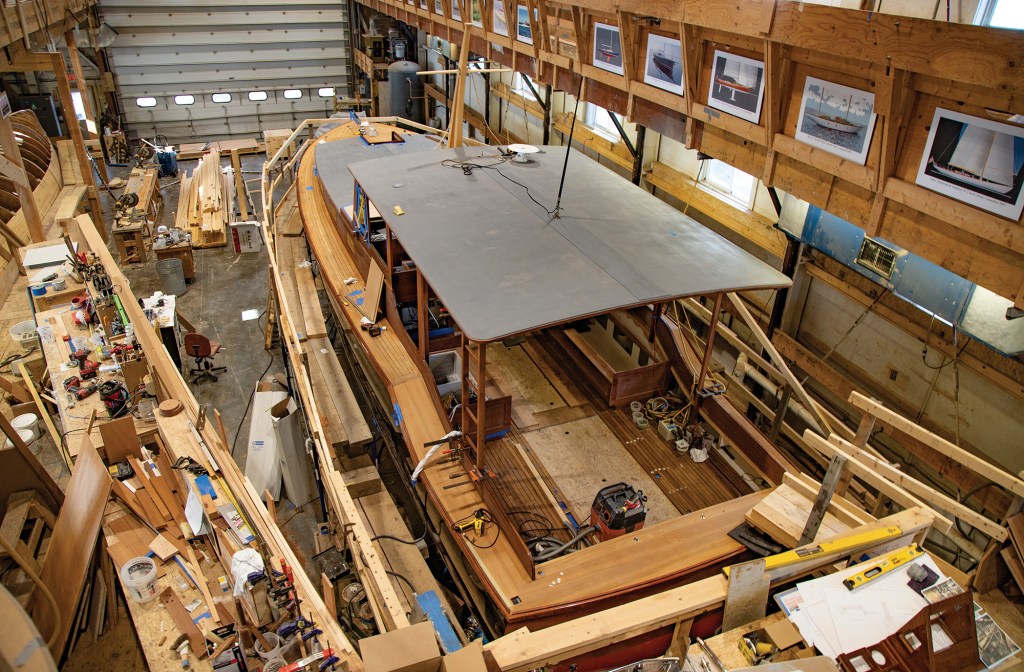
And most recently another Wheeler, the 55-foot motoryacht Syntax, which launched last year. This largest of the modern quartet is the most complex due to her size—60,000 pounds—and 2,000 horsepower. So how are modern wooden yachts of this size designed and built?
The key to wooden boatbuilding in the post-typewriter era is a process called cold-molding. Unlike the plank and frame method used on grandpa’s leaky boat, cold molding has a lot more to do with the methods used to build your fiberglass dream machine. Think of cold molding as a method which replaces layers of fiberglass with sheets of engineered, rot-resistant marine plywood coated in epoxy resin, much like fiberglass. And with 99-percent fewer seams than an old wooden boat given the large span of the wood plies.
With the hull’s bulkheads and frames upside down, these sheets and strips of wood are sheathed over them diagonally, each layer coated in aforementioned high-strength epoxy resin. Subsequent layers are applied at differing angles, usually 45 or 90 degrees to the previous layer. This alternating grain direction is crucial; it distributes stress evenly across the hull similar to the principle behind laying up a fiberglass hull laminate. The number of layers of marine plywood depends on the boat’s size and intended use, typically ranging from two to five plies. But in the case of the big and fast Wheeler 55, we used six quarter-inch plies for the hull bottom for a total thickness of an inch and a half. The material properties inherent in this layup provide the needed panel stiffness for her bottom loads and the pressure from more than 30 knots underway. The hull topsides were engineered with four layers for a 1-inch total thickness. Each layer is sanded smooth before the next is applied to ensure a seamless bond.
Once all layers are applied and the epoxy has cured, the resulting hull is a single, monolithic structure without those seasonally pesky seams found on grandpa’s boat.
For even more fiberglass-esque low maintenance, the hull’s exterior is sheathed in a layer of fiberglass cloth set in epoxy resin. This outer FRP skin provides abrasion resistance and seals the wood completely from moisture. Finally, the hull is faired, primed, and painted or varnished to achieve a flawless finish. Wax on, wax off.
Modern wooden boats are not to be feared. They are beautiful, resilient vessels that marry traditional aesthetics with modern engineering. And they’re more than strong enough to be hit over and over again with a golf club—should the need arise.
This article originally appeared in the January 2026 issue of Power & Motoryacht magazine.