In the world of gleaming hulls and six-figure tenders, where owners slip between archipelagos with the frictionless ease of royalty, there is an unspoken truth: the ocean still takes what it wants. Tenders vanish. Weather turns. A quiet thump in the night might be a fender—or the start of a piratical nightmare. Increasingly, the only thing standing between a yacht and a million-dollar problem is a suite of invisible technologies, blinking patiently in the bilges and bulkheads.
By any measure, there’s a strange intimacy to a machine that knows your face better than the maître d’ at your yacht club. On the sun-shot teak decks of the world’s most coveted yachts—those floating expressions of freedom, ambition, and personal taste when it knows no bounds—privacy remains the last and most zealously guarded luxury. Be it a megayacht, a center-console fishing boat, or anything in between, there remains no better vessel on God’s blue-green earth for exercising the freedom of privacy than watercraft.
It is into this soft but fiercely defended territory that Brian Kane has inserted himself, quietly but decisively, with a kind of intellectual grace that belies the tectonic importance of his work. Kane is CEO of Global Ocean Security Technologies (GOST Global), the marine security company he co-founded—one that increasingly relies on artificial intelligence, probabilistic authentication, and powerful tracking systems to guard vessels that now look less like playthings and more like floating Fort Knoxes.
During a late-fall video call, Kane appears on my screen with the casual ease of a man who has spent nearly two decades contemplating the many ways people enter—and shouldn’t enter—other people’s boats.
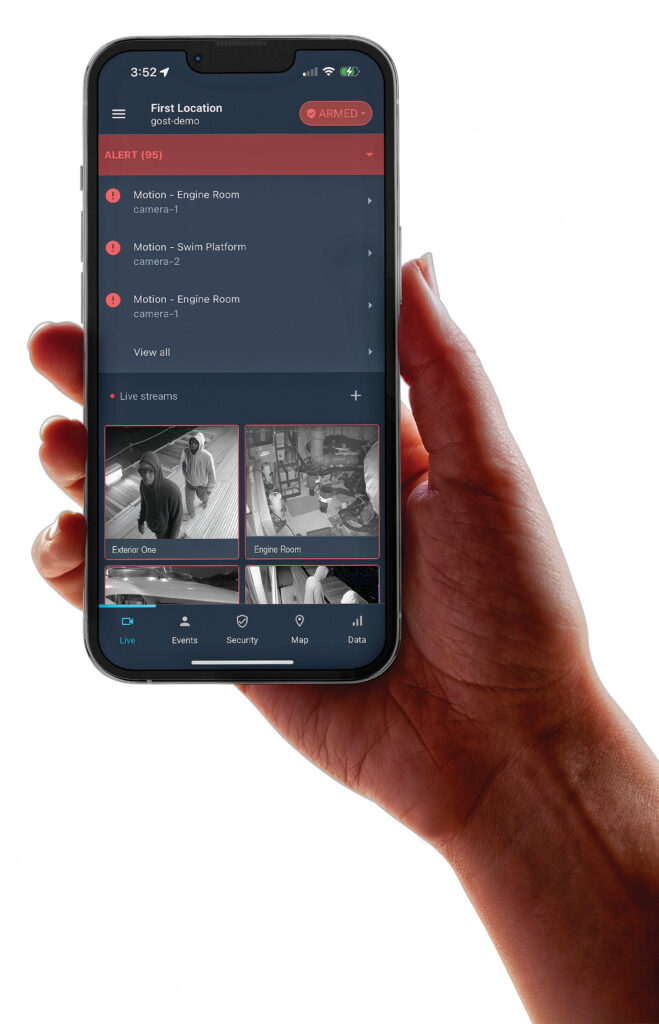
Kane spends much of his life looking at other people’s boats through the cold eye of the security camera: portable, permanent, hidden, overt, infrared. He has watched thieves hurry across swim platforms under moonlight, watched drunken crews slipping onboard before dawn, watched strangers test cabin doors, and looked on as owners sleep through notifications that might have spared them a half-million-dollar stolen electronics replacement. But these are small stories; Kane has bigger ones.
I vaguely recall a tale of intrigue behind another photo, which he had previously shared over a dinner meeting in New York several months back. Kane launches into the memory. “The one you’re speaking of,” he says, “was a big Google executive…he was on his Downeast-style boat in Marina del Rey. Had a full GOST camera system onboard.”
“The dealer called us after the incident,” Kane says. “‘Hey, the police are looking to get into the GOST camera system. Do you have access?’ I’m like, I don’t have access. They think there’s foul play. The owner was found dead that morning.”
He pauses. “Sure enough, the guy had never changed his password from their original setting.”
With a warrant in hand, Kane unlocked the system. What the footage showed was grim: “He overdosed—he was basically convulsing on the ground, and he had a hooker onboard who gave him the drugs. She took a sip of wine and took off.”
Later, authorities discovered she’d done the same thing to another man months earlier. She went to prison for manslaughter. “It’s a shitty way to go,” Kane says. “He had a family and kids…. And then dad’s found dead with a hooker on his boat.” Kane does not tell this like a detective or a voyeur. He tells it like a man painfully familiar with the range of human behavior that boats, for all their beauty, inevitably attract. See, again, “privacy.”
Quickly shifting gears, Kane regales me with a story from the opposite end of the moral spectrum: “Here’s a good one,” he says. “An early case. Teenagers were stealing booze off the back of a Sea Ray. One kid falls over—already drunk. The owner saw it on the system and knew exactly who the kids were. He didn’t call the police—he called their parents.” He laughs. “Self-governance. Kids being kids.”
This is Kane’s world: grim tales, harmless ones, expensive ones, human ones. And all of them, in some way, helped shape GOST.
When I ask him what gives GOST an edge over other marine security systems, Kane doesn’t reach for jargon. “Experience,” he says simply. “Experience of what it takes to truly secure a boat.”
“I was a launch driver in Edgartown,” he says of his entry into the maritime industry. “That was a college job. I ran docks and boats in high school and college.”
It was an apprenticeship shaped more by tide tables than textbooks, and it put him squarely on the path to the kind of stories most tech founders can’t dream of manufacturing. Take, for instance, the time he was hired to help deliver Jimmy Buffett’s 33-foot L&H (now called Salt Shaker) down to Ft. Lauderdale, only to watch the skipper hit a rock inside the harbor. “It was not me,” Kane emphasizes. “That’s the great thing about it. It was not me.”
The aftermath was nautical slapstick with real stakes. There was a gaping hole in the hull, a dislodged shaft, a bent rudder—and Kane standing there in the middle of it, watching the captain use a Black Dog sweatshirt—a Martha’s Vineyard emblem if there ever were one—to improvise repairs.
Buffett, in the middle of recording “It’s Five O’Clock Somewhere,” caught wind quickly. “He found out through his people,” Kane says. “There was an SOS on his boat in Sag Harbor in November 2003.” Somehow, the crew patched her up, got her seaworthy again, and ran her south. The final banter in the song ended up being included in reference to the incident, a commemoration in which Kane can’t help but take some small pride. “That boat’s still running around to this day.”
That incident—and Kane’s ability to stay unflappable while surrounded by mild maritime chaos—ended up shaping his career more than any diploma. Two weeks later, he packed his things and moved to Fort Lauderdale, the gravitational center of the global yachting world. He went to work installing electronics, conducting exhaustive 110-point checks for absentee owners, exercising valves and bilge pumps and tracking down gremlins in wiring harnesses. It was gritty work in spotless engine rooms, the kind that teaches a person exactly what can—and will—fail at sea.
A year in, the owner of Paradox Security Systems came to Kane’s shop with a prototype wireless security system. It was meant for buildings. Kane saw something else entirely. “I went to work integrating all their sensors into things the average boater’s worried about—security, beam sensors, deck sensors, high water, AC power loss, DC power loss, smoke, everything else,” he recalls. The system would dial a building owner (or manager) and engage in a two-way voice conversation, which, Kane imagined, would translate well to vessel security. It was, at the time, a bizarre concept: a boat that could phone you. A boat that could talk back.
From that oddball beginning, the company grew. Paradox Marine became GOST—Global Ocean Security Technologies—in 2010. The acronym was Kane’s idea. “Acronyms work,” he says. “I could change every one of my core boards tomorrow, and replace it with a new technology. People will still see GOST.”
What GOST does today borders on science fiction. Kane describes load-cell flex sensors—strain gauges hidden beneath fiberglass that detect the subtle changes in pressure when a foot lands on a deck. He mentions pull sensors that trigger alarms the moment a boat begins to be towed away from a dock. “We’ve had boats stolen by jet skis in the middle of the night,” he says. “Rowboats, too. People hook up the bow line and just drag it down a canal to do their dirty work.”
Even bait pens are monitored now. “Some crews poison bait,” he says matter-of-factly. “There are 3-, 4-million-dollar purses in these tournaments. Some people will do anything.”
These stories—and the sensors, and the alarms, and the systems—are the hardware. But the software is where Kane sees the future: authentication, facial recognition, AI-driven determination of who belongs onboard a vessel. This, he argues, is where marine security is beginning to surpass terrestrial systems. “You can’t really do it in a house,” he says. “Too many variables—delivery people, visitors, all kinds of transient faces. But a boat? Smaller universe. You can flag people. ‘I need to know if my ex-wife comes on board. I need to know if my ex-captain does.’”
That’s where GOST’s Specter AI and layered recognition come in—facial matching, Bluetooth proximity, phone location, and probabilistic scoring. If the AI is 88 or 89 percent confident a face matches an approved user, the system may let it through. If not, the owner gets a push notification: Someone is aboard your vessel. Approve?
“AI bridges the gaps,” Kane says. “It helps determine whether it’s a real threat—or just your friend’s kids stealing booze off the back.”
And the system’s reach extends beyond dockside. Increasingly, GOST’s tracking systems are mandated on large center consoles. Kane notes a recent case off Newfoundland: a mega-yacht towing a 35-foot tender in the dark. The tow line parted. No one noticed. AIS coverage was nonexistent. “We saved that boat,” he says. “The tracker narrowed it down. They got to it before it hit shore.”
Kane tells this story not triumphantly but practically. It’s the natural extension of a world in which boats are no longer isolated, analog islands but nodes in a network of sensors, data, and autonomous alerts.
Boating has always carried a certain romance, a certain illusion of untethered freedom. But what happens when the boat knows you? When it recognizes your face, your gait, your devices? When it maintains logs not just of intruders but of owners? When it has a better memory than you do? “AI is an amazing tool,” he says. “And every company that’s not using AI to a certain degree within the next two years won’t be a company anymore. That being said, you treat it like a tool and you do not let it control your life—” he pauses. “My biggest concern is humans getting dumber as the machines take over every aspect of our lives.”
This is not a Luddite talking. Kane has built a career on systems that see what humans can’t, that call for help when no one is aboard, that ensure an owner can sit down to lunch ashore in St. Barths without worrying about a shore-power dropout or a slipped line. His fear is not of technology itself, but of a world where people stop thinking because the systems think for them.
There is, perhaps, an irony here: The man whose company offers satellite tracking so advanced it can follow a tender drifting through the Gulf Stream is also the one insisting we hold on to our seamanship, our judgment, and our brains. And that may be the question lurking beneath the surface of the entire marine-tech revolution now cresting across the industry: If our boats become smarter, more autonomous, more perceptive than we are, what becomes of the mariner? What becomes of responsibility? Of vigilance? Of the art of knowing the sea?
Kane doesn’t lean into the philosophical. But the implications hang in the air, forming their own kind of question: As AI seeps deeper into the wheelhouse, will tomorrow’s yacht be less a sanctuary and more a sentient witness—and will the freedom we seek offshore evolve into something we don’t recognize?
For now, the answer is still human. But as AI accelerates, as facial-recognition cameras become standard on yachts, as global tracking edges toward omniscience, the future of marine security—and of boating itself—may hinge on whether we can keep that human voice at the center. Or whether, one day, the machines will thank us instead.
This article originally appeared in the March 2026 issue of Power & Motoryacht magazine.