Sometimes there’s nothing better for jet lag than a fast ride on a fast boat.” Thus spake Dan Harding as we climbed through the first boat we were to trial at this past year’s Cannes Yachting Festival. Despite bleary eyes, we’d landed on one of the most unique—and frankly thrilling—vessels we would encounter at the entire show.
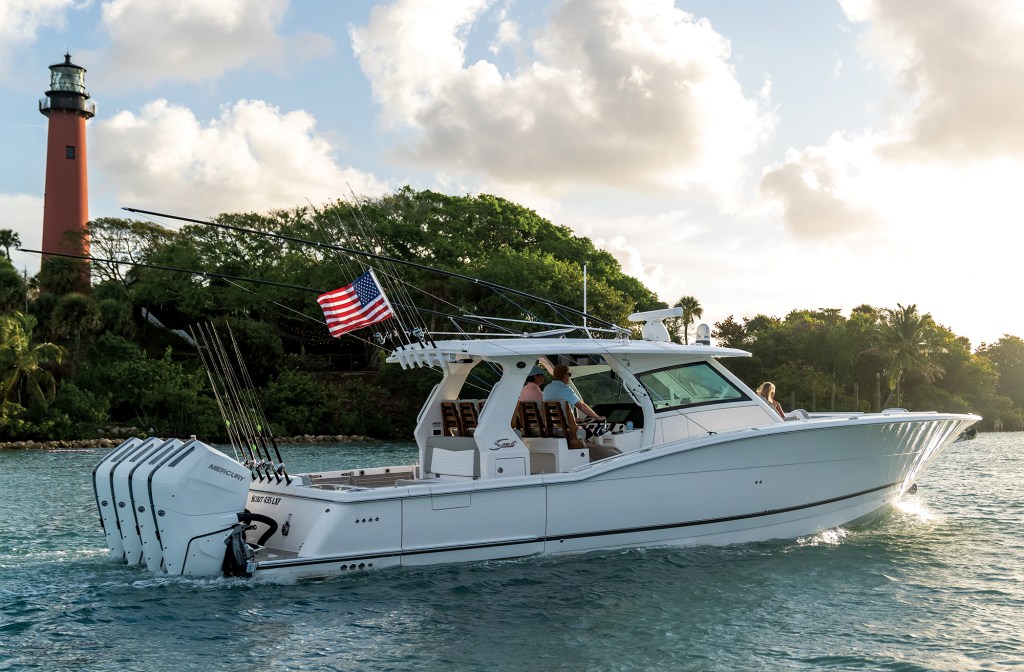
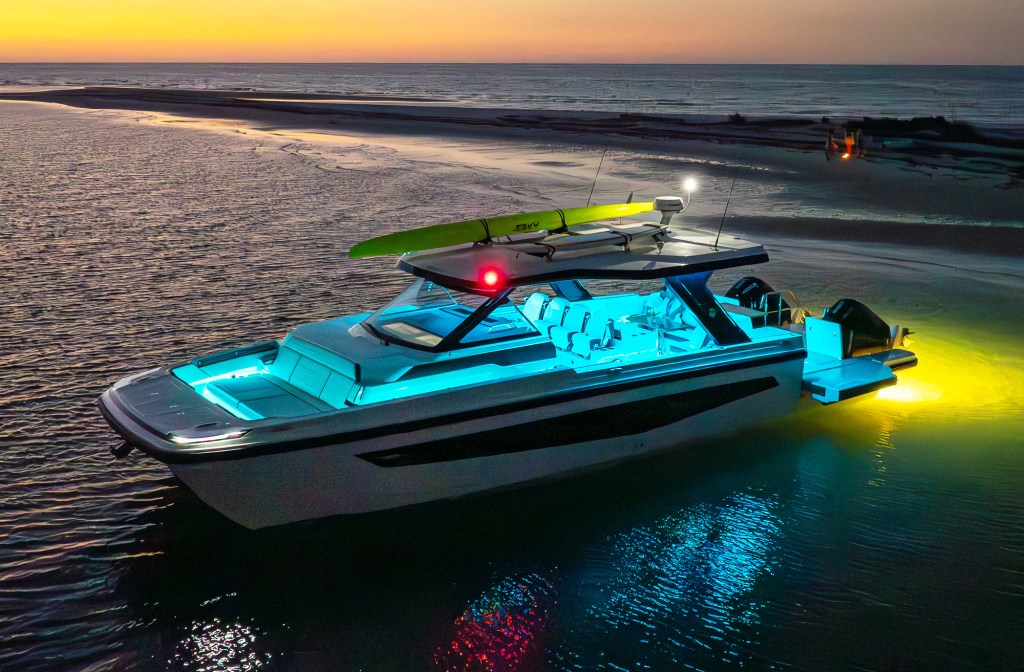
We’ve driven De Antonio yachts before, and as you’re probably aware, the Spanish company’s calling card is clever deployment of hidden outboard engines rather than IPS drives, inboards, or, well, visible outboards. Their biggest previous foray into this realm was the triple engined, 1200 max horsepower D42 day boat. This 45,000 pound, 60-foot Polish-built flagship though, carries the inboard outboard concept to a new extreme via quad V12 Mercury 600’s. We’ve never driven—or seen—another monohull cruiser quite like her. The closest comparison I might draw is the quintuple V12 Scout 670 that I raced aboard through Charleston waters early last year, but a foot beamier and outfitted for serious entertaining, the D60 is quite different—in her own very good way. At around $3 million to the Scout’s $6 to 7 million, she’s also a lot less expensive.
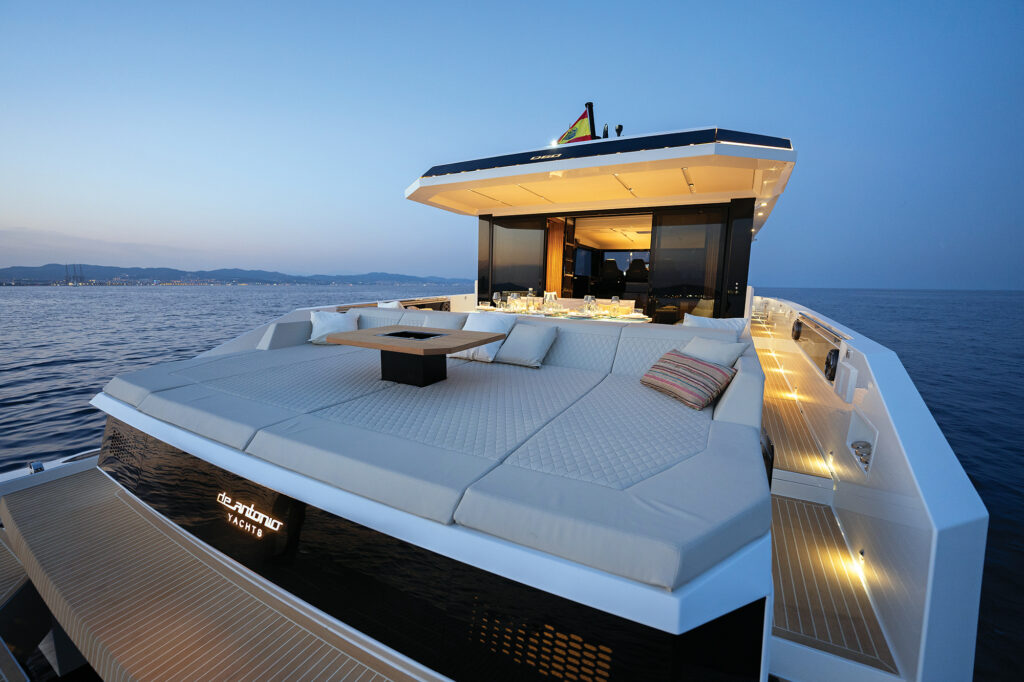
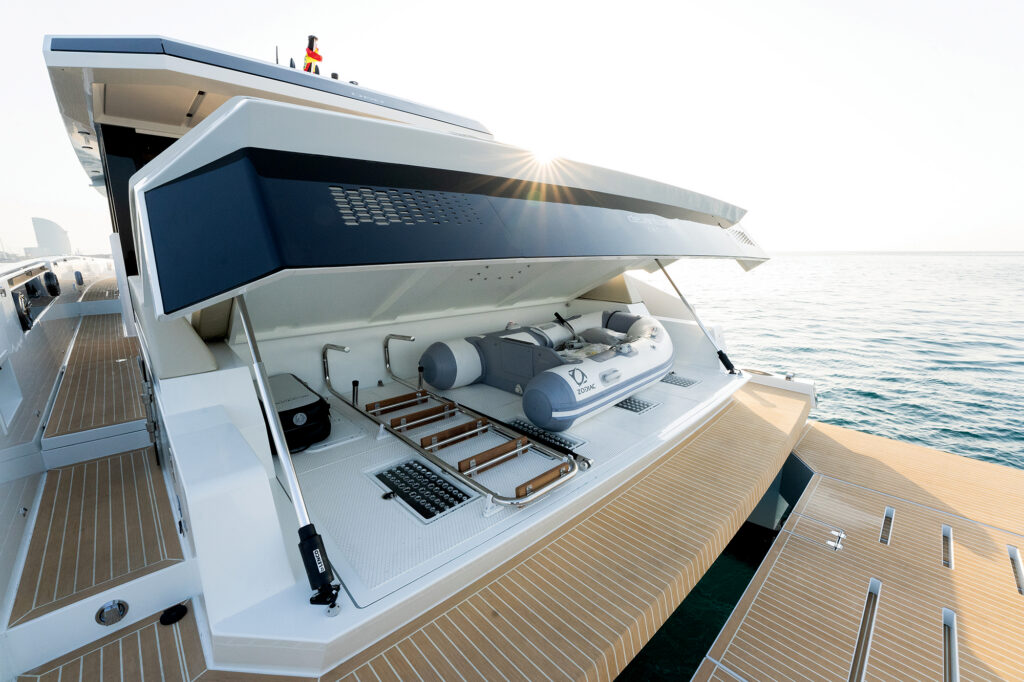
Our test boat, christened Matador is De Antonio’s hull number one. She comes standard with four 400-hp V10’s but this one was purchased by Formula One driver Carlos Sainz—so his 600-hp powerplant choice was obvious. Let’s start at her business end. Off the stern, you’ll find exactly what you’d expect from, say, an IPS-driven Azimut Seadeck 6—a well-sorted full-beam beach platform and retractable, submersible swim platform. This cool platform rises and swings in a near 270-degree arc to lower 20-plus inches into the brine. Supporting over 500 pounds, it allows for simple deployment of a Williams jet tender, which can then be hidden in a huge garage cleverly concealed beneath her mammoth sunpad and above the Mercs. Those Sainz-worthy powerplants are then cleverly concealed beneath the garage floor—which opens wide for easy service. Dan and I agreed, it’s a remarkable and very practical setup. Further adding practicality, a back-rested, retractable awning-shaded sunpad holds an ice-chest bearing teak table set at a perfect height for lunching, imbibing or plinking your laptop.
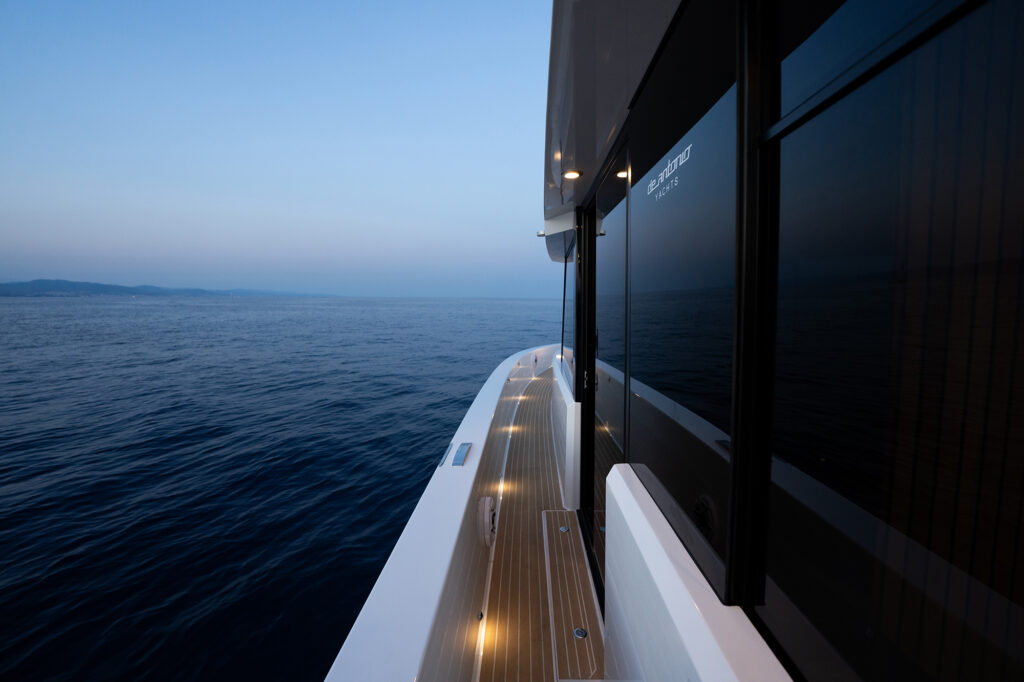
DeAntonio’s argument for the outboard configuration is multifold. First, stock Mercurys will offer easy service where these boats will mostly roam. Dent a propeller? Raise the injured motor, drive on three and replace the screw while underway—impossible with IPS or shaft drives. Then there’s draft. Engines up, this boat draws a mere three feet. An IPS-driven Seadeck 6 draws 4’8”. Underway, the D60 is incredibly quiet. At ten knots, we could barely even hear—or feel—the engines. At that slow cruise too, her double-stepped GRP hull functions more like a trawler’s—offering 26 gallon per hour consumption at 2400 RPM’s. With 977 gallons of gas, you’re looking at 35-plus hours of runtime and nearly 400 nm range. Interestingly too, the hull is efficient across a wide range of planing speeds and between 22 and 35 knots, consumption remains fairly flat. At 29 knots, she consumed around 95 gallons per hour, giving a range at speed just north of 300 nm. Top speed is said to be 46 knots, but in sporty Cannes conditions and with the fully-fueled boat carrying 15 humans, we felt confident pushing her to 36. Acceleration was startling, as was her turning radius. She remained flat, quiet and glued to the water through the short-period two-to-three-foot chop. The full carbon-fiber salon and structures above her hull were squeak- and rattle-free.
You can also find this video–and hundreds of our other reviews–here ▶
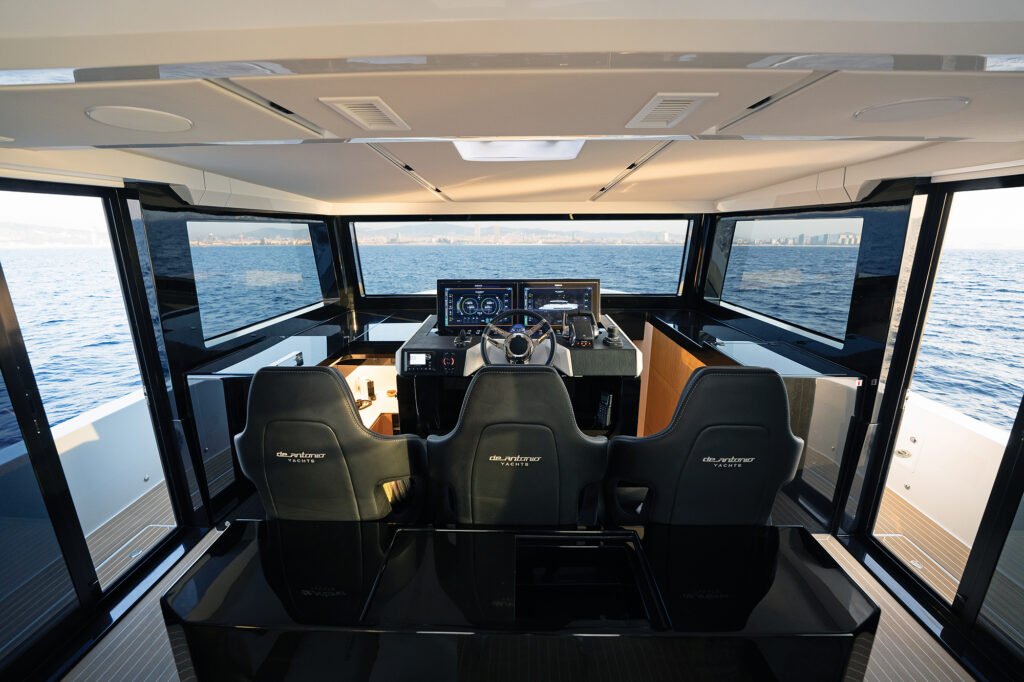
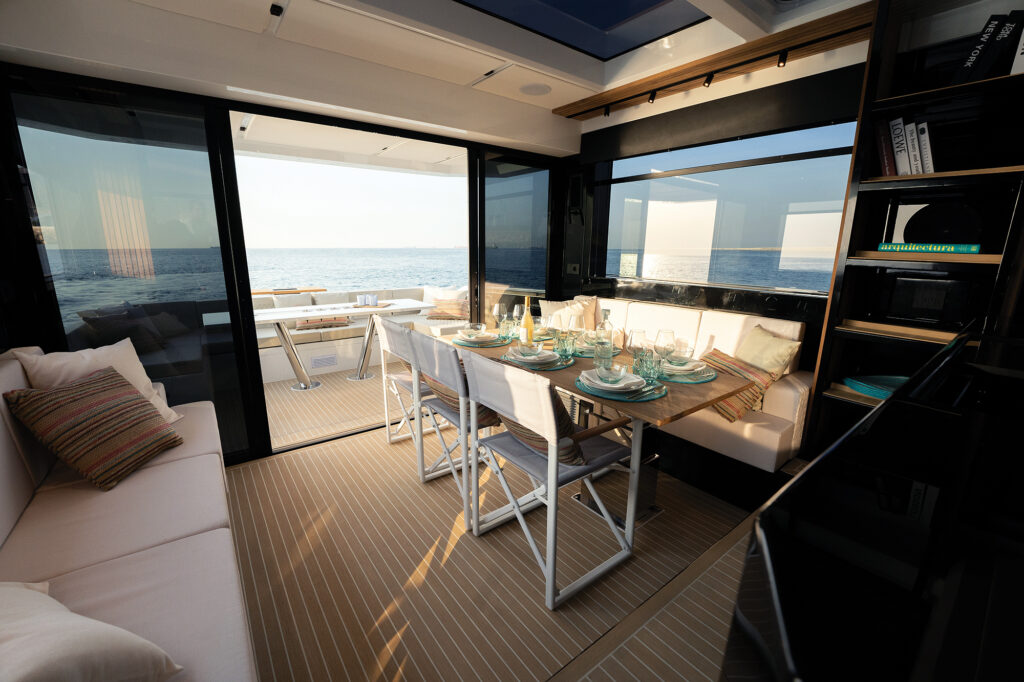
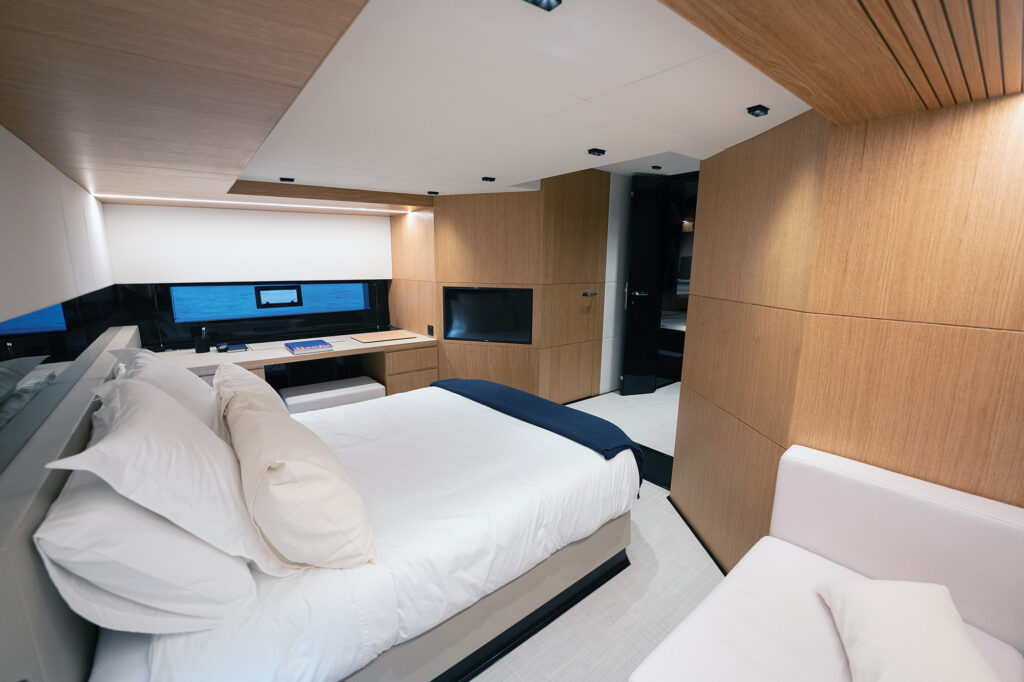
Continuing our walkthrough back at the marina, fit and finish appear top-notch. Forward of the Mercurys, the D60 offers a comfortable 8-person port-to-starboard dining arrangement (tipsy drinks are prevented by six deep cupholders too). Beneath the dining lounge, where you’d otherwise find an engine room, there’s an enormous standup space where the filters, hoses, fuel tank and genset reside. It would also hold an arsenal of surfboards, diving gear—anything that would fit down the hatch. Forward of the lounge, huge sliding doors open to a salon with lots to like. Twin fore-to aft lounges face each other from each side of the salon, with the portside lounge served by a telescoping table that can bring the dining party indoors. There’s a massive, full beam sunroof and substantial motorized windows above the lounges. Coupled with burly doors on either side of the centered helm, the D60 can either be hermetically sealed—with 100,000 BTUs of climate control—or literally become an open-model yacht. The twin-seat, Garmin-equipped helm is fully featured and offers 360 degree sightlines through a huge, flat forward windshield. Stairs on either side of the helm reach either a portside galley or an open-air “atrium” that reveals a huge, ensuite forward VIP suite (that head doubles as a day head). Beneath the helm, the even more impressive full-beam master suite is appointed with sweeping horizontal windows and chaises on either side of the amidships king bed. This “atrium” layout makes the boat feel even more open. It’s similar in concept to Omikron’s OT-60, another yacht we reviewed—and unexpectedly loved—last year.
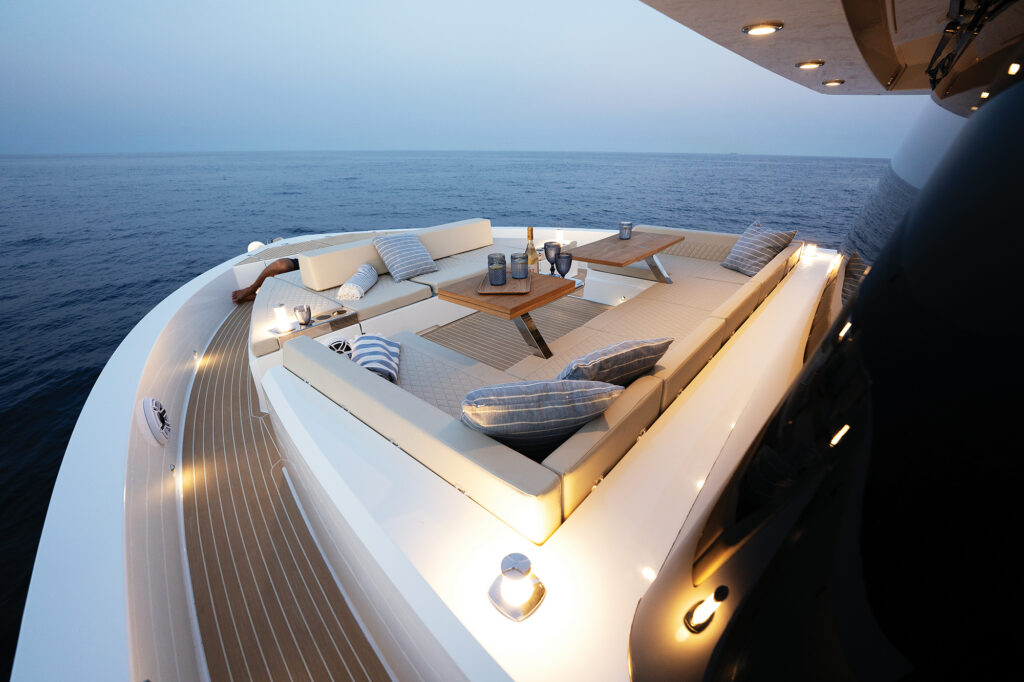
Just rearward of the helm, shelves on both side walls double as ladders to a nice, railing-secured roof sunpad that looks down on a forward entertaining area whose theme is versatility; a separate ensuite two-person crew cabin; another huge storage area under the forward sunpad that can be built as a pool/jacuzzi, and behind that? Perhaps, the best seat in the house—a U-shaped, six-plus-person lounge.
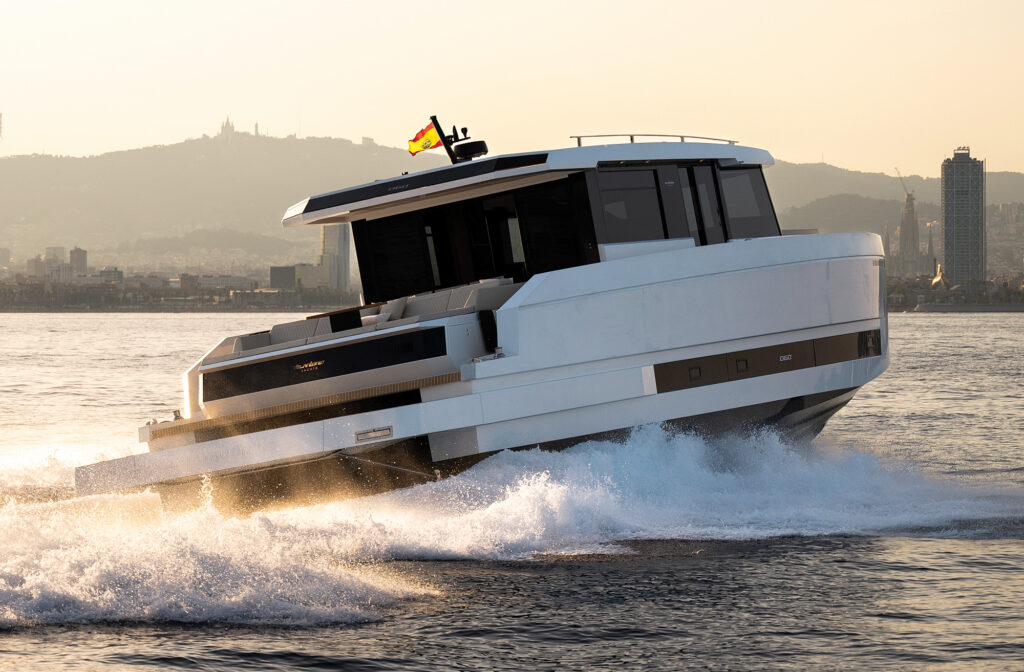
Closing thoughts: First, the D60 can also be configured with three cabins—appealing both to families and charter operators. Second, with her quiet, shallow draft and efficient ‘trawlability’, a yacht that’s more outwardly a weekender that could conceivably serve as a passagemaker. She may not have the range or setup of a Nordhavn, but no Nordhavn will cross Lake Michigan at 46 knots with motors that can be serviced by an outboard mechanic. Dan and I left the D60 feeling fairly recharged. De Antonio has created something functional, fast and unique—a real wolf in sheep’s clothing.
De Antonio D60 Specifications:
LOA: 60’8”
Beam: 17’1”
Draft: 3’2”
Displ.: 45,195 lb.
Fuel: 977 gal.
Water: 180 gal.
Power: 4/600-hp Mercury V12
Price: $2.5 to 3 million
This article originally appeared in the February 2026 issue of Power & Motoryacht magazine.