
By Capt. Vincent Daniello
PropSmith
For all its advantages, PropSmith (propsmith.com) has a couple of drawbacks. Each shaft size, including metric equivalents, require separate PropSmiths. Metric sizes aren’t necessarily uniform, either, often requiring a custom-threaded PropSmith for one individual boat. Holes drilled into props are likely threaded metric for European boats, unless props were replaced at some point in the U.S.—or even just one new prop threaded SAE while an original prop still holds metric threads.
In some cases—mostly higher-end boats built in Taiwan—the starboard shaft is threaded in the opposite direction from standard, requiring one PropSmith with a second, left-hand threaded plate. (With normal threads, if a propeller nut is loose it will tighten itself as the port shaft turns in forward gear, but loosen itself completely on the starboard shaft.)
PropSmith also needs enough shaft extending behind the propeller for the threaded plate to screw on. Recessed prop nuts, typically on Italian boats, often don’t allow this. (PropSmith will customize solutions for very little added cost.)
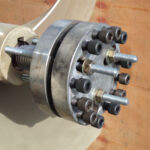
Photo courtesy of Frank & Jimmies Propellers
Other plate-type pullers, like this one produced by Frank & Jimmies Propellers (fjprop.com), work on the same principal of jackscrews spreading two plates. While the rods thread into the propeller like on a PropSmith, both plates fit behind the shaft. This allows two sizes of pullers to fit most boats, including shafts with metric threads. It also works without shaft threads protruding behind the propeller. The downside? It won’t press props back on, and there is nothing to keep the prop from sliding off the shaft as it is pulled. (When using most pullers, one nut is left on the shaft half an inch from the propeller to stop the prop once it’s released from the shaft taper.)
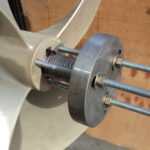
Photo courtesy of Frank & Jimmies Propellers
In a pinch, just a steel plate, threaded rod and nuts will pull a propeller with holes in the hub, although this setup will bring to bear much less force than a PropSmith creates with its jacking bolts.
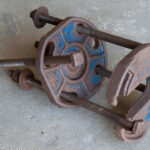
Tightening three or four bolts on this Walter puller (waltergear.com) compresses the two plates together—one between the strut and the propeller and the other centered on the end of the propeller shaft. Two sizes cover up to 3-inch shafts. This works well on three- or four-bladed props. Once props have more than four blades, though, the leading edge of one blade typically overlaps the trailing edge of its neighbor, so there is not space for the bolts to pass between blades.
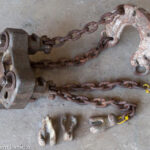
This Pro-Pull chain puller (rammount.com) is similar to the Walter, but chains connecting the two plates weave between overlapping propeller blades. The plate between the shaft and strut fits up to 2 1/2-inch shafts. For larger shafts, chains hook around propeller blades with hooks (shown here tie-wrapped to chain ends for storage).
Hydraulic propeller pullers are typically a variant of chain puller.
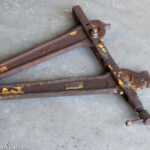
Tightening the top screw, at the wide end of the triangle of this Algonac (mindermanmarine.com) scissor puller, grips one edge of the propeller hub and also the center of the end of the propeller shaft. Tightening the other screw, at the narrow end of the triangle, separates the two arms. Leverage created where those arms pivot pressure the prop hub toward the shaft end. Two sizes cover props up to about 80 inches, but since pressure is exerted only on one edge of the propeller hub, not in line with the center of the propeller shaft as is the case with most pullers, Algonacs don’t work particularly well to pull stubborn props.
On many new propellers, blades protrude in front of the propeller hub enough that Walter or Pro-Pull plates ding the blades. Chains around blades might cause similar damage. Also, high-speed boats today may not have space between the propeller and strut to accommodate the plate of either a Walter or Pro-Pull puller, so the only option is the Pro-Pull using chains around the propeller blades. Algonac pullers also require clearance between the prop and strut.