
The late-90s, forest green, nearly rusted-out Chevy Suburban pulls into the train station parking lot in Stamford, Connecticut. It’s late summer circa 2019, and I am drenched to the bone in sweat, still donning my corporate fatigues after having caught a last-minute express train uptown from Manhattan’s Financial District and an express Metro North commuter. Such is the existence of the boatless, carless weekend warrior when a last-minute invite for a bluefin tuna trip pops up.
The invitation to fish came from Colin and Ryan Kelly, brothers whom I’ve known most of my life dating back to high school. Ambition and itinerance have carried them a long way since our intrepid teenage exploits. Patience, however, does not rank high among their virtues. Had I arrived at the predetermined rally point a few minutes late, I’d have missed my shot.
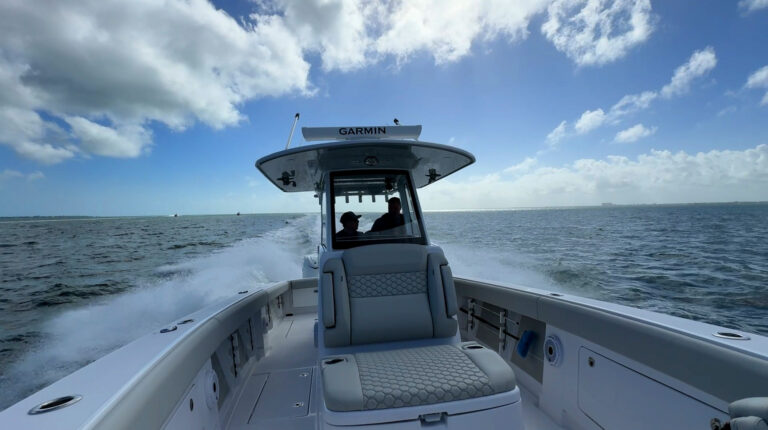
They waste no time coming to a full stop, and I jump aboard the land yacht with a 1998, 23-foot SeaCraft center console in tow. The SUV reeks of youthful exuberance. Cans of an energy elixir called “Bang” clank at my feet. Tins of chewing tobacco and flavored nicotine pouches occupy every nook and cranny of the console, save for the cup holders, which are stuffed with a pair of coozie-clad Bangs.
Wild-eyed and as ready as they ever will be for anything in this lifetime, they’re locked and loaded for a weekend run up to Cape Cod, Massachusetts. Just another Friday night for the tuna bros. There’s a one-track-mindedness about these tuna fishermen that reminds me of Melville’s Ahab and narcotic fiends alike. That 20-year-old SeaCraft, though? She’s sparkling. Their priorities are in check.
I spent some of my lazier, less ambitious fishing outings with the Kelly brothers aboard their 1980s Grady-White Seafarer and my Stur-Dee dory. More often than not, we were live-lining bunker for whatever struck. Far back as I can remember, these guys didn’t own a single plug. Their father, Frank, a longtime Philip Morris salesman from Queens, bought the boat for family outings with sights on tuna and shark fishing off Montauk, New York, at the eastern end of Long Island. Those trips happened from time to time, but more often than not, Colin and Ryan would commandeer the boat for “striper fishing,” which usually meant anything and everything while burning more gasoline than we could ever begin to repay.
Frank is a rare breed among fathers — with the patience of a saint, he subsidized his boys’ self-directed education in angling. It took a long time for all that to pay off in the way of table fare, but by their mid-20s, they were bringing home a steady stream of fillets.
Ryan, who is 27, has been relegated to the back of the Suburban, giving up his shotgun throne. To my bemusement, a member of the opposite sex is occupying the front passenger seat — a surprise, as these boys eat, drink and sleep with nothing but bluefin tuna on the brain. Outside of boat, tackle and vehicle upkeep, they have no social lives to speak of beyond a handful of beer-bellied contractors and plumbers twice their age with whom they occasionally brush shoulders. They live at home with their parents, which does not tend to appeal to the opposite sex.
Turns out the guest, Stephanie Sykora, is a captain herself and was introduced to Colin, who was 31 at the time, by a decidedly more gregarious mutual friend. We’d be returning her to her boat and crew on the way to the Cape. This was another not-so-small wonder to me; no deviation or detour for so much as a pit stop had ever been granted in our two-decade-and-counting camaraderie, and certainly not at the outset of a bluefin trip. The times they are a-changing.
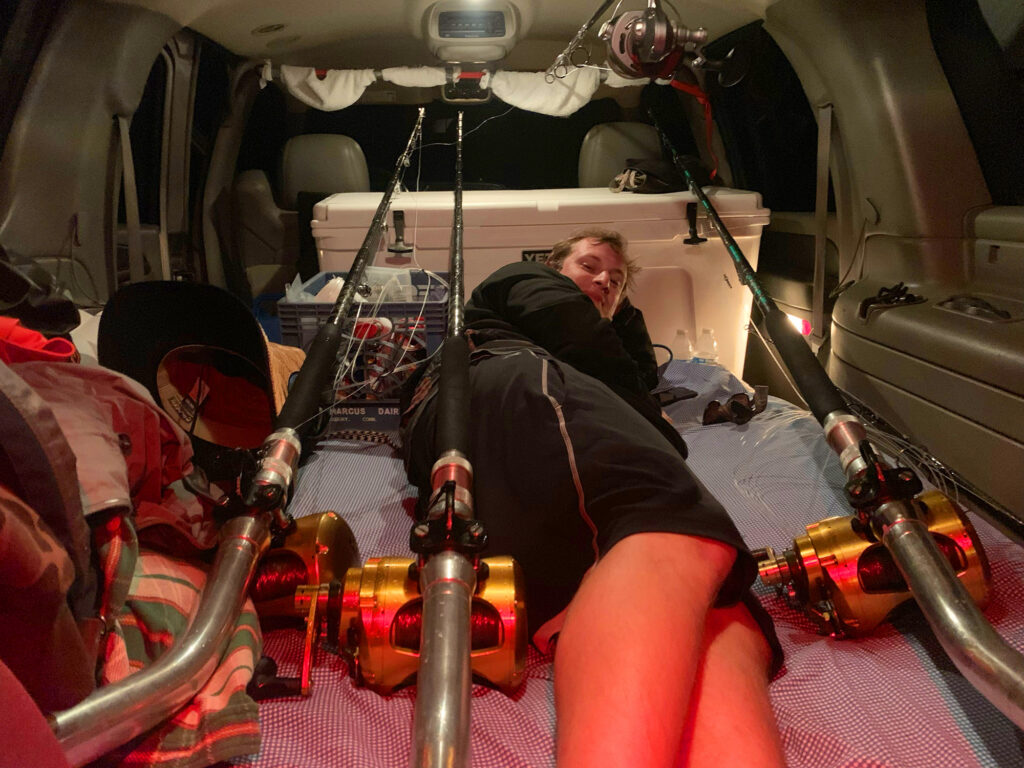
After parting ways with Stephanie — now Colin’s wife — we pull up to the boat ramp well past midnight. Our prospective departure time is 0300, which offers us about 90 minutes of shuteye — or at least vaguely horizontal recline. A typical sleepless weekend on meager rations.
Off and Running
As soon as my eyes close, I’m awoken by rattling gear. I’m on far different rhythms, unsure I can muster the energy for a marathon tuna adventure after a full week in Gotham. Breakfast is nowhere to be found at 0230 in this tiny, summer beach town. I settle for a 16-ounce Bang. Overcome with the jitters, I pass half the can off. Another friend hops aboard at the ramp with seconds to spare.
Despite a predawn stillness, I reach for the extra layer I left behind in the name of saving space. We putter into the fog to round up a few dozen mackerel before heading out to Stellwagen Bank, an underwater plateau reaching from the tip of Cape Cod north to Cape Anne, spanning the mouth of Cape Cod Bay. The fishing grounds are lit up by hundreds of vessels that make up the tuna fleet on an early Saturday morning, their lights resembling more of a city than anything you’ll see looking back toward land.
The high-stakes nature of chasing bluefin offshore has made irascible beasts of a melee of commercial fishermen, charter outfits and recreational anglers with licenses to sell fish and supplement their income. There’s also plenty of dabblers looking for a few loins and a photo opportunity with a giant. I feel for those who’ve worked their fingers raw to make a living from this fishery. These days, a giant bluefin tuna isn’t likely to bring in more than a handful of bucks a pound.
Of the hundreds of boats across the 800-plus square miles that make up Stellwagen Bank, there are bait fishermen on the hook, bait fishermen on the drift, trollers and the run-and-gun, light-tackle spin-fishing crowd. The Kellys fall somewhere in the middle. Are they making a living from commercial angling? No. Do they have a boat to pay off and humongous fuel bills that they hope to cover or at least partially subsidize? You bet. Fruitless days on these grounds sting.
High Hopes
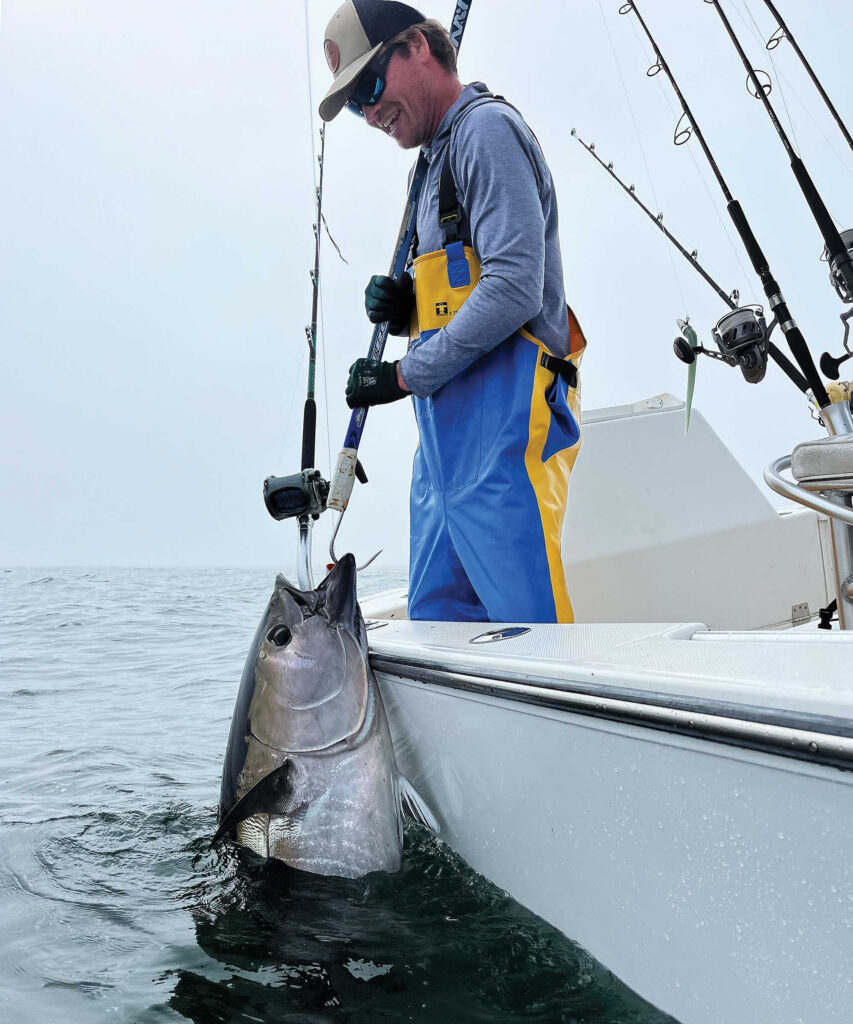
We see a few large fish rolling inside the bay while catching Atlantic mackerel, pollack, squid and whatever else surfaces on the sabiki rigs. With a few promising marks on the fishfinder and enough bait in the live well, we drop the hook. We’re in less than 10 fathoms, so covering the water column is easy. We’ve got one or two baits down deep and a couple in the middle. No sooner than we set them out, a fish piles on. We scramble across the deck to clear rods and toss the anchor line, which is attached to a large float for this very purpose. As we spring into action, the tension in the rod snaps back — the hook never set.
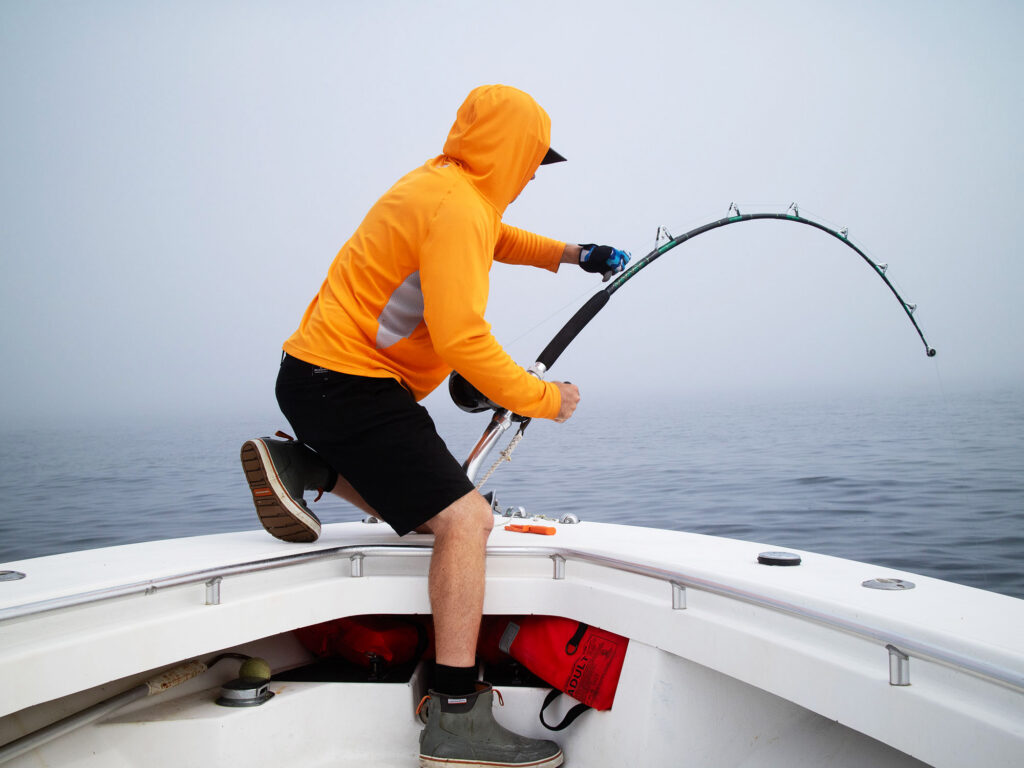
Bites two, three and four don’t go much better. The long day drags on. Just as the sun begins to set, line peels off toward the horizon, leaving a Penn International 130 singing the same song that makes up the ringtone on Colin’s phone. As the least-capable boat handler and the scrawniest of the ragtag crew, I’m directed to the bow to fight the fish — the grueling but “easy” job, in the scheme of things. I’m put where I can screw things up least.
As I reel down to keep the pressure on, the run stops suspiciously short of anything a tuna might do. We’re dealing with bycatch — a tangled thresher shark. It’s nearly dark when we get the brute boatside. Untangling and unhooking a full-size shark is challenging in any light, but with a dropping sun and just enough chop to unsteady the boat, we do our best and set the shark free. We decide to shoot back to shore to regroup.
Refueling
Dinner? The local seafood joints are closed, and nothing remotely fresh or whole is at our disposal. Gas station burritos, or 7-Eleven hot dogs? We retire to the Suburban for night two. It’s hard to say whether the second morning of waking up in the back of a dank, old Suburban is worse than the first. The scents, however, are compounding, especially since we’re bait fishing (and chumming).
Colin fires up the old gal and runs us halfway down the ramp before we’re upright. Again, bluefin on the brain. We load into the SeaCraft and inspect leaders, hooks, plugs and jigs. Off we go into the misty predawn, a little bit worse for wear than yesterday. Thankfully, we have backup by way of Cape Cod local Jimmy Quigley, the sprightly son of the old salt who’d christened the Kellys the “Tuna Brothers.”
Back on the hook, we take turns dozing off in a lone beanbag chair. Four baits loll in the water, and we do our best to train our sights on the balloons that suspend our rigs in place. Out of boredom or desperation, I load a medium-weight spinning rod — our designated sabiki rod for catching mackerel and pollack — with a live bait off the transom in hopes of nabbing a striper.
Before I can close the bail upon reaching bottom, it’s doubled over and spooled by a bluefin that would surely just as soon have picked up the next bait in its path — whoops. Hitting the proverbial wall, I abandon my post cutting mackerel at the bait board to keep the chum slick going. I won’t apologize for that one. It’s a grueling and thankless job I might have maintained energy reserves for had we procured decent accommodations.
Early afternoon rolls around, and whatever air movement we’d had in the morning is gone. The summer doldrums lead everything and everyone to sweat. The will to move is all but lost until, before everyone can hear the signature open-faced reel clicker engage, someone yells “Tight!”
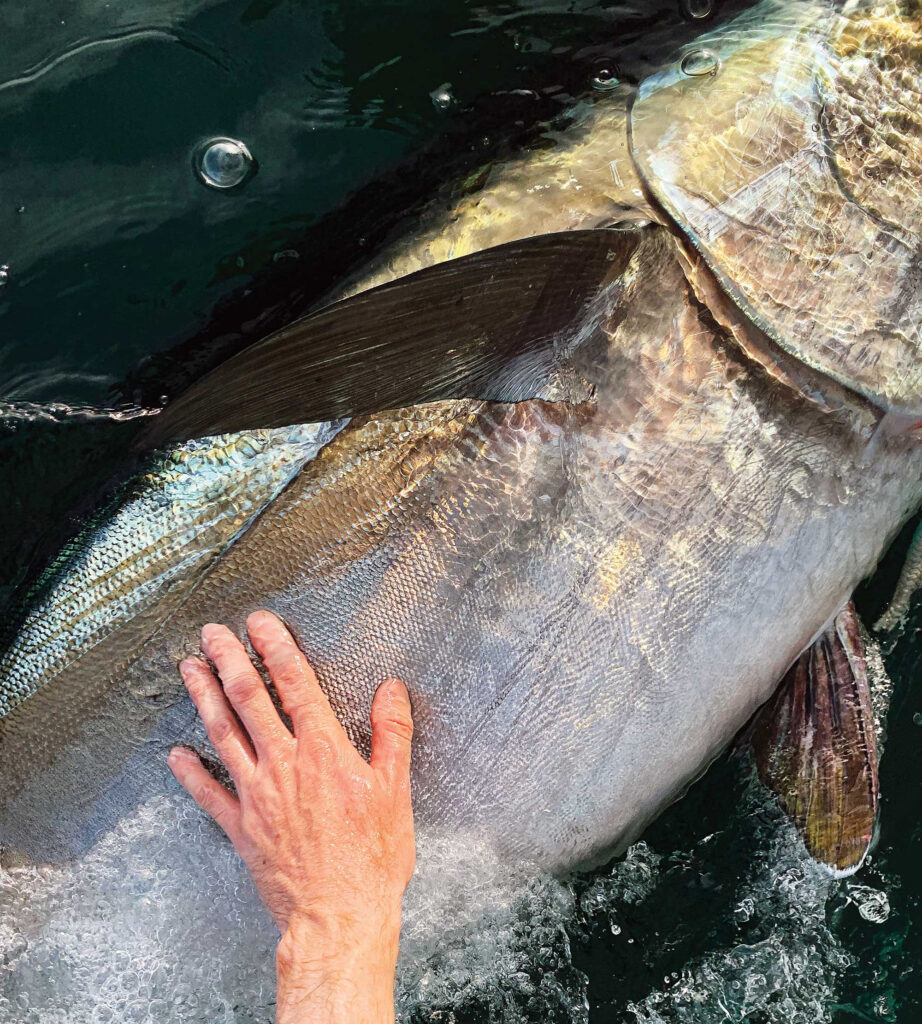
As if woken from a fever dream, we all fall in line, me at the swiveled rod holder in the bow. Despite a smattering of yellowfin schools and the odd bigeye in the mix farther offshore, this fish leaves no one guessing as to its species (bluefin) or size (commercial, or at least 73 inches). It’s a grueling game, gaining inches at a time. I recover just enough of the spool to harbor some sense of hope before the fish decides to head for Timbuktu.
With the rod stationary in the holder, the boat does the majority of the work. In less than an hour, the fish is licked and harpooned — finally, a payday comes over the rail. It’s not a particularly large bluefin, but it is a healthy, well-fed fish with a round belly, what some would call a “butterball.”
Jimmy, who seems to have a bottomless well of sprightliness, jumps to the task of dressing the fish. We unfold a large kill bag and fill it with ice from the fishbox and cooler. Jimmy saws off a gill plate and, getting no less than neck deep, cleans the fish’s core to pack it with ice.
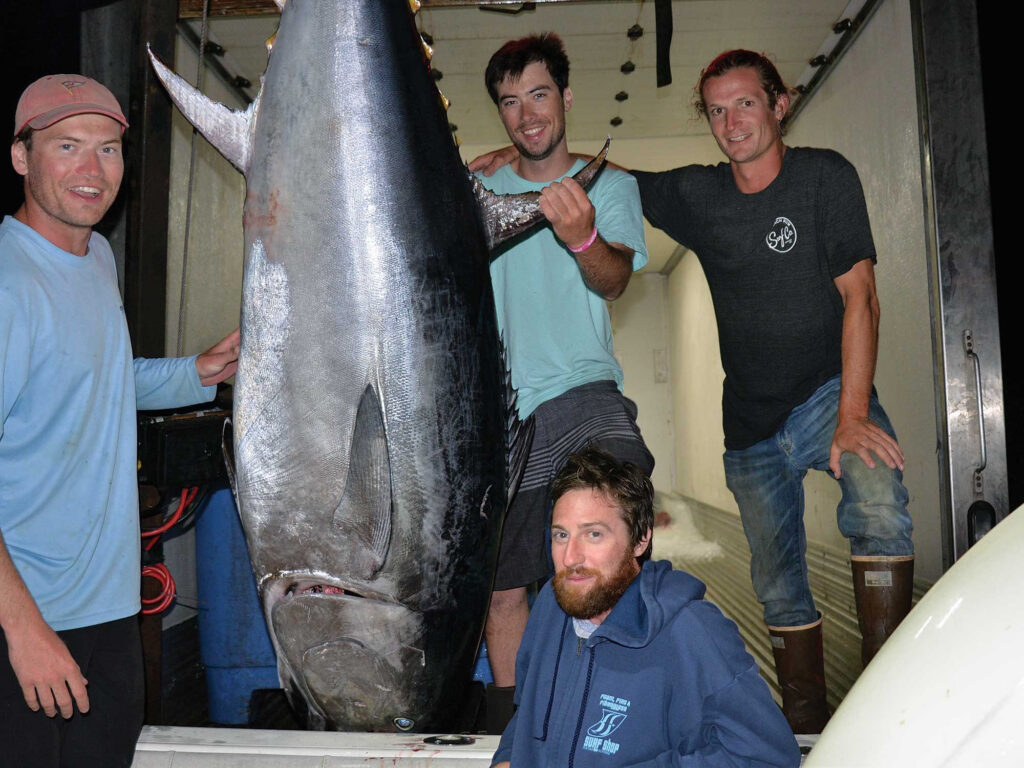
It’s midafternoon, and with a fish on deck in a surfboard-shaped bag full of gas station ice, there’s no time like the present to give it full throttle and make for the ramp, but not before calling a seafood merchant to meet us with a refrigerated truck. The clock is ticking. The faster we can bring down this fish’s temperature and the sooner we can get it into the truck, the better price it will fetch.
The tuna dresses out just shy of 400 pounds, an average bluefin by most standards. It will fetch what it fetches, but these days $6 to $8 per pound is as much as anyone with a commercial license can hope for. Sometimes it drops as low as $2 a pound, at which point full-time commercial anglers are basically out of work, and crews like ours think twice about killing these magnificent creatures. HMS (highly migratory species) permits don’t allow for fish larger than 73 inches to be harvested for subsistence, or “recreational,” purposes. It’s a whole lot of meat, granted, but the likes of us wouldn’t waste an ounce.
Battered, bruised and out of Bang, we secure the boat and pile back into the Suburban to take our chances with the Sunday traffic heading south on I-95 toward New York. Crawling along in stop-and-go traffic with no air conditioning and no breeze, the collective fragrance of the SUV occupants registers well into the range of reeking to high heaven. The windows stay open, and despite coming home empty-handed, I am grateful for the time on the water.
It’s well past midnight when we make it to the Kelly household in Glenville, the quaint village within Greenwich, Connecticut, where the Kellys grew up. Showers and beds await one and all. Before everyone retires, we talk about next week’s weather windows, which reels need servicing, and lines that need splicing, whipping and Bimini twisting. I keep my mouth shut and withdraw. This is what separates the steadfast tuna fishermen from, well, me. And I’m A-OK with that.