

For most attendees, The Monster Shark Tournament is just a day of great fishing. For others, the sight of the hanging sharks is a call to protest.
A fish hanging by its tail on a weigh-in stand is a
common sight at any big-game tournament, as
are photographers snapping shots of the
winner. But when tournament workers wave
their hands in front of a camera’s lens and town
police escort the shutterbug away from the festivities, it falls
outside the realm of the commonplace.
When Steven James started his Oak Bluffs Monster Shark
Tournament on Martha’s Vineyard back in 1986, he knew he
was going to rub a few folks the wrong way. He wasn’t a native
of the Massachusetts community, and New Englanders have the
reputation for turning a frosty shoulder to outsiders. But it was
neither the denizens nor the summer-cottage owners who raised
the biggest ruckus. It was a different greenhorn organization.
“When you see sharks hauled up on
docks…it encourages the notion that the
only value of these animals is in their
deaths,” says Humane Society of the
United States (HSUS) spokesman John
Grandy, who holds a doctorate in wildlife
ecology and management from the
University of Massachusetts. “We’re
against the killing,” he adds. According to
Grandy, the activist organization chose
this particular tournament to protest after
a picture of a record-breaking tiger shark
made the rounds on national news
programs in 2005. (Tiger sharks are no
longer allowed in the tournament, which
currently gives points for only threshers,
makos, and porbeagles.)
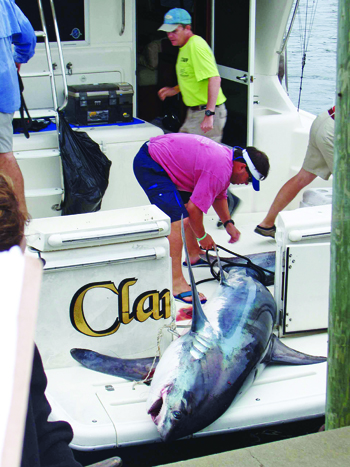
It’s time for weigh in for this massive catch.
James, who is also president of the
Boston Big Game Fishing Club and a
board member of the National Marine
Fisheries Service’s (NMFS) Highly
Migratory Species Advisory Panel, is
unabashed about his opinion on the
protesters’ stance. “If they weren’t so
busy trying to make money for
themselves with this PR stunt,” he says,
“they’d be touting the event.” To back up
his tournament’s record on conservation,
James points to the fact that he works
closely with both the Massachusetts
Division of Marine Fisheries and the
NMFS Apex Predators Investigation
based in Narragansett, Rhode Island. He
says that the tournament is the largest
source of both organizations’ catch,
release, and tag data. “I’ve also spent
$16,000 on satellite tags,” James continues,
“and the data is…donated to state
and federal fishery scientists.” Academics
from around the world attend the event
every year to collect DNA and perform
biopsies on the catch.
James believes the contest’s governing
rules promote conservation as well, “We
have the highest minimum-weight
requirement of any shark tournament in
the world.” There’s also a 100-point
punishment if you show up with an
underweight fish. “I am a guy who cares
about fishery management; and I’m
waist-deep in the game of fishery
management. I make my living from
fishing stocks—I want to see them
rebuilt. [The HSUS] is trying to blame the recreational fishery for the decline of
sharks…it’s simply not true.”
According to the HSUS’ Web site,
more than 100 million sharks are killed
every year worldwide, which works out
to roughly 11,000 sharks an hour. The
2008 Monster Shark Tournament kept a
total of 26 sharks out of around 2,500 that
were caught and released over two days.
Even Grandy concedes that the majority
of the impact on the predator’s population
comes from commercial fisheries,
but remains firm in his opposition to
recreational fishing’s “wanton destruction”
saying, “Many of the sharks that are
caught and released in these tournaments
die as a result of injuries that they
receive.” James strongly disputes this
assertion, stating that scientific research
by the state of Massachusetts puts the
mortality for catch-and-release at less
than one percent.
This article originally appeared in the October 2009 issue of Power & Motoryacht magazine.


The tags are used to collect data.
Castafari caught the 2005 record breaker that started the controversy.
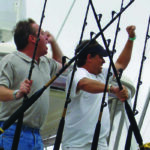
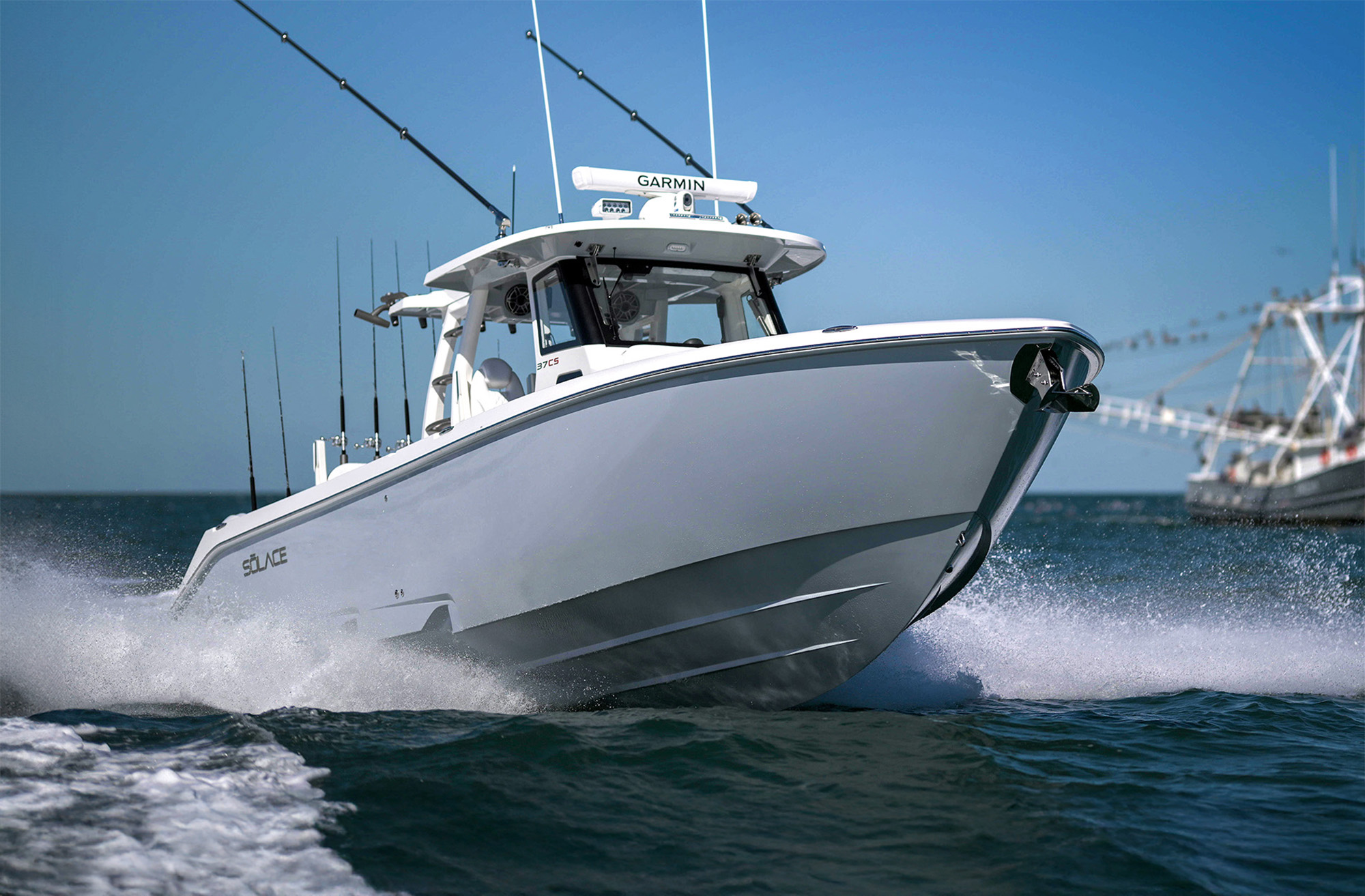
A pair of tournament anglers revel in a victorious day from their flying bridge.
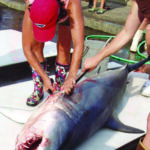

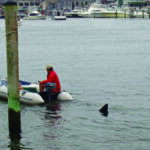
An angler hauls a dead shark to the scales.
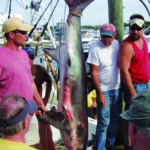
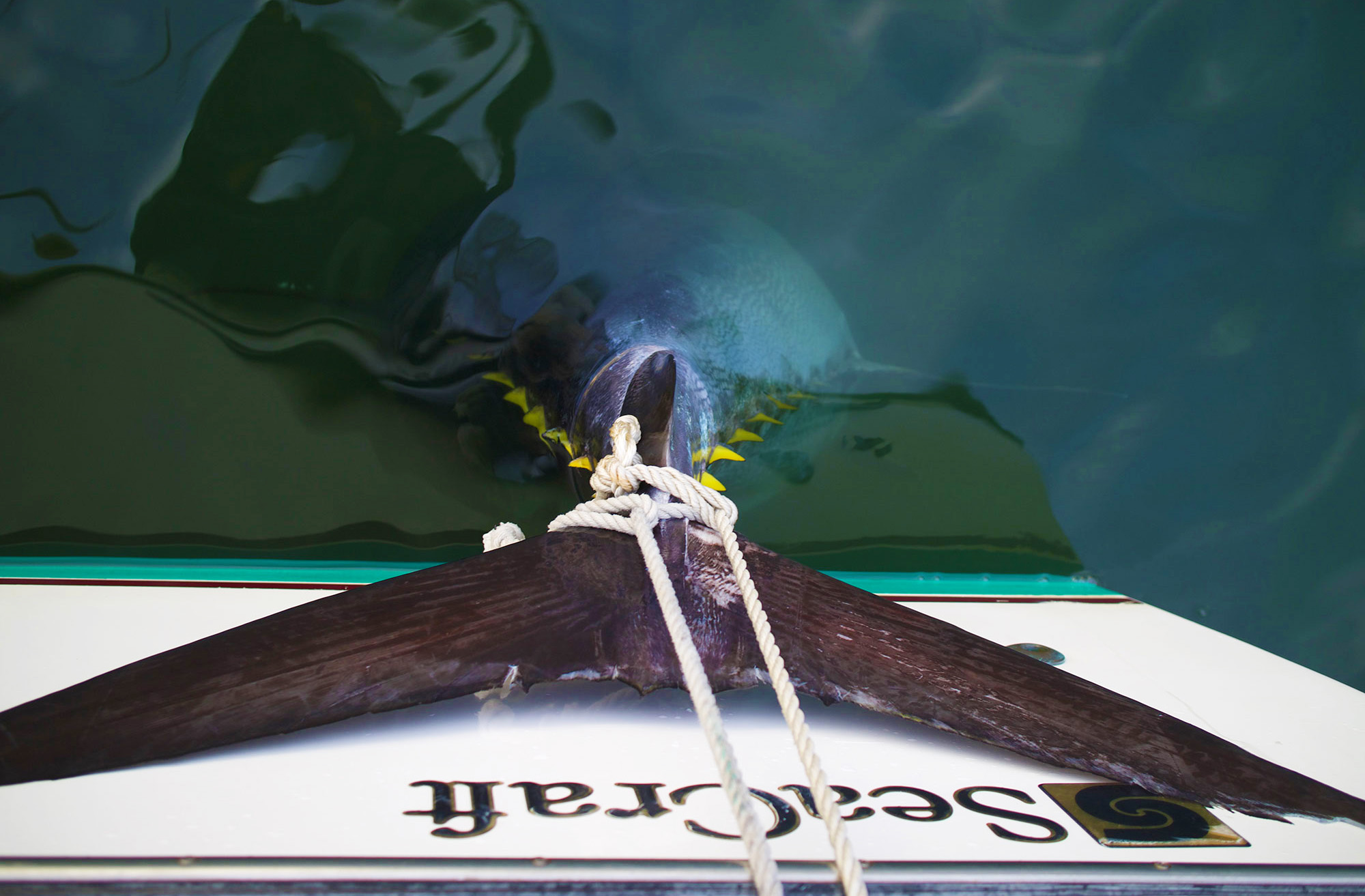
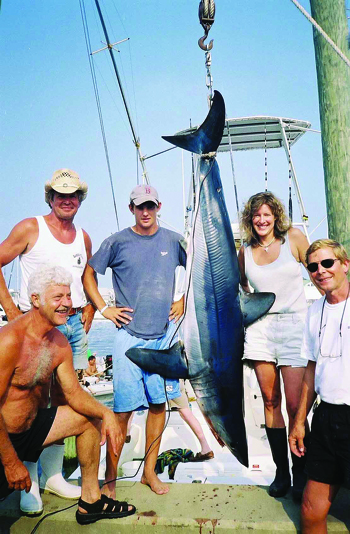
An angler holds the fin of his prize thresher shark.