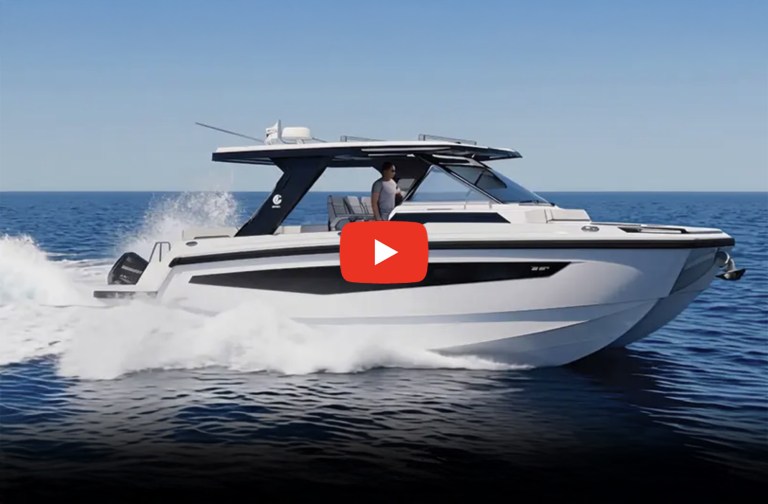

At my yacht design offices in the U.S. and Italy we are currently designing, among other things, high-volume production boats for a few of the largest U.S. builders. We actively seek opportunities to integrate features from grander, costlier vessels (the “other things”) into their smaller, more affordable sisters. This is known as trickle-down design.
Trickle-down is not a brand of incontinence underwear. Rather, it is the premise that innovations and style elements introduced at the top tiers of society and industry influence the broader public or lower tiers. Be it fashion, architecture or product design the trickle-down approach suggests that high-end design sets trends that eventually permeate mainstream markets.
Not to be confused with trickle-down economics, which also has its merits, the trickle-down practice was first popularized in fashion where haute couture collections often serve as inspiration for mass-market clothing. Gucci debuts avant-garde styles on the runway which are re-interpreted in more accessible forms for a mass market. Designer denim, a Calvin Klein staple in the 1980s, is now society’s baseline apparel. Hell, Walmart sells Calvin Klein underwear now. That’s trickle down.
Trickle down defines the automotive landscape. Luxury cars showcase cutting-edge features that, over time, become standard in more affordable vehicles. The S-Class Mercedes is usually referenced as the pinnacle in automotive tech and lux, which trickles down to the Mercedes E-class the next model year or so. And then into every other car on the market within the decade. You liked that diamond-quilted upholstery in a 2010 Bentley? Now it’s in a lot of Hyundai SUVs.
The initial trickle of design is inaccessible to the general public, since we want what we can’t have. Trickle down remains a foundational concept framing how style and innovation propagate across society, creating markets and profits. What the hell does this have to do with boats? A lot. You might have a 26-foot center console behind your house right now with four-stroke outboards, touch-screen satellite nav, a bow thruster and even a gyro-stabilizer—trickled down from cars, avionics, and cargo and naval ships, respectively.
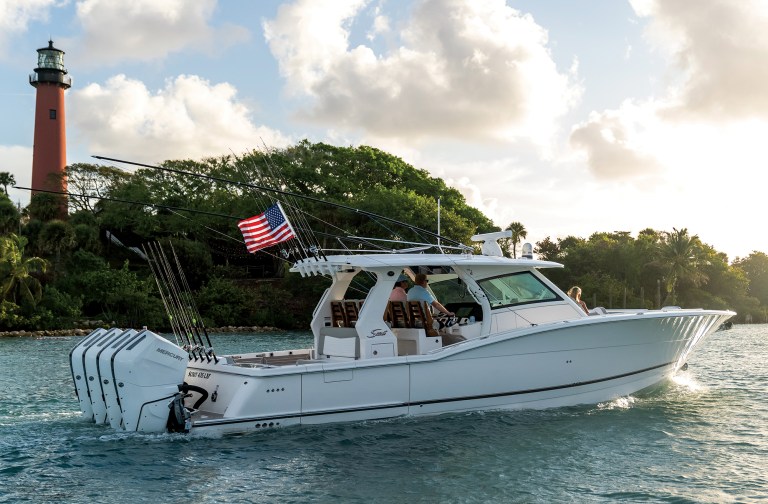
Trickle-down design has given us air-conditioned exterior helms on 34-foot runabouts. No ship of any size had air conditioning in 1930. Nor were 5,000-watt stereos on 23-foot center consoles. Play that funky music, white boy. And four or five V12s for your 50-foot dayboat? To mashup an Oprah Winfrey reference for those who know your WWII history: “You get a Rolls-Royce Merlin! YOU get a Rolls-Royce Merlin!”
Back at the office as I write this, we’re developing a pop-up bar, fridge, and icemaker island that hides under a sofa when you’ll want it to. But flip a switch or ask your phone and the cushion disappears as the bar rises to countertop height to quench your thirst. This was James Bond stuff in the 1960s but walk into a MarineMax later this year and you might see it. Yours for 240 easy monthly payments.
There are, however, opportunities for trickle-down design to go too far. A helipad on a 35-footer? Actually, I would not be surprised if, in the drug-smuggling ‘80s, a Robinson R22 made a brief appearance on the foredeck of a Cigarette Cafe Racer in the Gulf of America. That exception noted, let’s draw the line on choppers aboard boats at 75 feet, bare minimum. All in favor? Motion passes.
As sportfishing boats keep getting larger, those tuna towers aren’t getting any shorter. How about elevators on tuna towers? Since superyachts all have lifts, trickle that one down. Never mind the incredible weight aloft, mechanical complexity, aerodynamic drag, and the aesthetic disaster which would ensue. If Katy Perry can go to “space,” we can have elevators on tuna towers. Neither has happened, yet.
Fold-down hull sides on 17-foot flats boats? Unless your fishing buddies are blue-footed boobies, I doubt the reduction in freeboard is going to be noticed by anyone. (First time in 76 Inside Angle columns that I’ve had the opportunity to use the word boobies, guys. I’ll try harder.) Fold-down hull sides should be given a 32-foot lower limit.
We’ve written these three trickle-downs off at our offices. And speaking of lower limits, I only need to produce 700 words for this column. Bye for now!
This article originally appeared in the August/September 2025 issue of Power & Motoryacht magazine.