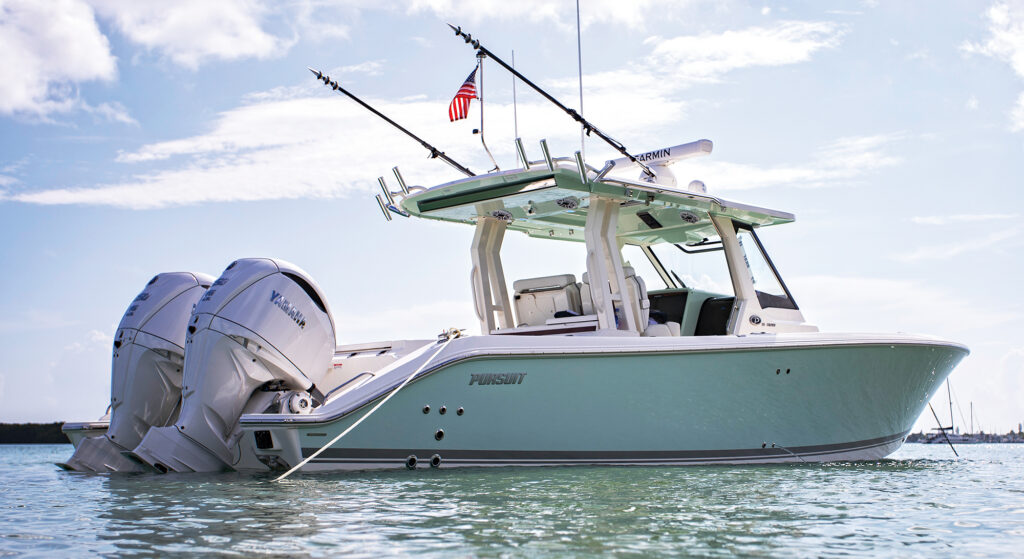
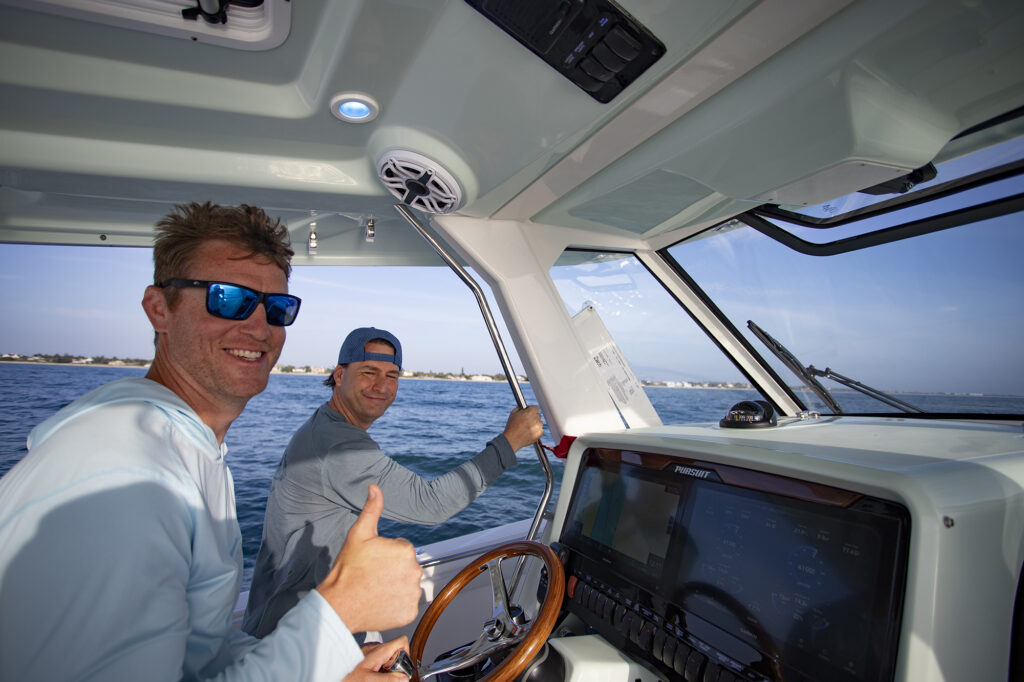
When you write about boats for a living, one self-evident truth of the profession is that the folks who build the boats you write about are busy people. It can take days to line up a phone call with a builder. A greater challenge is actually getting a builder out for a proper day on the water. That’s why I jumped at the chance to spend a day in Fort Pierce adventuring both inshore and offshore aboard Pursuit’s new S328 center console with Pursuit Boats President Chris Gratz.
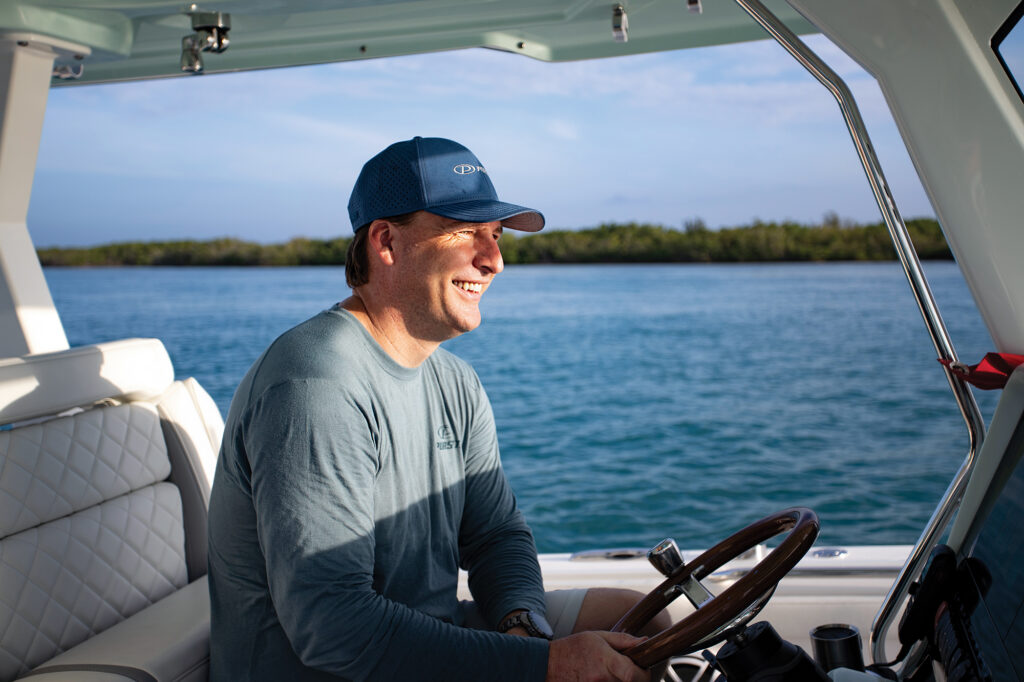
That Gratz would want to show off the boat himself shouldn’t really come as a surprise. Pursuit’s 42-year-old president is not flashy or brash. A lifelong diver, fisherman, and surfer, he possesses an easy, low-key confidence that comes from time being both inspired—and humbled by—the water.
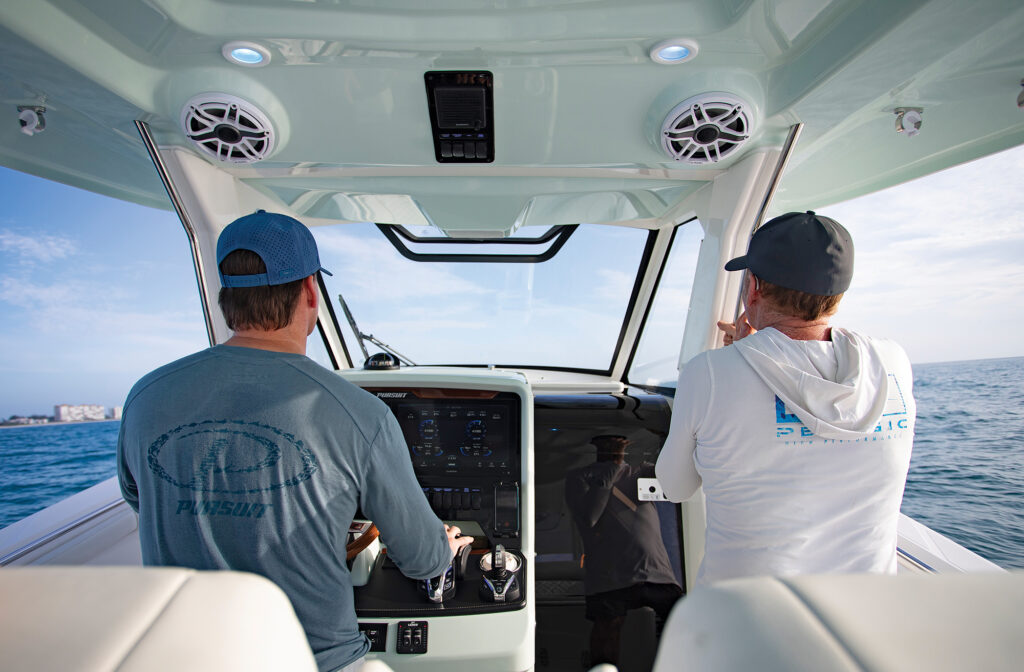
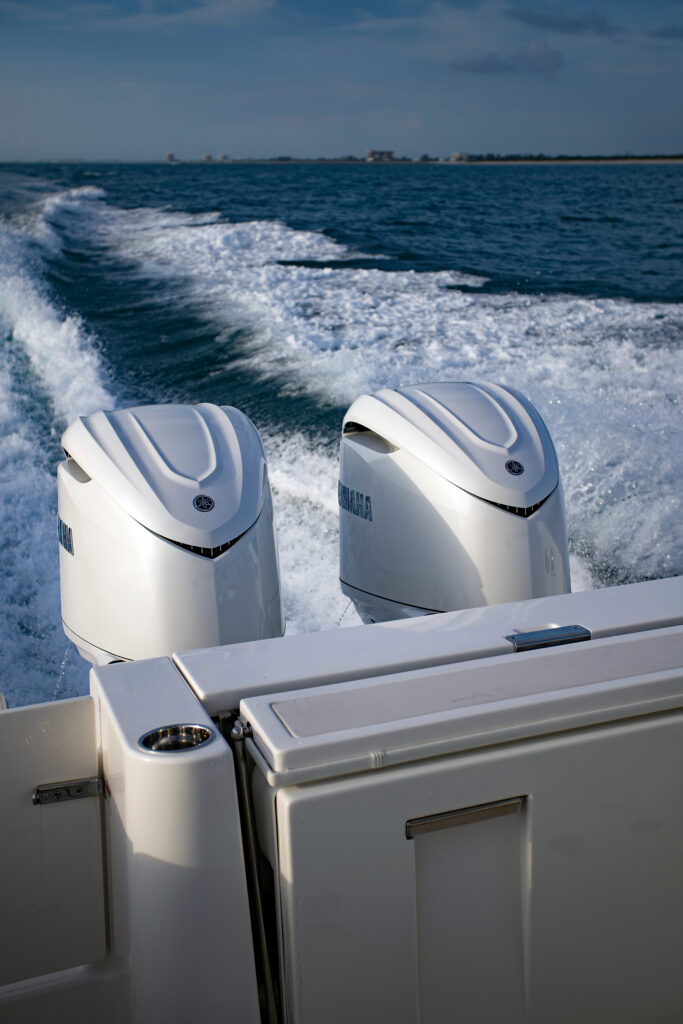
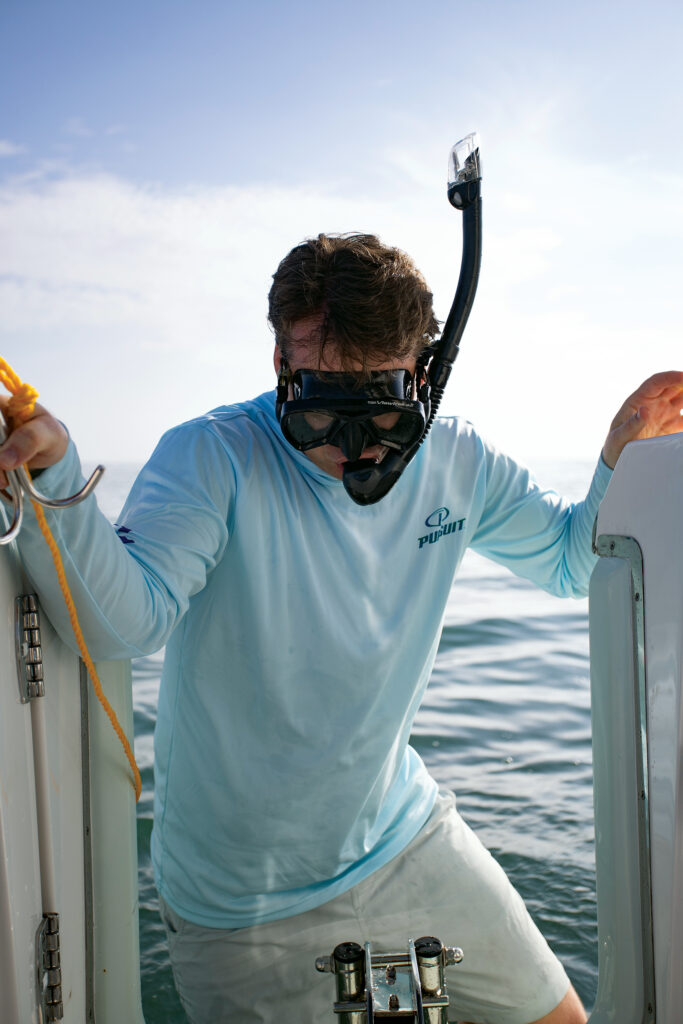
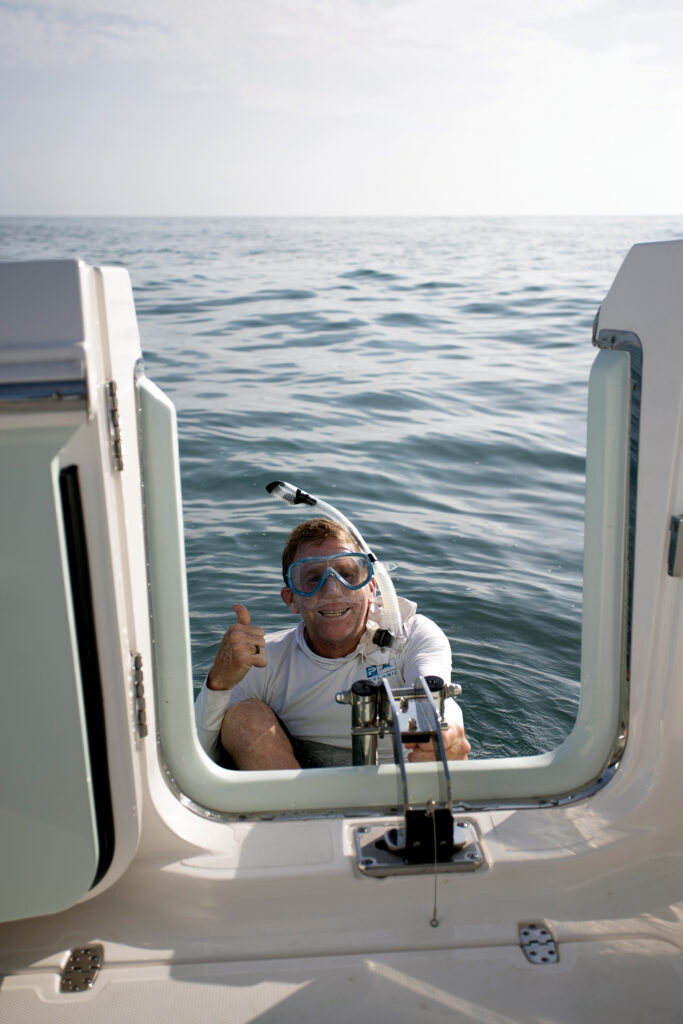
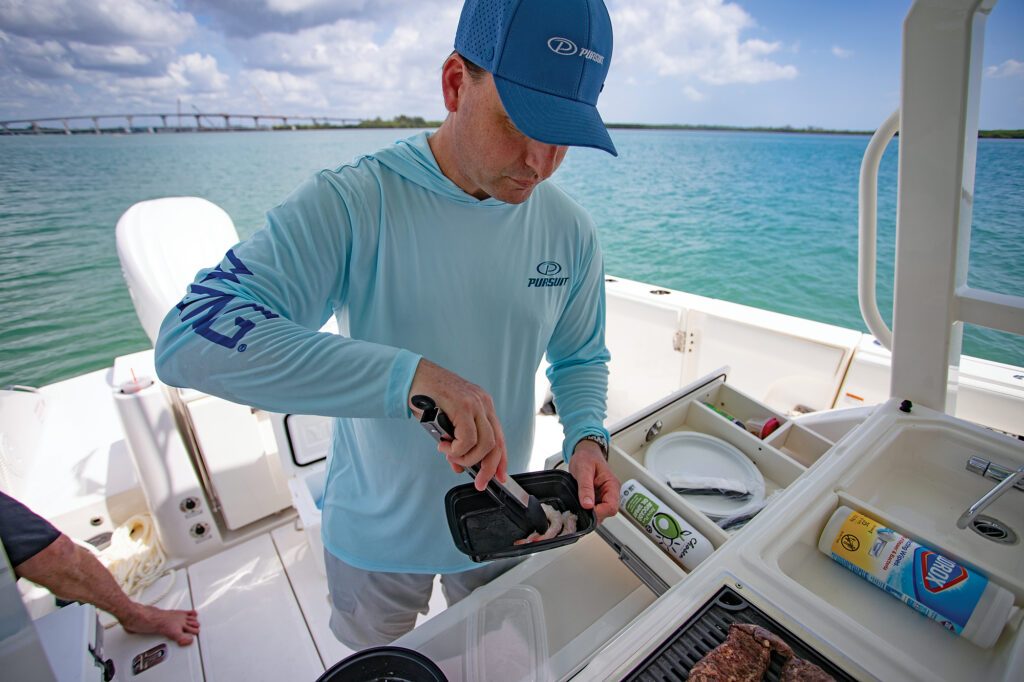
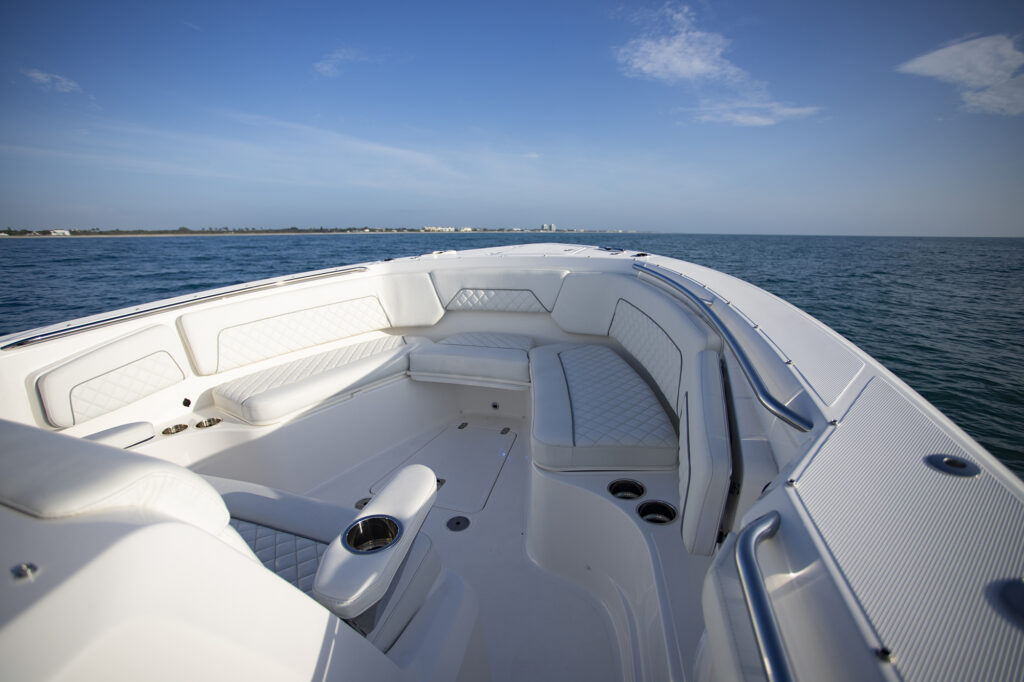
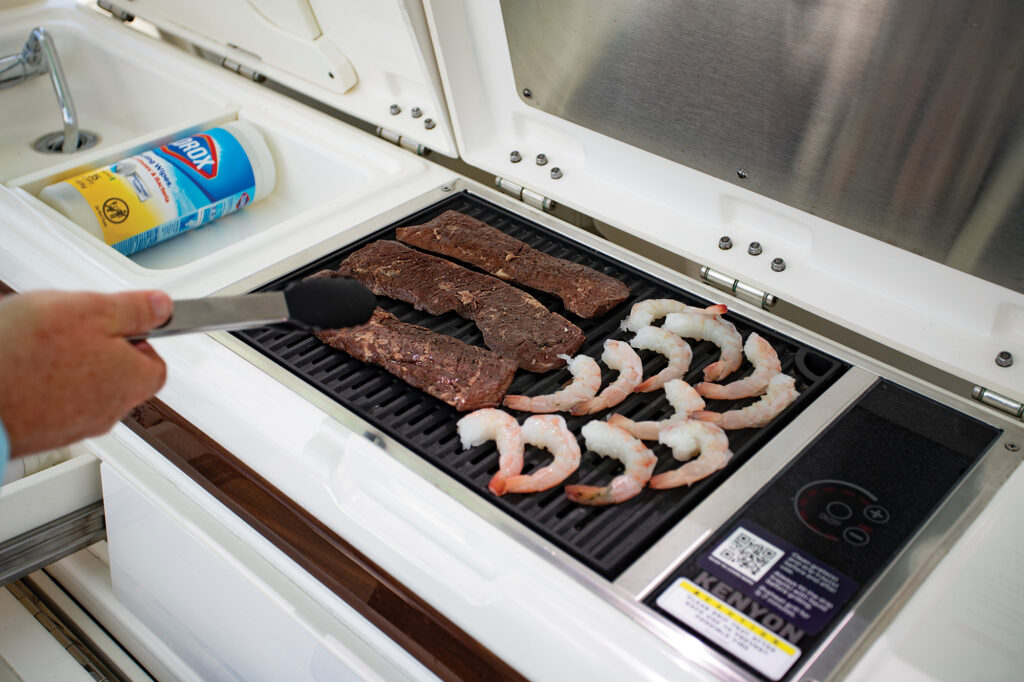
Our day together perfectly highlighted both the performance of the S328 and her versatility. On a warm Florida morning with a 10-plus-knot southerly breeze, we sliced the highly capable 32-footer northward through short-period Gulf Stream wind chop. A half-mile offshore, we anchored her up above a wrecked freighter, utilizing her stern door and telescoping ladder for a snorkeling session. After that, we bounded back over the waves to a tranquil Fort Pierce Inlet sandbar where Gratz served up steaks—which he’d personally marinated overnight—from the S328’s perfectly sorted cockpit galley as he told me his story.
Were you to envision an upbringing on Florida’s Atlantic coast, Gratz’s childhood would probably check all the boxes. He grew up in Stuart, 45 minutes south of the Pursuit factory. “I was born into boating,” he said. “I was on a boat, you know, before I could walk. My dad had me in the water snorkeling when I was 5.”
Gratz’s dad brought home a Pursuit 2600 when Chris was 9—and his family still owns it today. “Compared to the boat we had previously, I thought it was an ocean liner,” he said. “I always joke that my career with Pursuit started in third grade.”
The Gratzes used the versatile center console for everything, and those diverse use cases—offshore and inshore fishing, snorkeling and spearfishing, scuba diving, surfing, and sandbar picnics on secluded beaches—provided a real-world education on what it takes to make a boat fun and functional.
Despite an early life on the water, boats still weren’t an obvious career choice when Gratz enrolled at the University of Miami. He knew that he loved math and science—so mechanical engineering seemed a logical choice, but connecting the dots to hulls, helms, and outboards didn’t come until after he’d graduated. He first knocked on the doors of a few South Florida builders, but made little headway. Then he learned that the Pursuit factory was less than an hour north of Stuart. After he first handed in his resume 3 decades ago, he was hired as a design engineer. He threw himself into learning about marine systems, hydrodynamics, weights and balances, and then primitive computer-aided design. “I just tried to be a sponge and absorb everything I could,” he said. “It’s interesting, the evolution in our industry. We did everything by hand. We were just getting into 3D modeling, and our 3D models—the maturity from where we were to where we are now is just night and day.”
Gratz’s first big test was designing the stringer setup for a Denali 23 dual console. Soon after that came an assignment with the team that would build the new OS315—a substantial boat in Pursuit’s portfolio at the time. A photo of that model’s first splashdown still sits on his desk. “Just to remind me of that early passion,” he said.
Gratz steadily climbed through the Pursuit ranks. He didn’t have a master plan, he said, he just loved to build boats and kept moving up. Design and engineering led to a role leading a small team as an engineering manager, then came a directorship. After that, vice president of engineering and eventually VP of operations and engineering. That VP role gave him a comprehensive view of Pursuit’s overall production process—where it excelled, where it could be improved, what builds made sense in the company’s portfolio, and vitally, what sorts of initiatives and day-to-day interactions kept Pursuit’s employees and customers engaged. Pursuit, Gratz said, has been built atop a philosophy of three interconnected pillars: the employees, the customers, and the product. What has kept employees on the payroll for decades—and indeed, I saw this firsthand when meeting longtimers at the factory—is their engagement and stake in the boats. “They’re passionate about our product,” Gratz said. “They’re passionate about our customers.”
Keeping customers happy and impressing on them how important they are is vital, not only for morale, Gratz said, but for quality control in a company that turns out hundreds of boats every year. Employees are encouraged to find flaws in builds and components and to report them—not to place blame, but to improve the product and the process.
In 2024, Gratz accepted the role of president at Pursuit. Not bad for a 42-year-old Florida boat junkie. But as he dishes out a homemade salad, and flips the steaks, you’d simply never guess that this easygoing guy leads a centi-million dollar company. At hectic boat shows, we’ve noticed that we typically find Gratz in the booth. There, he’s indistinguishable from the rest of the team—simply talking to potential customers about boats. He laughed when he recalled how he once gave a colleague, who had never met him, a detailed and highly technical tour of a new build. When that colleague asked what his role was at the company, Gratz deadpanned: “Janitor and president.”
Gratz understands, he said, that for Pursuit’s customers, a boat isn’t just a product, but a gateway to a lifestyle that vastly expands horizons. That’s why he considers Pursuit’s owner rendezvous gatherings critical. At an upcoming excursion to the Abacos, he expects upwards of 45 boats and 200 customers. Some attendees are Pursuit veterans. Some are making their first run across the volatile Gulf Stream. Events like this, he said, are vital to not only encourage friendships across a like-minded Pursuit community, but to give owners confidence in the sorts of passages they—and their boats—are capable of. “People might not be comfortable making that run on their own,” he said. “It might be something they would have never done without this kind of format.”
These Pursuit rallies double, too, as offshore focus groups, where Gratz and company can understand how customers are using their boats: where and how they’re storing gear, how technology is being used—or not used, and what features buyers rely on the most. It’s invaluable firsthand intelligence, and Gratz ensures that sales, design, and engineering team members are on hand as both hosts and students. “We’re always watching, we’re always learning, we’re always engaging,” he said. “One of the real cool things about what we do is when we can solve a problem that a customer doesn’t even know they have, that’s a huge win.”
At the factory, Gratz’s days start early, with meetings at 6 a.m. They follow the rhythm and schedule of a manufacturing environment, but he said, no 2 days are ever the same. When he considers his trajectory, his favorite parts of the job are the same as they ever were; diving into a new design in an engineering meeting or walking through a new mock-up. “Boating has been a defining role in my life,” he said. “It’s my passion with work. It’s my passion outside of work.”
He hopes, he added, that potential customers will actually come to Fort Pierce to tour the plant. It’s there, he said, that Pursuit’s culture is on display. “It’s seeing that perspective,” he said. “Because you don’t just see it going to a boat show. You have to look deeper in the company.”
This article originally appeared in the January 2026 issue of Power & Motoryacht magazine.