A surfboard on the car,” my son, Louis, age 3 and a half, informed his mother and me as we piled into our little hatchback at our new outpost in the French West Indies. I had visions of putting him onto his first bonefish; his mother was (much more reasonably) concerned with making sure we had a regulation life vest for the little tyke.
Down at the beach, pairing up the lithium-powered Boost propulsion fin with its wristwatch-style remote and the Bote inflatable standup paddleboard (SUP) had Louis as excited as I’d ever seen him about anything aquatic. “Do you want to go on the surfboard with Daddy?” I asked him. “Okay,” was all the encouragement I needed. “Yes” is still not in his vocabulary, so any proposition not immediately met with a concise “No” is taken with encouragement. I figured he was, as much as with anything, all in.
But as soon as the board hit the shoreline of our local Base Nautique, Louis was put off—and I can’t blame him. At least not through any fault of Bote or Boost. He’s had a general aversion to watercraft since becoming seasick a handful of times on some unfortunate open-water passages where, admittedly, yours truly even felt a little green around the gills.
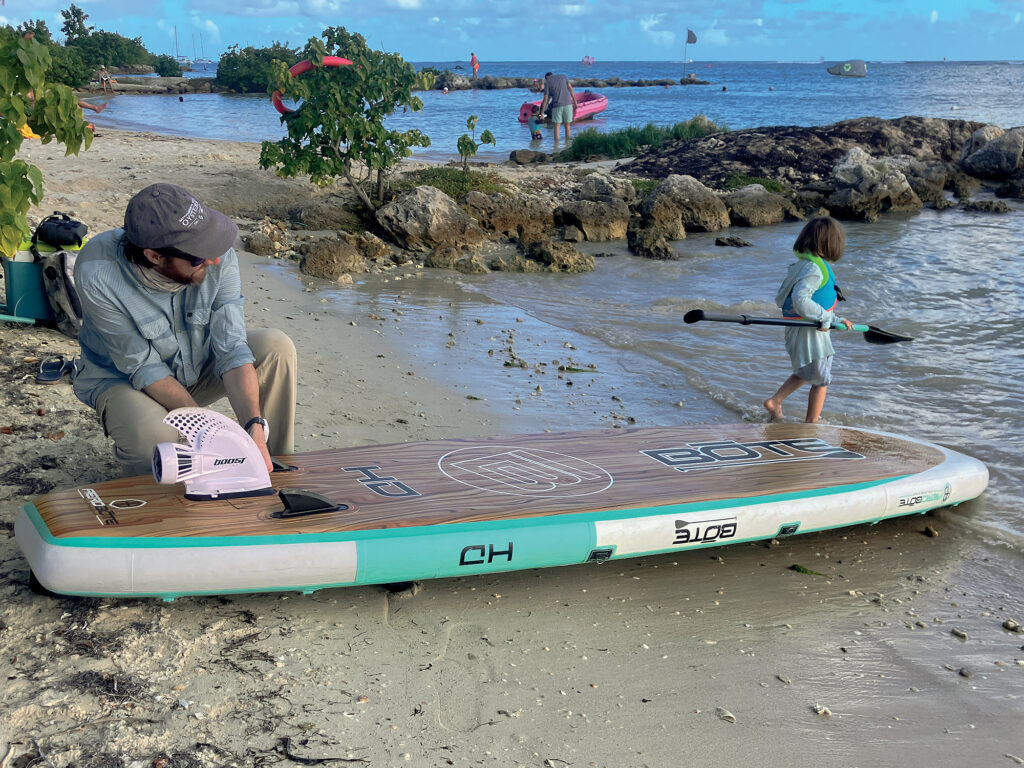
Louis turned to his Tonka trucks, plowing sand up and down the beach and cavorting with stray dogs, as is his wont around these parts. Fair enough, I figured. I’d take the inflatable SUP and Boost Fin for a little test drive first and make sure I had a handle on it before plopping a 3-year-old on the bow. His mother seemed to exhale with relief as I made this decision. I heard a nonchalant “Bye-bye, Daddy,” as I made for the flats with the whir of the electric motor’s plastic propeller engaging within its safety cage underfoot—a measure I’m sure my fly lines will come to appreciate in short order.
The Boost Fin—which comes in short- and long-range configurations—fits into all manner of surf-craft fin setups: FCS, FCSII, Future Fins, slide-in adapters for SUPs, soft-tops, and so on. If you’re not that familiar with surfboards, the aforementioned are the most standard configurations on the market, and you can verify yours corresponds by checking with the manufacturer’s specifications of your model—or intended model—in your manual or online. If you intend to use the thing for any prolonged period of time, particularly on a SUP, I’d recommend the 800-watt, long-range model off the bat, which houses a 7000-mAh battery and can run for between about 30 minutes (“Powerful Modes”) and 3 hours (“Surfing Assist”). Mounting is easy enough with the corresponding adapter—a plastic insert that fits into the central fin box of your SUP (or surfboard). A pair of hex screws mount the fin to the adapter, and a tap of the magnet built into the back of an (included) hex-wrench-screwdriver engages the fin and pairs it with the watch.
This doodad is ingenious is handy, but could use a key ring or a lanyard—some way of tethering it safely but for ready use while on the water. There’s a power-saving option that automatically shuts it off with an optional sleep timer. When the timer is set, and you want to reengage the Boost Fin, you either have to dismount (if safe to do so) or turn around, lie prone, and reach beneath the board to tap just the right spot on the fin—so I later found.
I have fished these flats dozens of times, and know where the bonefish hang. So much so, in fact, that on making the opposite side of the little slough between the beach and the flats, I landed myself smack-dab on a school of large ones. I was a little too late in making a cast, particularly in the 20-knot easterly coming across my port beam, but such is flats fishing, aboard a boat, SUP, or on foot.
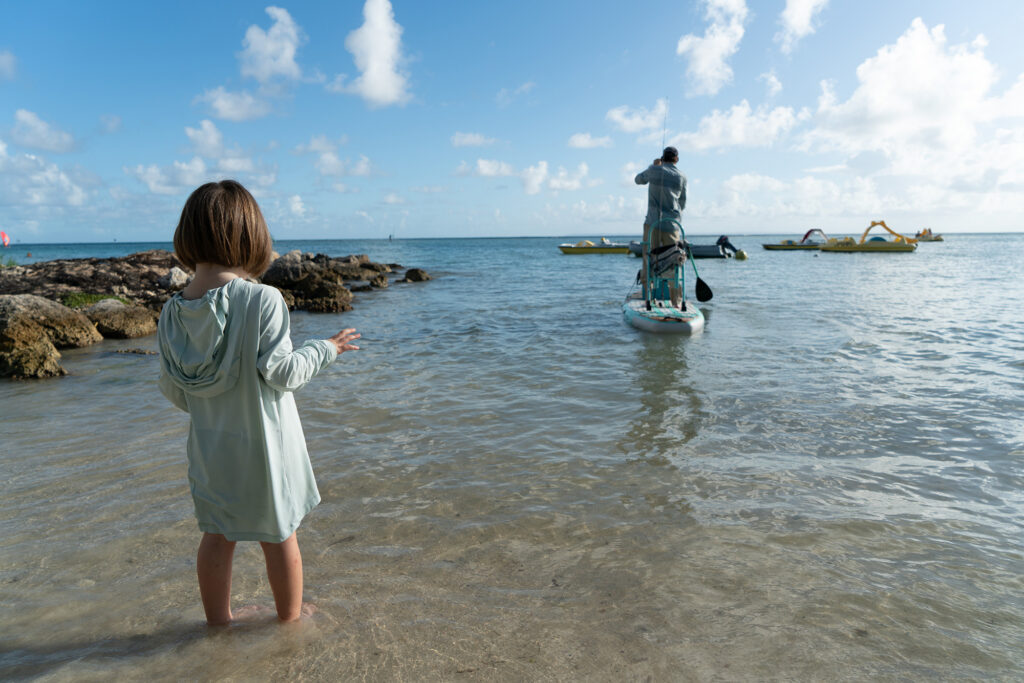
Onward I pressed upwind, with the help of the Boost Fin motor at full bore, which, with a little steerage from the SUP’s paddle, allowed me to beat directly upwind with ease via two remote buttons. One button engages a light-duty mode that more or less assists, while the other cranks up to full speed (the exact thrust can be dialed, but max is 20 pounds). These modes can also be altered within the app. Boost says this fin will top out at 8 and a half knots (10 mph) in the latter setting; I figure I hit about 3 or 4 knots going upwind on a relatively slow SUP built for flats fishing, so I’ll bet a faster board without so much fishing gear—to say nothing of a belly full of boudin—would more or less top out where they say it will. Crossing the small reef pass with a stroke to port or starboard here and there held me on course almost effortlessly, and reminded me a bit of rafting down a mild stretch of river, what with windchop on my nose and swell lolling in across my starboard beam—I’d be remiss here if I did not add that I do not, however, recommend this big board for surfing, but vague surfing experience helps.
Approaching the far side of the cut, I saw a little commotion near a little dropoff and engaged the slower speed button on the remote, which felt like a slow-trolling speed downwind and more or less held me in place going upwind (when I kept to it with the paddle). Although I had my medium-weight spinning outfit set up for bonefish, I decided to toss a soft-plastic tipped jig head toward the action. Not three cranks of the reel later and a large, pink whoosh at the surface told me all I needed to know: I needn’t have made that cast. A few yards of drag peeled off as I sailed downwind and felt the line catch in the coral and PLINK! That was that.
That was also just as well. I was quickly approaching the shallow, jagged reef break on the westward side of the cut, and this was when I came to realize that the Boost Fin had automatically put itself to sleep after 30 minutes. No matter how many times I pressed the paired wristwatch, I couldn’t get it to pick back up. This was the direct result of (shamefully characteristic) user error.
And this is where it is my responsibility as a seasoned product to direct you toward the instruction manual, which most level heads would have consulted well ahead of making this critical error. Because it turns out that you can adjust the fin’s sleep time with the Boost app. If an old-fashioned manual isn’t enough, use Boost Surfing’s thoughtful series of tutorials are at BoostSurfing.com. But I’m a trial-by-fire guy, and so, fearing I might have torched the system on my maiden voyage, I refrained from sticking the screwdriver underwater and trying to reach the corresponding magnetic strip on the fin (several inches beneath the surface and well behind where I stood on the board) in lumpy, rolling, windswept swell, I might add. It was less than convenient, and, as I fumbled with the wristwatch remote, I found myself tumbling into the drink. Fortunately, a couple decades of on-and-off surfing had me mitigating damage to anything beyond my pride, and I was able to swim to the board and catch it before it was halfway to Aruba. To wit: If you’re even a soupçon wiser than me, carry a life vest and always wear a leash—an inflatable SUP in a good breeze can get away from you far faster than you can swim. Also note: This all happened within a span of about 3 minutes or less, but I needn’t remind you that things go sideways fast out there.
I made my way onto a shallow sandflat where I regained my composure and rerigged my spinning outfit. I peppered the channel with casts here and there as I drifted across it at a swift 4 to 5 knots, and had no luck. Screaming downwind as I was, I can’t say I was surprised that my presentation didn’t appease any of my finned foes, but I was already bound forshore by now anyhow.
In retrospect, I’m glad I didn’t take Louis aboard on this near-fateful trip. There were a few matters to shake out first, and, well, 10 feet 6 inches is a large surfboard, but a rather diminutive boat. My local friend, Francois, met me at the water’s edge upon my return to terra firma where, he informed me, it was time to buy a boat. A bigger boat, I suppose he meant.
Francois is not wrong, and while Louis already had the good sense to avoid tempting any fate in the shallows with Daddy, I suspect the addition of a pushpole will make my trials a little more fruitful down the line.
As for the motor? Well, a few tutorials have since gone a long way.
The real win came when, in frustration, I flipped the board over on the sand to see if the lithium-ion battery of the Boost had prematurely gone flat. Suffice it to say that I probably could have easily employed it for another hour or so, just as advertised (and this one is a few years old and secondhand, at that). Tapping the hex-wrench screwdriver’s handle to the fin’s magnet, it whirred right to life—with more than 60% of its full juice still in reserve.
Pavlov’s motorhead, Louis, dropped his sandy Tonka and bolted right over. Gas, propane, diesel, or electric, there’s nothing like the sound of a revving (or whirring) motor in a boy’s ear. Have power, will travel—one way or another.
This article originally appeared in the March 2026 issue of Power & Motoryacht magazine.