Photos Courtesy of Mathews Boat Owners Association
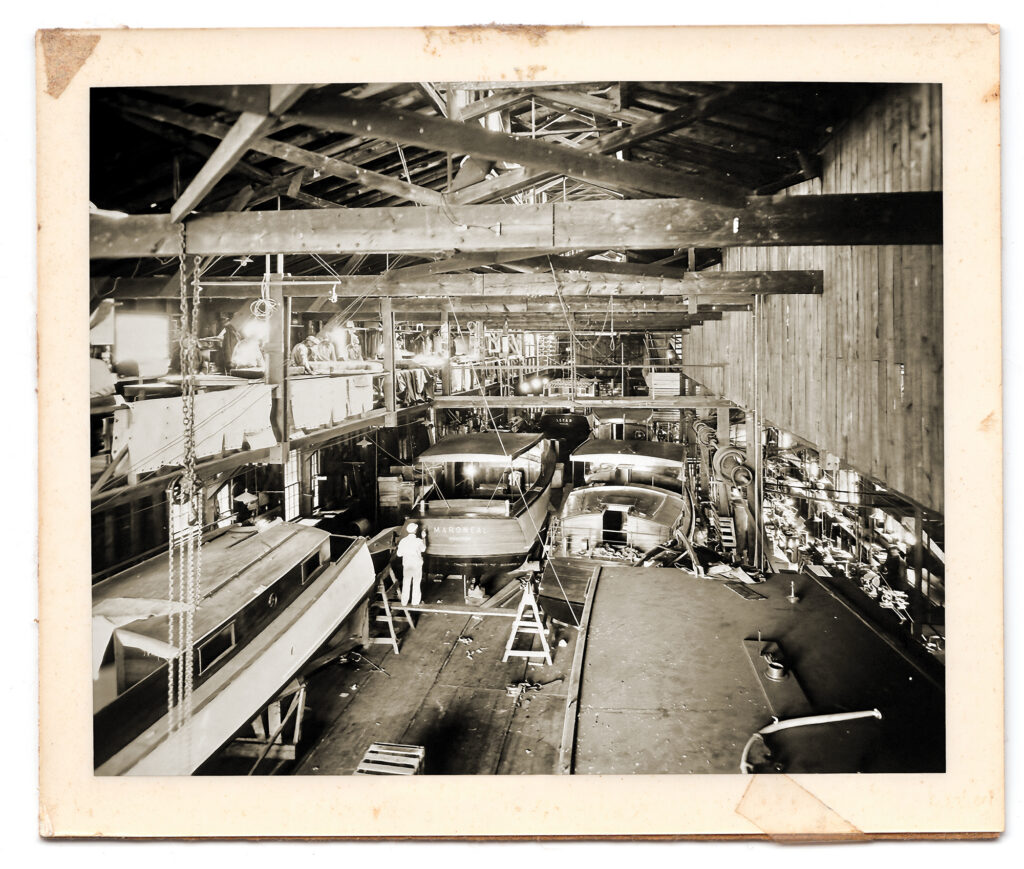
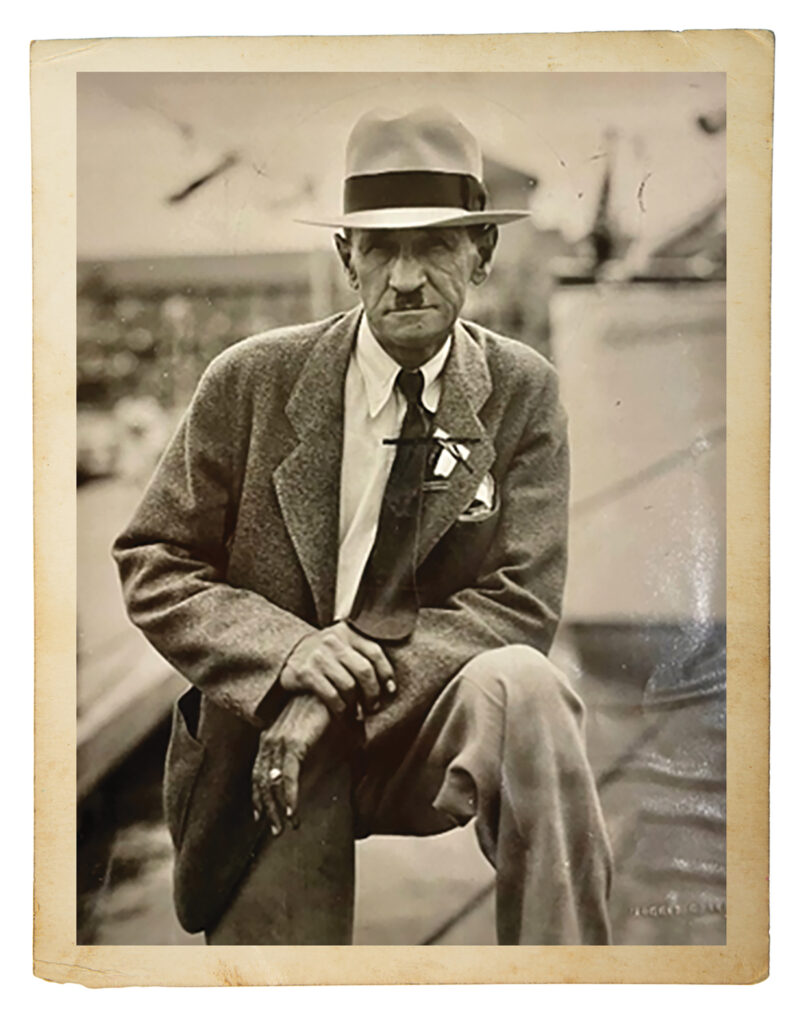
This is the story of the 70-foot yacht called Onward and a 9,000 mile passage that was but one of many firsts for Scott Mathews. In 1890, he became among the very first builders to put a gasoline motor aboard a small boat. In 1912, a 35-foot Mathews called Detroit became the first vessel to cross the Atlantic under gas power. In 1913, his 110-foot Aeldgytha became the first boat of its kind to rely on diesel power. In 1924, Mathews built the first cruiser production line—making his Port Clinton, Ohio yard, the Ford Motor Company of boating. Mathews Boat would remain in business until 1974—20 years after its founder’s death. What follows is a condensed version of Mathews’ account of the family journey aboard Onward that appeared in The Motor Boat magazine in 1907. Back in the era before depthfinders, advanced weather forecasts and radar, a Loop journey was a brave undertaking—as you’re about find out.
On May 25, 1907, one cold winter day, now nearly two years ago, with the thermometer registering ten below zero and a prospect of several months of snow, ice and bitter cold, our thoughts turned towards Florida and the South, with its balmy air, abundant foliage, ripening fruit and open waters for boating. We had tasted the pleasure of motorboating through a number of short summer cruises in home waters, and the prospect of an extended winter cruise was indeed tempting. At once we began to plan the general features of a boat, which should be large and sturdy enough to carry our party with comfort and safety through the itinerary we had discussed, and which contemplated, a cruise down the Mississippi to the Gulf of Mexico, then to the east coast and inland waters of Florida, where we expected to remain for the winter, thence, when ready, to take up our homeward cruise along the east coast, then take the inside route to New York, run up the Hudson, go through the Erie Canal and via Lake Erie to reach our home port at Toledo.
Our deliberations finally resulted in the placing of a contract with The Matthews Boat Co. of Port Clinton, Ohio, for the building of Onward, and it is needless to say that we watched the progress of the work with great enthusiasm and interest.
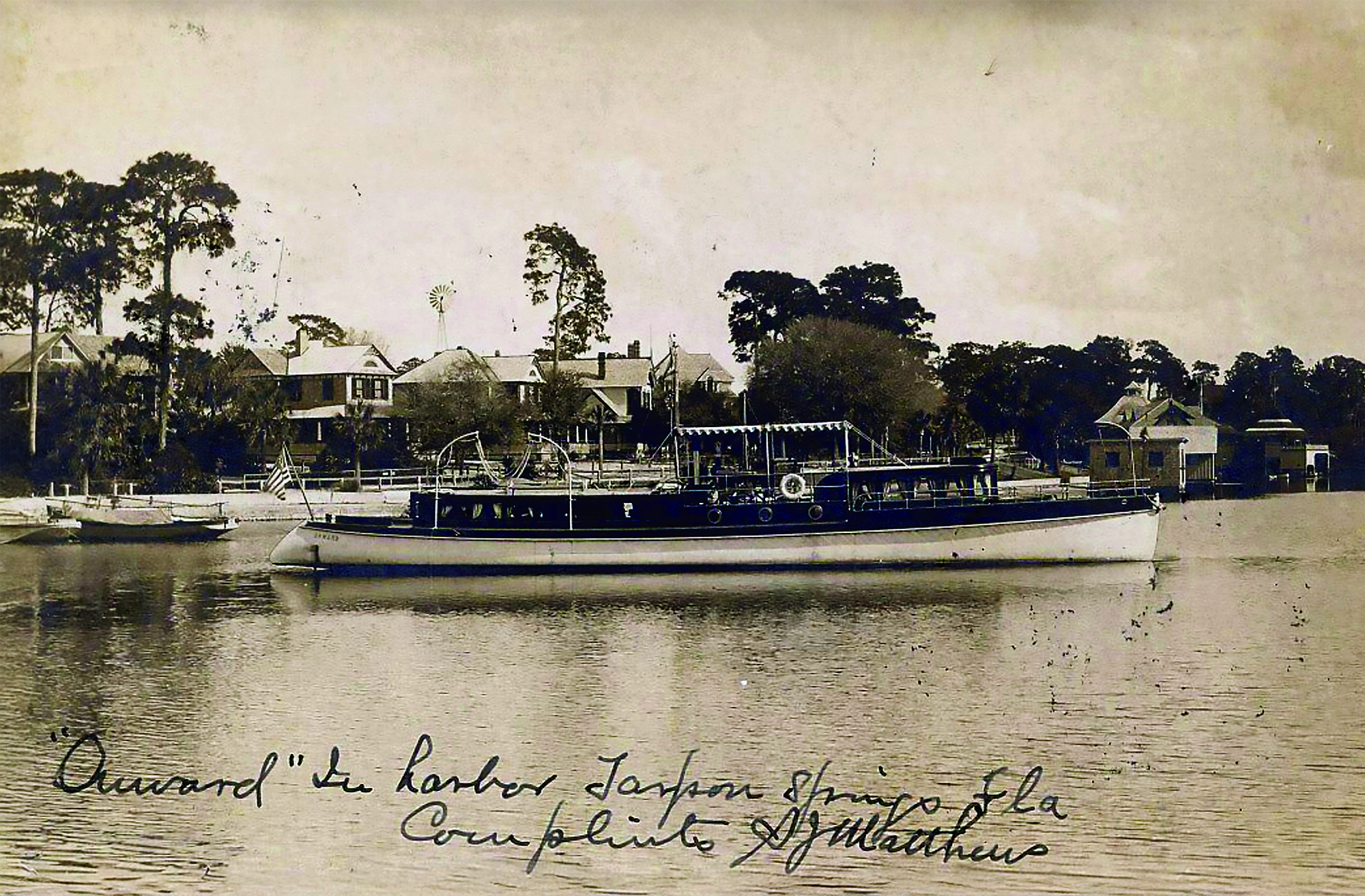
As a prelude to the story of our cruise, a short description of Onward may be pertinent, and perhaps also of some value to those who may be contemplating a similar cruise for the fun and recreation it affords. In fact, the success and pleasure of such a long jaunt is primarily dependent on the adaptability of the craft. It must be capable of contending with the stiff currents, the sand bars, and the shallow waters of the Mississippi, the oyster beds and open waters of the Gulf, and the exposure to the rough coast waters of the Atlantic, which, under some conditions, make navigation for a motoryacht very difficult and even dangerous. Absolute reliability of boat and motive power, with limited draft, staunchness, and ease of handling are positively essential features.
Onward is 70 feet over all; width is 11 feet 3½ inches, and draft, 3 feet 6 inches. This draft, while it gives stability for outside runs, is not too great for shallow waters. Good freeboard, with a low superstructure and ample deck room, with very strong construction and low center of gravity, were among the requirements. The latter was accomplished by placing the engine almost entirely below the water line, also the fresh water storage tanks, storage batteries for the lighting system, coal supply for the range, and the refrigerator. Onward has a 12-foot deck forward, a combined pilothouse and dining room, 12 feet by the width of the boat; a galley next aft, 4 feet 6 inches by the width of the boat; a motor room, 8 feet 2 inches long; a stateroom, 6 feet 6 inches by 7 feet; a bathroom, 5 feet by 5 feet 6 inches, and an after saloon, 9 feet by width of the boat. Every available inch of space is utilized for stowage, in wardrobes, cupboards, lockers and drawers, also two large bilge sections for fruit and vegetables; and they have all been needed. Provisions and supplies can be secured at almost every stop; but the spirit of “graft” is abroad all over the land. (Enough said.)
The pilothouse has one slide berth, making up 34 inches wide, a dining table seating comfortably eight persons, and a buffet extending from floor to ceiling, with doors opening to the galley. The galley is fitted with a hard-coal range, and connections to a hot-water tank. This was found to be one of the greatest conveniences aboard the boat, supplying hot water for a heating system, which gave us an even and comfortable temperature in all parts of the boat through radiators installed in out-of-the-way places, some in the floor, others in the sides, lavatories, and dressers. During some of the very cold and disagreeable weather, it was a delight to go below and enjoy dinner in a warm, dry room. The galley also has a large sink with hot and cold water connections, cupboards, dish racks, an electric fan for ventilating, and last, but not least, a refrigerator with a capacity for 400 pounds of ice.
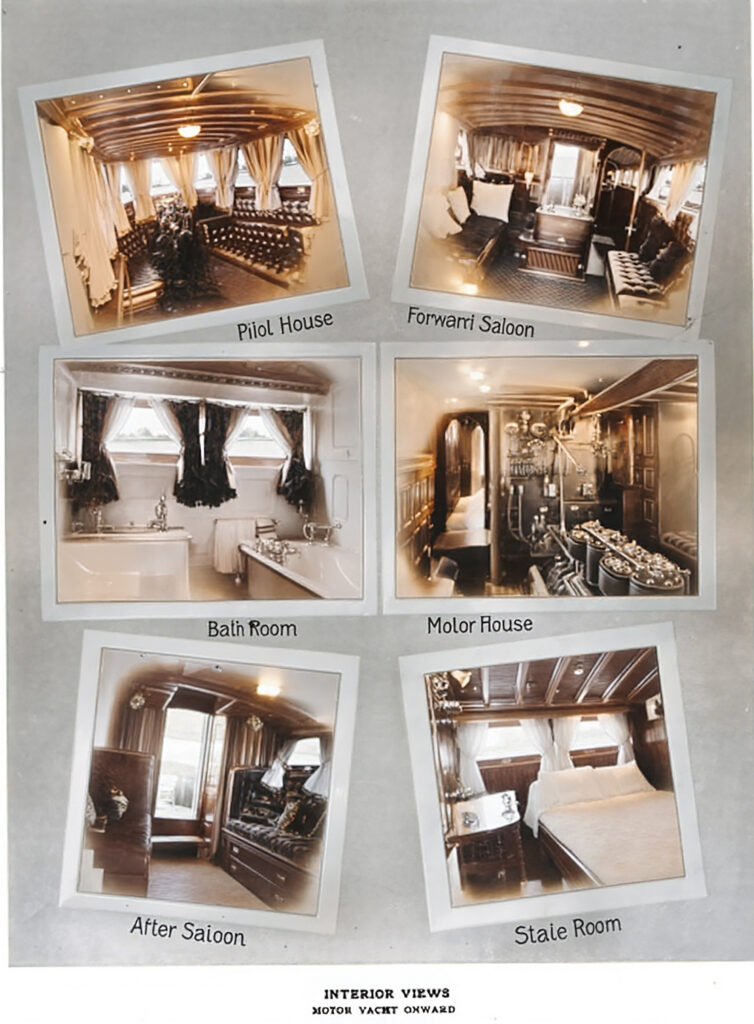
The engine room has two Pullman folding berths for the crew, and a large wardrobe. Aft of the engine room is a stateroom with a double berth; a lavatory with hot and cold water service, and a large wardrobe. Aft of this stateroom is the bathroom, fitted with full-sized bath, lavatory with hot and cold water, also a connection to the water jacket of the motor for hot salt-water baths. Instead of a flush deck aft, we have a large cockpit, with a water-tight floor and self-draining scuppers, also two large lockers for the storage of lubricating oils, paints, varnishes, signal lamps, kerosene, etc. Although a steering wheel and signals were fitted in the pilothouse they were seldom used, and, after a short experience, the pilothouse wheel was disconnected, using the bridge gear altogether. The motor is also handled from the bridge through a system of levers, giving complete control of the craft from this point. We found the bridge the most comfortable part of the boat for a cruise of this kind, and very often, during pleasant weather, we served dinner there to as many as ten or twelve people. So much for the description of Onward, which was to be our floating home probably for as extended a cruise (9,000 miles) as has ever been taken by a motoryacht.
Our reason for starting from Peoria, instead of going through the Great Lakes and down the canal, was due to the lateness of the season, as ice was already forming in the Northern lakes, and we found we would save 900 miles by starting from Peoria and going direct to the Gulf via the Illinois and Mississippi Rivers.
Motorboating, like most ventures in this world, is not entirely unalloyed bliss, and the first rift in our enjoyment came through a pulley on the dynamo, used for charging our electric storage system. The pulley was made of wood, and we found it almost impossible to keep the belt in place; furthermore, the pulley was really too large in diameter to give the number of revolutions necessary for charging the battery properly. An electrician accompanied us for the first ten miles and did all he could to remedy the trouble; but we finally had to replace the unsatisfactory pulley with one made of steel, of the right diameter and with flanges to hold the belt in position. Thus our pulley troubles ended.
We stayed at St. Louis until November 15, and here we secured the services of A. F. Hollingshead to pilot us to Cairo, Illinois. The first day’s run was 120 miles, to Grand Tower. We saw our first wild geese and ducks here, and found them very plentiful in this section. An experienced pilot is an absolute necessity on the Mississippi River, especially between St. Louis and Cairo, as the channels change continuously and there are dangerous bars, etc. The river, too, changes course constantly, one day flowing close to the boundaries of a city, and the next week or so being some distance away. In one place we saw a house, half of which had fallen into the river, and later we passed by one in the process of falling in. This erratic behavior of the river-furnishing more excitement than pleasure and comfort for the residents along its banks is accounted for by the sandy earth through which it passes, the constant tendency being for the earth at the outside of a bend to fall into the river and be deposited by it at some point further down, forming a bar.
On the 20th, which was clear and fair, but rather cold, we left Columbus at 7.35 a.m. and had a fine run of 84 miles, to Gayoso, Missouri, seeing our first cotton plantation near this town. Here we tied up for the night to some government dredges, through the courtesy of the captain. Finding a suitable anchorage for the night is one of the perplexing problems of Mississippi River navigation. Owing to the current and the difference in the rise and fall of the river, there are no docks or wharves to which a boat can be tied, and one may consider himself fortunate if he can find a coal barge or dredge, as the usual manner of tying up for the night is to run the bow of the boat on shore and put out a couple of lines from the stern to a convenient tree or stump. On inquiring the population of Gayoso, we were informed that the town had formerly been the county seat, but, on account of the encroachment of the river, the court house had been moved so often that it was finally worn out. This is a fair sample of the towns along the river. In the case of Gayoso only three or four small huts remained of what was once a prosperous town.
We left Memphis at 8.45 a.m. on December 7, went as far as the St. Francis River, and up that stream fifteen miles for an anchorage for the night. The following morning we passed into the Mississippi and down to Kangaroo Point, Arkansas. The water of the Arkansas, being of a brick color, there was a distinct line where it joined the Mississippi. This was a particularly desolate country. The weather was cold, making the handling of the boat an uncomfortable proceeding.
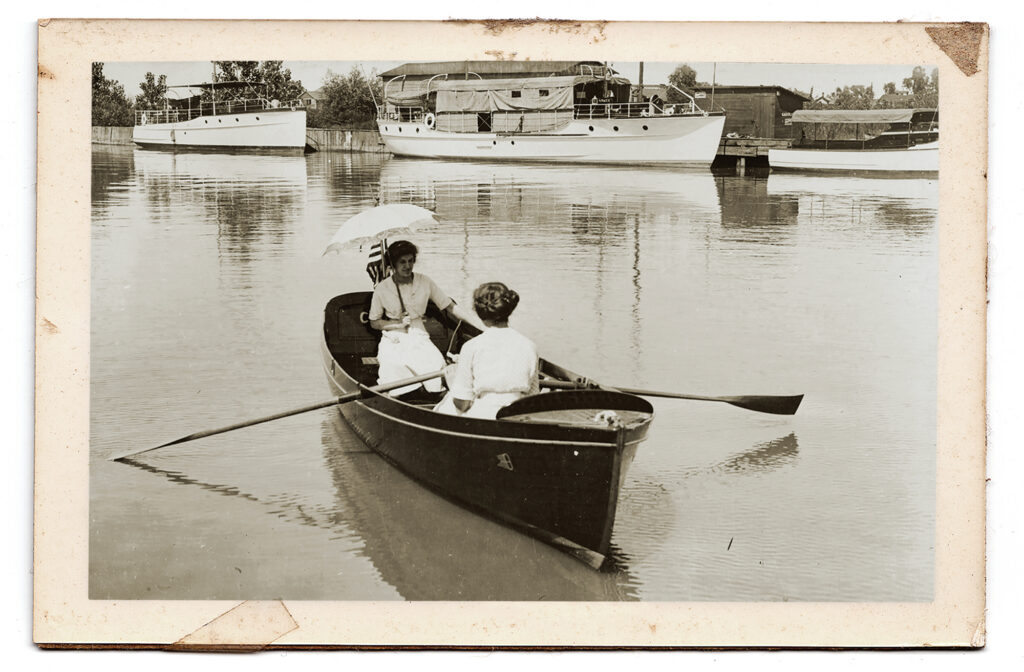
December 11 proved clear, cold, and quite frosty. We reached Greenville, Mississippi, at 2 p.m. where a local sage advised us to run the nose of the boat up on the rip-rap, his idea being that the little jetties which run out from it at different points form an eddy and break the current. We foolishly followed this suggestion, and soon after a big Mississippi towboat came down stream and threw a wash at least five feet high, which caused Onward to pound on the rocks which form the rip-rap, until it seemed that she would inevitably become a wreck.
On December 15, a very cold, disagreeable day, we ran from Greenville to Vicksburg, 135 miles, arriving at 6 p.m. This city is situated on the Yazoo River, a mile from the Mississippi, and as we neared it in the darkness we narrowly escaped bringing the trip and Onward to an untimely end. A large steel boat had been wrecked, and was lying directly across the channel. She had a lantern on the bow, and this we saw just as we were almost upon her, being within a couple of hundred feet of the big steel pilothouse. Our searchlight revealed the situation and enabled us to avoid an accident. We were disappointed in Vicksburg, however, as we found it a poor sort of town, where we received indifferent, even discourteous, treatment from tradespeople and others. We were rather glad to say good-bye to Vicksburg on December 17, at 7.30 a.m. and ran 125 miles, reaching Natchez at 5 p.m. This is a clean Southern city, very prettily situated on a high bluff. Here we found an empty coal barge, which we, of course, presumed was fastened securely to the bank, and we proceeded to tie the Onward to the upper end of the barge. Later in the evening, fortunately before we retired, we discovered that the barge had been carelessly tied, and that the current had cut in between it and the bank, and we were swinging out in the stream in a tremendous current, heading for a steamboat landing a short distance away, with the probability of being crushed between the two steam boats lying there.
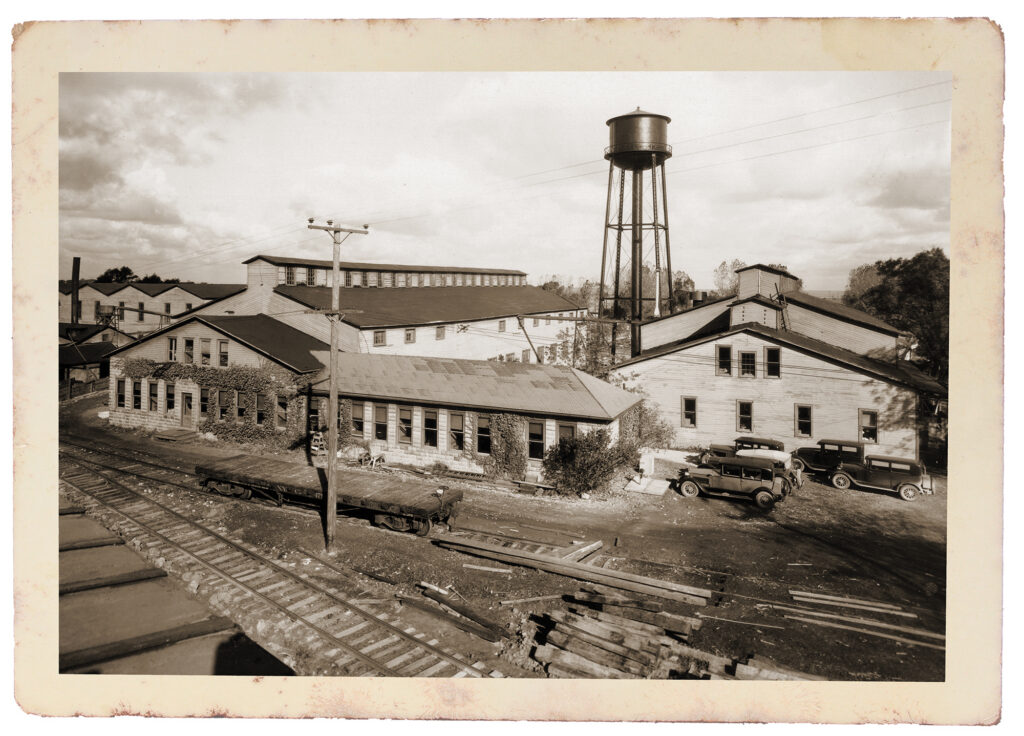
Finally we spied a small towboat lying along the shore in the willows. Coming alongside in the hardest part of the storm, we asked permission to tie up, which was readily granted, and the crew kindly gave us a helping hand in a downpour of rain. The following morning we learned that our anchorage was directly in front of the Louisiana Lepers’ Home, which is beautifully located over the levee. We were not anxious to get a nearer view, but were informed that they have about fifty inmates, and it is claimed that several people have been cured of the disease at this place.
We left our anchorage at 11 a.m. on December 21 and proceeded to New Orleans, seeing fields of Southern produce and other vegetation, which made us realize the difference between our surroundings and those of our less fortunate friends and neighbors in the frozen North; and we rejoiced that we had braved the dangers and discomforts of such a trip. We passed into the Lake Borne Canal about 6.30 p.m. and here we found that life, even in the Sunny South, was not “one grand, sweet song,” for mosquitoes came swarming about us in clouds.
Lake Pontchartrain is also very beautiful, and at the West End, convenient to New Orleans, is situated the Southern Yacht Club, which has a membership of 800 and is next to the oldest yacht club in the United States. Our visit at this club was one of the pleasantest experiences of our entire trip. They have a protected anchorage for boats and every convenience. The fleet is about equally divided as to sail and motorboats. We were met here by H. U. Hayden, and he, as well as Mr. Duvic, extended to us the courtesies of the club. Mr. Hayden is a friend of the writer, who the year before went South in a boat built by The Matthews Boat Co. and purchased a beautiful plantation on the north shore of Lake Pontchartrain, on the Tehefuncta River, which he calls “Piney Woods.” Here we spent Christmas Day, remaining, in fact, for a week, during which time we visited Covington, a beautiful town on the Bogneflaya River, also Madisonville and the shipyards.
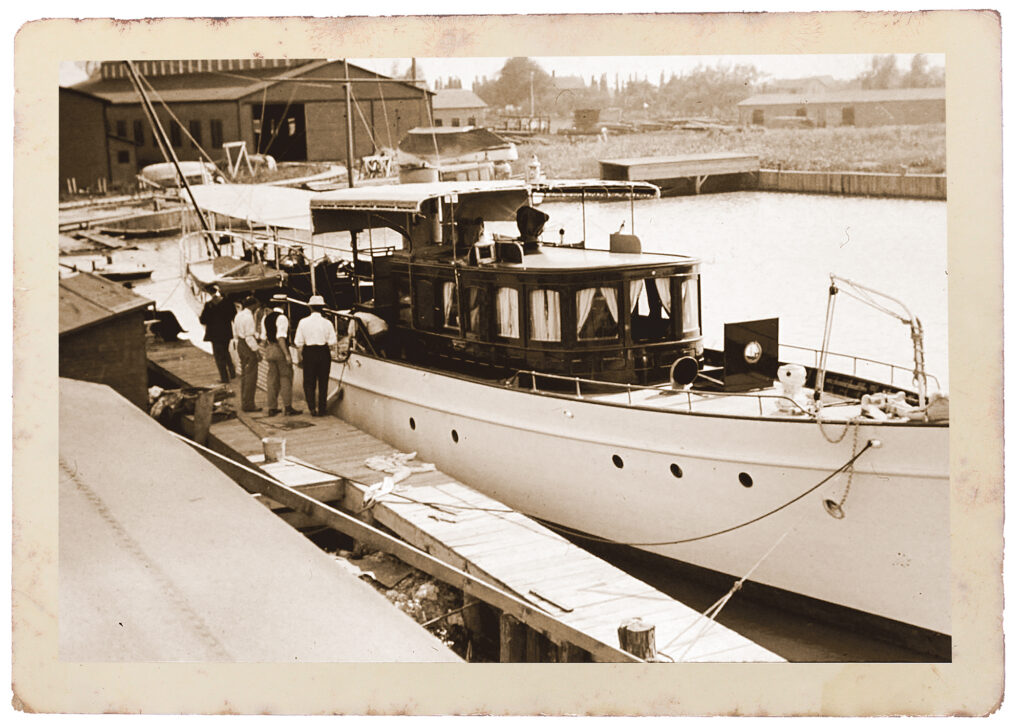
On January 5 we left New Orleans, Mr. Duvic accompanying us as far as Biloxi, Miss. We went through Lake Pontchartrain, Rigolet Pass and Lake Borne, then up the Mississippi Sound to Bay St. Louis, a very beautiful resort. Here we ate our first Southern oysters, and they were fine.
We found a very high swell running in the Gulf, and, in fact, when we got out into deep water we ran into by far the biggest sea we had encountered anywhere on the trip. After traveling for five or six miles we decided that forty miles of hammering through a sea of this kind was not exactly pleasurable, and so went back to Fort Morgan.
The next day, the government storm signal predicting a northwest blow, made it seem advisable for us to go to Mobile, a distance of thirty-five miles, which we did that afternoon. We found Mobile Bay very easy to navigate, being marked with beacons closely spaced and having, we believe, a 23-foot channel. We reached Mobile at 4 p.m. and found anchorage at the yacht club there. A little excitement, but no damage, attended our arrival. Just as we dropped anchor a steam pleasure boat tried to pass between our bow and a schooner-rigged yacht lying near us. The first-named boat’s beam was about thirty-five feet, and the distance between Onward and the yacht was not more than twenty-five. We quickly let go the anchor line and gave the engine full speed astern, thus managing to back far enough to allow the boat to pass between us by the narrow margin of one foot, they going at full speed.
We left on January 16, having on board a pilot to guide us through Santa Rosa Sound, which is a very shoal, narrow body of water extending sixty miles along the coast from Pensacola to East Pass. At 4 o’clock we ran into what is termed The Narrows. It was very foggy and several times we had to wait until it cleared. During one of these waits, which lasted several hours, we crossed the narrow strip of beach, which is called Santa Rosa Island, to the Gulf. This beach is composed entirely of pure-white sand, resembling snow and giving one the impression of cold until he gets ashore, when the heat quickly dispels the illusion.
Storms quickly following each other compelled our remaining at Santa Rosa Sound until January 24. On that morning we found anchored near us three fishing smacks, looking for a chance to go through the pass down the coast, and each was waiting for the other to pull up anchor first, as there was a heavy swell running over the pass. It is very difficult to navigate East Pass, especially if there is much swell. On Friday, January 26, we ran to Carrabelle, Florida, a small town at the east end of Apalachicola Bay. We found a very crooked, narrow and shoal channel at the entrance to the town, but succeeded in passing in safely and remained here over night. The following morning, however, we did not get out as easily as we came in; for there had been a slight difference in tide and we succeeded in running aground with a rising tide and spent the waiting time gathering oysters.
On February 12 we went as far as Knight’s Key Pass, and stopped thirty-five miles this side of Key West, entering Hawk Channel the next morning. That night we got an anchor line in our propeller wheel and it took several hours to remedy the trouble. We arrived at Biscayne Bay about 8 o’clock in the evening, after a very beautiful sail through the keys. We reached Miami on the morning of the 14th, with the thermometer reading 85 in the shade. We found this a very beautiful city and the principal Southern resort for yachtsmen. There were fully 125 fine yachts at anchor there at that time. The fishing is excellent, kingfish and mackerel being found here in greater abundance than anywhere else on the coast.
We started at 11 a.m. on February 20, and went through Lake Worth and the East Coast Canal to Jupiter inlet. Here we got aground just off the lighthouse. Upon inquiring for a pilot to take us through Jupiter Narrows, a distance of about four miles, the lighthouse keeper said his son would do it for $8. We declined his services. He said he didn’t think we would go a half mile, which was correct; but we do not think the presence of that son would have made any difference, for the trouble was caused by the fact that Onward draws 3 feet 6 inches and we could only find 3 feet 2 inches, so that we had to dig a channel, digging stern first through the shoal. This took us until the following day. Then we almost immediately got aground again, directly opposite the stake where the channel was supposed to be.
We ran up that river to Rockledge, where we arrived on February 24, at 4 p.m. My father has a winter home there, and we remained two months, resting about and enjoying the fine fishing. This is a very beautiful spot, and the boating on the Indian River is delightful, for it is very deep and wide for a distance of fifty or sixty miles. On April 10 we started north, going through the Haulover Canal, which connects the Indian River with the Mosquito Lagoon. This canal is about a half-mile long, and, at the time we passed through, we could carry six feet of water. We had a little trouble in Mosquito Lagoon, as it is rather difficult to navigate.
It was at New Smyrna that we first suffered from sand flies, and our screens were no protection. After that we were bothered with these little pests all the way up the coast to Norfolk. The only way to escape them was to anchor in an open body of water, where the breeze would strike the boat with considerable force, and to use kerosene oil as an ointment. On April 12 we continued our journey north, getting as far as the St. Johns Bar in a comparatively smooth sea and with a light southeast wind. It was on this day that The Mouth of the Miami River we saw our first and only whale, passing about an eighth of a mile away.
On Tuesday, the 17th, we left Florida for Georgia, the night being spent near Sapelo Island. Wednesday evening, just after dark, found us at Savannah, which we thought one of the most beautiful cities in the South.
Our next outside run, Georgetown to Southport, was made without incident. On the 30th we got as far as Corncake Inlet on the northerly side of Cape Fear, where, owing to a heavy sea, we spent the following day. On May 2 we passed out through the inlet, and the morning trip was very pleasant. However, about 11 o’clock the barometer fell very rapidly, and at 2 o’clock a wind blew a gale, giving us all the sea we wanted. Then, in the midst of this, about 4 p.m. the sparking points on one of our cylinders burned off, which left us with but three cylinders in this very heavy sea. We felt greatly relieved when we arrived without accident at Beaufort Harbor, about 6:30 p.m. This was the end of our outside runs, and we were not sorry.
On May 6 we went from Elizabeth City to Norfolk, a distance of forty-five miles, thirty of which were through the Dismal Swamp Canal, which belies its name, as it is really a pleasant trip.
On May 15 we left Onward at Nilson’s boatyard, to be painted and varnished, meanwhile visiting relatives in the mountains of Maryland. We spent two or three days in Philadelphia, seeing everything of interest, and on the morning of the 30th left for New York. We got as far as New Brunswick that day, having gone through the Delaware River to Elk River, then into Back Creek. Here we entered the Delaware & Raritan Canal, which is forty-five miles long, has thirteen locks and twenty-six swing bridges. On the morning of May 31 we started about 7 o’clock, coming down the Raritan River and into New York Bay, then up the Hudson River to the Columbia Yacht Club. Here we remained some weeks, visiting friends, receiving on board and, occasionally, making little trips on the local waters. Finally the home call becoming urgent, we set out up the Hudson to Albany, through the Erie Canal to Buffalo, and then through Lake Erie to our home port at Toledo, where you may well imagine that we, and Onward too, received a right royal welcome.
This article originally appeared in the February 2026 issue of Power & Motoryacht magazine.