Electric Leap
“OK, hit it.”
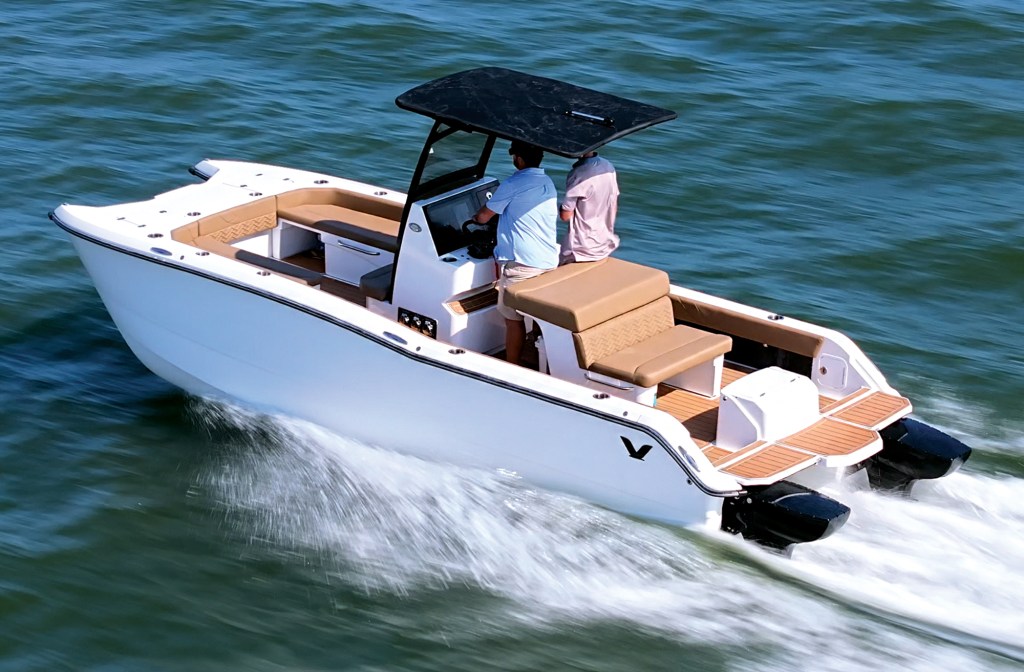
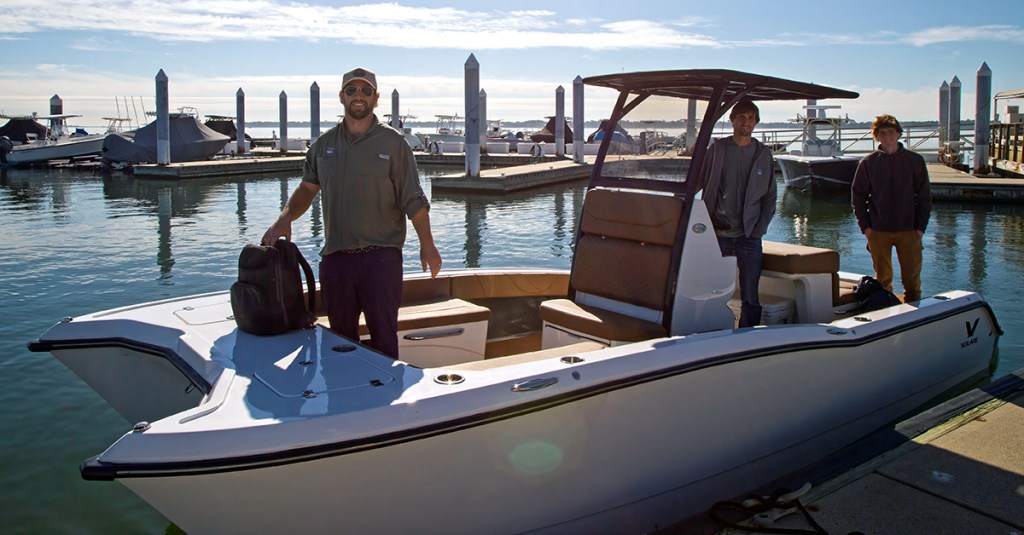
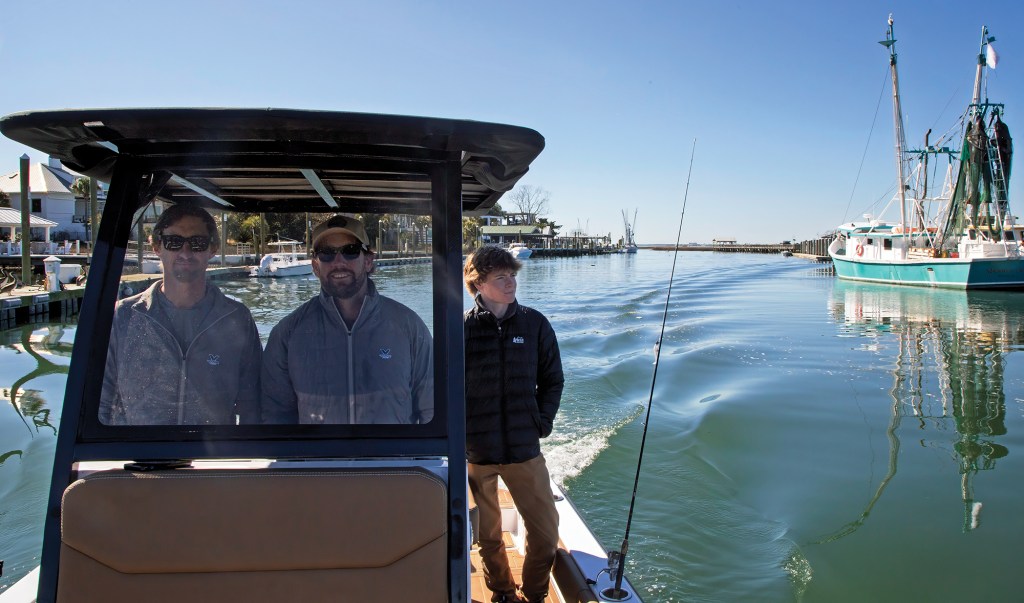
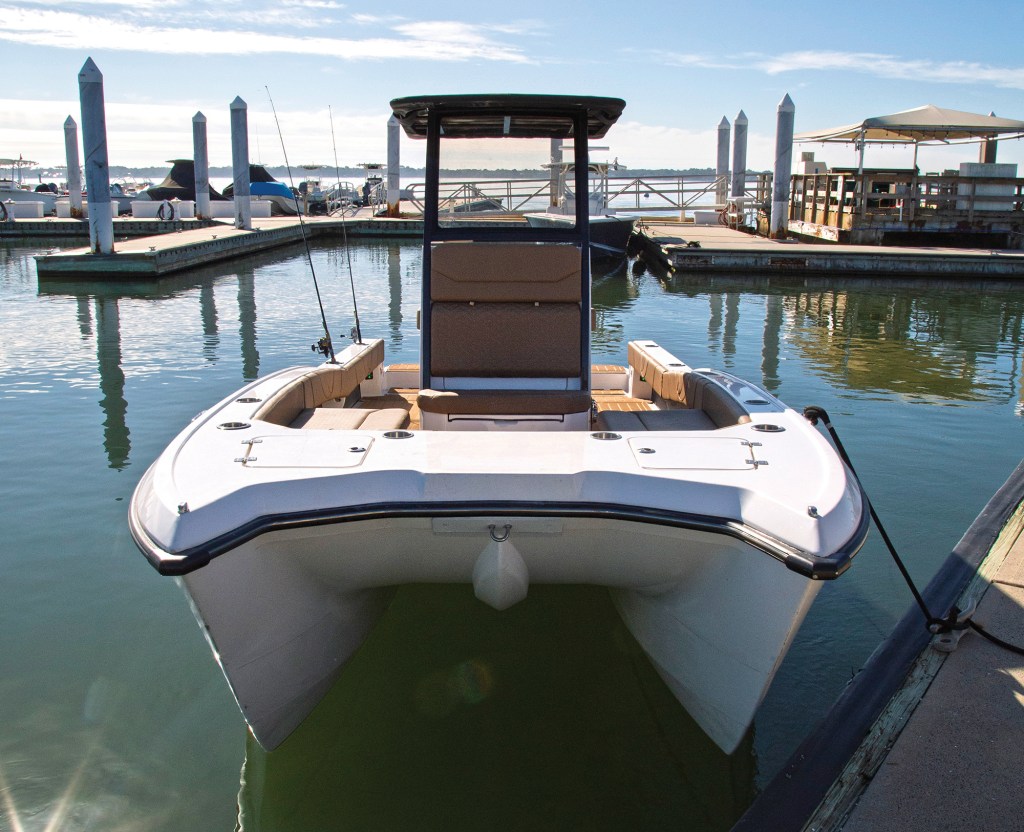
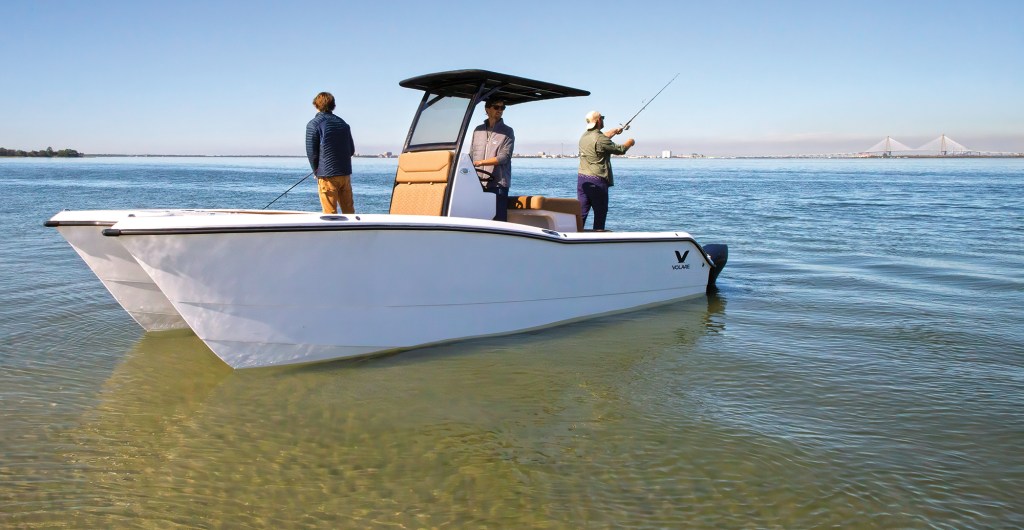
A warm midwinter’s day finds my son and me aboard Dustin Tupper and Matt Moore’s 23-foot center-console catamaran on Charleston Harbor. With high freeboard forward and a graceful descending sheerline, she’s sleek and eye-catching. But here in the hometown of Freeman Boatworks, handsome twin-hulled center consoles are common currency. And with its carbon-fiber T-top, Garmin-screened helm, and stitched leaning post—well, from abeam we might appear to be at the helm of a locally built Scout. That is, until the throttles are mashed on the Volare Artemis 23. Despite having twin outboards that only produce around 33 horsepower each, the carbon-fiber hull lunges forward like a scalded dog and planes instantly—a holeshot I’ve only ever felt aboard a quad-400-powered Freeman. But there’s no bow rise, and almost no sound—because the Artemis is lifted by a fixed foil—and she’s electric.
With a “Holy s—!”, I point the bow towards Charleston’s offshore jetties. “She’ll only top out at 30 miles an hour (26 knots),” says Tupper. “And her most efficient speed is 20 miles an hour (17 knots), but at that speed it’s seven to 10 times more efficient when you equate the kilowatt hours of electricity to the energy of gas required to maintain that speed. And each drive has only one moving part.”
The Artemis has been a labor of love for Tupper and Moore for the past four years. Since last Spring, they’ve been flogging her in southeastern waters—eager to have both the public and journalists drive their creation hard. That’s because they’re confident they’ve finally cracked the E-code: A production dayboat with the performance, reliability. and vitally, the range, to convince a boater like you or me to go electric. It’s a big hill to climb, and a big leap of faith to get there.
I first learned about Volare on a local news broadcast. A pretty young reporter headed out with Tupper, admitting she’d never driven a boat. But Tupper, a longtime engineer at Charleston’s Scout Boats, handed her the controls. She negotiated the cat through a skinny local creek with aplomb, but Tupper’s promise seemed improbable—40-plus miles of range, at speed, from an electric center console that drove and looked like, well, a powerboat. My skeptic’s radar pinged, but I was intrigued and reached out. Moore and Tupper immediately invited me to their small factory in Summerville. A stone’s throw from the huge Scout and Sportsman facilities, it’s a humble space they’re still tooling out. They don’t just want to build boats here, they want to build boats that haven’t been built.
Tupper, 39, and Moore, 37, grew up on the water together. Every summer’s day found them sailing, fishing, or racing along Charleston Harbor and through the local marshes and creeks. Moore had particularly been into sailing with his father, and the two made regular, occasionally terrifying passages between the Bahamas, Bermuda, and even Havana. Teaching sailing at Charleston’s Carolina Yacht Club, “I got a paid-for lunch, and made 7 dollars an hour,” laughs Moore. “I thought I was king of the world.”
“I never grew up with new boats,” Moore adds. “My dad would rather buy something out of the newspaper than get something new. We had a 17-foot Montauk (Whaler). To turn off the battery, you’d just take the wing-nut off the terminal. I didn’t even know about battery switches. I didn’t even really know new boats were like, a thing. Dustin and I—none of our friends ever had new boats. My dad got a 1980-something 23-foot SeaCraft when I was in college. It was the biggest powerboat I’d ever been on.”
Moore and Tupper both studied engineering at Clemson University, overlapping one year and continuing their childhood run of getting into trouble on and off the water. When he graduated, Moore was immediately hired by Scout. Tupper worked with his father, who ran a company that made geosynthetic fabrics and automotive textiles. Two and a half years in, Tupper called Moore about working for Scout. Moore chuckles: “That’s the last favor I ever did for Dustin. He quickly climbed the ranks.”
Tupper evolved into a director of engineering. He had a hand in the design of new builds for the better part of a decade—including the birth of “Project Everest,” Scout’s monster 670. Moore and Tupper worked on a myriad of digital partnerships with companies like MDI and Dometic—creating integrated plug-and-play systems that replaced ultra-custom wiring harnesses. There was also figuring out how to answer complicated engineering scenarios: How much lithium battery power would run an air conditioner overnight on a 400 LXF instead of a genset—and what changes would safely make that a reality? Moore ran the medium-sized boat facility—27 to 35 footers, then the 38- to 67-foot plant. He and Tupper regularly butted heads, because getting production boats out of the factory on time doesn’t always jibe with having everything on the boat 100-percent ready. “We had some epic drag outs,” Moore recalls.
After nearly a decade in a stressful factory environment, Moore longed to start his own company and he wanted Tupper to join him. In their differing, but complimentary roles at Scout, “we saw it from the consumer side, we saw it from the builder side,” says Moore. “We knew the pain points of both. So the goal would be to solve those pain points. I mean, I heard just this morning. ‘I just want a friend’s boat.’ We want to solve that problem. From the way you drive it to how you take care of it.”
“I was like, man, I know we can do it,” adds Tupper. “But there are so many boat builders now. It feels more like you’re building a brand than a boat company. What can we do to be really different?”
They didn’t consider themselves particularly green, but both saw possibility in the electric realm. The elephant in the room, though, was the basic fact that compared to cars, boats create enormous drag that goes up exponentially with speed—simply because water is so much denser than air. Electric motors are exceptionally efficient, but even the best batteries pack nowhere near the energy of a gallon of gas or diesel. The most efficient way to solve the drag issue is raising the hull entirely above the water on foils, which some builders have been trying. But that’s expensive, it requires complicated software to maintain a boat’s attitude, and when driving, it doesn’t feel like, well, a boat.
Tupper and Moore had closely followed fuel-efficient catamaran tech from TwinVee, World Cat, and Freeman. Even bigger advances in efficiency were coming from petroleum-powered cats with fixed, hull-spanning foils via builders like Aquila. A fixed foil doesn’t require constant software adjustments, gives up little draft, and simply generates lift passively. Aquila’s foil supports around 40 percent of the boat’s weight at speed, and gives upwards of 35-percent greater fuel economy over the foil-free model.
The pair had watched companies like XShore and emerging builders of powerful and relatively simple outboards like Flux Marine and Torqeedo. Monohulls weren’t proving efficient enough to deliver the range for a full day on the water without a massive battery pack. “That’s why we said, let’s do catamaran, electric, and foiling,” says Tupper.
None of this might have happened though, until a fateful day in 2022 when Tupper called a colleague named Brian Robinson. A longtime engineer at Lenco, Robinson’s innovations included ‘Troll-N-Go’, a joystick-controlled dual trolling motor system Robinson had developed with Scout. When he launched MDI electronics, Scout collaborations continued. In around 2015, Robinson and Scout’s Steve Potts experimented with new lithium battery systems and electric motors. “That bug just continued for me and Steve,” Robinson says. “But how do we make the boat go fast enough, and far enough? Just bolting on electric drives just doesn’t do it. You have to really look at every level of efficiency.”
When Robinson sold MDI, he found himself with the financial freedom to collaborate on new ventures. Eventually, another colleague, Scott Wood, connected him with Pete Melvin of Morelli & Melvin yacht designers—an America’s Cup foiling hull guru. “Pete—he’s a visionary,” says Robinson. “He was like, ‘This would be fun.’”
Working with a pair of mad-scientist firefighter fabricators, Robinson launched a venture called HydroFly. They built a 20-foot cat, “to determine if we could measure the efficiency gains of an efficient hull. And then, what happens when you add a foil? And then, what does electric propulsion mean on that?”
They experimented with foiling configurations driven by Torqueedos and E-Techs. Then came Dustin Tupper’s call. “I said, to Brian, we’re thinking about doing a catamaran; electric, semi-foiling,” Tupper recalls. “And he’s like, I’m working on something right now.”
“I’ll never forget it,” adds Moore. “Dustin says, ‘You’re never going to believe this. Brian’s already working on this, and they’re looking for a partner.”
“These are just down to earth guys I’ve known for almost a full decade, from Scout,” says Robinson. “They were two of the young engineers that truly helped Steve transform that company.”
Suddenly, Tupper and Moore shiftedfrom working for a boatbuilder to becoming a boatbuilder. Since both were starting young families, the harder sells were their wives. “They thought we were a little crazy,” Tupper says. “But they’ve been super supportive.”
They settled on the name, Volare, or “to fly” in Italian. After securing their small factory, the first order of business was a new test hull. “The criteria was, if you’re looking at it from profile, it can’t look like a cat,” says Tupper. “We don’t want it to look boxy.”
“I think we spent a month and a half just on the shape of the bow,” adds Moore. “We did a storyboard with boats we really like. I’m from the sailing world. Wally, Wajer, they’re so pretty. But that’s too far. We gotta bring some Lowcountry and southeastern boating into it. We call it Eurostal—European blended, coastal functionality.”
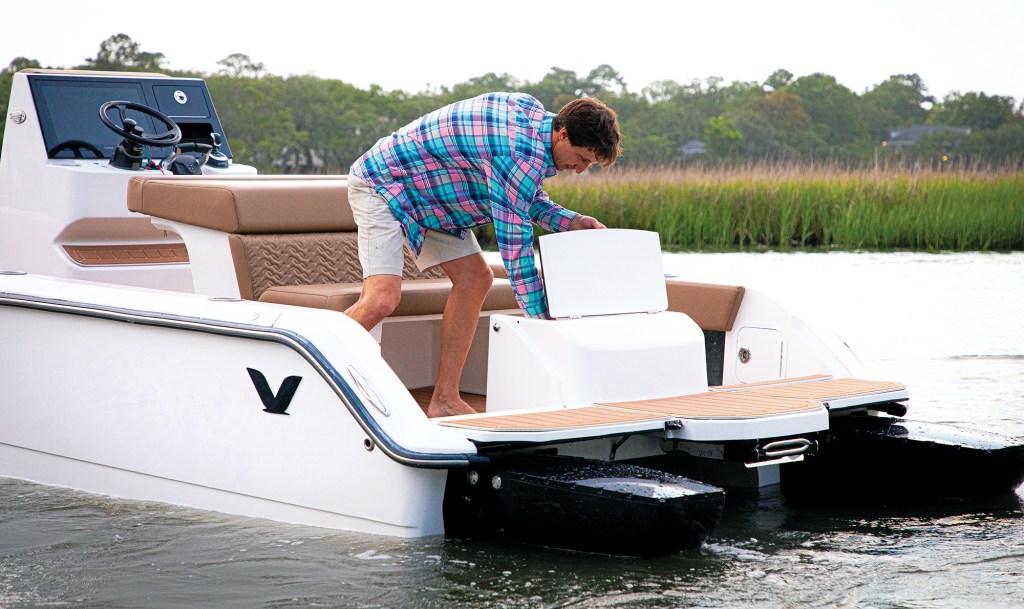
A 23-foot length would hold 10 people, and offer the sheerline and bow rake they were after. Full carbon-fiber construction would keep weight in the 3,500-pound range, with batteries and motors. Cool, 3D-printed boxes would be employed for storage instead of hatches—so you only had to load and unload gear once. They called their test mule “Hull Zero.”
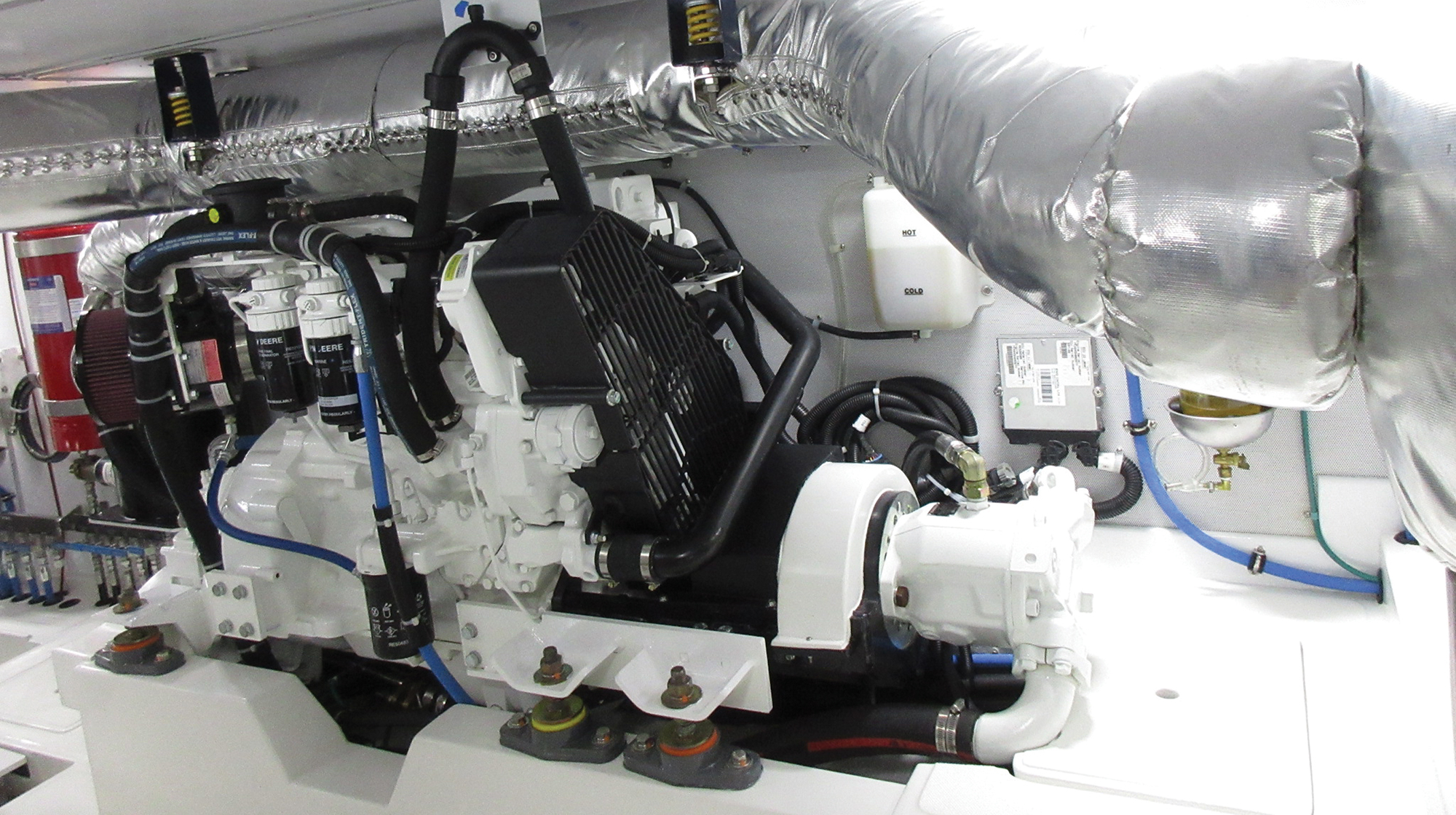
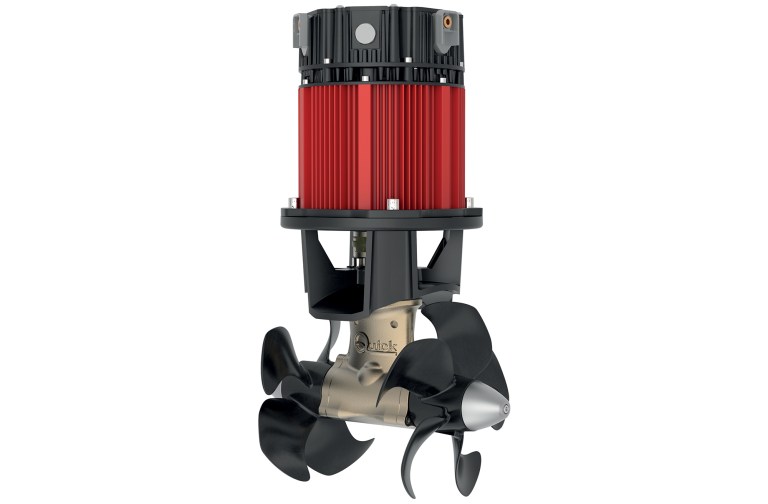
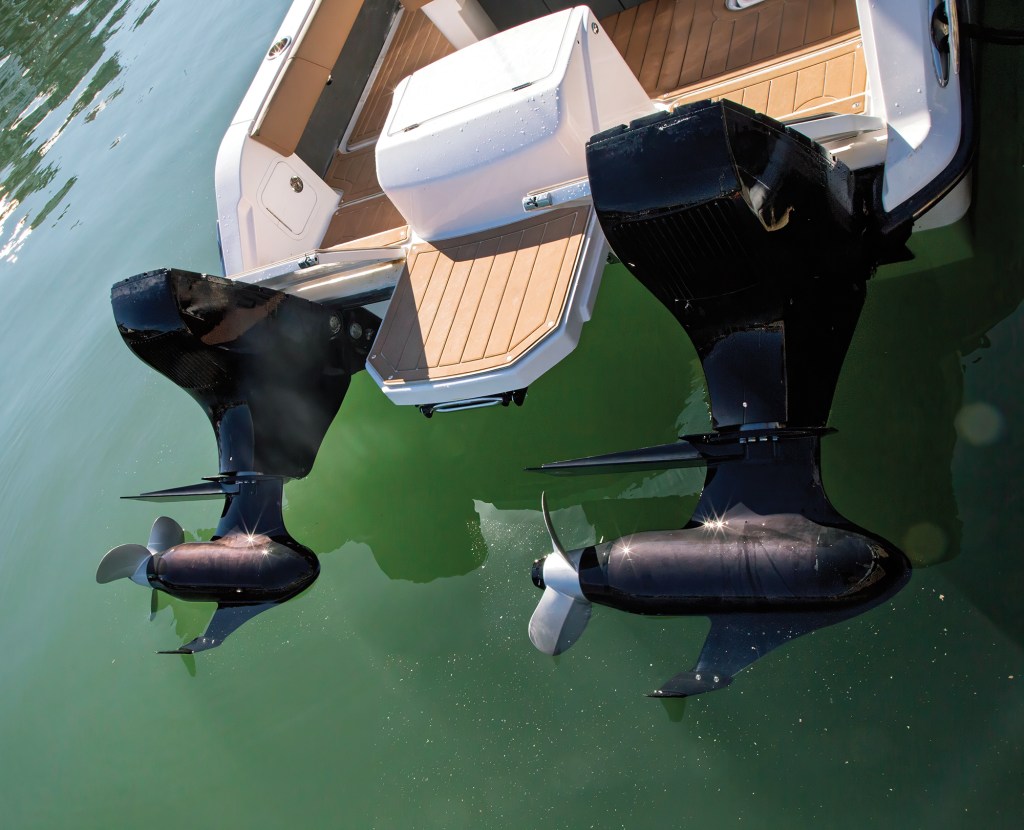
For the first round of propulsion, Volare worked with Dometic on a prototype “Volcan” outboard whose 25kW (33-horsepower) nacelle motor directly drives its propeller. Turning comes via the lower units much like Mercury’s 600, but the torquey Volcan lower units rotate 90 degrees each way, to the Mercury’s 45, delivering 360-degree rotation via the steering wheel. The motors also ran on 48 volts, much safer than 400-volt systems many companies are building.
Tupper and Moore wanted power to be “battery agnostic,” upgradeable as technology improved, and to run cool enough so no water- or glycol-based cooling was needed for the batteries or motors.
The Artemis’s test efficiency amazed. A gallon of gasoline holds around 33.7 kilowatt hours of energy. On a full charge, the 61-kilowatt-hour lithium battery pack delivered nearly 40 miles of range at 17 knots, and nearly 27 miles at her top speed of 26 knots. This equated to around 1.67 kWh of energy use at 17 knots, and 2.3 kWh at 26. More simply: At 17 knots, she gets nearly 20 miles per gallon.
Recently, Volare installed a set of solid-state batteries— what we went out with. The batteries weigh half of the LifPO4’s they replaced, and deliver 80 kWh instead of 61. This allows for a range of 47.8 miles at 17 knots and nearly 35 miles at 26. In comparison, a Yamaha-250-powered TwinVee 22 Bay catamaran consumes over 8 kWh per mile at 17 knots and over 9 kWh at 27 (averaging around 3 miles per gallon). A Yamaha-300-powered Pursuit 248S consumes around 20 kWh at 20 knots and 14 kWh at 26 (averaging 2 mpg).
“We designed the boat for efficiency,” says Moore. “Because we knew the first question on anyone’s mind was going to be, ‘How far does it go?’ What we did not fully understand was that when it gets up on the foil, how smooth the boat is.”
I can vouch for that—and for the boat’s consumption. The day my son Fritz and I joined Tupper and Moore aboard their fully-outfitted Hull Number One, the solid-state batteries were at a 60 percent charge. After nearly two hours of running around offshore, through the harbor and up into Shem Creek, a 30 percent charge remained. As for the ride? Well, even my prematurely jaded, Yamaha-loving 16-year-old son was impressed. For docking and trailering, the Artemis is more maneuverable than anything I’ve driven. Her big props can spin at a mere 100 RPM. With her Optimus joystick engaged, there’s no pause between forward and reverse. She goes exactly where you want, when you want, at the speed you want. A novice could maneuver her like a pro.
On the harbor, the water was glassy, but there were enough big boats running for us to test Volare’s chop chops. The cat gave no quarter in devouring the wakes. With small foils on her motors and the foil between her hulls, she’s very sensitive to motor trim; a few degrees is the difference between running bow up in calm conditions or bow down for chop. Offshore, a healthy swell awaited us, so we ran through it at pretty much every angle. Head-on, she absorbed the swells as if on a cushion. Taking them at a forward angle, she stayed firmly planted. Running with the swells on our stern quarter I wanted to see if she would be pushed sideways, as some cats are wont to do, but she tracked straight. Farther out, a shoal was focusing the swells into beautiful longboard waves, so my surfer son edged the Artemis into pretty shallow water just outside where the waves were breaking. With the steep swells at our stern, we literally surfed towards shore. Like piloting an electric foilboard, it was smooth, silent, and fun as hell.
As for complaints, they are few. First, the flat foil is not affixed to the hulls, but sticks down four inches below them independently amidships. In sharp, choppy turns at speed this can cause some skipping at the stern. Tupper and Moore are about to deploy a new dihedral foil that bolts directly to the sponsons. They say it will not only correct this, but enable the boat to bank more into turns. The other minor issue was simply another function of the foil. We had no trouble getting the boat into very skinny water to unsuccessfully cast for redfish, but the foil was, of course, the first thing to encounter the sand—so more care is needed when sandbar-hopping than on a non-foiling craft. I would suspect that the dihedral foil, which will be angled down towards the center, will work a bit better, because passengers could side-weight the boat should she hang up.
The 27-knot top speed of the 25 kW (33-horsepower) Volcan drives is not earth-shaking, even if the acceleration is. Couple that with the crazy-quiet operation and you simply don’t feel like you’re going as fast as you are. You can carry on a quiet conversation, and for those accustomed to droning outboards, it’s almost disconcerting. Tupper and Moore currently have Hull Zero equipped with 40 kW test motors from UK-based RAD Propulsion—and they plan to use these for production boats. They’ll offer the same 90-degree lower-unit turns, but will push the boat to 30 knots, still needing nothing more than a hose-down after a saltwater day.
As for the near future? Well, new sodium-ion test batteries should be arriving any day, Volare has sold four hulls and they just won a hotly contested local business grant from Charleston financier Ben Navarro. The near million-dollar prize is nice, but even better is the $217,000 order for an Artemis 23 to serve The Cooper, Navarro’s new waterfront Charleston Hotel. The Cooper had originally planned to purchase four new Scouts. But now it’s three Scouts, and an Artemis. This summer, hull number six will go to an early adopter from Virginia named Victor Rortvedt. A Tesla-driving owner of a Danish-built Rand electric monohull, Rortvedt loved the electric dayboat idea, but needed more range. He’ll run 160 kWh of solid-state batteries and RAD motors for a projected 80 miles of range and Chesapeake Bay peace of mind. “We did a water test in August and I was really, really surprised by the quality of what Volare put together,” he says. “As far as the specs, for its ability to propel itself, the stability, the speeds it can reach, and you know, it’s such a quiet boat. It’s really great for families and extended families and groups of friends to get together. Really, it kind of converted me back to being excited to stay on the electric boating journey.”
A few days after our first drive, Tupper, Moore and I engaged in a little thought experiment. Fast chargers are few and far between at American marinas. Say you want to dock for lunch and plug in. Would you get any usable range? We hooked up to a standard 50-amp dock outlet and fueled ourselves on chicken, rice, okra and tomatoes. An hour later, the battery had gone from an 81 percent state of charge, to 89—good for eight or nine miles at cruise. Not groundbreaking, but a nice top-off. “My favorite question is, ‘Hey Bo, what happens when you run out of battery?’” Moore says. “Well, ‘Hey Bo, what happens when you run out of gas? Don’t do it.’”
“I’ve known boats my whole life,” Tupper adds. “What Scout taught us was production boat building, right? We learned from building what we built to be the best. Now we’re going to take that knowledge and those quality steps to build the best boat out there.”
Listen to Chris’ conversation with the guys from Volare on our podcast >>
This article originally appeared in the April 2026 issue of Power & Motoryacht magazine.
Info: volareboats.com