
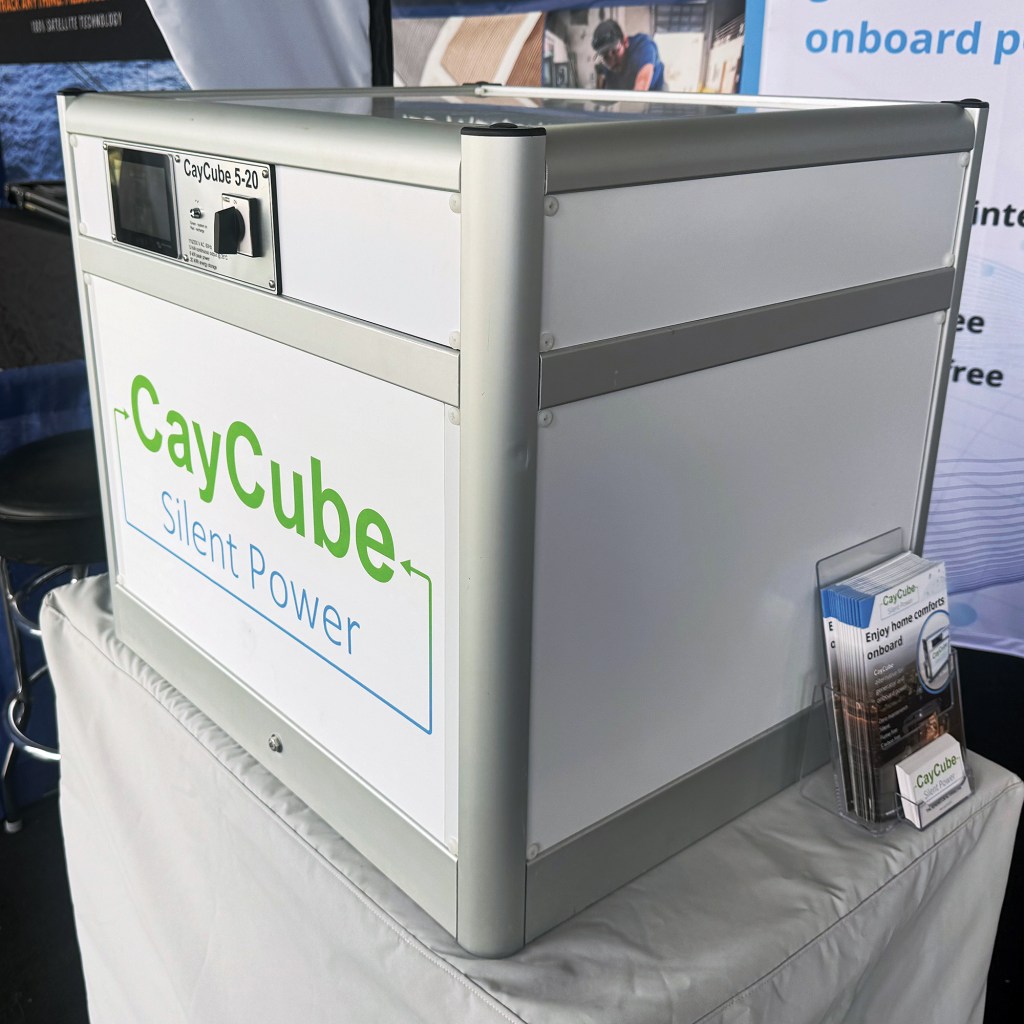
Each of the last few years, the Palm Beach International Boat Show has gained momentum and prominence. This year that momentum continued with several new product announcements. The CayCube from Cay Electronics made its Florida debut after an appearance at the Newport show and caught my eye. This self-contained AC and DC power system offers numerous integration options and helps solve numerous problems for boaters, boatyards, and service providers.
As CayCube Co-creator Rufus Van Gruisen explains, Cay-Cube is a self-contained 48-volt DC and 120/240-volt AC power system. It’s available in three models with three power levels: 5 kilovolt-amps (kVA) of inverted AC power with 20 kilowatt hours (kWh) of energy storage, 10 kVA AC with 40 kWh of storage and 15 kVA AC with 60 kWh of storage. The units are priced at $28,995, $49,995, and $69,995 respectively. CayCube also offers a single or dual 8kW alternator package with Arco Zeus alternators and regulators for $3,495 and $6,895 respectively.
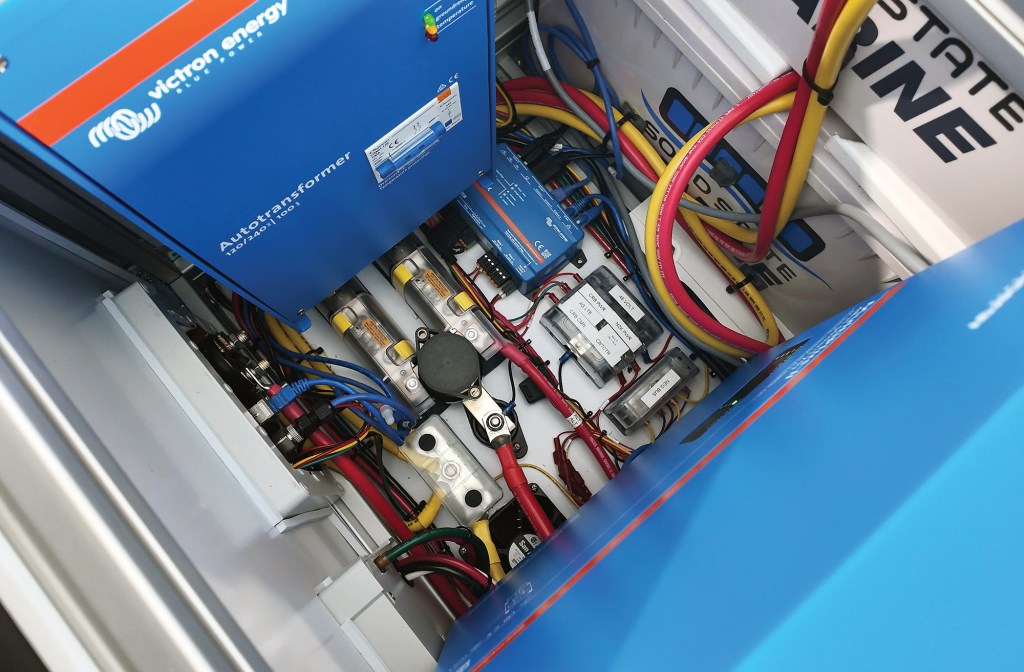
Fundamentally, a CayCube is a boat’s AC and DC power system in a box. That box contains carefully selected and integrated components. Nearly all those components are familiar, commodity parts. The power conversion and conditioning equipment is Victron’s, the batteries are from Solid State Marine, and the bus bars and distribution components are mostly Blue Sea and BEP. So let’s get something out of the way right up front. Yes, with some skill, you too can build a product very similar to the CayCube—probably for less than the retail price of the cubes. But I don’t think that’s the point of the product. A packaged solution offers significant value, and the time to properly engineer and assemble a product like this is far from trivial. Cay Electronics estimates a retrofit of lithium batteries, inverter, and attendant systems and components requires 40 to 80 hours of labor. As labor and installation rates close in on and exceed $200 per hour, that represents between $8,000 and $16,000. Having completed quite a few projects of that scale, those numbers feel right, or maybe even low.
At the heart of the cube sits a Victron MultiPlus II. This inverter/charger carries a rating of either 5,000, 10,000, or 15,000 VA depending on the CayCube model. In a familiar approach, they have selected a 230v model programmed to output 240v, 60hz AC power. That power feeds an autotransformer providing 120/240v split-phase output for all 120- and 240-volt loads on the boat.
The DC side of the CayCube brings power from the batteries directly to Class T fuse holders. A large contactor sits on the output of the fuses and controls DC power to the system. From the contactor, DC power routes to the inverter’s DC connections and to the DC connection on the CayCube’s DC output box. The power connection on the output box can feed the boat’s DC house system at 48 volts. For boats with lower-voltage house power systems, DC-to-DC converters—and possibly lower-voltage batteries—will need to be employed.
Control and management of the CayCube comes from a Victron Cerbo and touch screen. Cay has not tried to disguise or obfuscate the obvious Victron bones of the system, and I think that was a good decision. I haven’t done a thorough evaluation of the cost of the components, and I don’t think it’s really the point. But, just looking at the cost of the batteries ($15,000), the inverter ($1,500), and the Autotransformer ($500), I don’t see as large a premium for the fully integrated system as I might have expected. The numbers of the CayCube do get up there, especially at $70,000 for the 15kVA/60kWh model. But, that’s a huge amount of power and not a power system we typically see quoted as a single number.
So what applications make sense with CayCube? To have that conversation, we need to talk about its physical size. Taking a look at the technical specs, the CayCube comes in very close to typical generator sizes. For example, a Cummins Onan generator sized from 4 to 5 kW weighs 365 pounds and occupies a space 20 by 26 by 21 inches. Stepping up to a 9.5 to 13 kW generator, you’re looking at 695 pounds occupying 22 by 41 by 23 inches of space.
Overall, it appears a similarly sized CayCube may be slightly larger than a similarly sized generator. However, without an exhaust system, cooling water system, and fuel lines, the total system size and weight is likely to be the same or less for a CayCube. Additionally, most boats for which a CayCube is an appropriate tool would have an inverter, deep-cycle batteries, and other components elsewhere.
Which platforms make the most sense for this unit? A larger day boat strikes me as an ideal platform in a generator-free application. These boats tend to be stored at a dock with shore power and typically don’t stray too far or for too many nights. At the Palm Beach show, Hinckley brought a 37-foot picnic boat demonstrating their refit program. The boat included a CayCube 5 kVA/20 kWh. (Hinckley will offer CayCubes to refit customers.)
Longer-range boats with generators can benefit dramatically from a CayCube and the ability to run the generator less. Plus, when the generator is running, its output can be better utilized to quickly charge the CayCube’s batteries. Even larger boats with multiple generators can look at replacing one generator with a CayCube and making use of the alternator charging to provide redundancy while also reducing generator run time. I am a big fan of any solution that reduces generator run time. No matter how quiet, I find the rumble and exhaust of a generator highly disruptive to the peace of an anchorage.
But, I also love my creature comforts. So, a system that allows me to minimize that disruption while still providing all the comforts ranks very highly.
I don’t foresee a hands-on test of a CayCube. I don’t think I could fit one anywhere but in the cabin of my little Edgewater 28. But, I do look forward to keeping up with Cay Electronics and seeing where they take this product. My hunch is that they will find plenty of demand for a pre-engineered, pre-integrated, marine-specific power system with best-of-breed components.
This article originally appeared in the August/September 2026 issue of Power & Motoryacht magazine.