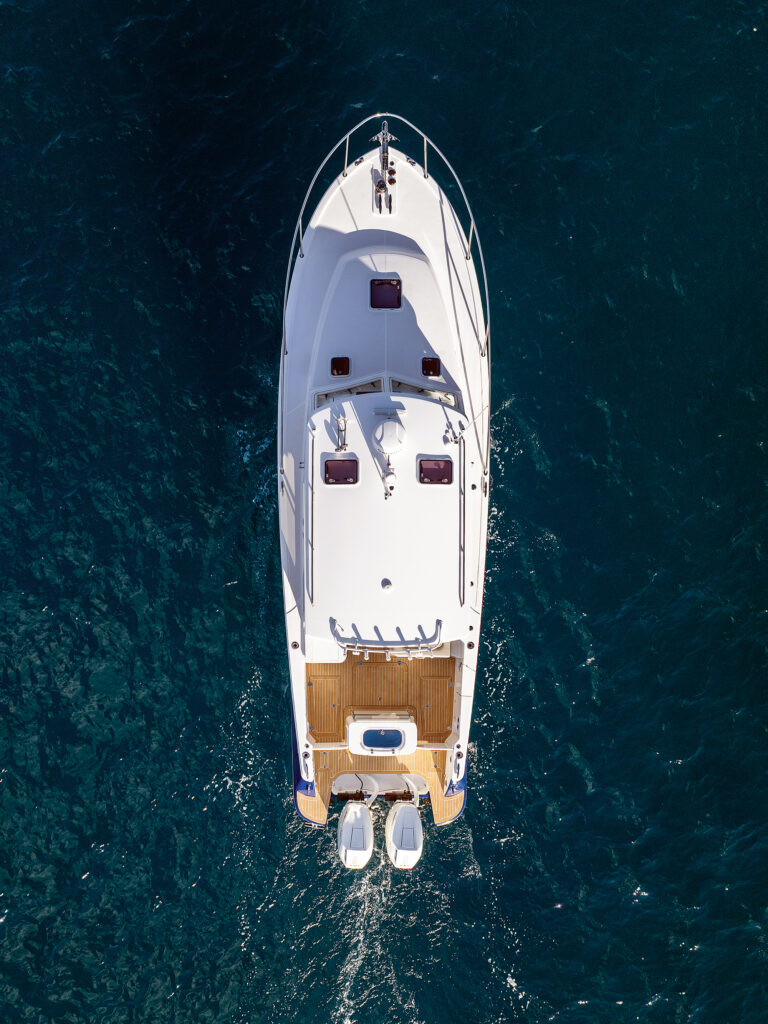
“We gave a valiant effort,” Jeff Donahue, MJM Yachts’ Vice President of Sales, told me after I’d spent a few hours perched on the ample bow of the builder’s surprisingly fishable new 38RS, or “Retreat Sportfish Series,” as they’re billing this family-friendly sportfish-cruiser crossover.
My first sight of the 38RS was at its debut, at the 2025 Newport Boat Show. Immediately, I thought back to my New England youth, eyeing the Hinckleys and Sabres, the Down East picnic boats that made up so much of the local fleet around me. How badly, in spite of their high-luster brightwork, mahogany coaming boards, and raw teak decks, I wanted to fish them. The Down East is, after all, historically a fishing boat through and through. Where, oh where along the line did they lose that precious, defining resonance with their DNA? Bereft of rodholders—save for perhaps a lone pair in the transom for ensign waving—fish boxes, and open cockpit space, Down Easts make fine picnic boats, but what of the fisher folk who want to cast aboard something with some connection to regional history, to their forefathers?
This sentiment has swirled deep inside of me since before I could even point out a Down East in a mooring field. I felt it when I looked at the jagged, fiberglass center consoles and cuddy cabins of the millennium—modern, able, and as angler-ready as ever—that just seemed to lack the soul of my grandfathers’ boats.
“Why would you ever want to get blood on those decks?” my father, a yachtie and a sailor with a general aversion to fishing (it’s often said that the predilection skips a generation) would say, trying to blanket his admonishment with a question, when I would ask whether these boats could be fished. And he had a point: The annual upkeep of those boats matched the entire price tag of our collective fleet: his wee catboat and my little lapstrake dory.
And so, something to the tune of a quarter-century later, there was the answer to my adolescent prayers. Other obsessions had, admittedly, since come and gone, but I never quite let go of this one. Dockside right where she ought to have been all along and in resplendent homage to the region and its working watermen, lay a true Down East built, in most modern-day respects, for doing what she was designed to do.
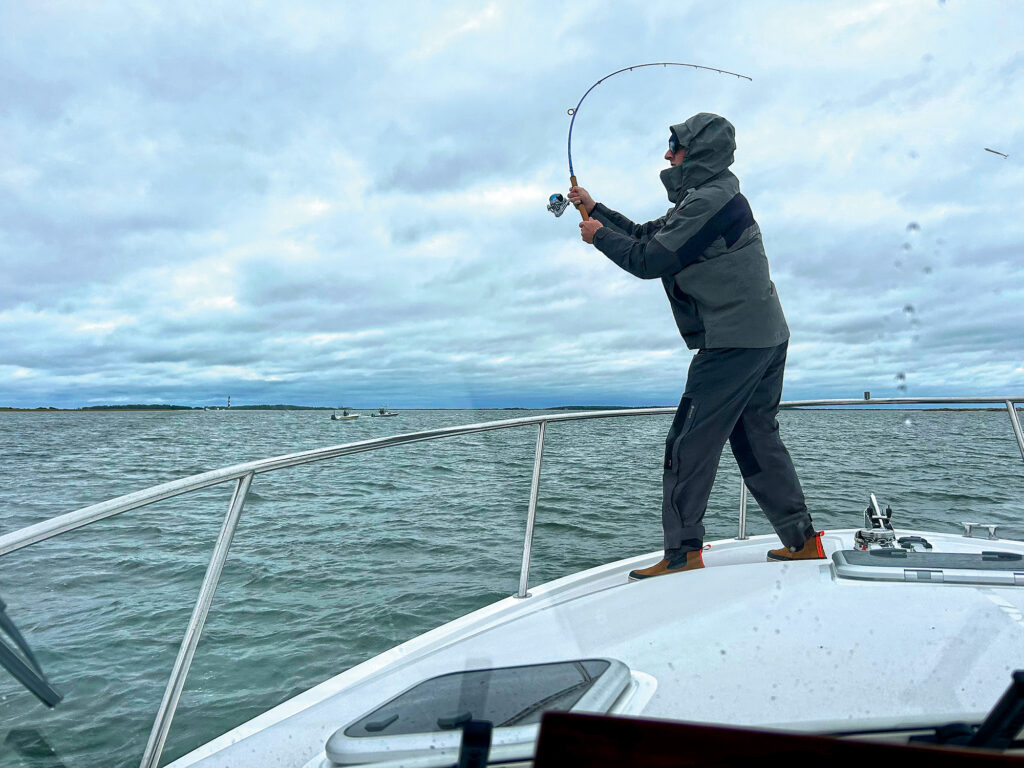
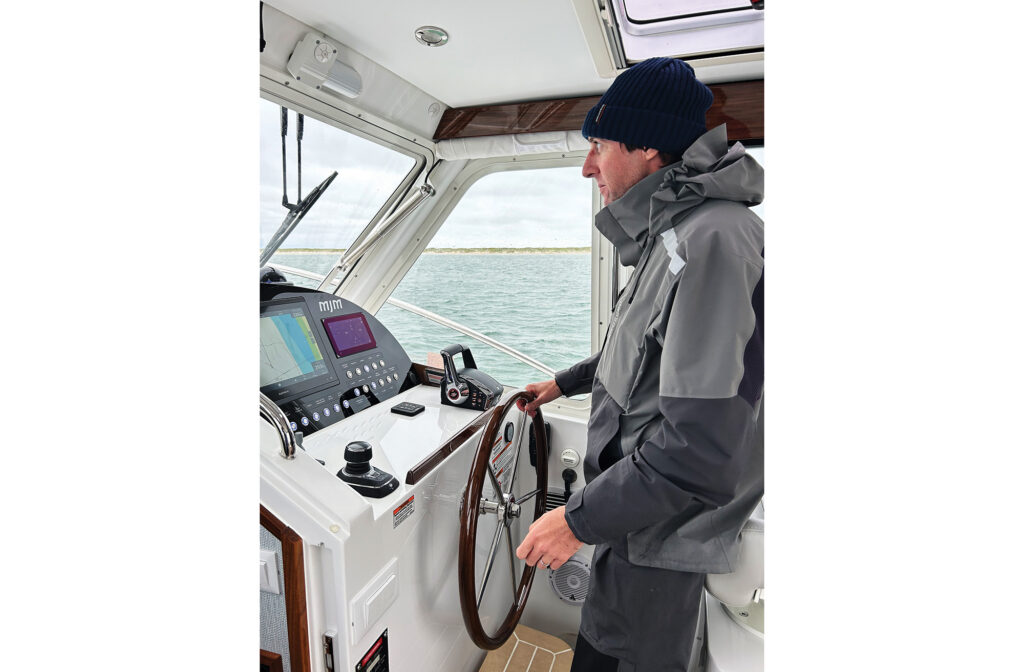
So a few months later, it was fitting that, during an early-fall trip to put hull number one of the 38RS through her paces off of Beaufort, North Carolina (down the Pamlico River and across the Pamlico Sound from MJM’s new headquarters in Washington, North Carolina), we were in the middle of a weeklong nor’easter fit for the hull’s namesake waters.
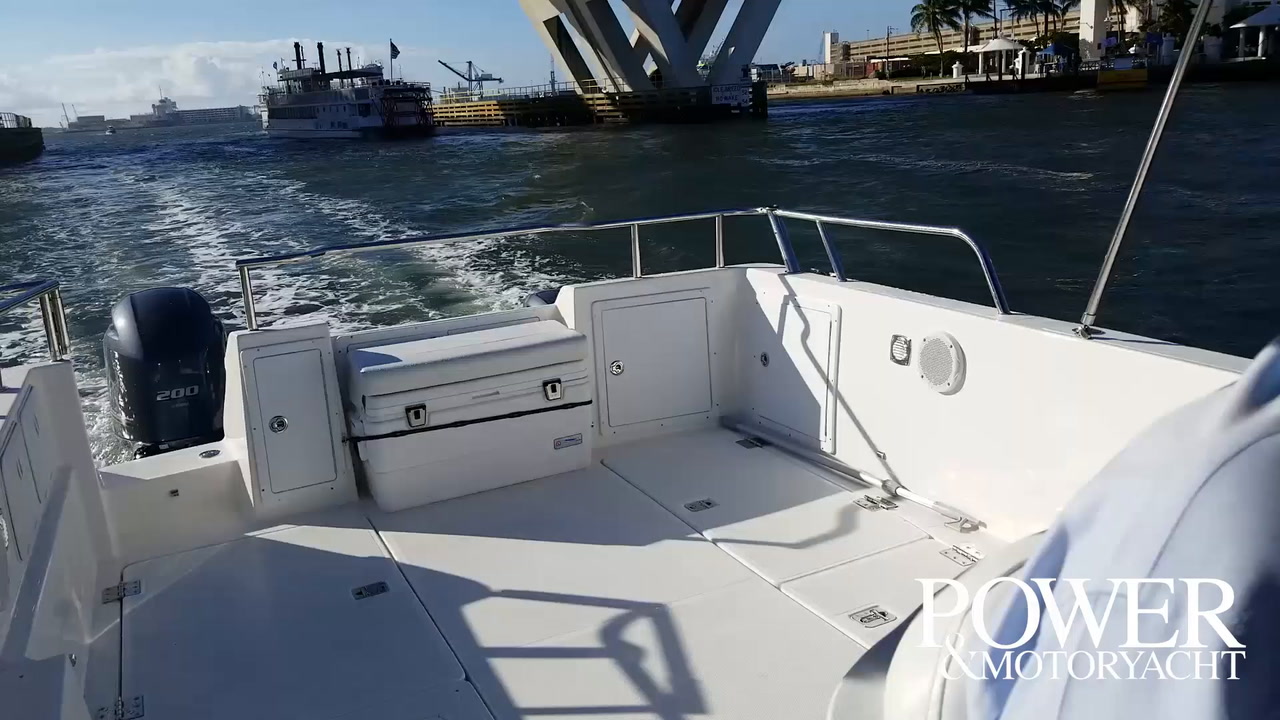
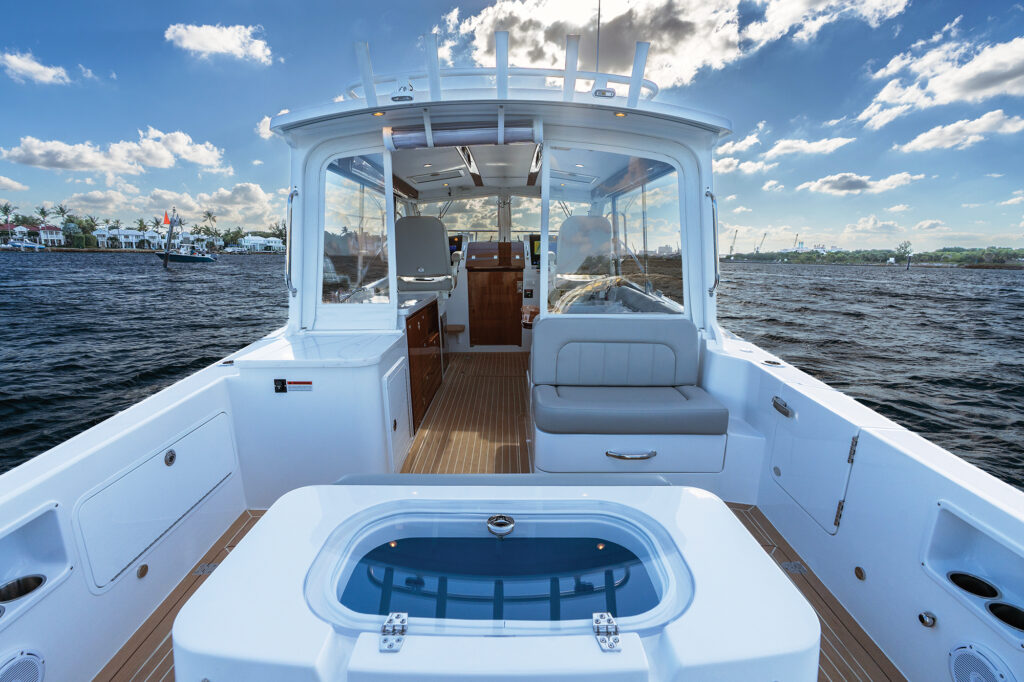
Standing in the cockpit and looking aft over choppy water, you almost feel as though you’re standing in the accommodating rear cockpit of a center console of the same size. A rounded livewell sits just aft of center if you account for the same-level swim platform that makes for a perfect walkaround when matching port and starboard safety doors are opened, keeping bait access central for all. Festooned with a forward-facing folding bench across from a fixed aft-facing bench just to starboard, the cockpit is sundowner-ready in a second flat. And if you really wanted to go over the top, you could have a capacious champagne bucket in that livewell, which no cocktail-cruising guest has to be any the wiser held mullet or menhaden mere hours earlier.
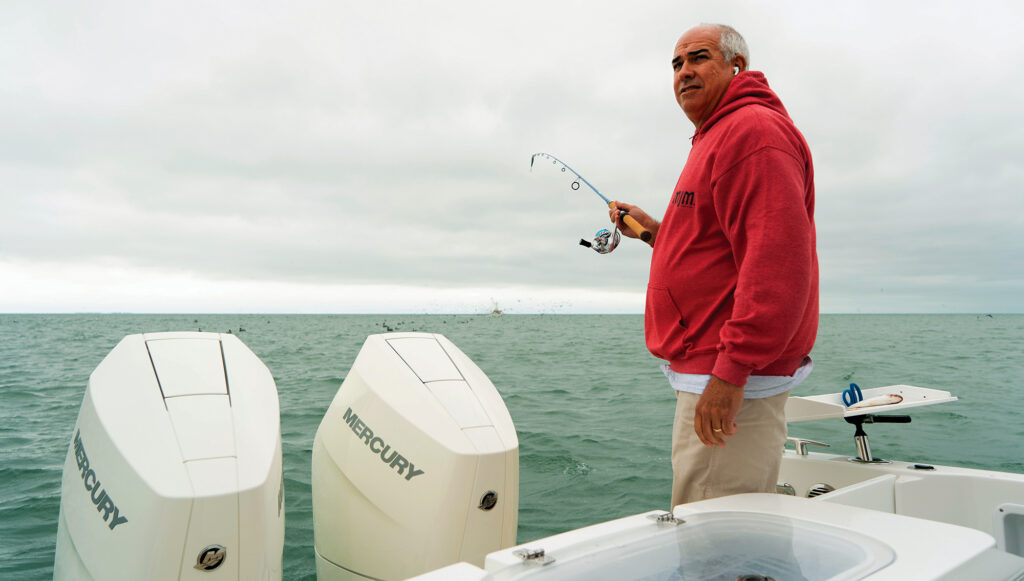
Among the very first things today’s recreational anglers will assess to gauge a boat’s fishiness is the number of rodholders on board. There are a four rodholders (some cupholder combinations) around the 38RS’ cockpit rails, two simple rodholders affixed to the aft section of the 40-gallon baitwell, and a seven-rod rocket launcher on the hardtop, to which outriggers can also be affixed.
This still leaves room for a tackle-storage system to port and aft of the pilothouse galley, and, beneath the bench opposite that, a hatch to a storage area that is just about fit for crew quarters—depending on how much you like your crew. Still, I figure you could fit a half-dozen offshore rods down there comfortably, with room for several boxes and bags to spare.
Once through the inlet, we worked our way down the beach to where local intel suggested the red drum bite had been on fire the previous day. We kicked on the Skyhook, which instructed our 400-horsepower V10 Verados (300-pony V8s are standard) to keep us stationary between what were now colliding winds, seas, and tide.
“We’re the Grey Poupon of the fishing fleet,” Donahue said of our faithful steed with the sort of candor I can’t recall having received from any VP of sales of any company. “No one’s going to fish this thing hard.”
It’s pleasantly refreshing to hear a rep be so honest about his company’s offerings. No, this isn’t a competitive fishing boat, so it might fall short in the eyes of someone who has regularly fished tournaments throughout his life. But to the metropolitan weekend warrior looking for a little trace of Hemingway existence come Friday evening, I’d give the 38RS a thumbs up.
You might not enter the White Marlin Open or engage in run-and-gun offshore duty, to Donahue’s point, but could you edge up to the rocks and have more than one or two hopeful anglers toss plugs, or set a handful of baits for a pleasant respite from the call of terra firma’s duties while drifting off into dreamland? You bet. I’d probably go so far as nearshore bluefin fishig in the summer. You would have no trouble taking a family or two out for some bottom fishing—or even diving or spearfishing. And all of the above would be done without much if any competition in the style department.
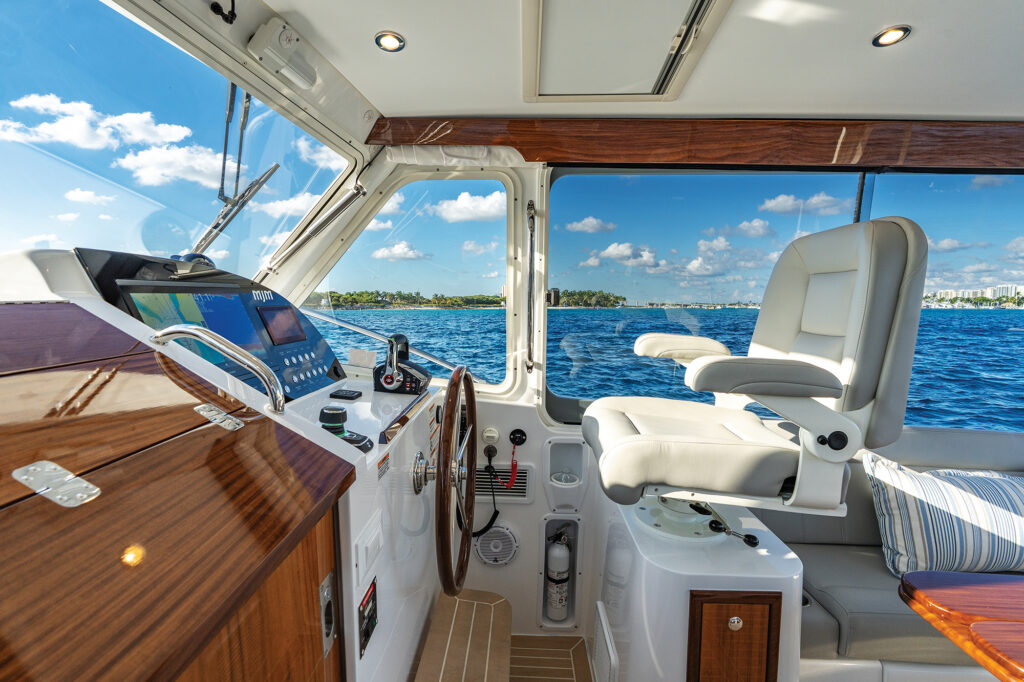
During this excursion, in these unseasonably raw conditions, I found Donahue and I rather nimbly assailing our prospective fishy foes with several manners of technique. Meanwhile, in the heated wheelhouse, MJM’s Marketing Associate, Madelyn Knobel, nursed a migraine from the L-shaped settee. My sympathies aside, I couldn’t help but notice how well this boat’s dualities performed.
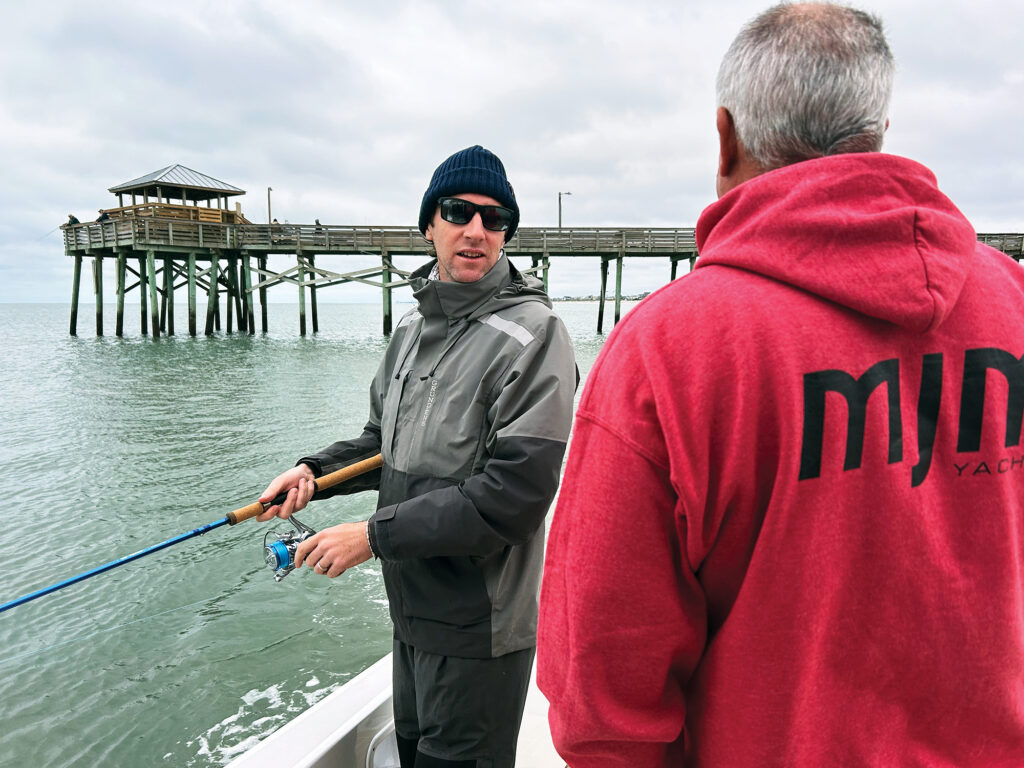
Donahue and I split the cockpit, slinging bait in the shallows near the inlet and down the beach, and vertical jigging on a nearshore wreck where I’m nearly certain I dropped a good grouper just before it broke the surface—through no fault of the boat.
The 38RS is, in every sense, a relic and an answer to the modern-day demands of overnighters, picnickers, and yes, anglers. The stern might have a curious pair of outboards to which inboard purists might not relate, but then their boats likely aren’t hitting anywhere near the 43-knot top hop we reached—in chop, at that. And while there are touches of teak topside and in the pilothouse, the decking is an engineered alternative, about which I proudly splattered the first bit of blood, if only from a small bluefish. That particular catch was a decidedly less honorable distinction in some light, but it gave me pause to laugh: I have a habit, or rather a curse, of traveling far from my home waters in the Northeast in search of relative exotics like red drum and seatrout only to be met by this one lone, and all too familiar genus.
I made a point of leaving that blood on deck not quite as a trophy but out of curiosity: How well does blood come out of this faux teak? Six hours later, the sun had broken through, I’d almost pulled off my Grundéns, and those stains were thoroughly baked in. Did my little experiment account for the fact that Donahue, Knobel, and co. would be showing this very vessel at the Fort Lauderdale boat show in two weeks’ time? Of course not. Fortunately for them, it came right up with little more than a splash of water and the wipe of a cloth.
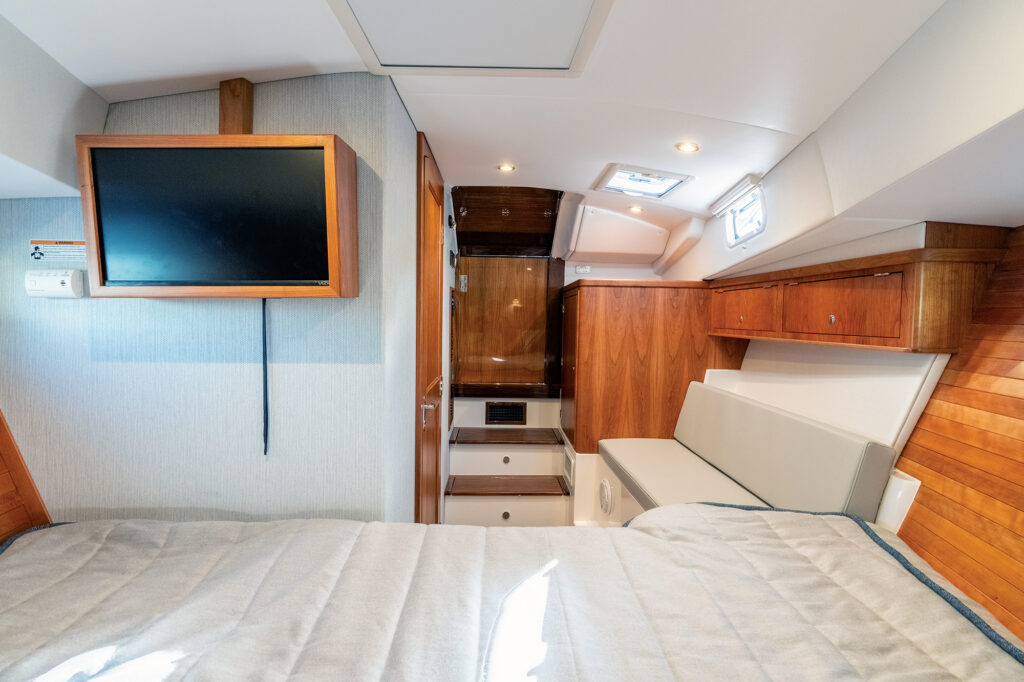
Below in the berth lay another world, something more endemic to the rest of MJM’s fleet and the haughtier picnic boats of our time. I felt no need to hunch or huddle as I stepped through the oiled cherry companionway, a delightfully bright finish that made up the bulkheads, lined the interior of the hull, and defined the entire cabin with its generous V-berth layout, shelving, and full-sized head with separate shower, complete with a bench. This wasn’t just a hideout or a hovel in an overnight pinch; it was much more inviting than most spaces I’m used to finding on a boat this size. Again, more space for the family to spread out and a world away from the mess and/or chaos that could be taking place in the cockpit. I also liked the large bench just aft of the forepeak to port, which offers a little living space beyond a berth, but more importantly makes dressing and changing a much easier affair in what is, again, an often tight nook on other 38-footers.
The one issue I foresaw down below was the neon-blue gleam coming from the large, uncovered systems panel on the bulkhead of the head. That’s an easy enough fix, but one you might want to address before spending the night.
Back in the pilothouse, I had designs on putting the flowing, galley-up design to work by showing Donahue a thing or two about the lesser-known epicurean delight of false albacore (aka bonita) crudo, at which he (and most other anglers) turn up their nose, but tend to become converts after a demonstration.
Later on, as we stationed ourselves in a rip during the last couple hours of a tide, I hucked epoxy and metal jigs at selective false albacore. While Donahue played run and gun at the helm and put me where I needed to be during the typically ephemeral feeds that took place, I planned a dish with a little soy sauce, a pepper, and a packet of crystallized lemon taken from the beverage cart on my flight down. Grey Poupon, indeed. I was going to put that Corian countertop to good use, I mused, noting that I’d have to work around the recessed television screen built peculiarly into the middle of it. That’s a design element I’d probably change, but then again, there was plenty of surface area to allow a cook to work around it. Not that it would matter on this day—the fish weren’t biting and my catch-and-cook prowess would have to be displayed to Donahue on a later date.
In the end, we might not have been the fastest hull in that agile little caravan of jaunty center consoles, though we had no trouble pushing 30 knots almost right out of the hole thanks to 800 horsepower behind us. And despite hitting nearly twice our speed, none of the CC crews in our group hooked up either. Most importantly, we remained high and dry while the rest of the fleet was dousing their foulies and feeling, we can only imagine, a bit raw. Given the choice in the blustery nor’easterly weather, I’ll take high and dry and fishless. Chances are that your weekend Hemingway would too.
This article originally appeared in the February 2026 issue of Power & Motoryacht magazine.