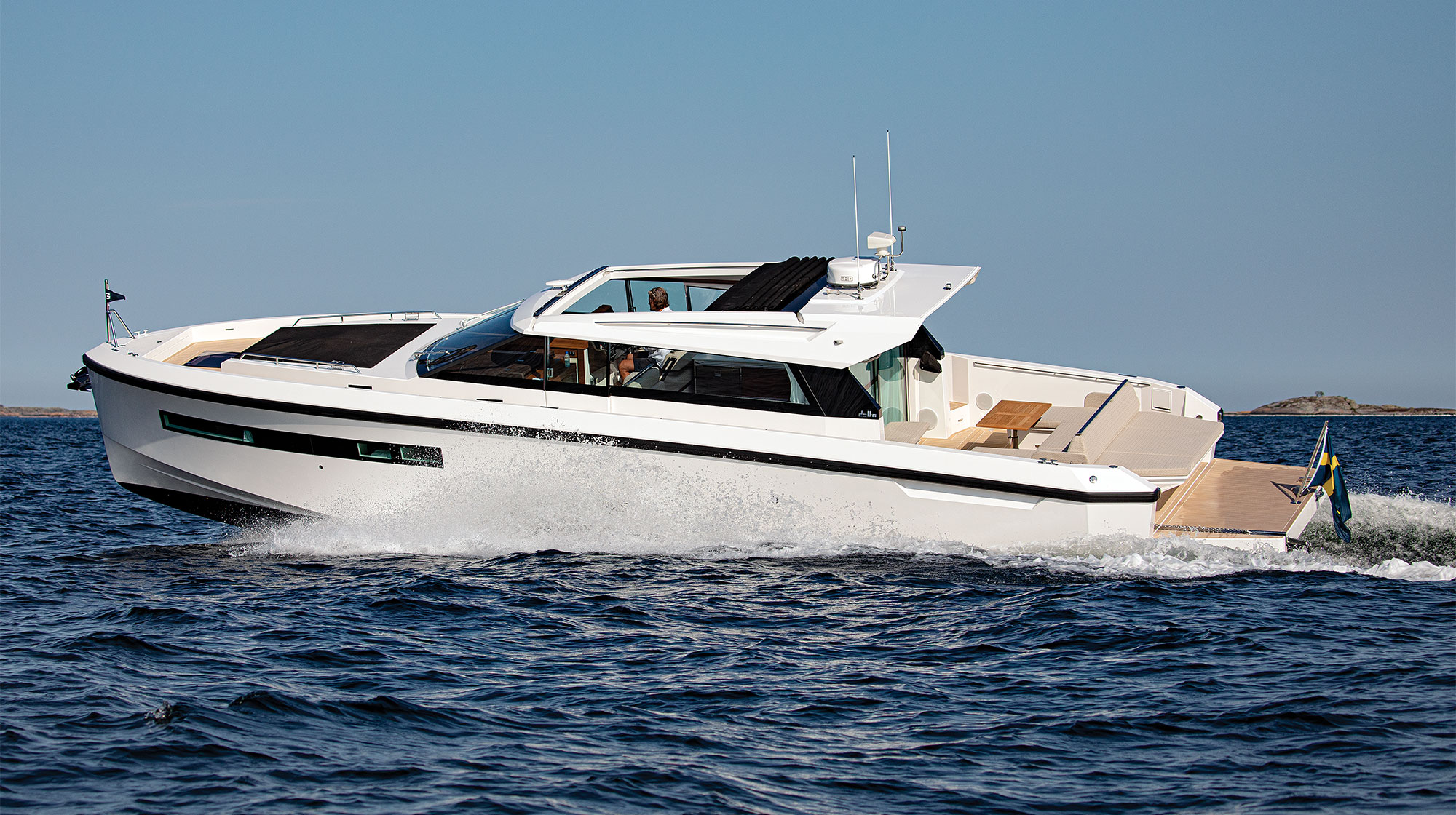

The boat traffic on Lake Worth Inlet was stacked up like I-95 in downtown Miami. It was move-out day for the Palm Beach boat show and a procession of yachts and giant sportfishermen was churning the waters into a frenzy of chest-high wakes bouncing around like bumper cars.
A steady southeast wind layered chop atop the building seas. These were exactly the conditions I was hoping for to sea trial the Regulator 35. Almost all boats ride well on calm days, but a few chunky, short-period swells will separate the wheat from the chaff.
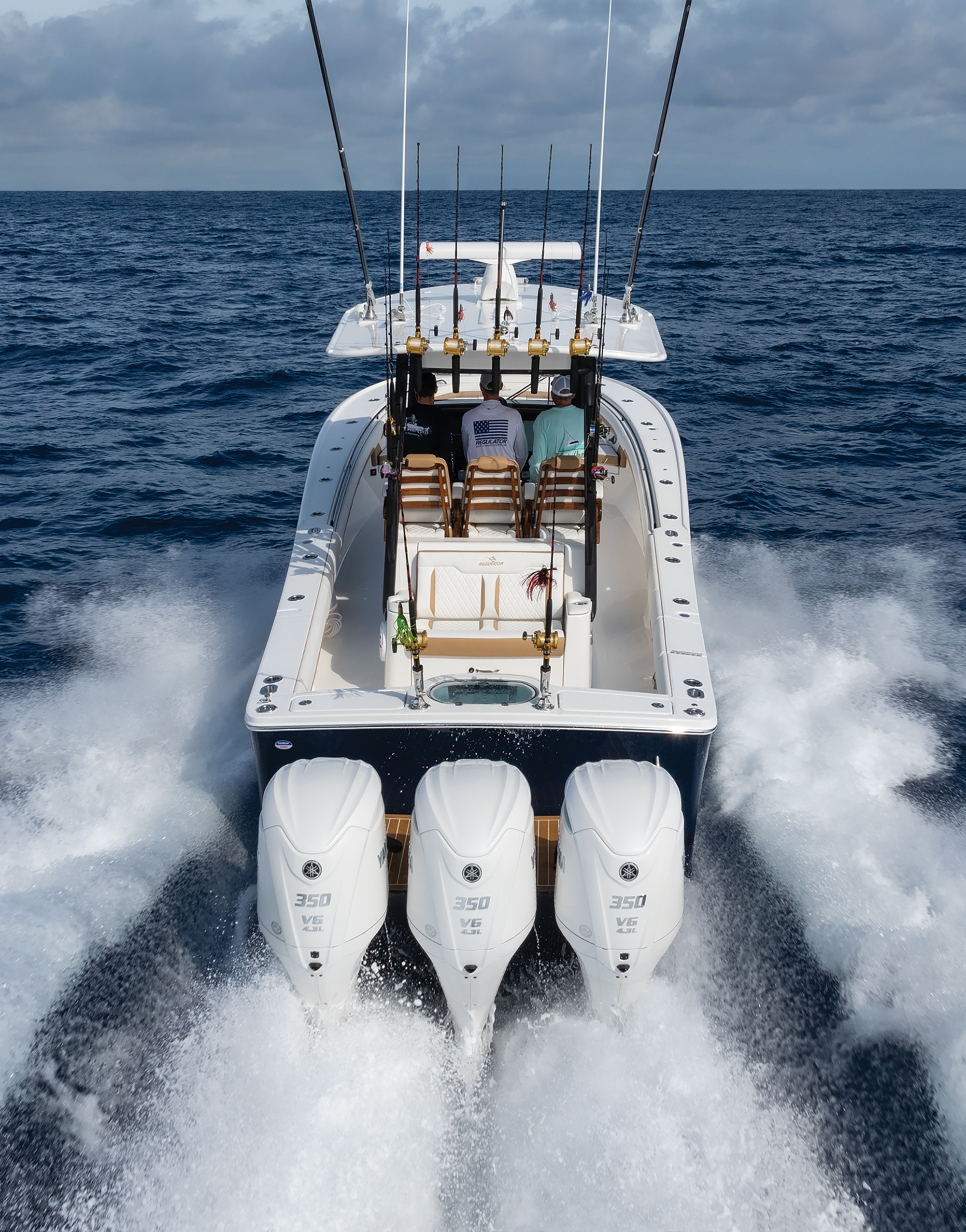
Tom Kniskern, a longtime Regulator dealer who operates KMC Marine in Lighthouse Point, Florida, manned the helm as we picked our way through the inlet toward open water. Once we had enough room to put the boat up on plane, the Regulator ride showed through. As we gained speed and got on top of the waves, the ride continued to improve. We found a happy cruise at 36 knots, zipping along in the 2- to 4-footers and netting .8 mpg. There were no hard slams, rattles, or nosedives. We could’ve easily kept going all the way to the Bahamas with just one hand on the wheel. At wide-open throttle, the boat safely motored along at 50 knots in the lumpy seas. And we were comfortably talking, not yelling.
The Regulator 35 is perhaps the most technologically advanced boat the Edenton, North Carolina builder has introduced. The boat is not only equipped with a lithium-ion battery inverter system to power all of the electronic demands, but the very first Dometic G3 electric gyro stabilizer installed in a boat. At the stern you’ll find the Seakeeper Ride auto-leveling “vessel attitude control system.”
You can also find this video–and hundreds of our other reviews–here ▶
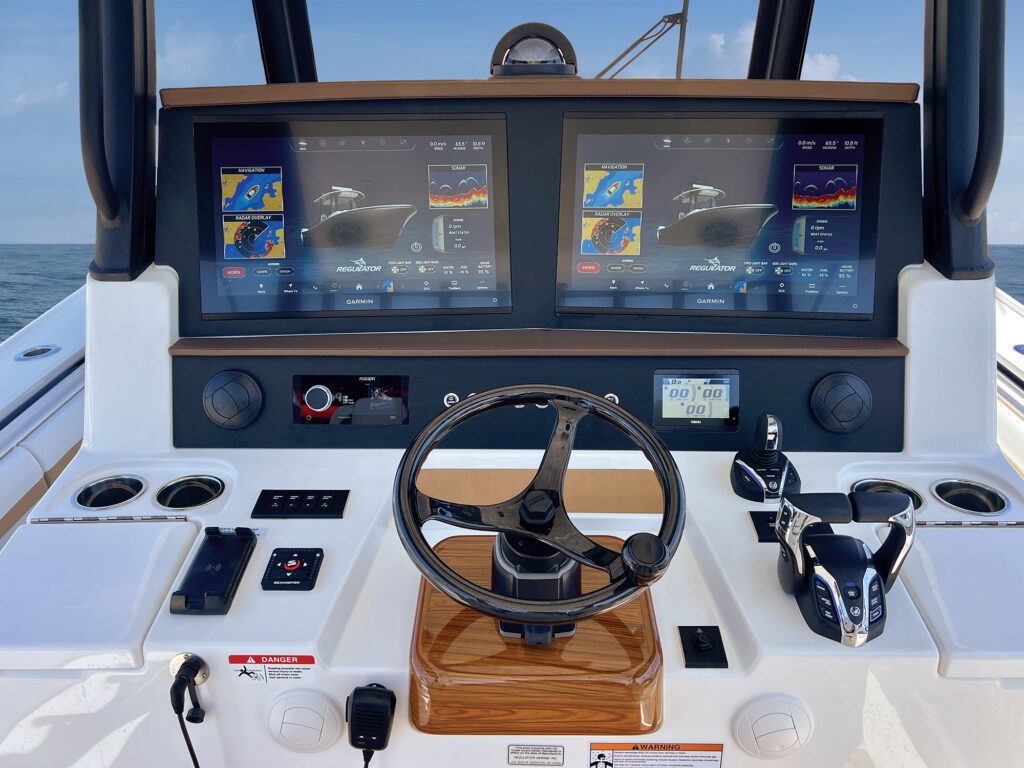
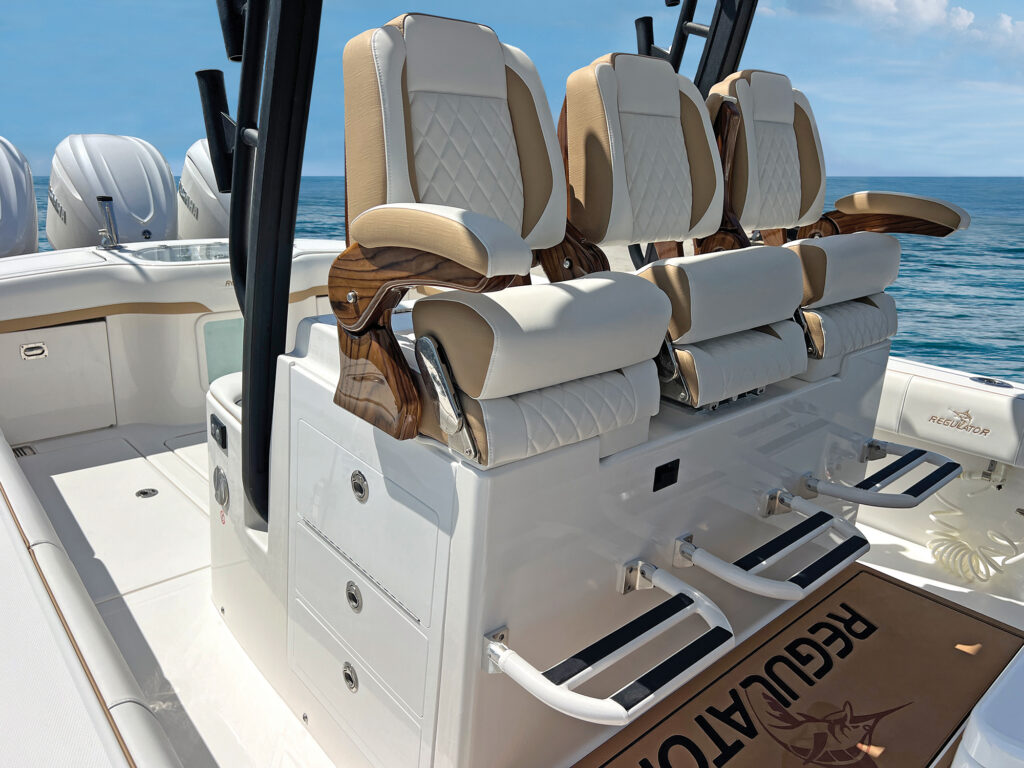
As we cruised away from the inlet, I took the helm and got to feel the boat’s responsiveness and running attitude firsthand. I don’t know if the secret sauce was a mix of the gyro and Ride or Regulator’s venerable hull design, but man, it sure was fun to drive the 35 in these conditions. Powered with triple 350-horsepower Yamahas, the boat just ate up the seas whether we ran head into the waves, down sea, or beam-to. The helm is luxe with a brown-and-black dash. The twin 22-inch Garmin screens are slightly offset, angled inward toward the operator to make them easier to see. Visibility through the solid glass windshield is unobstructed and Regulator included an electrically controlled ventilation system with two settings to let the breeze flow in. Regulator offers digital switching as part of the MyHelm control system, but there’s also a row of actual switches for onboard necessities like lights, horn, and pumps. The three helm chairs are both handsome and comfortable with teak armrests.
Regulator offers diesel gensets on many of its models to power the growing list of ship systems owners want on their center console. The 35 is the first Regulator to scrap the genset (and additional diesel tank) in favor of an inverter to power the AC, gyro, lights, livewells, refrigerators, and more. The 35 has three lithium batteries for the onboard systems that hold a total of 900 amp hours along with three lead-acid batteries for starting the engines and holding excess charge from the Yamaha outboards—each engine has a 70-amp alternator. “We’ve got Dometic DC chargers on the boat and are able to put 150 amps into the batteries from the engines,” says David Clubbs, Regulator’s VP of Product Development and Engineering. “With 900 amp hours, if you’re sitting around 90 amps for normal use, then you’ve got 10 hours of runtime with the system. We wanted the customers to be able to park the boat, walk away from it for a couple hours, leave everything on and trust it’s still fine.”
Kniskern inadvertently tested the boat’s impressive battery run time when he docked the vessel at the Palm Beach boat show. He plugged the boat into shore power, which automatically switches the inverter to a pass-through and begins to charge the batteries. What he didn’t realize was the shore power wasn’t working. He left the boat’s AC running, along with a bunch of other stuff. When he returned to the boat more than a day later, the Garmin MFDs, which monitor battery life, showed that the batteries still had 38 percent of life left in them. There are two chargers on board when the plug-in time comes, though: a 100-amp charger for the lithium batteries and a 40-amp charger for the starting batteries.
“We wanted the boat to be very much like a home,” Clubbs says. “You go in, you turn the air conditioner on, you set it, you forget it.”
To house the electrical systems, Regulator created a machine space under the aft-facing mezzanine, and it’s a thing of beauty. The Dometic G3 gyro lives in here along with what seems like miles of wiring and switches that are meticulously run and labeled. There’s quite a bit of copper snaking through there, yet it feels organized and spacious.
The Regulator 35’s center of gravity is under the helm, which is where the bulk of her weight resides, including the 405-gallon fuel tank. This helps the boat ride just right no matter how much fuel you have on board: “We try to get the center of gravity right under the helmsman,” Clubbs says. “We were able to do that on the 35 so you get really good control of the boat no matter what the fuel capacity is.”
Regulator also mounted the gyro down low because these units are not light at 570 pounds. The Dometic G3 differs from other gyros because it’s completely electric with no zincs to change and no potential hydraulic leaks, which means zero maintenance, according to Dometic. It spins up in just 16 minutes, has a low power draw and seemed quieter than other gyros I’ve seen (and heard) in the field.
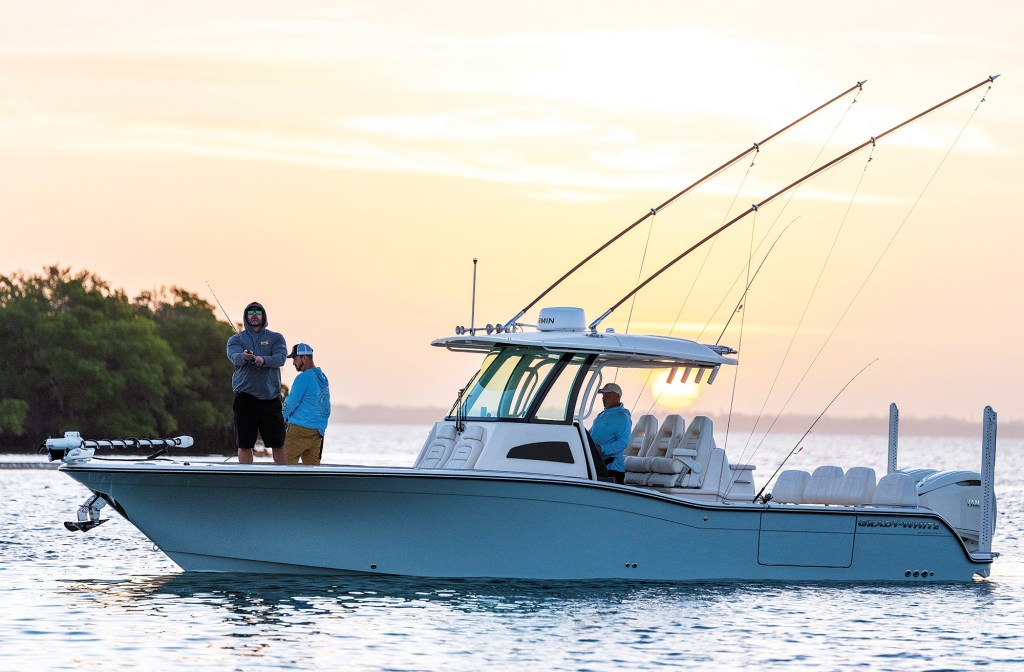
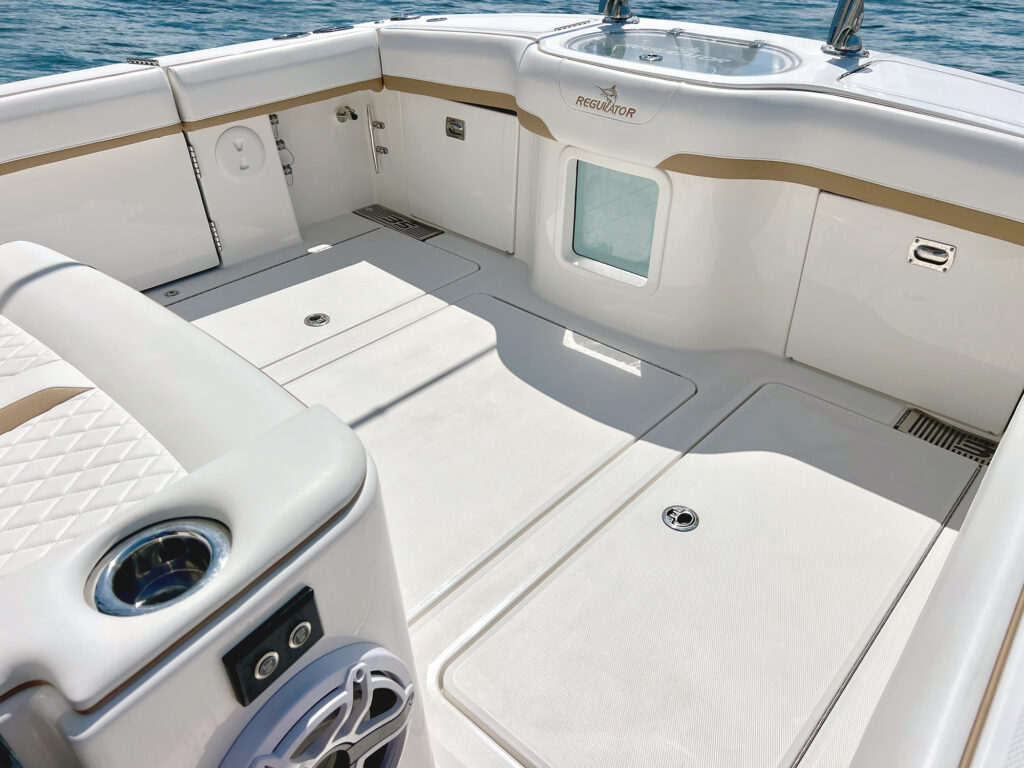
Make no mistake about it, the Regulator 35 is built for fishing. The cockpit is spacious and thoughtfully designed. Regulator placed a 43-gallon pressurized, oval-shaped livewell in the center of the transom. Kniskern said the boat has a self-cleaning sea chest that automatically runs every hour to rid itself of weeds or debris like a macerator. If you notice the flow dropping, you can manually hit it. Both stern quarters have a box/prep station, one with a sink and bait tray, the other with a washdown hose. Our test boat had Burnewiin quick-switch mounts on the transom which can be used to hold cutting boards, a grill, or rod holders. The fold-down seats flanking the livewell are handy on the ride out and easily stow away. We spun the boat and backed into the waves to see how the hull would perform in a fish fight and the deck stayed bone dry. The cockpit is plenty big for four or more anglers and the in-deck fish boxes can hold all the fish you can catch. And with a range of 400-plus nautical miles, you can get into a lot of fishy situations.
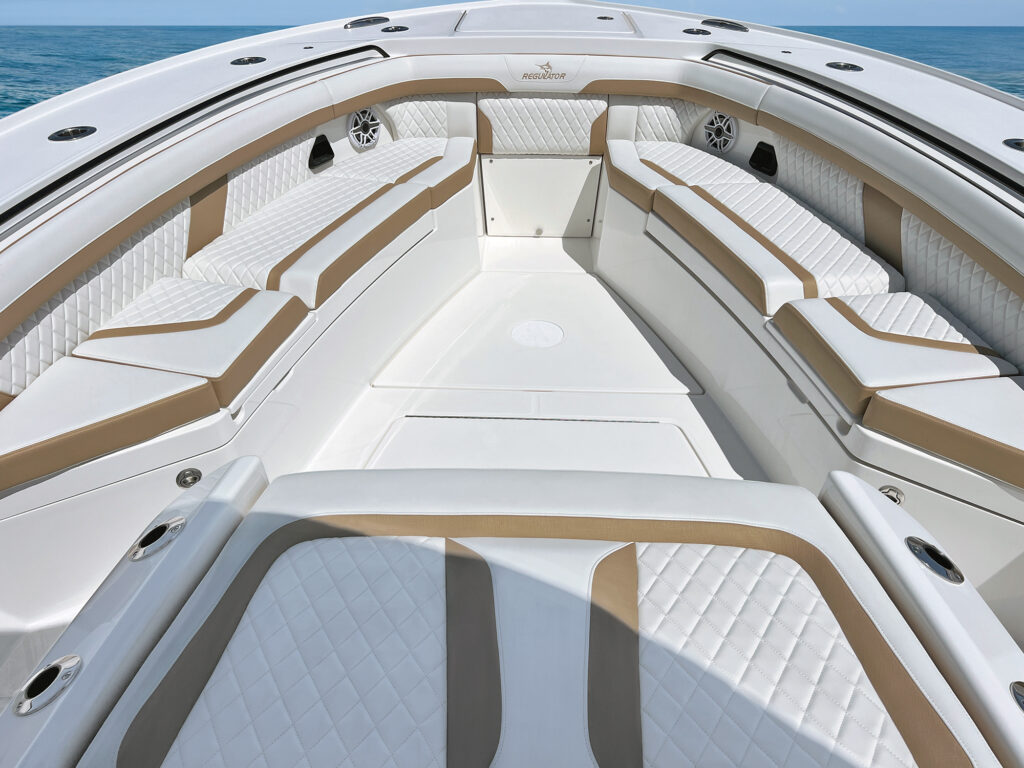
When it comes time for entertaining, the bow is where I’d want to be. A comfy lounge seat forward of the console has a massive cooler underneath. The cushions stay in place with heavy-duty magnets—a new trend we’re seeing and loving. This makes accessing the storage under the seats much easier. The cushions slide to let you open the hatch, then they slide back into place. And if you’re wondering if they will blow away, don’t. During our 50-knot top-hop test in all that chop, they didn’t bounce a bit.
Inside the console is a head, rod storage, access to the electronics, and a bunk for naps on those long canyon runs. Once again, Regulator does an impressive job maximizing all the space on a boat. The 35 is many things in one. It’s handsome, high performing, comfortable, and very fishy.
Regulator 35 Specifications:
LOA: 35’1”
Beam: 11’9”
Draft: 3’4”
Displ.: 16,500 lb.
Water: 36 gal.
Fuel: 405 gal.
Power: 3/350-hp Yamaha
This article originally appeared in the November 2025 issue of Power & Motoryacht magazine.