There’s no replacement for skilled
labor. Anyone who’s ever held a job
doesn’t need a lecture on the merits
of consistent leadership and the costs
associated with retraining and
rehiring a work force. Few boatbuilders
understand this as well as
Regal, which currently employs
more than 100 workers who have
been with the company for more
than 20 years. There’s a philosophy of continuity at Regal that
not only applies to the way it treats its employees, but also to how it makes its boats.
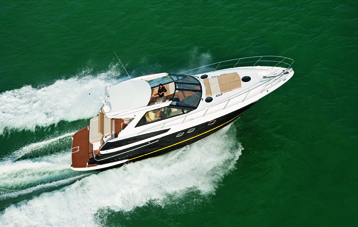
The 44 Sports Coupe is a perfect example of how this builder
fosters better products. She’s a reworking of the 44 Express,
which debuted in 2005 and which replaced the 42 Express that
came out in 2002. The two-stateroom, two-head midcabin
layout, popular because it nicely accommodates two couples or
a family of four, has remained. But boaters’ tastes have changed
with time, and the 44 reflects their new desires. Company
captain Frank Stoeber, a veteran who teaches courses at Regal
on everything from lamination to diesel engine repair, tells me
that after talking with a swath of 44 Express owners, Regal
found that people wanted the ability to “better control the environment”
of the boat’s helm area. “They wanted to open it up
and use it for entertainment,” he recalls, adding, “So people
started suggesting a coupe.”
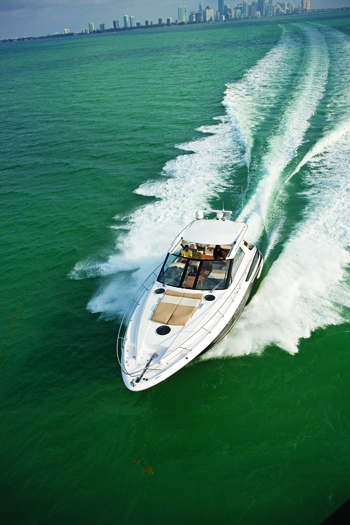
The coupe design transforms this boat from an open-cockpit
dayboat to a fully enclosed coastal cruiser, and during my sea
trial from Clearwater to Tarpon Springs, Florida, its advantages
were readily apparent. The 38-square-foot sunroof rests
directly on the windshield’s stainless steel header. (A small eave
on it relieves the stress on the gasket.) With the push of a button
on the helm console, the roof slides back leaving only the windshield
frame, just as it would on a convertible automobile. For
less sunny days, or to get the most out of the air conditioning, a
standard Strataglass curtain drops across the area aft of the helm;
for those who want a more robust enclosure, a sliding cockpit
door with stainless steel frame and Lexan panes is an option.
The cockpit arrangement has also changed. The windshield’s
center panel now opens out to allow access to the foredeck (an
unobtrusive magnetic latch keeps the door open, even underway;
a lever-style latch ensures it stays closed.) Other smart
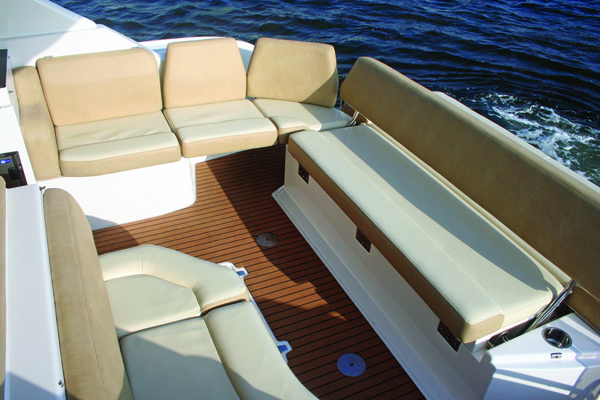
alterations here include a raised Ultraleather settee to port. It’s
elevated by about six inches, providing not only more headroom
in the stateroom beneath it, but also 360-degree views to
anyone seated here. (On the older models this seat was more of
a crescent shape, but it has been reworked into a C-shape to
accommodate more occupants.) Behind it, you’ll find stowage
for the optional high-gloss cherry cockpit table, which lays horizontally
instead of vertically, making it easier to get it in and
out. Both of the 44’s topside tables are interchangeable, so you
can take the larger one (a $3,138 option), which is intended for
the cockpit, and move it to the helm area and vice versa.
Regal made other improvements to the cockpit area, like
nixing the step between it and the helm by raising the sole, and in the process, creating an unobstructed walkway while providing
more headroom in the engine space below. And the Lshape
settee’s seatback flips forward to create a backrest for
sunbathers on the centerline cockpit sunpad. One more thing
that you probably wouldn’t notice on first glance, or even on
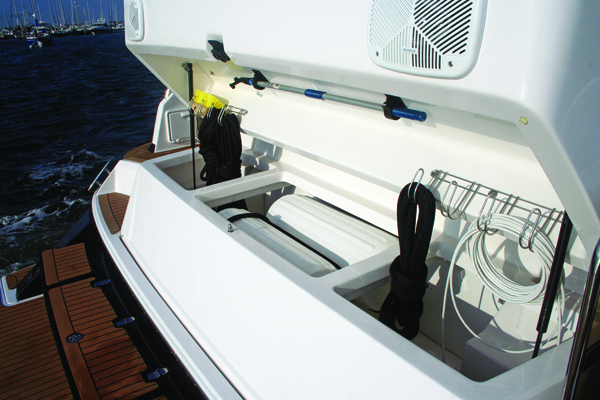
close inspection, is that most of the components, from the swim
platform to the deck hatches, have been resin-infused, a process
that both lightens them and increases their strength.
,
The interior got a rethink as well, with a focus on the details: a
stainless steel fiddle atop the armoire-style hanging locker to
port, additional sea rails on shelving and cabinetry, and gas rams
on the sole’s scuttles, which give access to large stowage compartments
covered with marine-grade trunk liner. The only
drawback I found in the interior was with the layout of the
midcabin: It’s a bit dark, since it lacks ports, and with just a foot
or so between the twin berths (a filler can be inserted to convert
it into a queen), it felt tight. Also, the shower here, which does
not have a separate stall, has just 5’10” of headroom, compared
to the master’s stall shower, with its frosted hatch above and
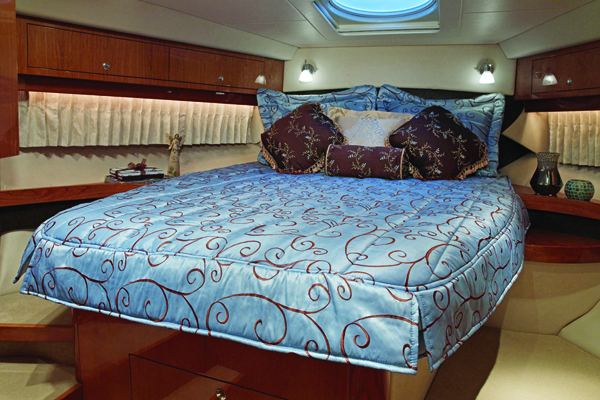
7’8″ of headroom. The master stateroom itself has plenty of
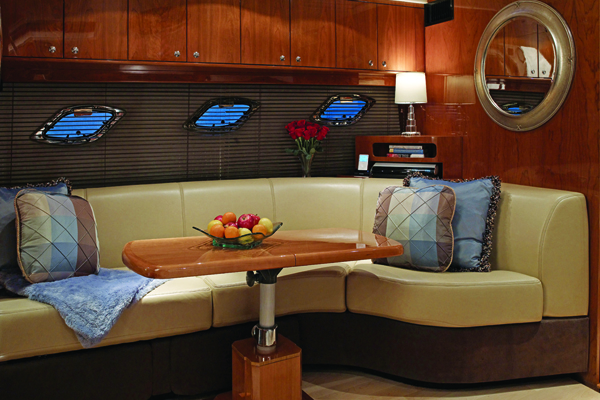
light entering from a Lewmar hatch and opening ports. The
saloon is also well lit by opening ports, and has other thoughtful details like a curved granite countertop, two-burner EuroKera
cooktop, and scalloped cherrywood steps.
The attention to detail circulates throughout the build
process. Besides complying with ISO (International Standards
Organization) regulation 9001/2000, which ensures documentation
and testing of virtually all products that come off the
assembly line, Regal follows other, internal guidelines. One is its
method for deciding where to place system equipment. “We
give everything two numbers on a scale of one to ten,” says
Stoeber. “The first number is how often an item needs to be
maintained. The second is how critical it is if it fails.” When the
numbers are multiplied together, the team gets the Repeat
Process Number (RPN). In placing a product, Regal uses the
RPN number, which must be less than 40, to help find the
optimum location. In the engine room, I could see the payoff.
Seawater strainers, which can clog, were readily accessible,
while items such as the black-water discharge pump—mounted
on the forward firewall and requiring little upkeep—were more
difficult to reach.
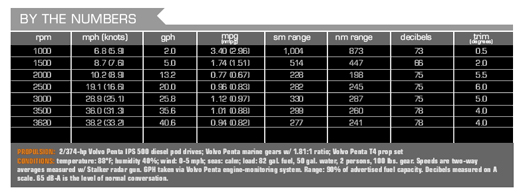
The hull was also redone (by Michael Peters) to accommodate
twin 370-hp IPS 500 pod drives, not available on the older
models. They powered our boat to a cruise speed of 28.9 mph
(25.1 knots) at 3000 rpm on mostly flat water, responded
instantly to helm input, and generated dramatically tight turns.
But I was more impressed by the sound levels, which even at
WOT (3620 rpm and 38.2 mph/33.2 knots), never exceeded 78
dB-A (65 dB-A is the normal level of conversation). Stoeber
explained that one reason for the low readings was the relocation
of an air-conditioning compressor from underneath the
wet bar to a compartment off the aft cabin. Extra layers of
Whisperwall acoustic-dampening panels didn’t hurt either.
At Tarpon Springs Stoeber took the helm and scooted the 44
Sports Coupe onto a TraveLift. (She was bound for a boat show
in Georgia the next day.) After snapping some shots, available
on my blog (www.powerandmotoryacht.com/blogs), I had a
chance to speak with the driver of the transport truck, Patrick
Prainito. It turns out he’s one of Regal’s Platinum-level master
builders, which means he’s licensed and qualified in all aspects
of the company’s operations, from driving trucks and boats to
working in the lamination shop and performing engine repairs.
Prainito says that one reason for his ascension is that Regal both
helped and encouraged him along the way, including paying for
schooling. Promoting quality seems to be systemic at Regal, and
the results were evident on the 44.
Noteworthy:
Kenyon Smokeless Grill
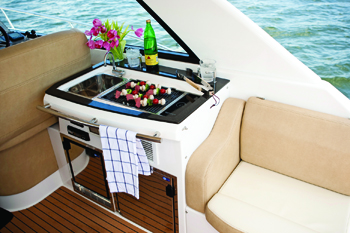
Cooking smoke can be a real hassle on
a boat. It damages overheads and
leaves a smell that won’t come out for
weeks—if ever. That’s why I was
surprised to see a grill directly
underneath the eggshell-colored
padding that protects a 19″ flat-panel
TV in the 44’s helm area. Capt. Frank
Stoeber explained that this was
Kenyon’s new smokeless wonder,
which the company claims eliminates
fretting about interior odors and
stains.
Kenyon conceals the unit’s electric
heating element beneath non-stick
grates, which eliminates the chances
of scorching food and thus smoke.
Drippings fall into a removable (and
disposable) pan in the base, so cleanup
is easy. The 21″ unit retails for
around $950 and makes a for a fine
upgrade on any vessel. —G.R.
Contact: Regal Yachts (407) 851- 4360.
www.powerandmotoryacht.com/regal/.
The Boat
Standard Equipment
2/374-hp Volvo Penta IPS 500 gasoline
pod drives; Volvo Penta electronic
steering and controls; 26,000-Btu
Dometic reverse-cycle A/C; 7.3-kW
Kohler genset; 2/Groco ARG-750
seawater strainers; 2/Group 31 and
1/8D batteries; wiring runs with Mate-NLock
II Deutsch connectors; fuel-transfer
pump; Vitrofrigo ‘fridge and freezer;
Fireboy fire-suppression system;
2/Vacuflush MSDs; 2/Racor filters with
hand primers (no site bowls); Pro Nautic
battery charger; Saniguard holding-tank
filter; Sea Tech plumbing connectors; central
vacuum system; Ultraleather upholstery;
Bose 3-2-1 entertainment system;
innerspring mattresses; Fusion Marine
stereo; 1/Garmin 5212 chartplotter
Optional Equipment
Splendide 2000S washer/dryer combo; second Garmin 5212 chartplotter; Raymarine ST6002
Other Specification
Cabin:1 master, 1 guest
Specifications
- Optional Power: 2/374-hp Volvo Penta IPS 500 diesels; 2/435-hp Volvo Penta IPS 600 diesels
- Water Capacity: 101
- Overall Length: 46’0″
- Beam: 14’0″
- Fuel Capacity: 328
- Draft: 3’8″
- Year: 2009
- Type: Product+boattest
- Standard Power: 2/374-hp Volvo Penta IPS 500s
The Test
Test Boat Specifications
- Price as Tested: $622,797
The Numbers
This article originally appeared in the October 2009 issue of Power & Motoryacht magazine.
The Photos