Hot Ticket
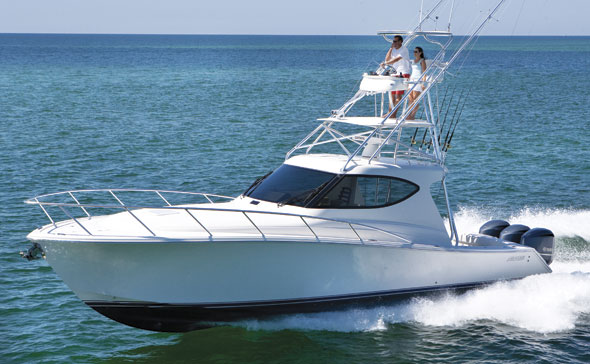
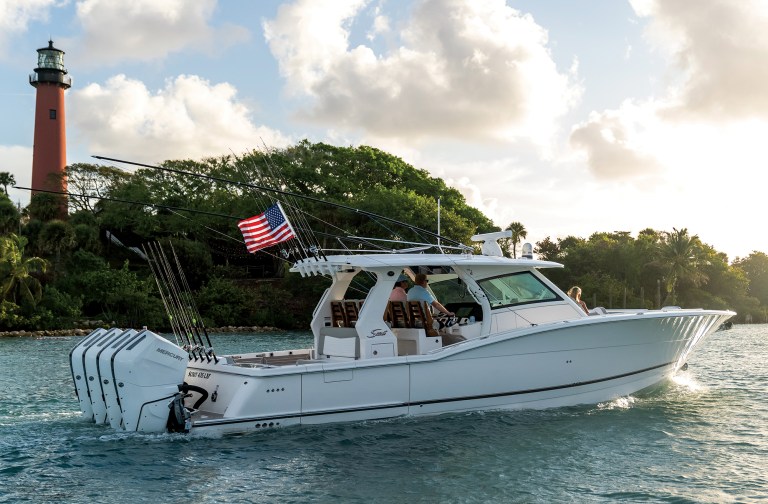
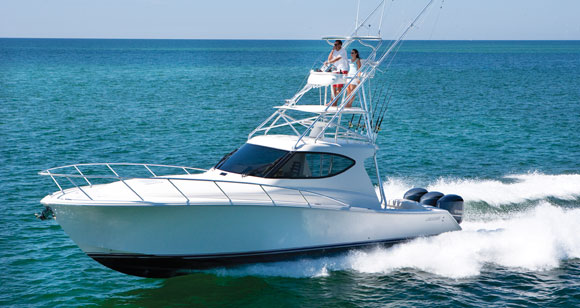
Thanks to her cool, swept-back profile, triple outboard power, and blazing offshore performance, the Jupiter 41 Sport Bridge puts out some serious sizzle.
I love outboards—always have. I remember the first Evinrude my dad ever owned many decades ago—a gleaming 40-horsepower beast that literally snarled in a turn, exhaled the deeply romantic fragrance of marinized internal combustion, and seemed absolutely, monstrously, wonderfully immense at the time. “Biggest motor on the lake,” guys used to say about it. “Runs like a bat outta hell.”
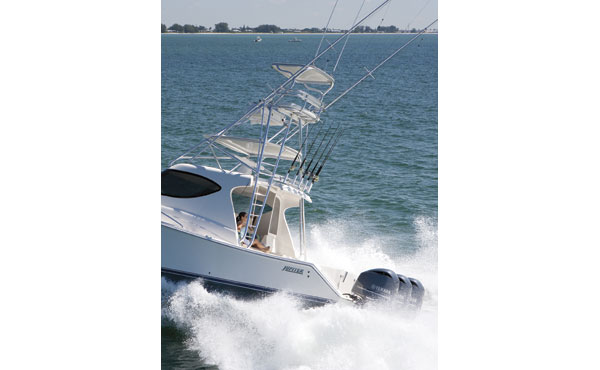
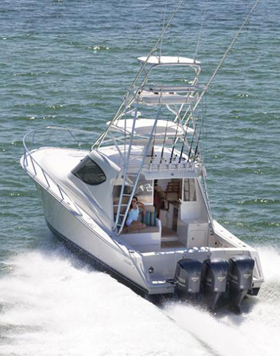
Of course, mega-motors today lend a certain quaintness to reminiscences like this. Consider, for instance, the Jupiter 41 Sport Bridge shown here, a boat I had the opportunity to sea trial some months ago in Palmetto, Florida. The combined might of the triple four-stroke Yammies hanging off her transom freakin’ boggles the mind—1,050 horsepower! That’s more juice than a twin-turbocharged Ferrari F430 TT’s got, for cripe’s sake.
Outboards have certain advantages, too, even on a boat like the 41 SB, which was designed and built to cruise certainly, but also to fish the far horizons. Oh yeah, tuna-hauling access through the transom door’s gonna be a tad cluttered, given the hulking presence of three massive motors. And utilizing the fancy (albeit optional) dive ladder just beyond may prove a little tricky, too. But then, there are other things to contemplate here, like, let’s say, performance.
See more photos of the
Jupiter 41 Sport Bridge here
Tampa Bay Rocket
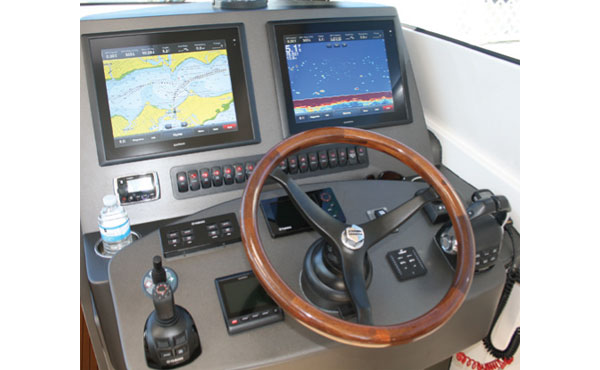
I crank up my test drive by anchoring my butt against the leading edge of a Release Marine ladderback helm chair, so I can use the little jewel as a sort of stand-up-to-steer bolster—you know, for improved control, and maybe a little cool-handed coolness, too. And then, since I’m really into driving boats, I quickly pick up on the fact that both the adjustable teak-rimmed steering wheel and the twin-stick engine control have been seemingly positioned for my personal ergonomic benefit. And then finally, since I’m really, really, really into driving boats, I only wait about a nanosecond before pourin’ the coal to ’er, as we used to say in the days of my riotous youth, and the revs start rising like they’ve been shot out of a gun.
Whoooooeeee! In a heartbeat, the 41’s doing dang near 45 knots, with her triple 350s emitting little more than a stealthy purr, and the Tampa Bay chop blowing past in an absolute blur. I glance over my shoulder to see if there’s anybody else approaching the Sunshine Skyway Bridge at the moment. At warp speed. Inbound.
“Whataya think?” I ask the guy sitting on the L-shaped settee to port, Todd Albrecht, sales honcho for Jupiter, “Pull a hardover turn at top speed?”
“Go for it, Bill,” he grins.
I tap the fast and instantly effective electric Lenco tabs down just a hair, the point being to add a few more G-forces to the upcoming turn. And then, after I’ve trimmed the lower units in a bit too—and with a burst of velocity-lovin’ joy suffusing my heart—I crank the wheel hardover, spinning the 41 like a top.
Man! The sideways centrifugal oomph squashes me against the starboard inwale as I shoot a quick look over my shoulder again to see the triples back there carving a frothy-white, super-tight scimitar. Albrecht is holding on for dear life.
Do we lose a few revs? Yeah, sure. Maybe a couple of hundred, but the 41 regains quickly, never evinces a whiff of blowout, and in seconds we’re barreling back towards Egmont Key, with the tabs tapped back up (to boost speed), the lower units tapped up as well, and a ride that’s smooth and floaty, but rail-ridin’ straight.
“Look at that,” I enthuse, as our 41’s nose gently rises and falls, holding an unerringly steady course. “She’s steering herself, Todd—my hands are just touchin’ the wheel. Not really holdin’ on at all.”
Meanwhile, Back at the Dock
Of course, just about any outboard boat’s performance is gonna outshine an inboard’s in open water. To begin with, an outboard’s prop is typically located well abaft the after edge of the boat’s running surface, which gives the prop more bite because it’s running in denser, less aerated water. In addition, an outboard’s prop can be tweaked for optimum efficiency and speed, either up or down. And furthermore, an outboard’s prop is both steerable and transom-mounted—it produces fast, positive directionality and, because of its location with respect to the boat’s longitudinal center of gravity (LCG), exerts big-time turning leverage, especially when whipped hard-over.
Not all of these virtues are as virtuous dockside as they are offshore, however. More to the point, while outboard power is also tops in directionality when backing into a slip, it poses some challenges for a joystick-type engine-control system like the Yamaha Helm Master we had on our test boat. More specifically, once we’d completed our sea trial, I did some close-quarters maneuvering and then docked the 41 starboard-side-to against a wharf in Palmetto’s Snead Island Cutoff, working against conditions that turned out to be just a bit problematic.
Although the independently actuating, computer-controlled Yamahas were indeed able to walk the boat sideways with some authority via joystick, I noted that they took a fair amount of time swinging the 41’s bow through the eye of the prevailing tidal current. The problem, I’d say, was leverage. Vessels with inboards or pods have props that are comparatively close to their LCGs—this means they require less leveraging force to rotate them against wind and current. But the props on our 41 were much farther aft comparatively and therefore much farther from her LCG—a lot more leveraging oomph was required to produce results.
“But ya know,” I told Albrecht, as I employed the 41’s Lewmar bow thruster to smartly address the foible, “This thruster compensates quite nicely.”
And Substance Too?
Lest I give the impression that the 41 is just another sizzling hot ticket, allow me to finish this test report with only a few of the features that caught my fancy as I examined the boat dockside, starting with the sea chest in the lazarette, an area under a cockpit hatch just forward of the transom.
Made of welded stainless steel, the sea chest feeds an ample livewell, a Cruisair air-conditioning system, and an optional Fischer Panda genset, which has its own 43-gallon tank for diesel fuel. Sea chests cut the number of through-hull fittings and, if properly designed, simplify bilge arrangements. Excellent!
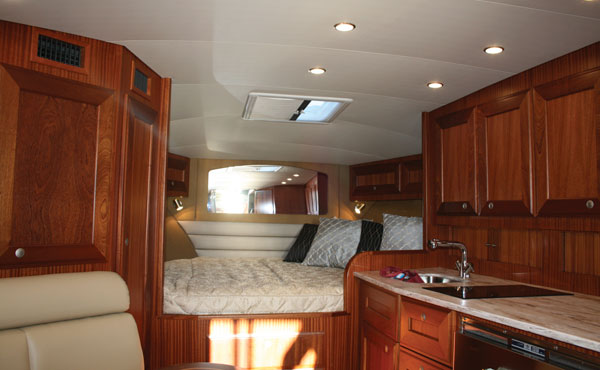
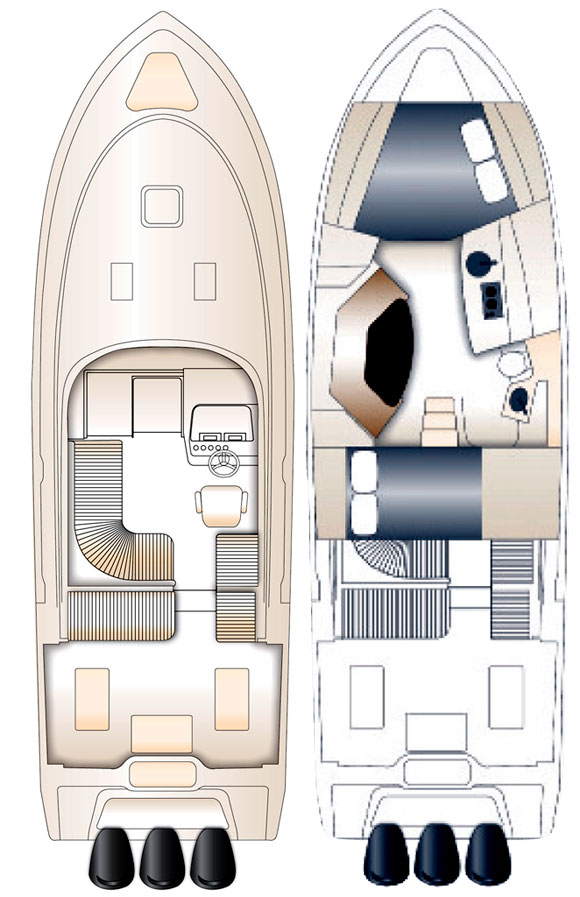
The 41’s top-notch interior appointments constituted the next attraction. There’s no question that the boat’s basic layout is quite simple, with an athwartship queen berth forward (with memory-foam mattress), another queen (also with memory-foam mattress) in a mid-cabin further aft, and a dinette, galley, and head compartment (with separate shower stall) in between.
But hey, the elements that populate said layout are truly impressive. The sapele woodwork, for example, is precisely joined and finished with a warm satin urethane.
The deck planks are of stout maple, with interstitial strips of sapele. Cabinets have Southco latches and finely crafted raised-panel doors. Upholstery (inside the boat and out) is tight, comfortable, and crisply baseball-stitched. And the windows have no obstructing middle mullions, not anywhere. Even the windshield is one big piece of tempered glass!
And then, there was one remaining aspect of the Jupiter 41 Sport Bridge that made a great impact on me as I turned to take a parting look before hitting the trail for home. The vision stopped me in my tracks for a long, long moment.
“Now that,” I murmured at last, after savoring the vessel’s sweet, salty, swept-back profile with deep, reverential fervor, “is one boaty-lookin’ boat!”
Click here for Jupiter Marine’s contact information and index of articles
Brokerage Listings Powered by BoatQuest.com
Click to see listings of Jupiter Marine Yachts currently for sale on BoatQuest.com.
The Boat
Layout Diagram
Optional Equipment
Noteworthy Options: Custom Awlcraft paint job ($8,490); G.G. Schmitt & Sons tower ($70,120); portside entry door ($10,590); and Cruisair A/C unit on bridge deck ($6,485).
On Location
So What’s Up, Carl?
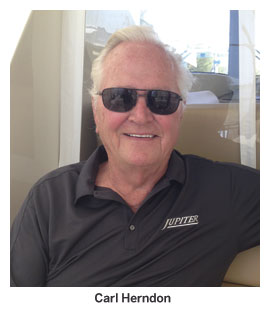
Carl Herndon’s been fishing and building boats most of his life. The founder of the well-regarded Blackfin Yacht Corporation (builder of the famed and fishy Blackfin Combi) and former president of Bertram Yachts, Herndon is now the CEO of Jupiter Marine International, a boutiquey, detail-oriented outfit that employs more than a few of Herndon’s friends and relations. His plans for the summer are about the same as they have been for the past couple of decades—he and his family will spend about a month at some spot in the Bahamas. “This year,” he says, “we’re taking one of our 38s over…we’re sold out of the 41s. And we’re going to the Abacos—I love the Abacos. We’re gonna rent a house—think we’ve got a place on White Sound lined up—and have the boat right nearby. And we’ll catch some fish, oh yeah. But hey, you know…you can’t fish all the time, Bill. You gotta eat too! We’ll have some wonderful meals over there if the past is any measure. And we’ll have fish just about every day. Fish, rice, and vegetables. Gotta love it, eh?
Other Specification
Generator: 1/8-kW Fisher-Panda, Warranty: basic boat 1 year; limited lifetime hull
Specifications
- Optional Power: 4/Yamaha four-stroke F300s, a variety of outboards
- Water Capacity: 80
- Overall Length: 40’3″
- Displacement: 22,480 lb.
- Beam: 12’8″
- Fuel Capacity: 445
- Draft: 3’6″
- Year: 2016
- Type: Product+boattest
The Test
Conditions During Boat Test
Air temperature: 81ºF; humidity: 68%; seas: 1′ or less; wind: variable, light
Load During Boat Test
350 gal. fuel, 79 gal. water, 4 persons, 100 lb. gear.
Test Boat Specifications
- Test Engine: 3/350-hp Yamaha four-stroke F350s
- Transmission/Ratio: Yamaha; 1.73:1 ratio
- Props: 15 1/2 x 19 3-blade stainless steel
- Price as Tested: $815,000
The Numbers
| RPM | KNOTS | GPH | RANGE | dB(A) |
|---|---|---|---|---|
| 600 | 3.5 | 2.3 | 609 | 62 |
| 1000 | 5.5 | 4.6 | 476 | 63 |
| 1500 | 7.5 | 7.9 | 380 | 65 |
| 2000 | 9.2 | 13.0 | 283 | 68 |
| 2500 | 10.2 | 20.6 | 198 | 74 |
| 3000 | 12.2 | 30.0 | 163 | 78 |
| 3500 | 18.4 | 35.9 | 205 | 79 |
| 4000 | 27.3 | 42.2 | 259 | 80 |
| 4500 | 32.9 | 53.0 | 249 | 81 |
| 5000 | 37.2 | 64.3 | 232 | 81 |
| 5500 | 40.2 | 83.9 | 192 | 83 |
| 5900 | 44.6 | 100.5 | 178 | 83 |
This article originally appeared in the June 2015 issue of Power & Motoryacht magazine.
The Photos