When you spend time getting to know the builders of America’s custom sportfishing boats, a few common threads emerge. The first is, not surprisingly, a maniacal passion for chasing pelagics. The second is a humble and resin-soaked origin story. The third is that these builders—every one I’ve met to this point—have overlapping and remarkably collaborative backgrounds with both their contemporaries and the forebears who mentored them. If you wanted to find a case study in how these threads can be woven together, you’d do well get to know Jarrett Bay founder, Randy Ramsey.
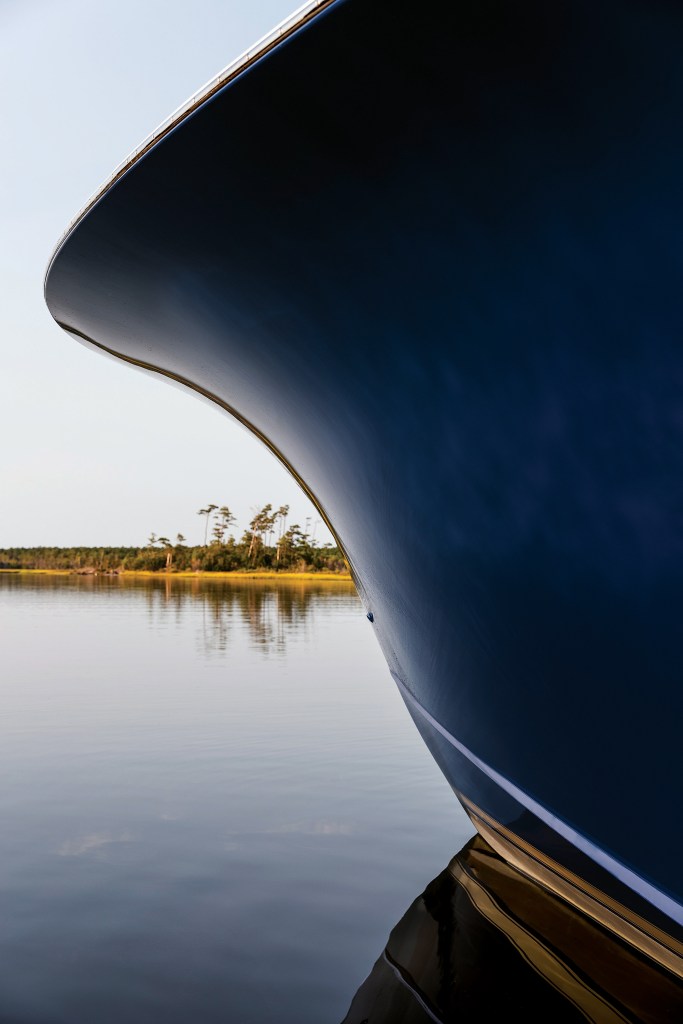
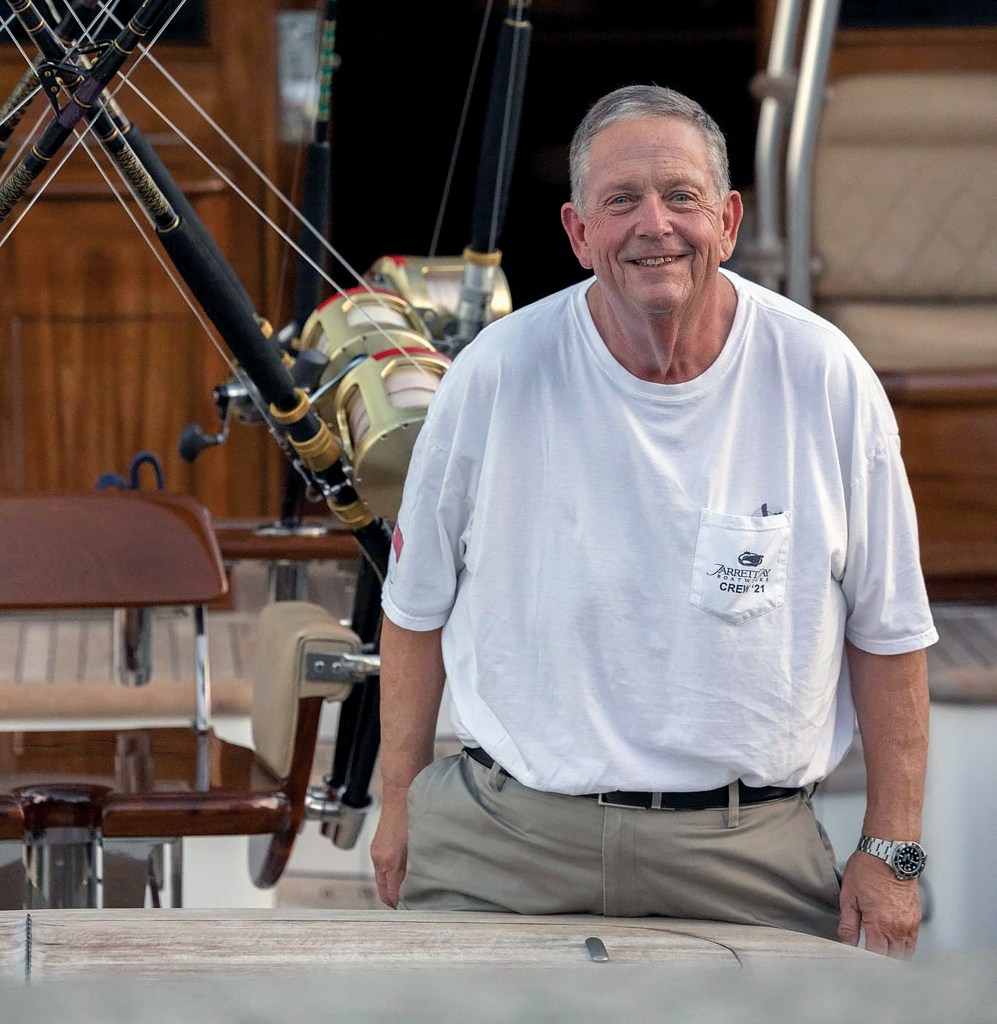
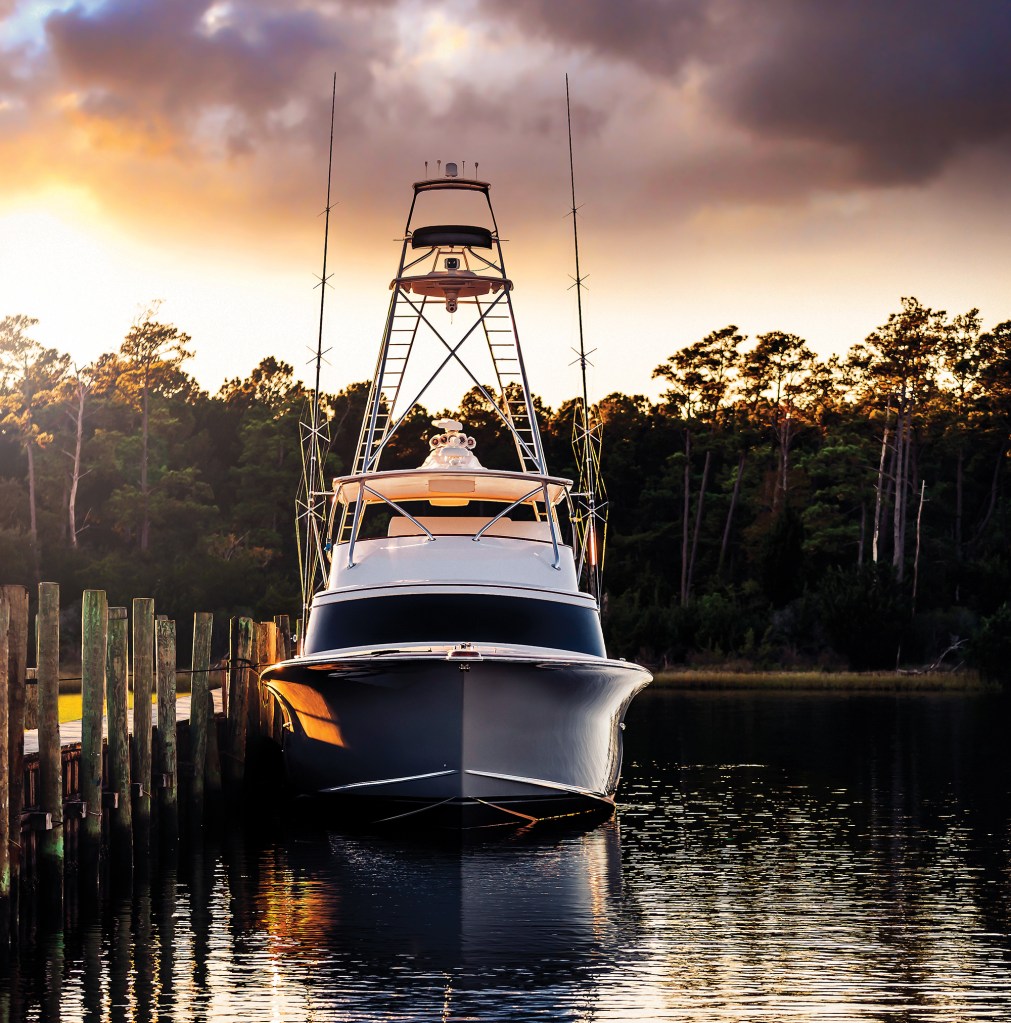
To many of the readers of this magazine, the 63-year-old Ramsey is no stranger. He’s been building Jarrett Bay sportfishers for 40 years. The hulls his company has turned out are iconic. Perched right alongside the Intracoastal Waterway just outside of Morehead City, the Jarrett Bay yard has grown beyond anything Ramsey dared dream. Recently, Ramsey signed a deal with Safe Harbor Marinas that will likely expand the Carteret County operation and keep his company going long after he finally decides to hand over the reel.
Walking into Jarrett Bay’s office, you’re greeted not only by Ramsey, but a series of grainy entryway photos that begin to tell the company’s origin story. The first photo is, perhaps, the most important. A small crew is literally holding up the rickety rooftop of a big shed so a new boat can be wheeled out. “What you can’t see,” Ramsey says in his deep eastern Carolina drawl, “is it’s being pulled out by a bulldozer—on a homemade trailer. That’s hull number seven.”
When they were starting out, rent on that $250-a-month Williston, North Carolina shed was all Ramsey and his partner Jim Luxton could afford. The roof leaked—badly. One day, a New Bern-based sportfishing fanatic and construction company owner named Jack Huddle stopped in. “He’d tied his boat up in the same area I tied my boat in,” Ramsey recalls. “He says, ‘I want to build a boat.’ I said, ‘Well, great, what do you want?’ He said, I want about a 43 footer, and he handed me a Hatteras Yachts brochure and said, ‘I want this interior.’ So I said, ‘Okay, we can do that.’ He said, ‘How much is it gonna cost?’ And I say, ‘Mr. Huddle, we build boats, you know, so time and material. We work for $12 an hour and 10 percent on materials.’ He said, ‘You got a deal. What do we need to do?’ ‘Well, I need to buy some juniper, because we buy juniper and dry it—get the sap out of it. And he says, ‘Well, just send me a bill tomorrow. Then, he handed me a card. So we shook hands.”
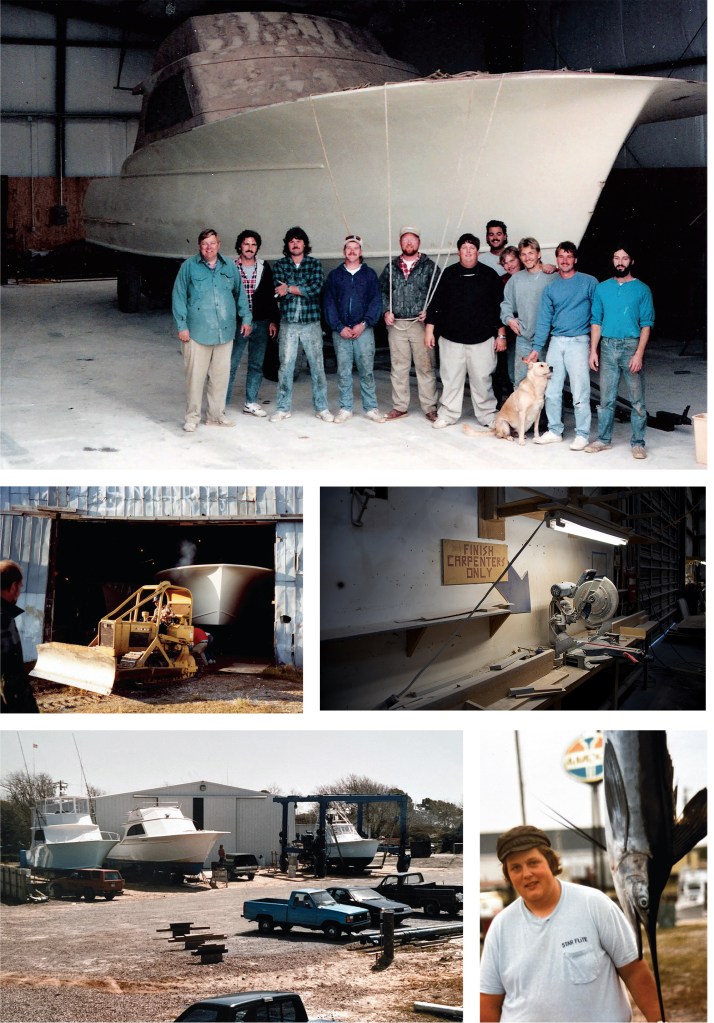
The handshake build went smoothly until the day the crew painted the boat and a pop-up thunderstorm met the shed’s leaky roof. The paint job was ruined. “We had to re-sand and repaint it,” says Ramsey. “When Mr. Huddle comes in, he says, ‘You can’t do this. You can’t continue to work like this. You got to have a better building.’ I said, ‘Mr. Huddle, we’re broke. We can’t have a better building.’ He said, ‘You go find a piece of land and I’ll rent it to you for the same thing.”
Growing up in Kinston, North Carolina, Randy Ramsey reckons he was pretty much born to fish. His father was a rabid angler who towed the family, and their runabout, up and down the North Carolina coast all year long chasing red drum, flounder, sea bass, and mackerel. Ramsey’s uncle ran charters out of Murrells Inlet, South Carolina, and one day when Ramsey was 10, an offshore trip into the translucent waters of the Gulf Stream changed his life. Reeling in dolphin and big kings, Ramsey was amazed. “I came back in, I said, ‘Man, I can get paid to do this? I can get paid, to go fishing?’”
Ramsey began logging his captain’s hours right then. When he was 16, his equally briny parents took over running Grayson’s marina at Harker’s Island, North Carolina, renaming it the Harker’s Island Fishing Center. Ramsey was pretty much on the water every day. He studied fishing and the boats North Carolina’s storied builders were turning out like a scholar. One day, a salty neighbor named Burgess Lewis made an offer. “He said, ‘Do you have a boat?’” Ramsey recalls. “I said, “No sir, I don’t. And he said, ‘If you can get two sheets of plywood and 100 feet of juniper, you and I’ll build one.’”
After Ramsey scraped up enough money for a used outboard, that boat would become both transportation and livelihood. “I was flounder gigging in high school, trying to make a little money on the side,” he says. “That boat allowed me the opportunity to do that—and the opportunity to learn about the water. I took all kind of jobs. I worked on a tugboat, working in the sounds, carrying old junk cars off Cape Lookout. So, everything sort of played its part.”
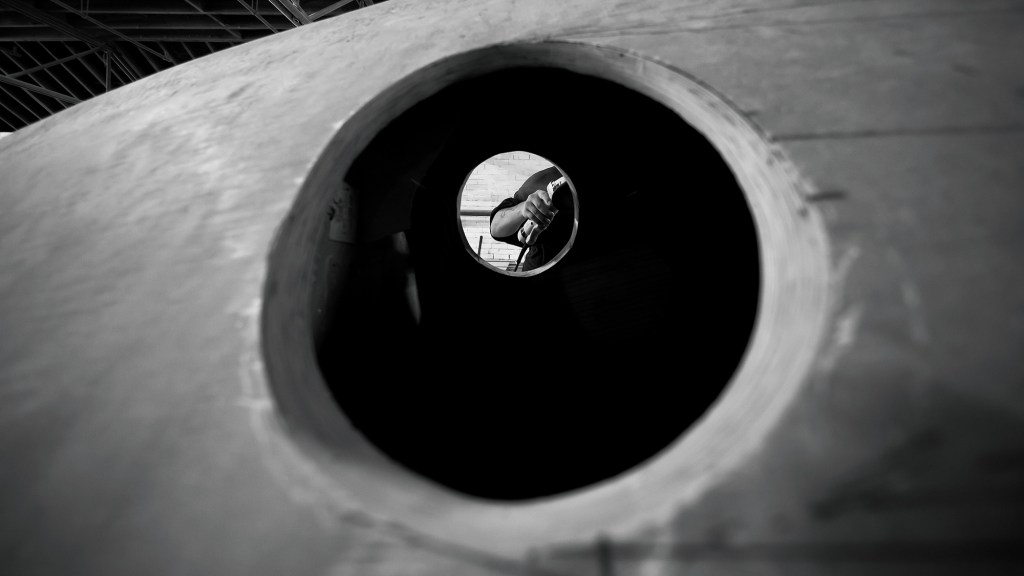
Harker’s Island was full of boat builders. “James, Earl, and Calvin Rose,” says Ramsey. “There was Mr. Willis. The Lewis brothers. So I had these opportunities to go around all these shops, see who was building boats and how they were building—and I was fascinated by it.”
The day he turned 18, Ramsey tested for his six-pack captain’s license. “And just to add a little pressure, the next day, I’d already booked a charter,” he chuckles. “So I sort of had to pass.”
Ramsey’s first “serious” charter boat was a 43-foot, 1967 Tiffany Cockrell called Redfin. With her 318-horsepower two-stroke, GM diesel, she’d hit 11 knots. She was slow and cumbersome, but she was a start. Ramsey quickly learned that you couldn’t make a full-time living in a seasonal economy running charters, so he supplemented his income with duck hunting excursions and odd marine jobs. Eventually, he found work with Marshall Harris, a master builder in Marshallburg, North Carolina. Harris built one boat every year, and was part of a tight network of Carolina builders who deepened Ramsey’s naval architecture well. One day, Ramsey and friend and future partner Jim Luxton chartered a day fishing with Outer Banks icon Omie Tillett. A founding father of Carolina sportfishing and boatbuilding, Tillett championed “Carolina flare” boats with a deep-V and a serious hull flare for slicing through swells while keeping the spray off the helm and crew. His 53-foot Sportsman proved a revelation. “I couldn’t believe how much better that boat handled the ocean,” Ramsey says. “How much quicker it was. How much better it handled around the dock than anything I’d ever fished on. So Jim and I set our sights on trying to build something similar.”
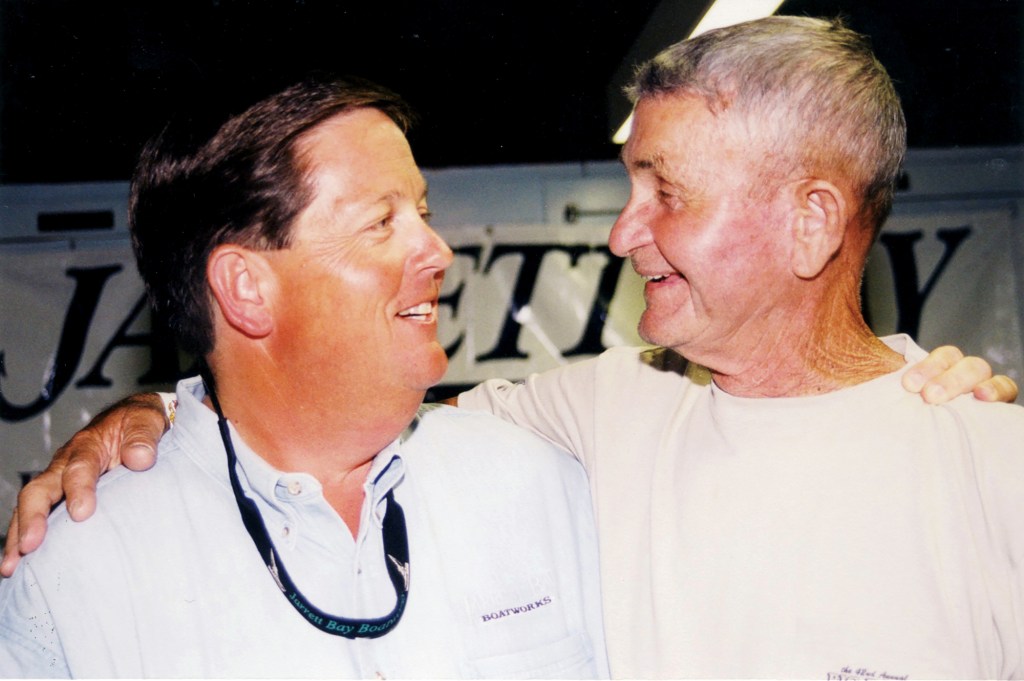
Ramsey and Luxton convinced charter customers Gene Boyer and Bucky Dennis to help fund their first boat, “because we didn’t have any money.” Then they set up shop in the infamous $250-a-month Williston shed. It sat on a body of water called Jarrett Bay. Their first table of hull measurements came on a single sheet of paper courtesy of Wanchese builder Glen “P-Nut” Haught. Epoxy/wood construction was revolutionizing wooden boat building, so Ramsey called West Epoxies. “They said, ‘What’s the name of your company?’” he recalls. “I said, ‘We don’t have a company name.’ They said, well, you don’t have a company then you can’t buy from us.’ So I literally looked out the back door of the shed we were in and I said, ‘Well, we’re Jarrett Bay Boatworks.’”
Months later, Sensation rolled out from beneath the leaky roof. With her trademark Carolina flare, the boat still fishes from the Morehead City waterfront to this day, and as Ramsey and Luxton successfully ran her for charters, their reputation grew—but not their wallets. Then in 1988, Jack Huddle commissioned hull number five. After her stormy paint disaster, his sleek and sturdy 43-footer would be christened Builder’s Choice. Huddle saw something in Ramsey, and wanted him to succeed—in a new building.
They found their spot six miles away in Marshallburg. True to his word, Huddle put up a single building on a far larger piece of property. Then a second. “Then he shows up with a Travelift one day,” recalls Ramsey. “He says, ‘You’re now in the repair business, because I’m not getting enough revenue off this.’ So I said, ‘Mr. Huddle, we don’t want to be in the repair business.’ And he said, ‘Well, you’re in the repair business.’ And it worked out great for us.”
A few years later, Huddle told Ramsey that his insurance company saw Ramsey’s diversifying business as too big a risk. Huddle wanted Ramsey to buy him out. To this day, Ramsey’s not sure whether it was an entrepreneurial bluff. “So I said, Mr. Huddle, we’re in the same place we were in Williston, we don’t have any money.”
Huddle hand-penned a simple ledger showing how much he had into the property and its general finances. “He said, ‘You go down to your local BB&T or whoever you bank with, you show them this handwritten ledger,” Ramsey says. He and Luxton were loaned the money. “He allowed us to become sort of the landlords of our future. The opportunity that family gave us, you would never do for anyone but your child. We built this industrial park. We moved here in 1999. They put roads in the infrastructure, and they built buildings for us. They repaired buildings. All this on a handshake. And their company, Trader Construction, continues to work for us today.”
Jarrett Bay has built five sportfishers for the Huddle family to date. Four Builder’s Choices and Rebelette, a 56-footer owned by Jack’s son Carl. “My dad, he was the old-school handshake type of guy,” Carl says. “Obviously, we do have contracts since we’re, you know, general contractors. But with real estate and other bartering deals, he was just of that generation—a lot of trust, looking a fellow in the eye. He just saw something trustworthy in Randy and appreciated his hard work.”
Aside from a reception desk whose Vineyard Vines-commissioned facade is the stern section of a sportfisher, Jarrett Bay’s HQ doesn’t look all that different from that of many substantial builders. But with a slew of repairs, refits and two mammoth 90-foot builds in progress, employees are busy in different ways than you’d find at any production-boat company. All the boats are custom, so every repair and refit order is different and no two days are the same. Challenges—and creative solutions—are constant. Jarrett Bay engineer, Payton Lanier, says it’s the only way he’d want to work. “There’s always some head scratching to do,” he says. “There’s never a dull moment around here.”
To illustrate his point, Lanier introduces young engineer Dominic Grasso. On a screen, Grasso is manipulating a 3D image of the custom hatch that will be fitted on the foredeck of hull 68. The gooseneck hinges for the hatch will be mated to a mechanical actuator. The hinges and actuators are available off the shelf. But the bracket that will attach them to the hatch, the hinge structural supports, and the mount where the actuator pushes the hinges will all be custom fabricated. Grasso studied mechanical engineering at Penn State. But this sort of solution is “a little bit of trial and error.”
“The amount of detail that goes into this is enormous,” says Lanier. “Whether it’s stuff like this or interior components, mechanical systems—the whole nine yards. And you’ve got to prep this stuff so it works for next three decades—or more.”
On his own screen, Lanier has been “pushing around parts and pieces,” in configuring hull 69’s interior. “You go in these little circles when you’re doing this,” he says. “It doesn’t matter what you’re doing, layouts or things like Dom’s doing—it’s all an evolution. It’s all the design spiral. You just keep kind of working it down until you get to that perfect design for that customer.”
This hull, affectionately called “Project Ultra,” will feature a full-beam master. That makes its interior layout very different from hull 68’s identical double-master-stateroom layout. “That’s the beauty in what we do,” Lanier says. “We’re just messing around with different orientations and how many people they can sleep, etc. We’re trying to check as many of those want boxes as possible.”
Across the hall, Lanier introduces veterans Brian Gray and Josh Fulcher. They’re working on hull 68’s headliners. Onscreen, the 3D walkthrough for the boat is astonishingly detailed. Gray “walks” me down the stairs. They have to work within parameters—for strength, bulkhead layout, walls, and doorways must contribute to structural integrity, “but we’re limited to our imagination,” he says.
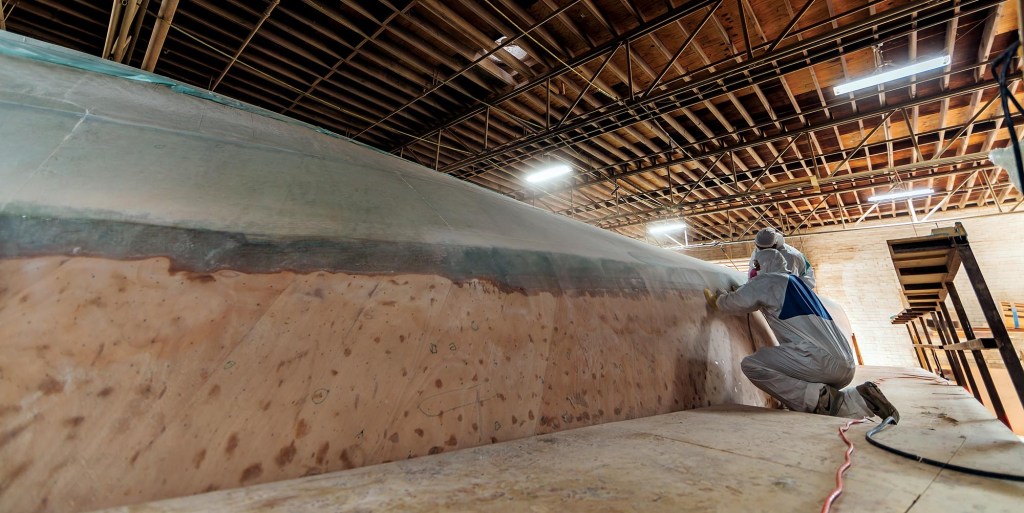
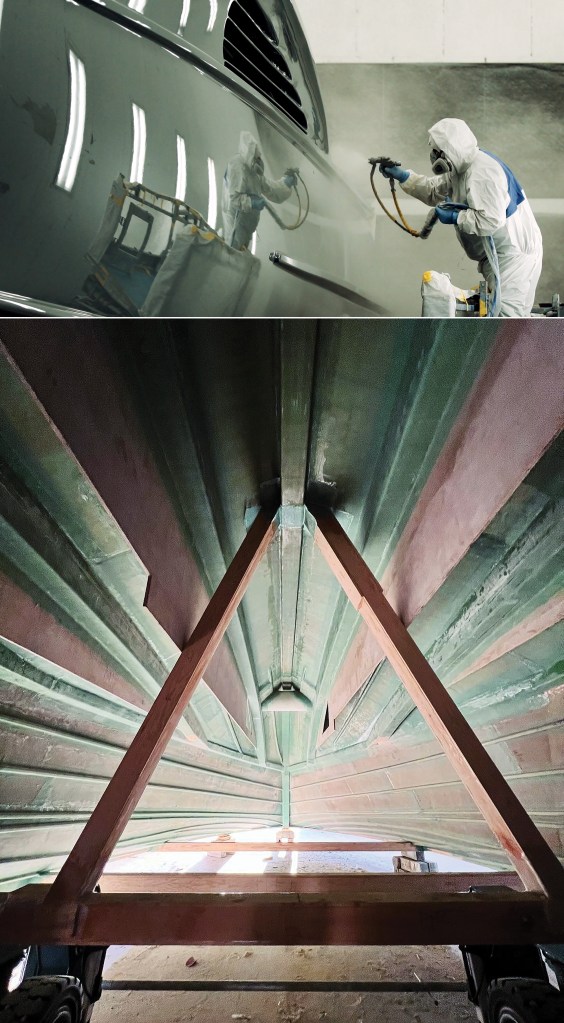
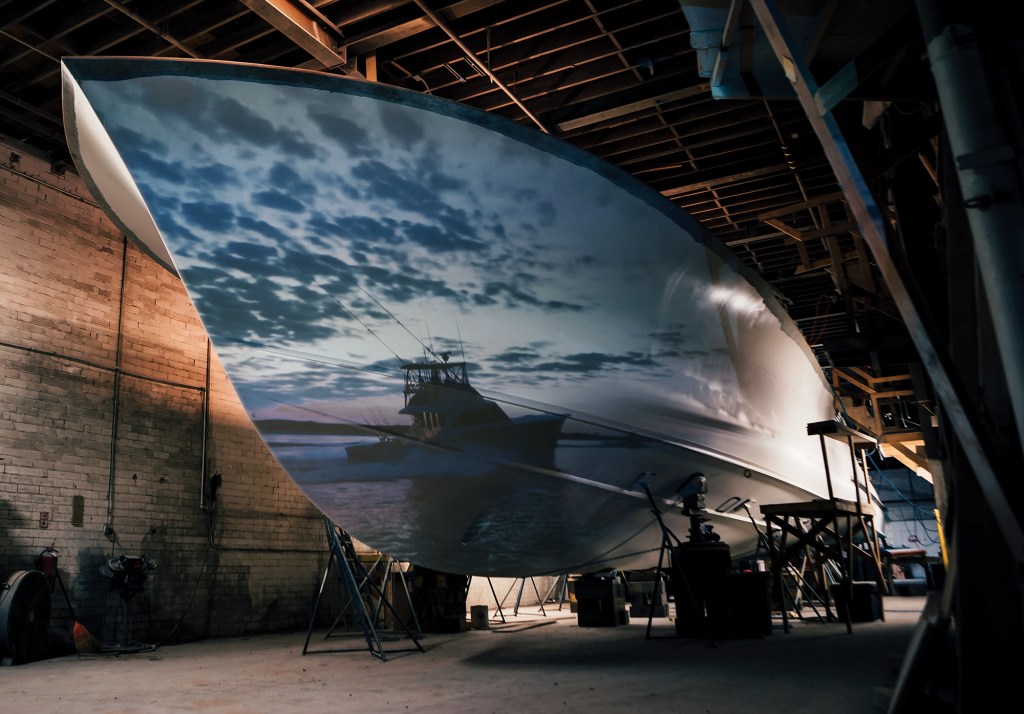
On the floor, I meet Jarrett Bay’s gregarious construction foreman, RV Hodge. If you’ve ever watched Jarrett Bay’s Carolina Flare Insider videos, you’ve seen this two-plus-decade Jarrett Bay veteran in action. Fit and funny, Hodge is an outdoorsman, a writer, a host, and, well, a genius. He shows off the huge, wooden “strongback” for hull 69. This will be the scaffold the crew will work on, and where the hull will rest during the first year of its construction life as it’s built upside down on this structure. “We build the strongback to match each boat,” he says. “Fortunately, we have back-to-back 90[-footers], so I think the process was essentially identical.”
There will be only 9 inches of clearance to the ceiling as the boat is built. When it’s trailered out, that clearance will drop to around 1.75 inches. The hull plywood will be epoxied in place right above the strongback; bonding the layer is incredibly labor intensive. As the panels are planked, 200,000 wood screws are used to clamp them together so they can be precisely epoxied. They’ll be removed and re-screwed as each of the three layers of planking goes on. “So it’s 200,000 screws for three rounds,” says Lanier.
“This is what it takes to make the masterpiece,” adds Hodge.
Hodge and Lanier roll up to the facility where hull 68 is nearing completion. Seeing her sleek, purpose-built form gobbling up the vast space is just impressive as hell. Touring her dusty staterooms, the work is breathtaking; gleaming, hand-polished hardwoods, wiring and hose routing that must be hidden but also accessible. Pieces test-fitted with old-school pencil marks all over. Paper diagrams showing where everything will go. On board, I again find Josh Fulcher, along with fellow Jarrett Bay Veterans Scott Young and Kyle Willis discussing the build. Young came on after four years in the Coast Guard. He started out painting, “til I got fed up with that and I went in and said, ‘I gotta do something else.’”
Young’s prior fiberglass expertise had come via surfboards, but soon he was overseeing layups and carpentry. “I kind of learned everything I know from working beside someone and watching them,” he adds. “Everything’s progressed since I’ve been here—the technology and the planning that goes into what we do. It’s easier to see the vision now. We can put you there and see the end product before we even start.”
Willis came onboard in 1998 as a land-based electrician and budding family man. “I talked directly to Randy,” he says. “I was working for myself, but I didn’t have insurance. We sat and talked for probably half an hour. He offered me the job, just as laid back, easy going, his door is always open—and it was the easiest job I ever got. Every time he’d see me in the yard, he’d hold his arms up, and I’d look at him like, ‘I’m working on it, I’m working on it.’ Then every time I finish something, I go in his office. ‘What’s next boss?’ He’d tell me what to do, and I’d knock that out.”
“It’s amazing, over the years, the things that he’s done for us,” adds Young. “When an employee’s been in a hard time, whether that’s been after an auto collision that was nowhere near involved with Jarrett Bay—just out on a Sunday, got in a bad wreck. After hurricanes—making it so an ice truck—18-wheeler, full of ice—is coming out. Opening the yard up so we can all fill our tanks full of gas.”
“I had an appendicitis,” says Willis. “I was in the hospital for eight days. He either called or texted every day to make sure I was okay.”
“We had an employee who hadn’t been here very long, and he was diagnosed with lung cancer,” adds Hodge. “And he sadly didn’t make it. But Randy footed the bill for us to go and fix up an apartment for him in his brother-in-law’s house when he was not able to work. Randy just paid for all the materials. And we had a bunch of guys volunteer when they built that all up. So literally the last six, seven months of his life, he had some place to live. That just tells you. I mean, he knows everybody, and he’s a shrewd businessman, but he also has a very big heart.”
Listen to Chris Dixon’s conversation with Randy Ramsey on the Power and Motoryacht podcast >>
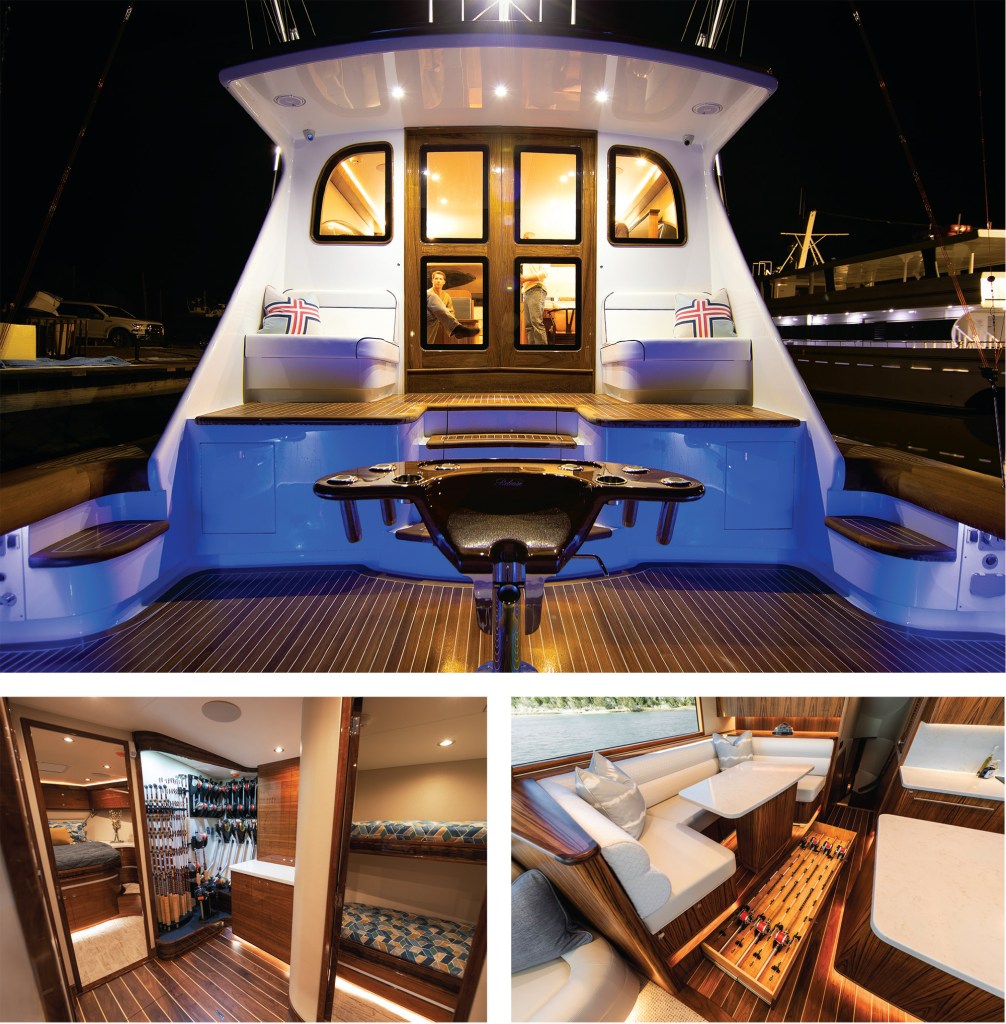
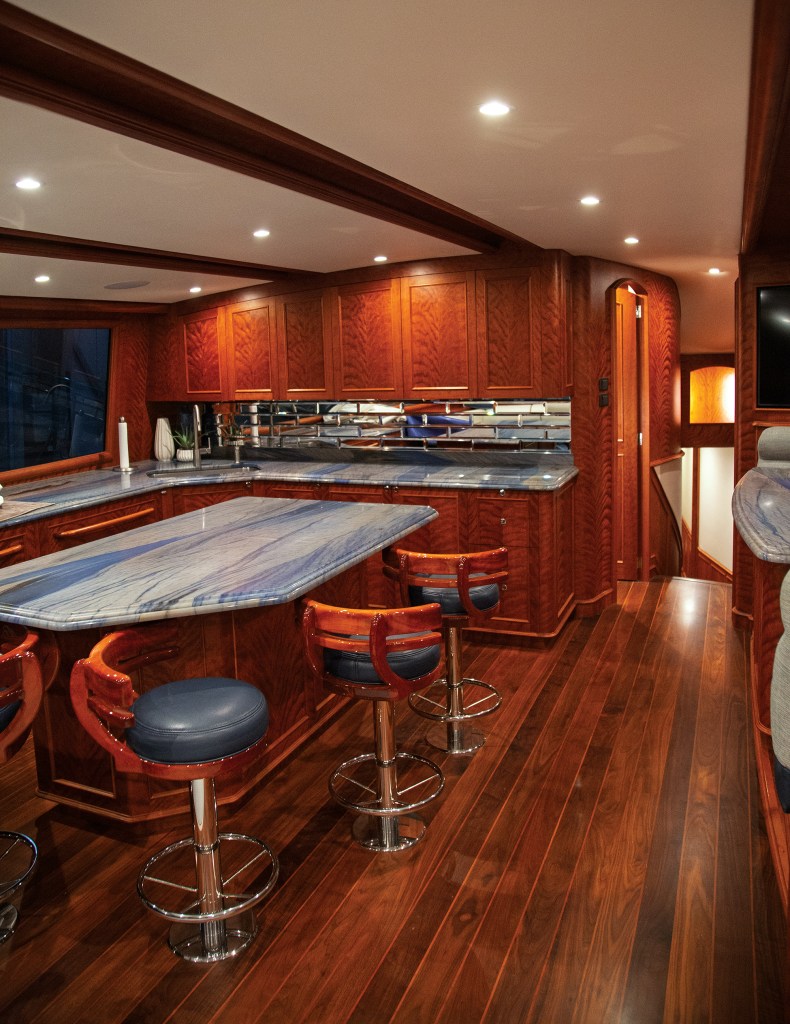
Driving through the 73-acre yard back to Ramsey’s office, Lanier and I stop down at the docks to tour Carl Huddle’s incredible Rebelette. From the exquisite welds on her tower to her gleaming walnut and her blinding marble countertops, the boat is high art. “I’ll tell you,” Carl Huddle tells me later. “Unless you’ve built a boat like that, you really can’t appreciate them. I mean, Jarrett Bay works with you every step of the way. There isn’t a thing on that boat that I didn’t have a hand in making a decision on. Obviously, I leaned on their expertise. Little things that they said: ‘Hey, you may want to consider this, because we’re having problems with this particular aspect of the boat. We think this will work better for you.’ I just have two staterooms, you know. I’m not traveling a lot with the boat. My wife and I may want to go out to Cape Lookout and spend the night. So it’s a boat that, you know, my wife and I could actually take out. It’s not complicated. It’s got a joystick. It’s just real simple to operate. But then, it’s a true workhorse. When you’re traveling the ocean and wanting to fish, it’s just remarkable.”
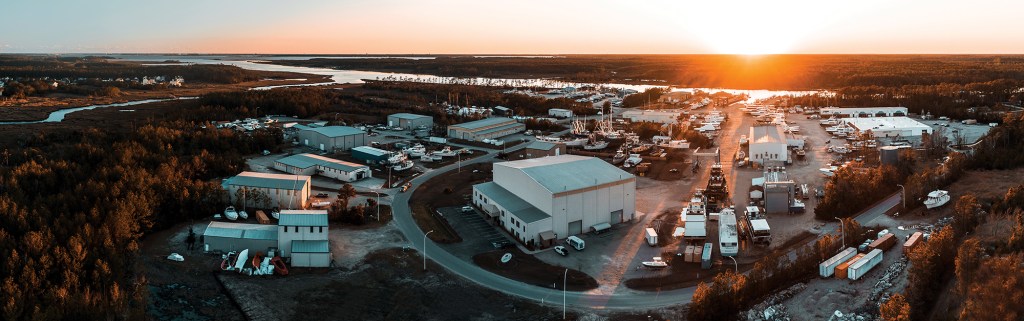
Lanier and Ramsey point out the marine ecosystem that has evolved around Jarrett Bay to support over 150 employees. Caterpillar, MAN, MTU, and Volvo Penta all have servicing distributors here. There are upholstery shops, metal fabricators, welders, and propeller repairers. The Ramsey-led Bluewater Yacht Sales brokers 400 boats a year here. A decade ago, Ramsey began pondering how this ecosystem might survive when he was no longer at the helm. His son Alan wasn’t in the marine industry. Eventually, Rives Potts, the CEO of Safe Harbor came calling. “I didn’t see us as a fit though,” says Ramsey. “What Safe Harbor was buying was marinas—they weren’t buying very large boatyards. And we also build boats. They didn’t really have any other boat builders under that umbrella. But when they first started talking to me, they said, you’re a good fit. You’re in the mid-Atlantic, you’ve built a very good reputation, and we’d like you to continue building boats. We don’t want to take you apart. We want to make you better. Put in more infrastructure and invest in your company and your employees.”
In 2022, he reached an agreement. Ramsey would sell Jarrett Bay and Bluewater, to Safe Harbor but he’d also continue as VP of Operations, remaining the gregarious public face of the operation. Since Safe Harbor Jarrett Bay is on the ICW, Ramsey says, more slip spaces for boaters are to come, but pretty much, it’s still business as usual. And business is good.
Back at the office, Ramsey has to duck into some more meetings, so I snap a few photos and thank him for his time. It is, he assures me, no problem. “I love to tell our story,” he says. “I mean, our story is the American dream. It really is.”
Info: jarrettbay.com
This article originally appeared in the June/July 2026 issue of Power & Motoryacht magazine.