
Back in 2005, Volvo Penta took a huge leap of faith at the London Boat Show. For it was there that the storied builder of marine propulsion systems unveiled a drive that had taken 10 years to develop—the IPS or Inboard Performance System. Steerable “pod” drives were not unfamiliar in the big ship space. Queen Mary II had just been launched, bearing four mammoth Rolls-Royce pods. But the idea of a fully self-contained, high-speed inboard steering and propulsion package for boats in the 30- to 50-foot range was radical. More radical yet was the execution. First, rather than pushing the boat, as propellers have done through the ages, an IPS pod’s twin, contra-rotating screws pulled a boat through the water from the front of the drive unit. That forward position allowed the props to grab “clean” water not yet agitated or aerated by a shaft or forward gear housing while full propwash thrust across the entire rudder delivered precise steering. Second, without a down-angled shaft, the propeller could run at a 90-degree angle to a vessel’s deadrise—creating no effect on a boat’s trim and further boosting efficiency. Third, compared to a shaft-driven system, IPS was incredibly compact—freeing up valuable space in the engine room, or giving room belowdecks for more, well, rooms. Volvo Penta promised skeptics too—its independently rotating pods would offer remarkable dockside maneuverability and should a pod strike a submerged object, its lower half would simply shear off. An expensive repair on an expensive system, for sure, but at least (in most cases) you wouldn’t sink. It was a soup to nuts, plug-and-play system and with it, Volvo Penta promised a 20 percent higher top end, a 15 percent acceleration boost and 30 percent better fuel efficiency.
Our own Bill Pike tested IPS during its very early days. The first system he recalls was a secret 2004 run in Miami aboard a Tiara. The first system lacked joystick control. “Volvo was very excited about this stuff—understandably,” Pike recalls. “But you had to operate it using throttles and shifts— and I found it to be the most confusing thing. Running the thing in open water was pretty good, but trying to dock it was a mystery to me. I was thinking to myself, oh man, nobody’s ever going to be able to use this.”
Volvo insiders though, promised Pike—wait, there’s something more to come. Then in what he thinks was 2005, he drove IPS with joystick control. “It was kind of like, oh, OK, now I understand,” he says. “Then I drove a Grand Banks Eastbay 46 with IPS out of Lighthouse Point in Florida. It was sporty coming back in. You’ve got to be pretty careful—you don’t go just straight in. You’ve got to make some turns. I was impressed with the way that boat handled. Then, the boat was behind a guy’s house. And I remember docking it. That was, you know, kind of a joyful experience.”
Two-plus decades on and 45,000 units later, it’s safe to say IPS is here to stay. A full IPS ecosystem has emerged, with three different-sized drive units for vessels from 35- to 100-foot in light commercial and yacht configurations and Volvo’s newest “Professional Platform” for mega yacht and commercial boats between 82- and 180-feet. But Volvo Penta is not finished. And that’s why I ventured to their Krossholmen testing facility on a flawless spring morning—not only to witness the unveiling of a new diesel-electric IPS hybrid-electric drive system and a mammoth dual-motor IPS drive, but to flog them.
This would be my first trip to Sweden. Arriving during a week of uncharacteristically dazzling late spring weather, I wandered the vibrant west coast town of Gothenburg while munching on a dinner plate-sized cinnamon roll the town is famous for. Just west of Gothenburg, hidden behind a series of granite outcroppings lies Volvo Penta’s Krossholmen marine-testing facility. I’ve never seen any place quite like it.
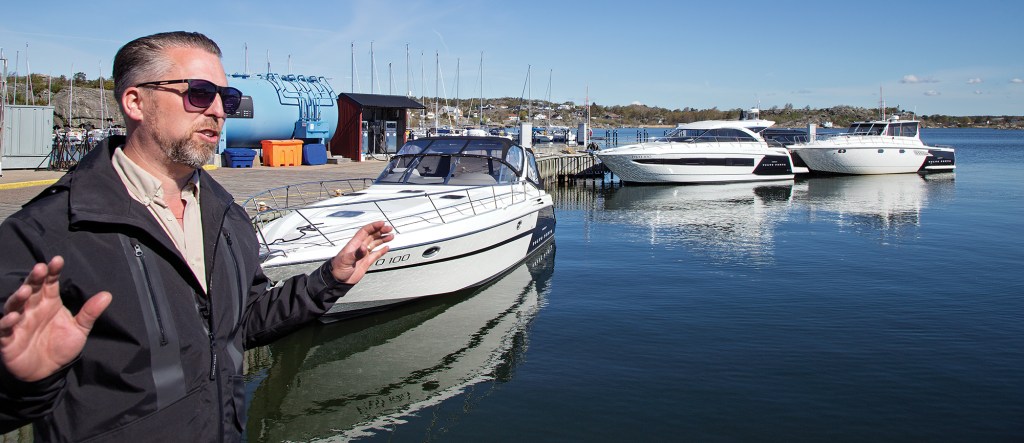
Entering Krossholmen’s gate, you’d have no inkling of the depth of this operation. Up until 1967, Krossholmen was a shipyard for a small boatbuilder called Judlar. Volvo Penta acquired the yard in 1968 and the site has only grown. Today, around 25 engineers and mariners might be busy corrosion-testing mammoth battery banks and engine components, or installing or tearing out electronics or drive-train equipment on the nearly 30 onsite boats. Test vessels include the very first IPS-equipped boat, a Cranchi 41, gutted Azimut and Tiara test mules, a pair of heavy-water rescue “LPD” vessels and smaller boats with serious history. One small red and white cabin cruiser dates back to the ‘70s. “It’s worth nothing in money,” says Robin Andersson, Krossholmen’s gregarious manager. “But that was actually the first electric boat they ever had in the open sea.”
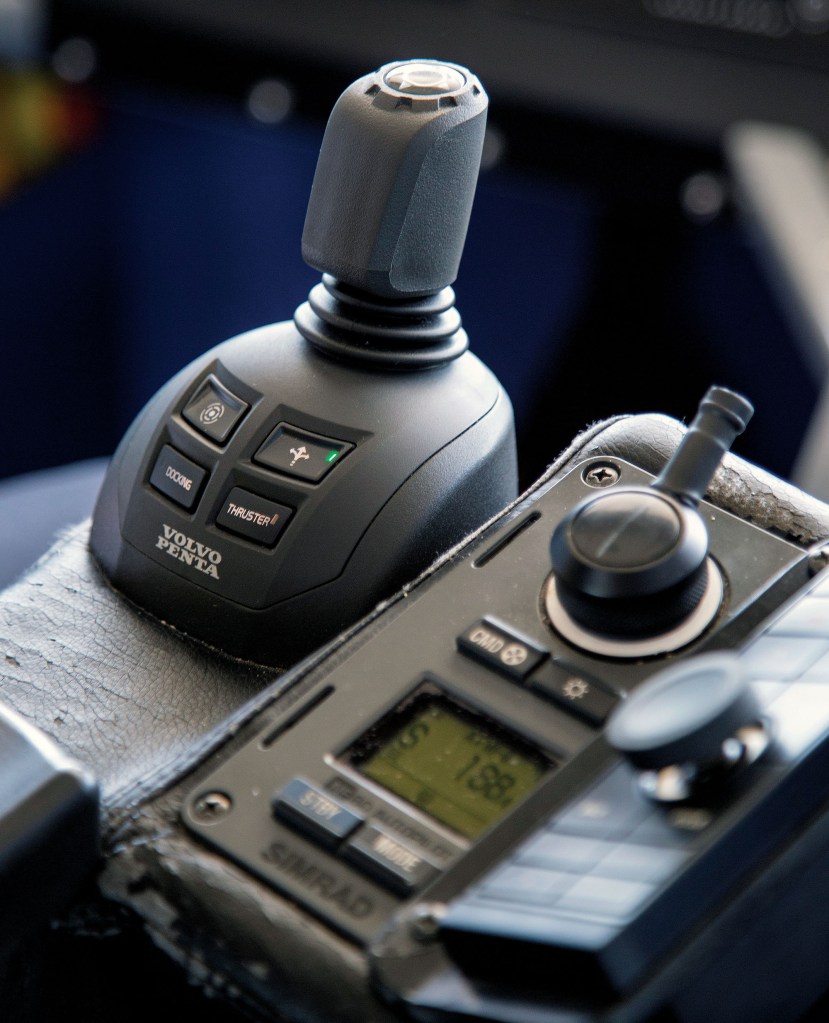
A gearhead who drives one of a few Dodge Vipers in Sweden (and a 2018 Ram Hemi pickup), Andersson has a fascinating job where no two days here are the same. He’s constantly interacting with different engineers, boatbuilders and mechanics testing all manner of experimental technology. He oversees technicians trying to break stuff—which is always fun—and he organizes a slew of boats, investigating every conceivable configuration of propulsion. He points to a battered, mid-sized Tiara: “It’s not maybe looking so nice, but that is triple installation of IPS 10—the first boat we tried out triple installations on. It’s completely empty inside. All connections and modules are visible so they can change anything immediately. We really stress the system so when we do software we can integrate stations by plugging in cables and stress the system to its maximum.”
“We don’t know anybody who has something like what we have here,” Andersson adds. “We can go out. Nobody notices us … operate boats and test the latest and the greatest.”
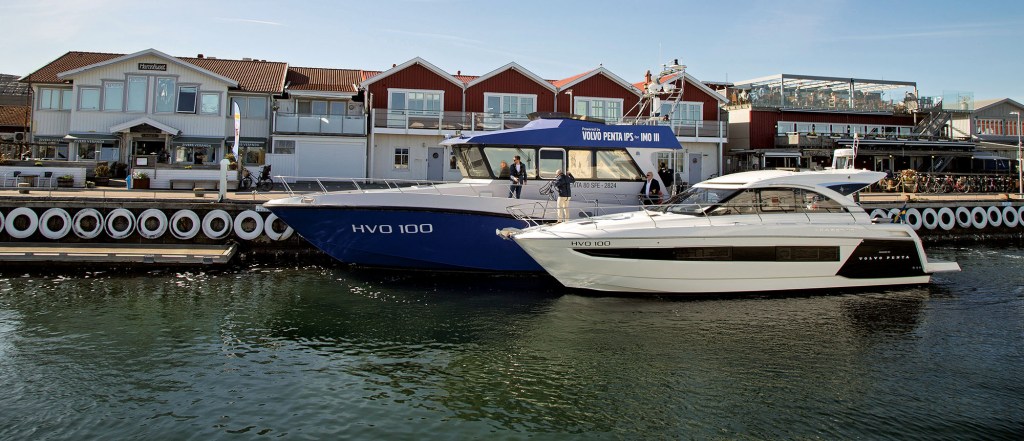
Krossholmen boats and onsite fuel tanks sport three letters on them: HVO. Everything diesel here runs not on diesel, but hydrogenated vegetable oil. It’s a bit more expensive than standard diesel, but the drop-in replacement fuel burns clean with a vague smell of French fries, and reduces overall carbon emissions by around 90 percent—an ongoing goal Volvo Penta says it’s committed to.
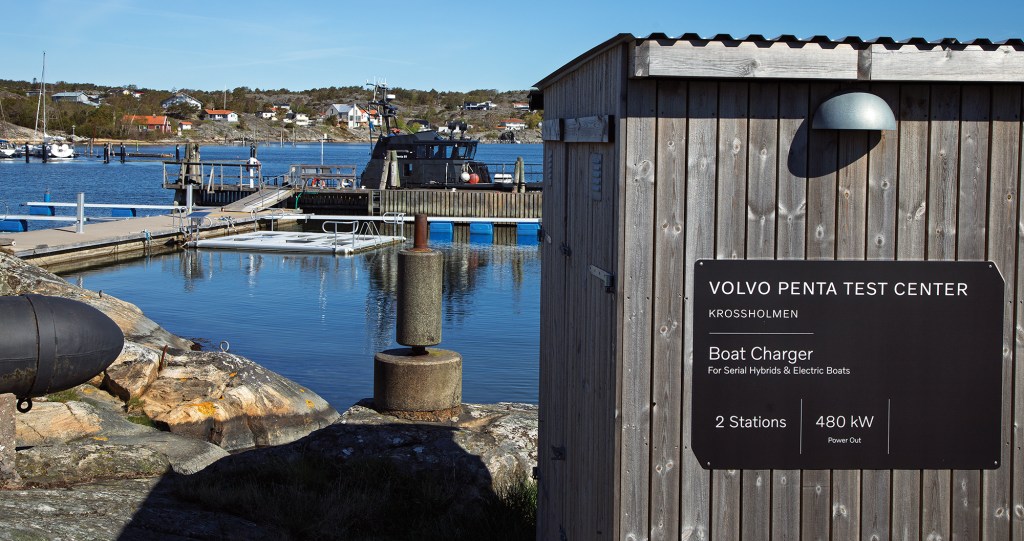
One nondescript building hides a jungle of wires, connectors, and boxes undergoing testing of extreme heat and cold. The boxes hold batteries and charging equipment that pulls power from an adjacent solar-covered rooftop. Another outbuilding is filled with banks of used Volvo electric car batteries. Krossholmen is tapped into the local power grid, but to avoid straining that grid, they store those batteries’ electricity so gobs of amps are available to test super-fast charge systems or running high-voltage motors. Engineers here are even working to employ boats like the one I was there to drive as electron storage vessels for the power grid itself. “Here in Sweden, boats are only in water maybe from April to October,” says Andersson. “Half of the year, they are standing on land and doing nothing. They could support the grid instead—just hooking up into chargers that push and pull power … and then you have a payback from the city for supporting the grid.”
The battery-laden boat docked alongside the solar panels is called Penta 80. She’s a 66-foot, 42-ton aluminum-hulled Swedish-built patrol boat with a graceful tumblehome and reverse raked pilot house windshield. Sporting a helm straight out of “Star Trek,” Penta 80 has been testing diesel IPS drivelines for better than a decade. But more recent has been the development Volvo Penta’s “Glass Cockpit” control system and hybrid IPS system.
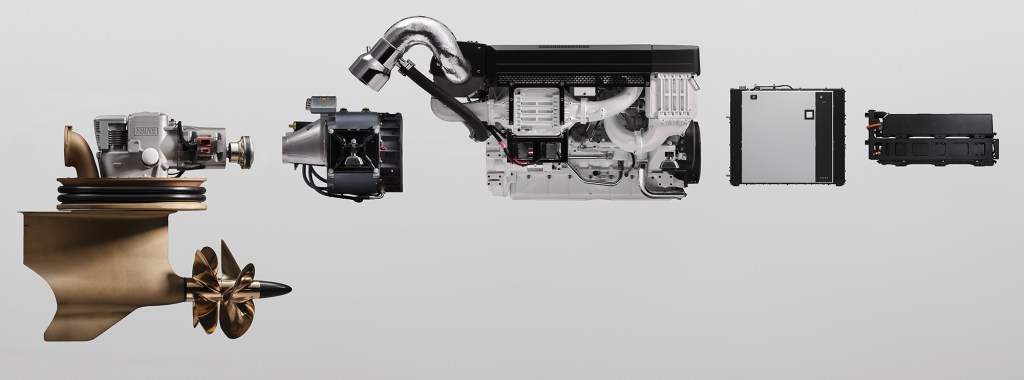
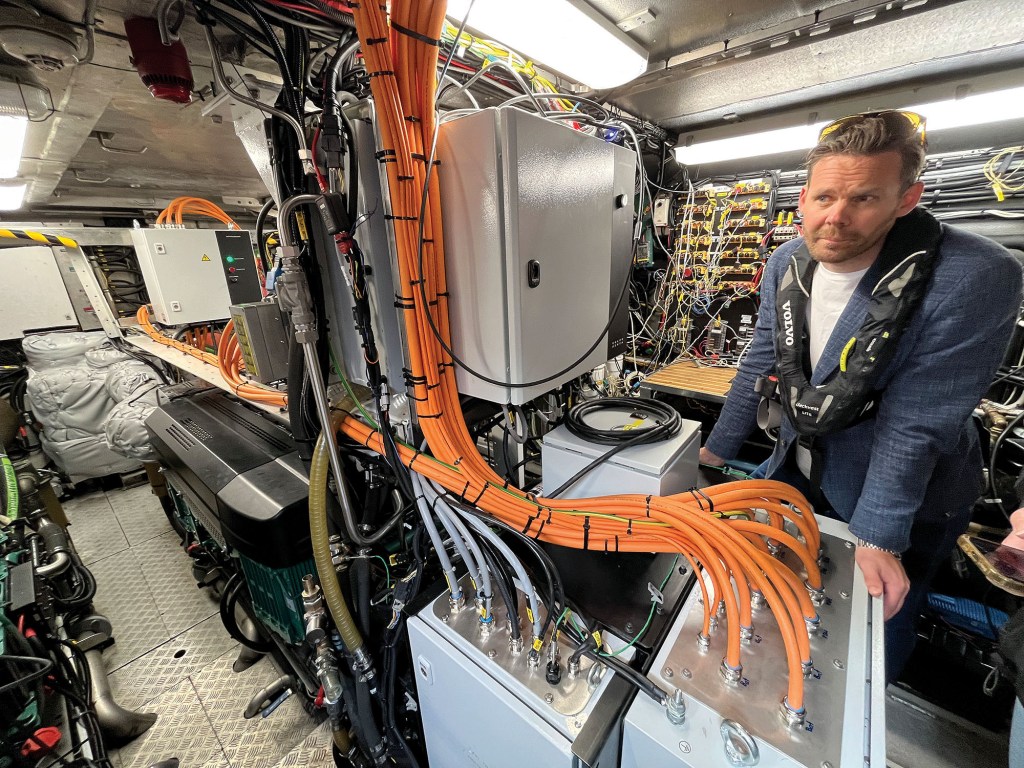
When Volvo Penta’s VP of Yacht and Superyacht Sales Nicola Pomi officially unveiled the hybrid system alongside the dock, what I saw looked much like a standard IPS. On Penta 80, combustion comes via dual 1,350-horsepower inline sixes, but cleverly sandwiched between the diesel and the pod unit is the magic puck: a big, cylindrical 160-kW (214-horsepower) electric motor. Not a one-trick-pony, when spun by the diesels, that motor becomes a generator, sending energy via a new Power Distribution Unit to the boat’s helm, systems, and a 147- or 221-kWh lithium iron phosphate (LiFePO4) battery bank. After 40 to 45 minutes of running the diesel in pure charge mode, these batteries are fully loaded—and even the smaller kW pack will silently run Penta 80’s systems for 11 hours. The secret sauce, says Penta 80 captain Stefan Heinerås, is the way the system blends optimal electrical generation with propulsion based on how much throttle is used.
As I’ll soon learn, driving Penta 80 on electrons could not be simpler. Tapping the screen to shift into “Pure Electric” mode and pulling away with joystick control, you immediately notice that a highly maneuverable IPS system is even more maneuverable on electricity. Unlike a combustion engine, there’s no minimum ‘idle speed,’ so the props can be throttled from nearly zero rpm for precise control—and there’s no mechanical lurch between forward and reverse. Then, there’s the near silence. Combustion IPS systems are quiet, but electric is simply next level. Even in the engine room, regular conversation is easy—and it doesn’t get hot.
Motoring for a few minutes in “Pure Electric” to clear Krossholmen’s low-lying granite uplifts, we reach the broad, busy, and beautiful waterway where the Göta älv (a river) becomes Rivö Fjord on its way to the North Sea. The boat will run around 40 minutes on pure electric at her 11-knot top electric speed, and around five and a half hours at 5 to 6 knots. Highly intuitive displays show range, state of charge and discharge, the percentage of power coming from which source—and the power balance between diesel and electric propulsion or generation. Heinerås says “Hybrid Electric” mode is likely to be the default most of the time. Like a hybrid car, the boat shifts into electric for low-speed operation and automatically determines the power source needed based on demand, transitioning to combustion as speed increases. Tapping “Hybrid Fuel” mode, the system primarily runs on HVO/diesel, only utilizing the electric motor for acceleration and quick maneuvering. Tapping “Cross Over” mode, the system automatically alternates between the starboard and port combustion engines and electric drives to minimize running hours and extend service intervals.
With 2,000 horsepower, Penta 80’s acceleration is impressive, even with around 10 of us onboard. At the helm, I’m seriously impressed with the metal boat’s maneuverability on her way to a 35-knot top end. Even crossing back over her wake in a hard turn, she loses no grip and maintains rock solid Swedish composure. And then there’s her assisted docking. Coming dockside under electric power in a 10-knot breeze, the confidence the system inspires is almost alarming. Using sensors and the GPS antenna to measure bow and stern distance from the dock, thrust adjusts so that your approach remains parallel to the dock. I tested this on a 42-foot stern-drive MJM 4 at Miami in 2024. Even with the Sturm und Drang of the MJM’s diesels and their shaft transmissions, that system was impressive. Driven by silent electricity, Penta 80’s is at another level.
After stepping off Penta 80, we would soon be driving a completely different vessel in Penta 40, a 154-foot high-speed catamaran that operated for two decades as Helgeland, a 199-passenger ferry (she still retains her seats) that ran through stormy Norwegian waters.
Penta 40 has run 10,000 hours testing a wildly avant-garde-looking system: IPS Professional. With this system, the IPS drives we’re accustomed to are attached to a single pod transmission, but to each massive pod is bolted a pair of engines, one fore and one aft of the pod drive. They’re designed for yachts and commercial vessels between 82 and 180 feet and can support between 2,800 and 8,000 horsepower. Software will support a four-drive system with eight engines at speeds of up to 40 knots.
Aboard Penta 40, Francesco Giudice, Volvo Penta’s Yacht & Superyacht Sales Director, says that compared to the original shaft drive, this 3,200-horsepower cat reaches 30 knots in 28 seconds—compared to her original 50. IPS saves 4,000 pounds of weight and yields a 20-percent tighter turning radius. In “Eco” mode, which shuts down two of the engines at 5 knots, she consumes 1.3 gallons per nautical mile, compared to 4 gallons with shafts. From 15- to 30-plus knots, she’s about 20 percent more efficient than she was with shafts. In the engine room, Giudice shows how incredibly quiet and compact the installation is. “If you compare a shaft line system, you can imagine how this can open up to different opportunities from a design point of view, and different benefit. You save roughly 50 percent of space in terms of engine room. That means more space on board—extra paying load for a commercial vessel, or extra space to enjoy life on board a yacht.”
Currently Volvo Penta only offers the combustion version of IPS Professional drives—and they’re installing them on boats that include a Sanlorenzo 120. But the most remarkable perk of these drives will come over the next couple of years as the company introduces hybrid-electric and even electric-only versions.
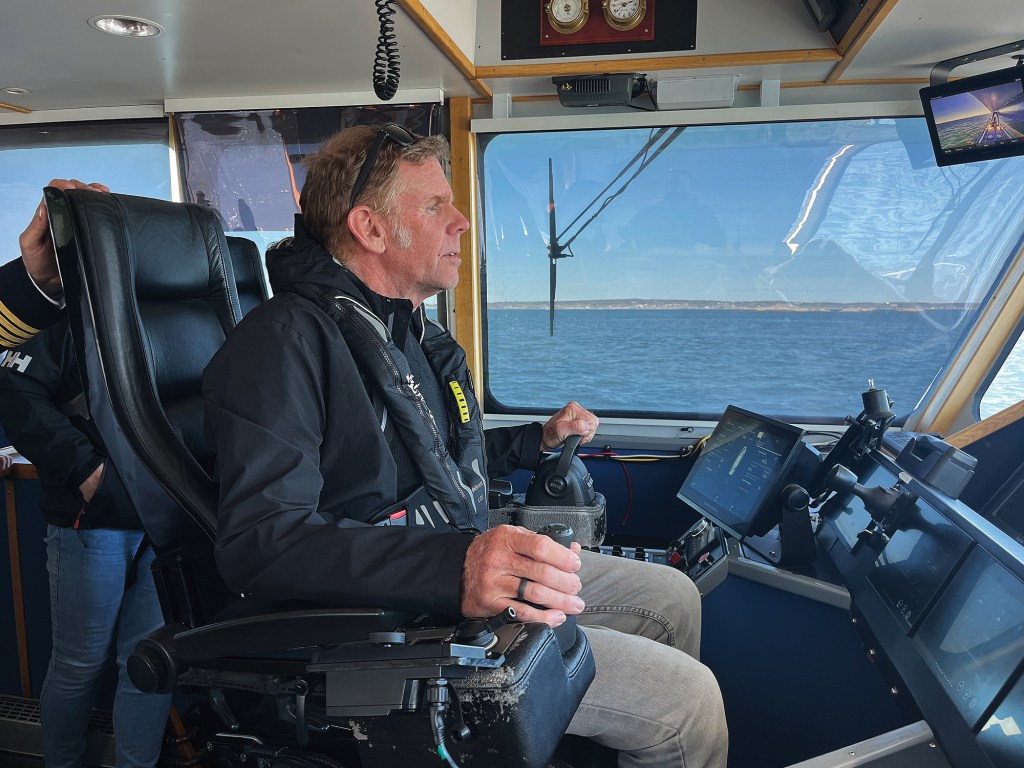
If the helm of Penta 80 was something out of “Star Trek,” then Penta 40’s is from “Star Wars.” Three stories up, I’m surrounded by windows and screens, tucked into a shock-absorbing, sliding helm chair that puts every aspect of this imposing vessel’s controls at my fingertips. The displays show the four 800-horsepower engines, loads, consumption, and whether they’re shut down for Eco-mode operation. At Capt. Thomas Hansson’s urging, I peg the throttles and we’re quickly skimming along at 35 knots. When Hansonn suggests a hard over turn, I find she corners like a sports car, losing almost no speed and galloping across her substantial wake like a Viking warrior. Reaching the open sea, swells are running 3 to 4 feet. We don’t slow down. I never knew such a big vessel could be so much fun.
Approaching Krossholmen, Hansson shows Penta 40’s final trick. We take turns nudging this tall vessel up to the dock. Solo. In the wind. This should be left up to a skilled captain. But again, the automatic docking keeps us parallel to the dock as I slowly inch closer for a tie off.
My time in Sweden ends in downtown Stockholm. I check into my hotel, grab a burger and a beer, and have a little time to reflect on a whirlwind journey. First, I’ll be back—hopefully with my wife and hopefully staying aboard a boat so we can properly explore this gorgeous country. The people are warm, well-educated, forward-thinking, and often hilarious. Swedish culture is deep, diverse, and fascinating, and what those Swedes have achieved with this latest round of IPS tech is the true culmination of thousands of years of maritime evolution. And even now, they’re just getting started.
This article originally appeared in the August/Septmeber 2026 issue of Power & Motoryacht magazine.


