There’s a moment of truth only a true boatbuilder knows. It’s the nerve-racking moment when months (or years) of theory, design, measurements, intuition, bloody knuckles, curses, hopes, and dreams all come together—or fall apart. It’s the moment when an untested hull first slides onto the water and gets underway. With Footloose, that moment came 6 years ago on a tidal creek outside of Charleston. The builder was a local boat fanatic named Chris Nistad, and the gleaming, hand-hewn, cold-molded, 33-foot center console was unlike anything he had ever built. To make matters even more fraught, Chris hadn’t spent the previous year and a half building the boat for just any old customer, but for a salty, seasoned mariner; a tugboat captain and deep-dyed angler named Pete—an exacting client who also happened to be his dad.
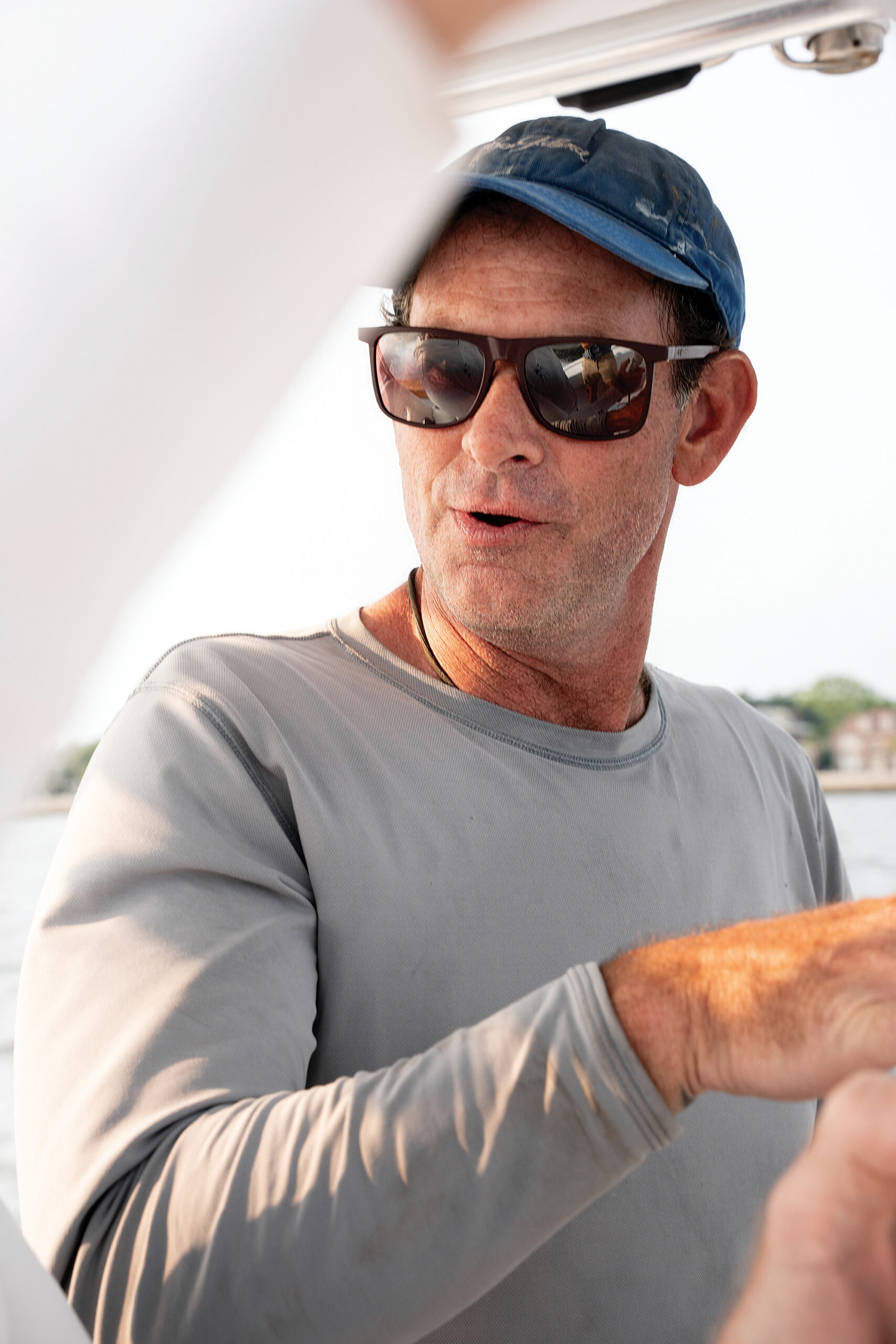
“We were on the Folly River when we launched it,” recalls Chris’s older brother Gunnar. “The boat didn’t even have a T-Top yet. Chris was just—he was nervous as hell.”
The jig-built boat had one particular thing going for her right off the bat—a dramatically flared deep-blue, deep-V hull that Chris designed in partnership with the legendary Steve French. Out back hung dual Yamaha 300s, so the Nistads reckoned she’d be plenty fast. Idling in the channel, her waterline was exactly where Chris had hoped, “But I still didn’t know it was going to work,” he confesses at his parents’ elegant home in a historic Charleston neighborhood. Then he recounts pegging the throttles.
Pete raises his forearm out at a straight, horizontal angle and chuckles: “The boat comes up out of the water like this, just straight up.”
“And then it just took off,” interjects Gunnar. “It was like, whoa. Wow. Holy cow!”
Now happy as a clam in Lowcountry pluff mud, Pete chided his builder. “Well, Christopher, it took you goddamn long enough.”
You can also find this video–and hundreds of our other videos–here ▶
I first became aware of Footloose several years ago because Chris built it just up the road from my house in a gritty little enclave near Folly Beach along Signal Point Road. Signal Point still holds a humming hub of mariners, welders, mechanics, and resin artists. The Renkens (Sea Fox) once had operations here, as did Billy Freeman. A slew of lesser-known but first-rate craftsmen like Kurt Oberle, Jack Budak, Doug Dow, Jim Noland, and Frank Middleton—who built the wooden jig for Freeman’s first catamaran hull—have graced Signal Point too. Nistad cut his teeth—and eventually even sliced the tips off a few his fingers—amidst these boatsmiths.
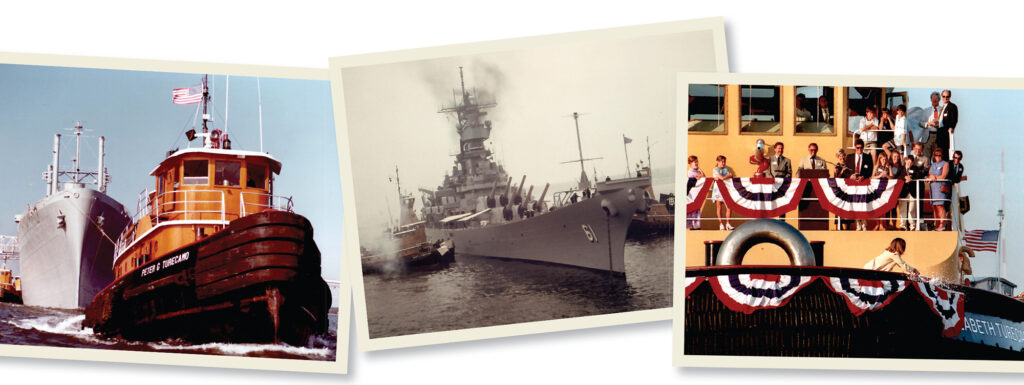
Chris was born in 1972, while Pete worked as a Detroit executive for Owens Corning fiberglass. Pete’s father-in-law, Bart Turecamo, was director of New York’s Turecamo Coastal and Harbor Towing Corporation—a company founded in 1927 by Chris’s great grandfather Bartholdi “Barney” Turecamo. Pete went to work with Bart around 1978, and Bart soon expanded to Charleston, entrusting Pete with the job. Turecamo was known for exquisite boats—instantly recognizable for their woodgrain painted houses.
Bart passed a sportfishing gene on to Chris and his older brother, Gunnar. “He had a 64-foot Hatteras,” Chris recalls. “The first 64 ever built. He also had the first 58 and the first 53.”
The Nistad brothers and sister Jennifer grew up in Snee Farm, a subdivision north of Charleston. Shem Creek shrimp docks, empty Capers Island beaches, and the stunning Cape Romain National Wildlife Refuge were the family fishing and boating playgrounds. First came a 21-foot Wellcraft. Then a 31-foot Tiara—which ran clear down to south Florida. The Nistads were a family of means, but Pete didn’t let the kids off easily. Sweltering summers were spent chipping, sandblasting, maintaining, and crewing the tugs. “You were always tired,” Chris says. “Tons and tons of maintenance. It’s still a tugboat, ‘til you got up close. Like, yacht finish. Immaculate. Every screw head had to be oriented north, south, east, and west.”
“One time we were docking a car ship,” Chris continues. “That captain goes, ‘I’ve been all over the world, and I’ve seen thousands of tugboats, and that is by far the prettiest tugboat I’ve ever seen.’ I was up there in the pilot house and I finally got it.’”
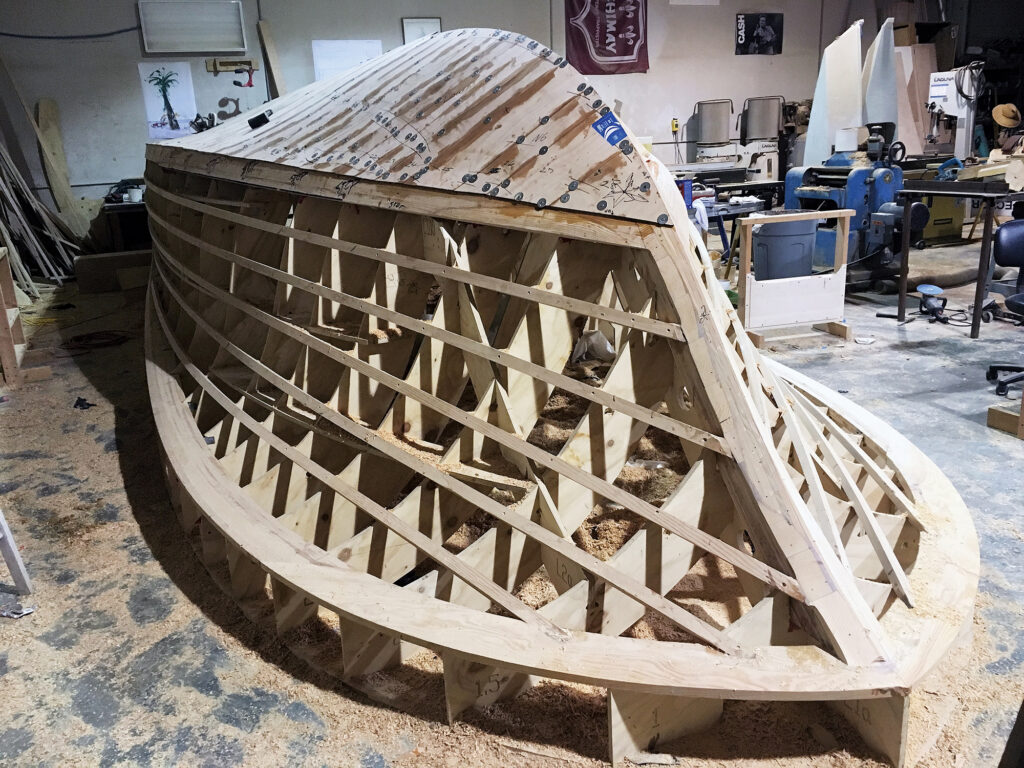
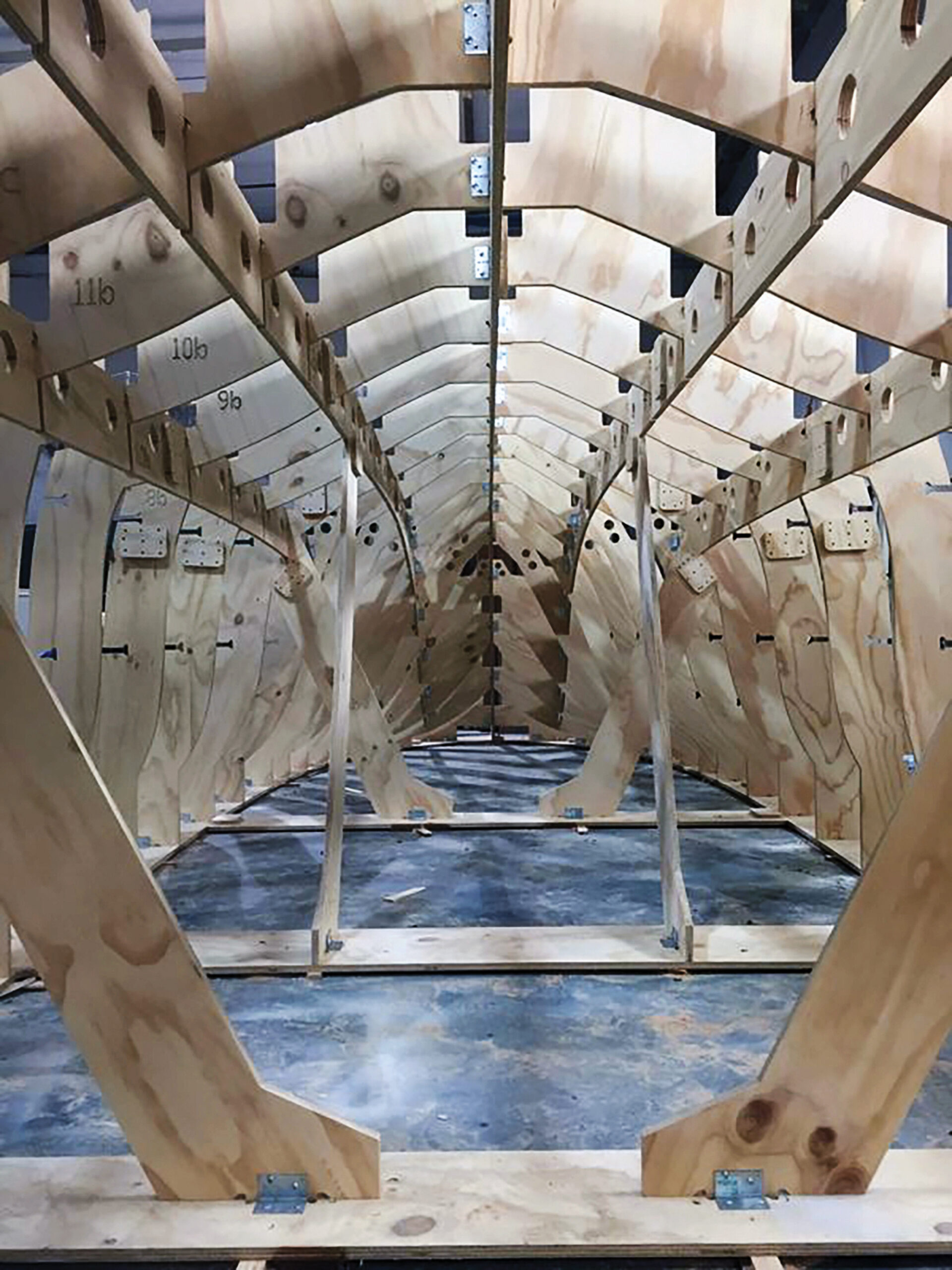
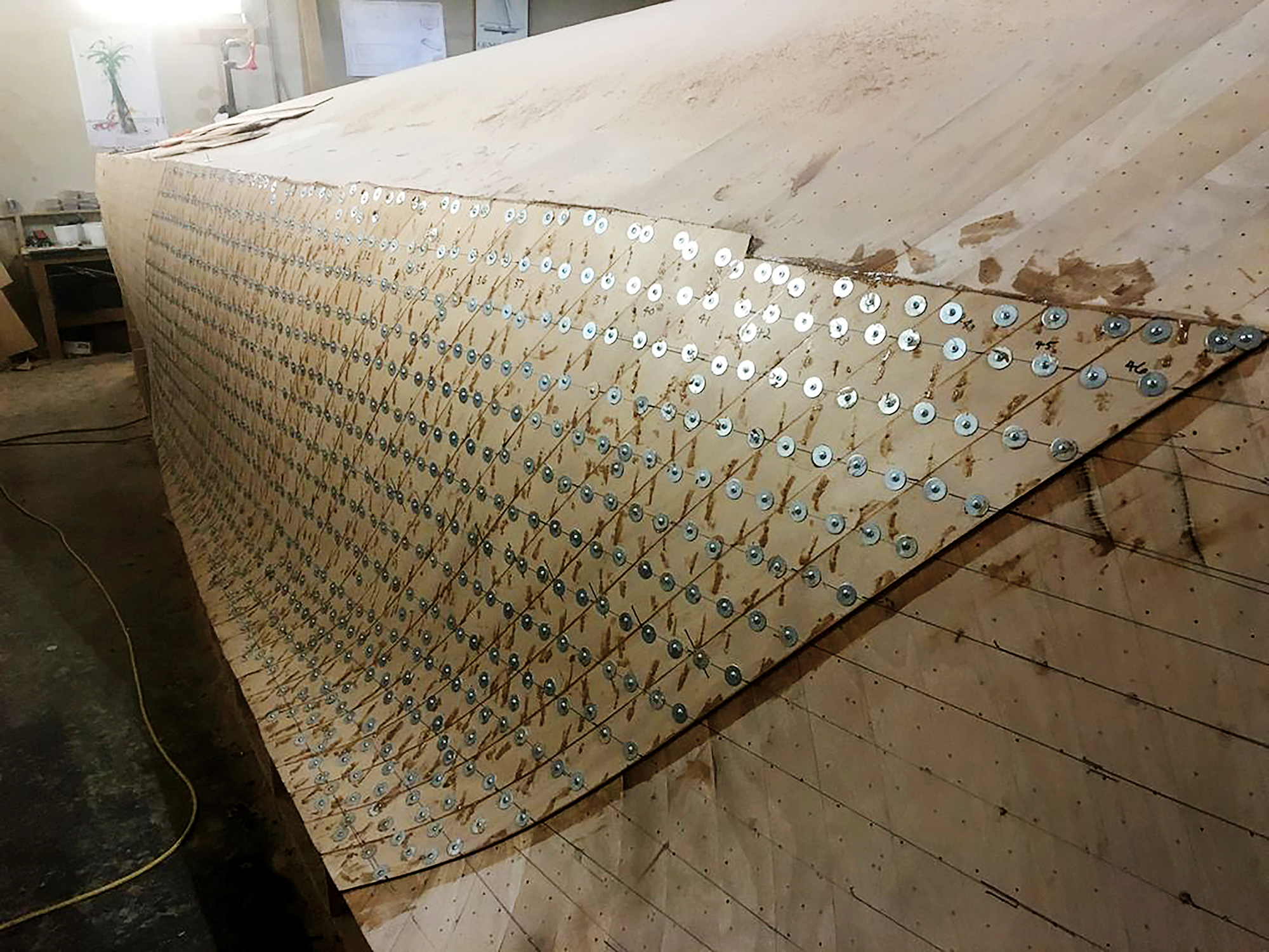
Utter precision and obsessive attention to detail. All those screws hold the hull laminates in place for bonding—then every single one is removed and the holes are filled.
Keeping a boat pretty and functional became second nature for Chris and Gunnar. During summers off from Clemson University, Chris was promoted to offshore deckhand, working up to a 200-ton masters license running the tug Robert Turecamo. “I loved it,” he reflects. “There was no such thing as an average day.”
Pete formed partnerships and expanded to Brunswick, Savannah, and Jacksonville. Before selling the business in 2015, he was up to around 100 boats. In the early 2000s, Chris was making a solid captain’s income. But he’d also been bitten by the boatbuilding bug after undertaking a 14-foot stitch-and-glue Phil Bolger skiff. “I built it in my garage,” Chris says. “Then I started doing little things around the house. I built cabinets, taught myself. Then I got married. And the hours on the tugboat—that lifestyle was just too hard for newlyweds. My wife was like, ‘The only thing I ever heard you say you would want to do is build boats.’ I quit the next day.”
Taking a massive pay cut, Chris went to work for Mount Pleasant boatbuilder Mark Bayne, a shipwright whose alumni include powercat pioneer Billy Freeman. “Everybody I know that builds boats or does things with wooden boats worked for Mark,” says Chris.
The couple sold their downtown Charleston house and moved into a modest place on Charleston’s James Island. Chris laughs: “I went from making tugboat-captain money to making, I have no idea how to build a boat working for a boatbuilder money. But Mark taught me to build a boat.”
Bayne was just starting construction on a 58-foot sportfisherman called Dixie Rig. “It was jig built,” says Chris. “Cold molded. Mark threw you right in there. If he had confidence in your ability to use a tool, he could teach you to use it properly.”
Another shipwright named Frank Middleton, today known as one of the world’s premiere carvers of wooden duck decoys, also worked on the boat. “I learned a lot from Frank, too,” says Chris. “How to frame and plank, learned to fair; I built the stern for a 58-foot custom sportfish. Building that boat was a lot of fun. It took about a year and a half. It seems like every boat’s taken about a year and a half. It doesn’t matter the size. You can only fit so many people on a boat working.”
Nistad learned how unseen engineering touches on a wood-framed boat determine its longevity. Take the limber holes that drain water that makes its way to the stringer. If you seal the drilled stringer holes from seepage with G10 epoxy, “then there’s no chance of getting water into the stringer,” he says. He also developed an ability to eyeball measurements without using a ruler—and an obsessive eye for fine-point detail.
As the 58-footer was nearing completion, Mark Bayne and a few others got the wild idea to build a 140-foot-long tall ship modeled after a 19th-century Charleston pilot schooner. She would become SSV Spirit of South Carolina—a volunteer-supported educational vessel still sailing today as a living classroom and was to be built with donated vintage tools that included a mammoth circular saw that cut the live oak flitches for her ribs. “The day the newspaper showed up, they wanted a picture,” says Chris. “The deadwood was there. So, Mark told me, ‘Go cut an inch off the end of that piece.’ That was, officially, the first cut made on site for the boat.”
The unpaid work provided free woodworking master classes. Spirit was followed by work for Middleton on a variety of projects: detailed restorations; building a 50-foot sportfisherman; and a graceful, high-bowed, center-console skiff called an Ocean Pointer. “Then Frank and I got together as partners and built a 58—as a spec boat,” he says with a grimace. “The boat was finished just in time for the financial crisis.”
Though the sportfisherman sold for a serious loss, a crestfallen Chris had a significant skillset and now, a son named Enzo to support. Rather than new builds, Nistad Boatworks kept the family fed through a steady diet of dockside repairs and word-of-mouth high-end restorations—most recently, an immaculate 58-foot Egg Harbor.
During this period, while prepping a sailboat for the Georgetown Wooden Boat Show, a moment of distraction at the circular saw took off the tip of his left index, middle, and ring fingers; the latter was sewn back on. “I don’t recommend doing that,” says Chris, holding up his hand. “One day, Kurt Oberle, who I rent shop space from, he goes: ‘Until this year, I never noticed how many old boat guys are missing fingers.’”
Still, Chris found himself itching to build another boat. In the late ‘80s, Pete and Kathy had owned a ruby-red, tank-tough 31-foot Ocean Master center console that Chris and Gunnar had been crazy about. Then, a Fleming 50 was to be the first Footloose. “But I never took delivery,” Pete says. “A guy offered me so much money, so I just sold him the boat.”
Pete always loved Hinckleys and their exquisite detail, so next came a 37-foot Hinckley Picnic. But it didn’t really lend itself to the kind of muddy, bloody Lowcountry boating the family was raised on. “The kids never liked it because it wasn’t a fishing boat,” says Pete.
Pete told Gunnar he was considering a Contender or Regulator. “You can’t do that,” Gunnar replied. “If you don’t let Chris build a boat, he might never talk to you again.”
“So that was the deal we charged Chris with,” says Pete. “You’ve seen how Hinckley builds boats. You’ve seen the quality. Build me a Hinckley—but make it a center console.”
Most builders have moved away from jig-built boats to fiberglass mold-based hulls. But Chris knew the old style still has its advantages. “A cold-molded boat is lighter and stronger,” he says. “You can build it stiffer. And if it’s built properly, it’ll last forever.”
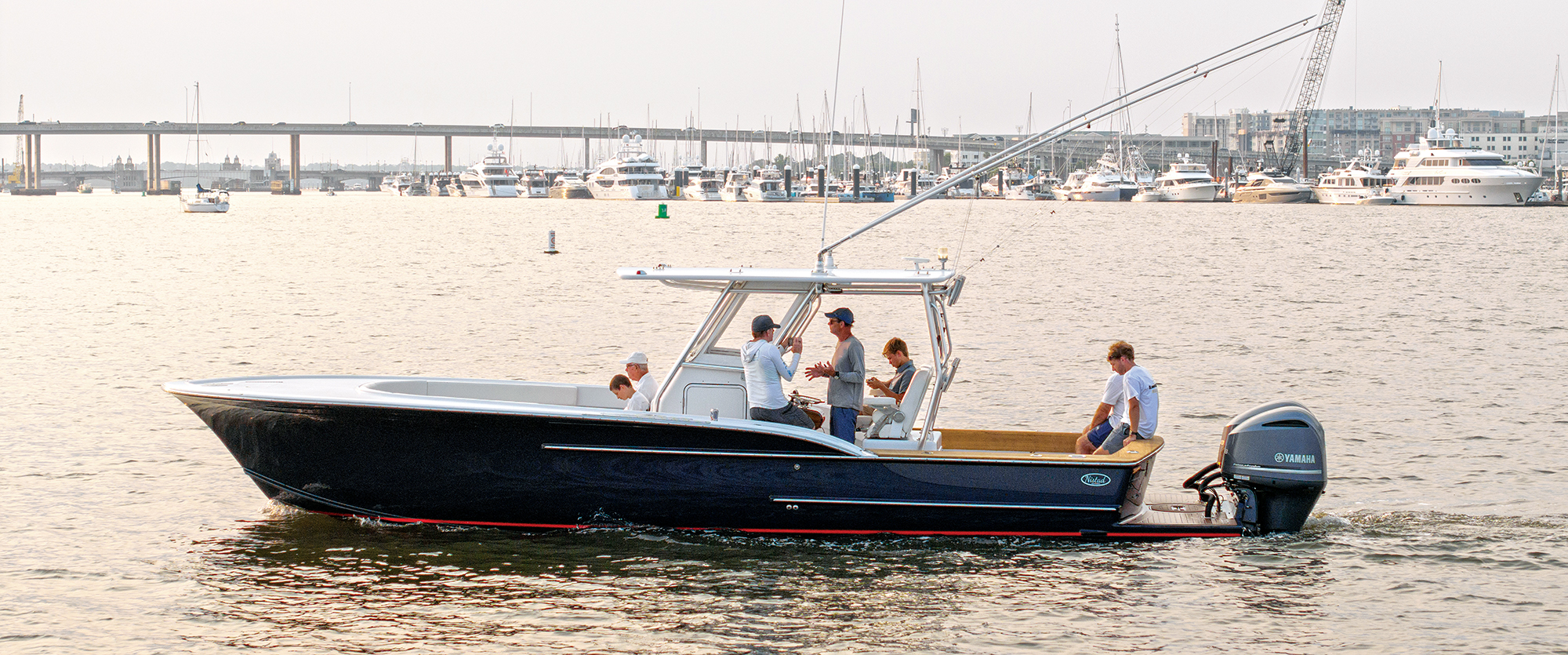
Chris had been impressed with Steve French’s hullshapes. So, he commissioned a 33-foot deep-V with plenty of flare. “It’s called a Waveform hull,” says Chris. “I didn’t do anything to change the overall shape of the bottom or the chines. That’s not my wheelhouse. But I got to design what the boat looked like from the waterline up with him. I’d say, ‘take this line, take this point, and move it this way or that way.’ Then click ‘enter’—changing the shape of the sheer, the turndown, the flare, and the stem; the overall shape of the boat.”
The final shape took cues from the Ocean Master—with a broken sheerline about two-thirds of the way back from her dramatically flared bow and deep, full-beam rear fishing and engine platform extending from the transom. The hull was not stepped at the start of the platform, but ran smoothly to the Yamahas.
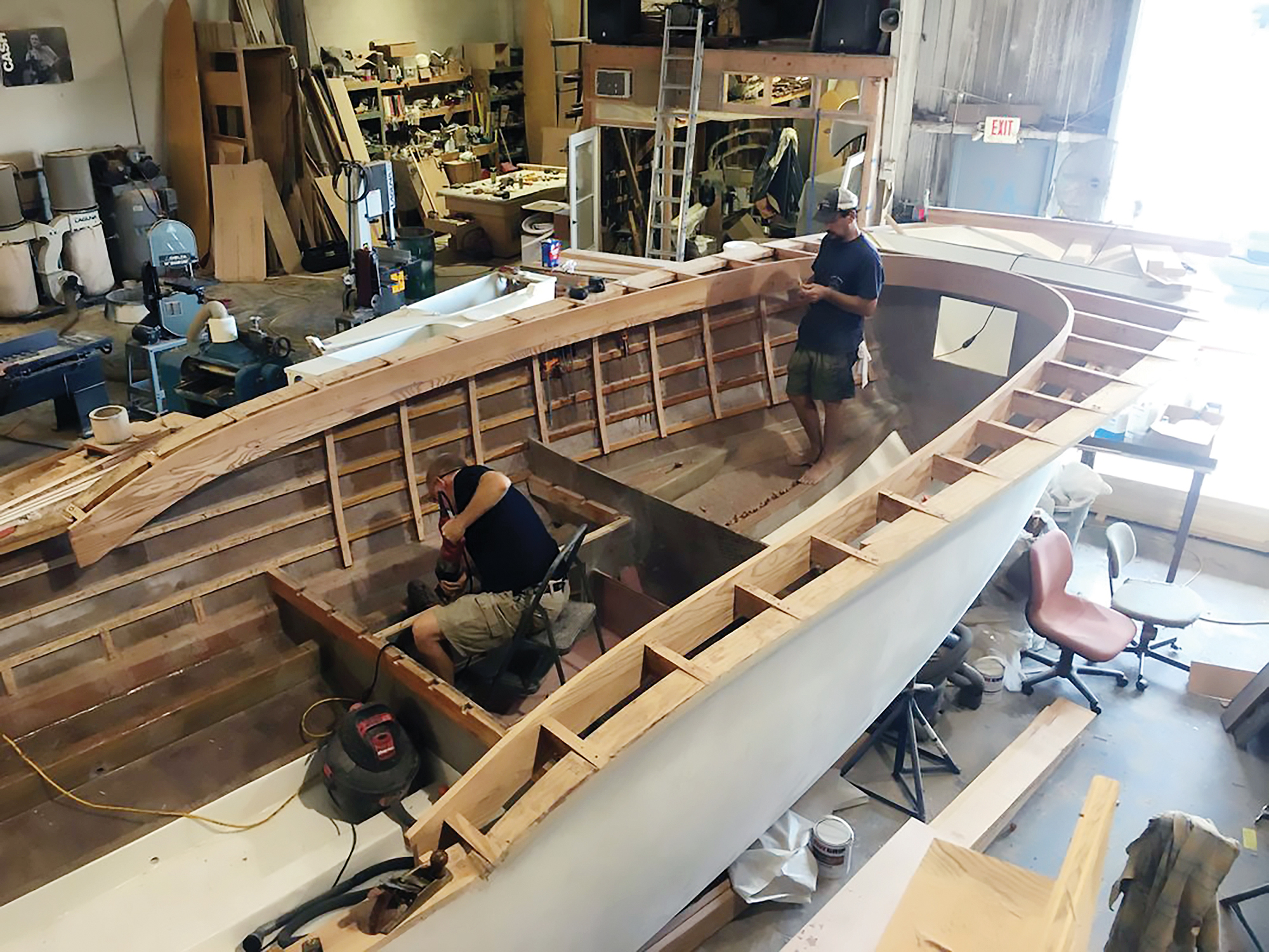
Nistad and right-hand-man Jim Noland built a jig and then began the long process of cutting and mounting the stringers, transom, keel, stem, and chines. That would be followed by three layers of Okume hull planking laid in alternating directions for strength. That process took months of work and thousands of screws and washers to precisely hold the laminates together for bonding. Then they’d remove the screws and fill the holes with epoxy. “Then we lay 1708 fiberglass cloth on it,” says Nistad. “I like Mas epoxies, so we set the glass in epoxy.”
Footloose became a social hub for area builders and friends. “Chris has friends that are accountants, lawyers, whatever—the full gamut,” says Pete. “They all showed up every day and brought beer. They’d sit around and drink beer for an hour, talking about building the boat.”
“It was called Beer 30,” says Chris. “Instead of going to a bar at the end of the day, you’d go see a boat being built.”
When the time came to flip the hull so work could begin on the deck and console, a huge turning party ensued. “It was a fun process,” says Pete. “You’d go down there, and we probably wasted a lot of money, but it was worth it. Chris, he’d be sitting there, just staring at it. His mind would be churned about ‘What can I do next? How do I do it? How can I make this better?’”
Sometimes, when Gunnar, who works as a Charleston attorney, and Chris’s buddies made suggestions, they were considered. Other times: “It was, ‘No, that’s stupid—shut up and get away.’” Gunnar laughs. “That’s his world. I’ll tell him how to buy car insurance or where to go if he needs a will.”
Chris wanted Footloose’s working surfaces functional with a full head below the console, and clean—with hardware only visible if it served an immediate purpose. “The only things on the dash are the things that you need. If you’re gonna go fishing, you’re gonna leave in the morning and turn your running lights on. And you don’t need to look at that switch all day long. Or any other switches.”
Those switches—and the VHF (including a handheld dash-plug unit) are easily reachable, but out of the way inside the console door.
The deck was to be open for moving around with a fish on, with retractable cleats, a huge fish locker forward, and a broad, rounded platform at the bow above the forward seating, for casting and getting a higher vantage point when fighting a fish. The scuppers would follow hidden routing that would allow them to drain through a sleek, hand-shaped port Noland crafted in the boot stripe. To minimize the need for hatches to access the bilges, filters, valves, or electronic systems, Chris hid componentry behind the subwoofer and speakers. “And all plumbing for the hoses and the deck fills and pump out can be done through the speakers,” he adds.
The gleaming wooden binnacle took hours and hours to handcraft and polish. The leaning post seats would offer 360-degree sightlines. Custom—and flawlessly welded—T-Top support bars would have handholds in exactly the right places and plenty of rod holders but, aside from the outriggers, not much else. “I’ve seen T-Tops with 20 or 30 facets,” says Chris. “I just didn’t have a need for that.
“We were thinking, too: We don’t want a lot of seats,” Gunnar adds. “The bow had plenty of seating. In the stern, we can throw bean bags, or sit on coolers, so there’s plenty of room to move around and fish.”
Dual Yamaha 300s would be reliable and should make the boat plenty fast—hopefully 44 knots. “I just don’t see any need to go 70 or 80 miles an hour,” Chris says. “That seems silly.”
If there was a problem with the build—if you could call it a problem—it was Chris’s obsessive-compulsive attention to detail honed while maintaining tugs and working with accomplished builders. It’s an affliction common to serious builders, who can spot issues or asymmetries you or I would overlook entirely. For the stainless strips that protect cleated lines from hull chafe, you might not immediately notice the compass-perfect alignment of screws, “but you’d notice them if they weren’t right,” says Chris. And if you noticed that the ends of the mirrored steel strips were also perfectly rounded, you’d assume they were cast that way. But they’re shaped and polished by hand. When it came time to bottom-paint the 33, “I was saying to Jim, the bottom-paint line is about an eighth of an inch different from this side to that side,” Chris recalls. “He’s like, ‘What? You can’t see both sides.’ I was like, yeah, go look at it.’ It was off.”
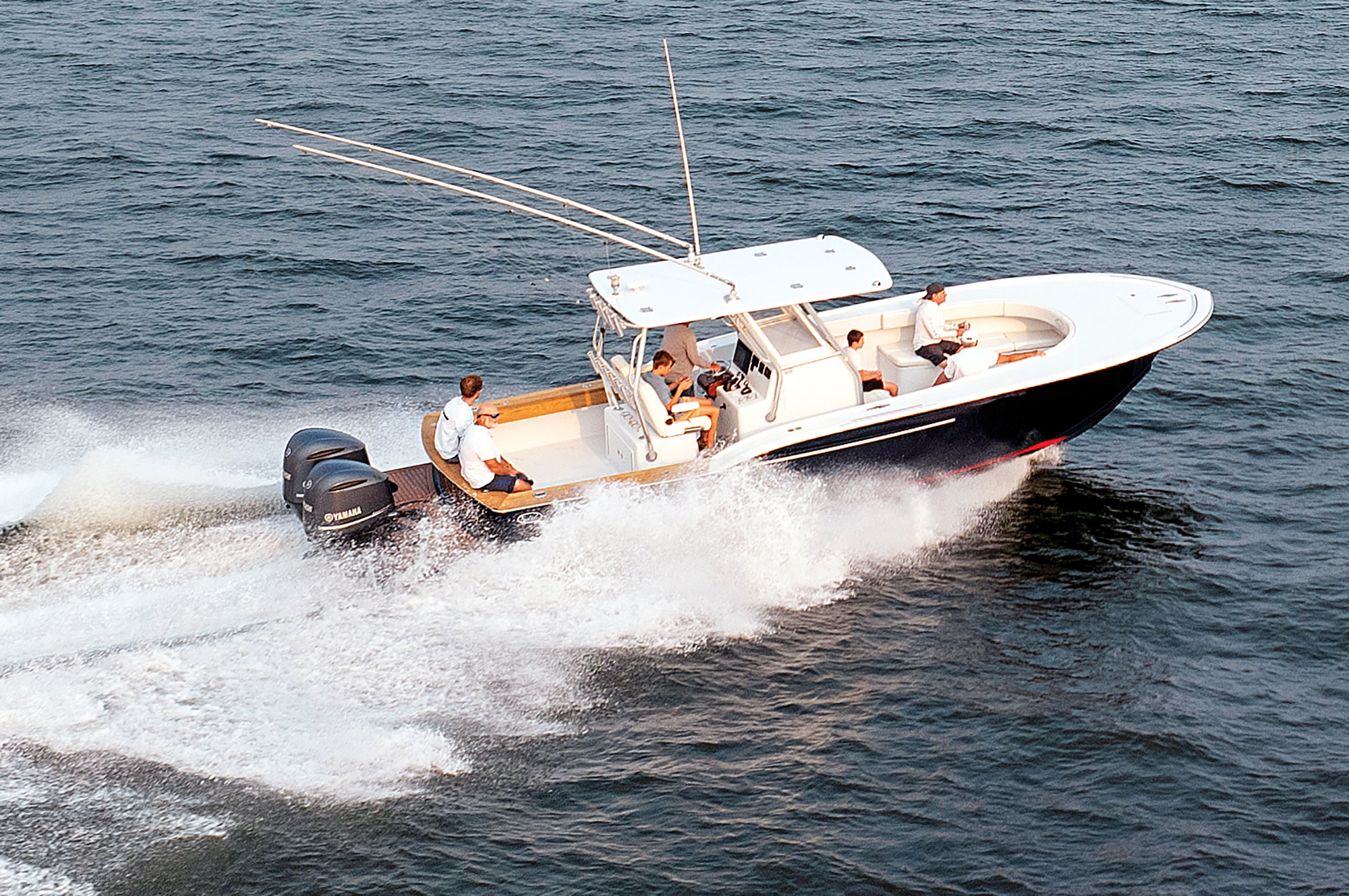
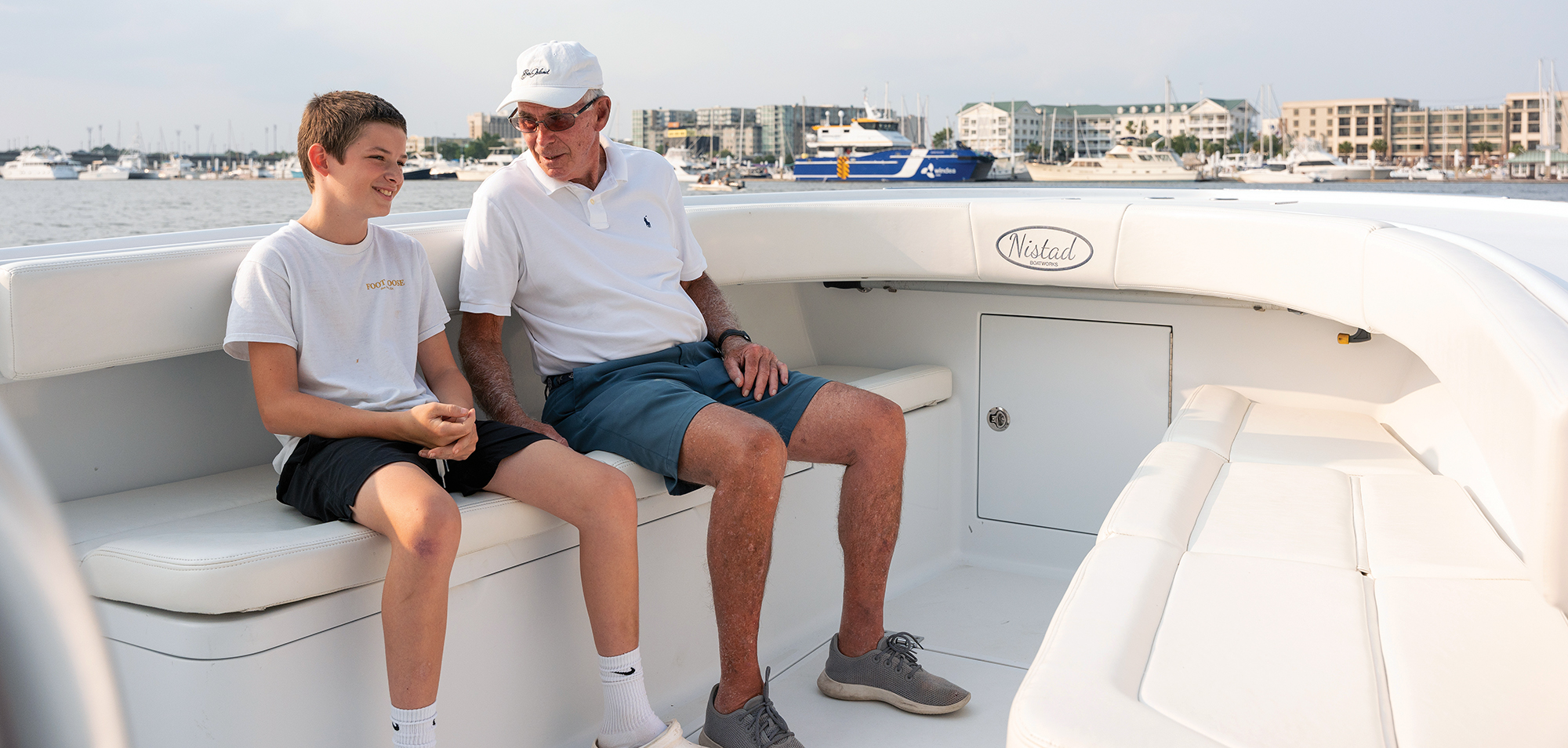
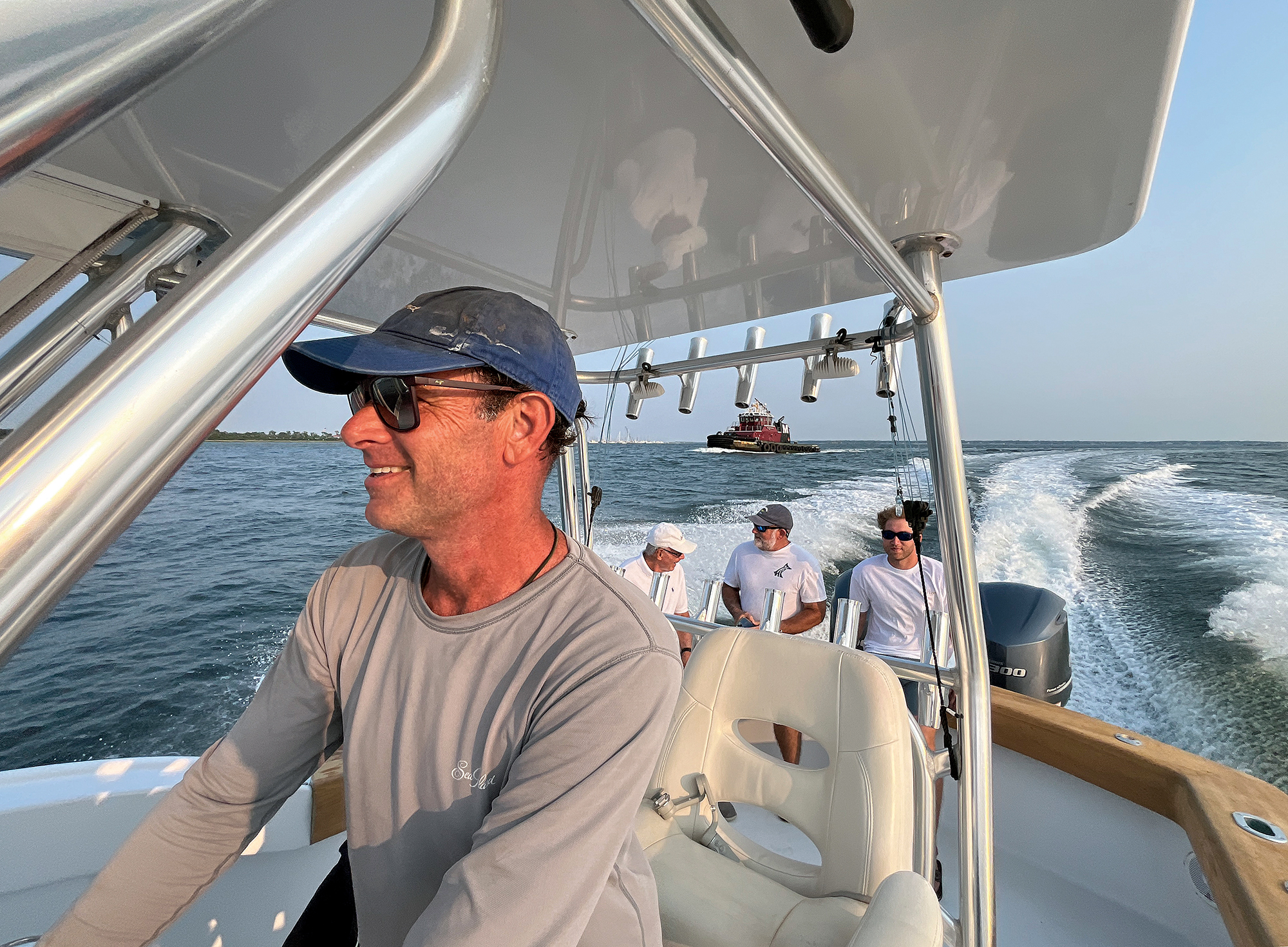
After a year and a half of untold hours, Footloose splashed down. Bounding over waves and chop with a solidity that can only come from a wood-framed boat, she performed better than the Nistads had hoped. Today, after hundreds of hours of fishing with the family, and a $70,000 prize in the Arthur Smith fishing tournament, she’s going back in after having her hull resprayed with navy Awlgrip and her teak freshly scrubbed, she looks damn near brand new. I jump at the chance for a sunset shakedown with Pete, Gunnar, Gunnar Jr., Chris, and Enzo. Just past the Coast Guard station, Chris offers me the helm. With almost zero bow rise out of the hole, she runs hard to the promised 44 knots. Near Charleston’s iconic Ravenel Bridge, we find the beautiful 110-foot Elizabeth Turecamo pushing a mammoth Europe-bound ship filled with South Carolina-built BMWs. Pete gives her a wistful look. “I built it. Around 1998 or so,” he says.
“I worked on that ship—a lot,” adds Chris, before recalling a couple of harrowing moments docking towering car-carriers during high winds. Cruising with a father and son aboard a boat built for the father by the son—and then passing a tugboat built by the father and crewed by the son—well, that’s just a pretty damn cool moment. We run alongside the Elizabeth after she frees the ship and streak across her 3-foot wake like it’s not there. Where a 33-foot mold-built boat of her dimensions might slam into a wave’s trough, she just slices through with zero drama. Bringing her hard over through the tug’s wake, she carves through the bumps like a knife. “When we’re going offshore in 5-, 6-foot seas, we’re still running along at 30,” says Pete. “It’s squish, squish, squish, not pound, pound, pound. The ride is just amazing.”
After completing Footloose, Chris trailered her to the Ft. Lauderdale boat show hoping for another sale, but she returned to Charleston without a sister ship in the works. He could have gone hard trying to market custom builds, but he faced a dilemma that many bespoke craftspeople can surely relate to. “Before we started that boat, I was always busy with small projects,” Chris says. “Then when we started the boat, I started telling guys, ‘I don’t have time to do that. I’m building a boat.’ It takes 18 months to build Footloose. And in those 18 months, you keep saying no to jobs and people stop calling. So, we finished, and the phone wasn’t ringing, and I didn’t have another boat to build; that’s stressful. I had to start calling around to people I knew. I was like, ‘you got any extra work?’ It took a while to get my name back out there.”
Today, Chris is back up to the point that he has three colleagues working on various projects. I ask if there’s a way to divide attention between steady dockside and yard restoration jobs and building custom boats. It’d be tough, he says, because the folks he’s employing now would be the same ones to work on a new build. “I just feel like the boat that I’m building would suffer if I had to divide my attention.”
It seems a dilemma he’s about to face yet again, though, because a northeastern client has just asked Chris to build him a boat much like Footloose.
When I ask if there’s anything they’d change on another version of Footloose, Gunnar chimes in. “You know, at the time, we were thinking 32, 33 feet was kind of where we wanted, because we can get it on a trailer, you could keep it down to two engines—it just made sense. Now, you know, if I wanted this boat again, I’d want it 38, 39. Build it big enough where I could still have two engines with the new Yamaha 450s.”
On hearing this, Pete grins and thinks for a second. Eyes widen at what he says next: “Well, maybe we sell this one—and build a new one.”
This article originally appeared in the October 2025 issue of Power & Motoryacht magazine.