When asked to describe the state of Grand Banks Yachts’ Malaysia factory as he took the company over 11 years ago, Mark Richards minced zero words: “The tools were dead. The machinery was dead. No gardens. No nothing. The whole thing was a mess. To be honest, Grand Banks was ready for the toilet bowl—and had one leg sticking out of the toilet bowl. I managed to grab its ankle, and we managed to pull it back out.”
It was a steamy morning in Johor Bahru, Malaysia. This equatorial city lies just across the Johor Strait waterway from the bizarre island megalopolis we know as Singapore. I was walking the Grand Banks halls with a crew of bleary-eyed marine journos after a 17-hour flight to Singapore’s wildly modern Changi Airport and an hour-long bus ride over the border and through a surreal world. Booming Singapore is sterile and dystopian—with rows of alternately fantastical and numbingly nondescript skyscrapers stretching across the horizon like something out of A Wrinkle in Time. Border signs advertised that we could be fined $10,000 for bringing in a vape pen, though when it comes to actual outdoor advertising, that’s pretty much outlawed altogether, too. Chewing gum was banned for sale back in 1992. Caning is used as a very visible deterrent to malfeasance like, say, graffiti or selling drugs. Control. Cleanliness. Order. Johor Bahru on the other hand, is rough and tumble. Rising from Malaysia’s jungle of bizarre tropical trees, this Islamic city is booming in its own way—mom and pop electronics shops, yoga studios, real estate offices, furniture stores and corner car repair lots stand jammed up against restaurants serving food from every corner of the globe. It’s from this boisterous hodgepodge of humanity that Mark Richards and the crew at Grand Banks and Palm Beach are floating just north of 25 yachts every year. Within a couple of hours of our arrival, they’re set to cut the ribbon, opening a massive new facility that will hold even more. That’s why we’re here.
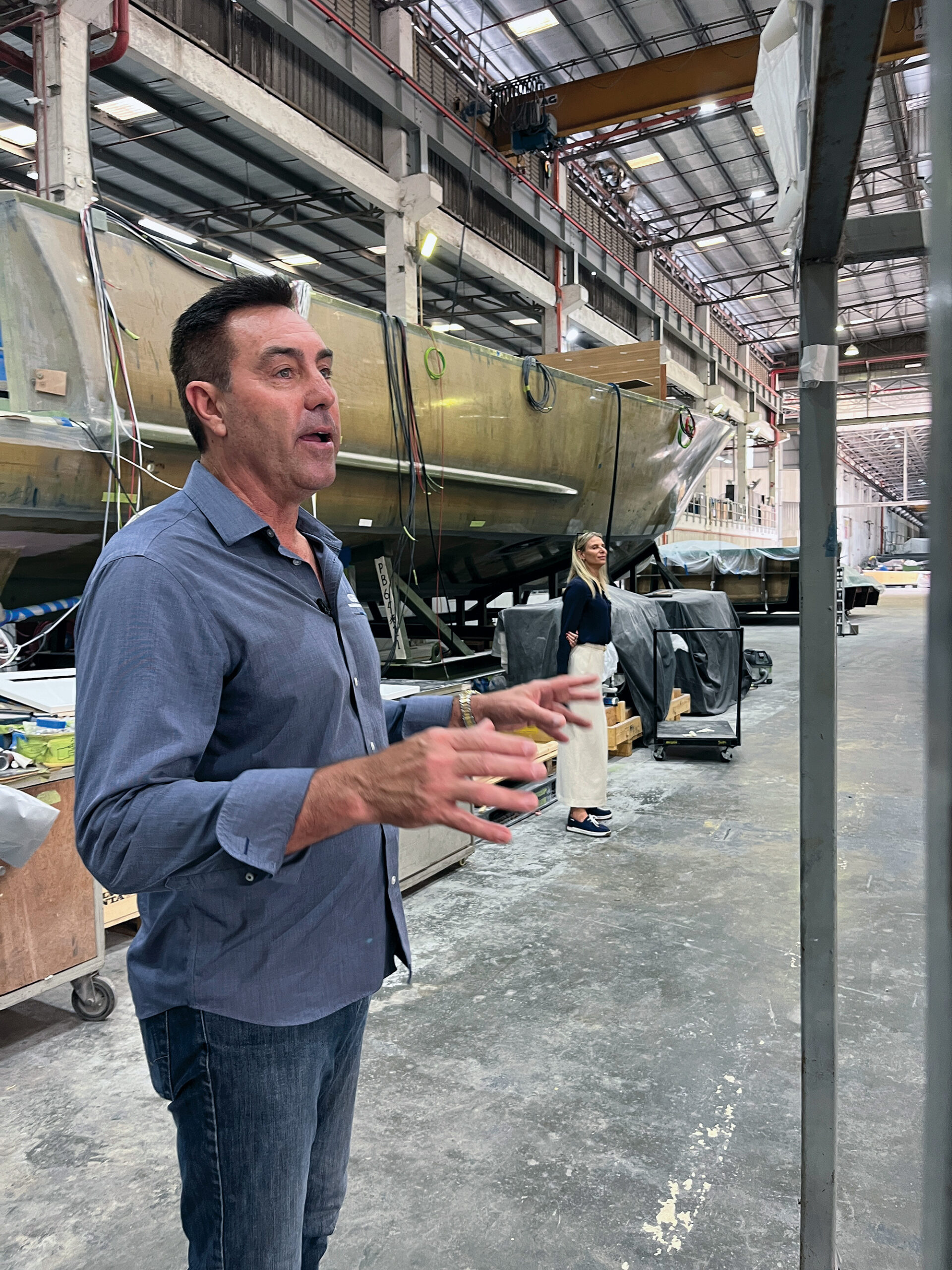
Richards is fascinating, larger than life and witty as heck. Despite being raised in Sydney, Australia’s fishing, surfing and sailing paradise of Palm Beach, Richards’ parents weren’t all that into boats. Yet a boat was the first toy Richards, now 56, recalls playing with as a baby. By age six, he was taking classes at a school that taught both sailing and powerboating. By 13, the self-described sufferer of obsessive-compulsive disorder was putting budding boatbuilding skills to work developing his own cold-molded hulls and running the launch at the local yacht club. Richards began apprenticing with professional boatbuilders at 15. Seriously entrepreneurial, he then started buying old boats—oyster tugs, launches and small ferries, turning them into pleasure boats and reselling them. “I started from nothing,” he said while leading a tour of the new factory. “Out of my toolbox as a kid. That’s how I started in business.”
Power or sail, Richards just wanted to be on boats. He dove deeply into sailboat racing, becoming a feared captain and competitor. He also became a studious engineer of the materials and construction methods that make a boat tough, fast and light—and in some cases, too light. In 1995, he was competing in the America’s Cup off San Diego when the boat One Australiabroke in half and sank over the space of a couple of minutes.
Later that year, Richards chose to put his experience to a larger test with the building of his first Palm Beach yacht. The idea behind these boutique, custom motoryachts would be exacting attention to detail, cutting-edge construction—and speed. Richards patented a new hullshape he called V-Warp. Eleven years ago, Richards sold Palm Beach to the consortium that owned Grand Banks and its nearly half-a-million-square-foot Malaysian operation. The deal was that Richards would not only stay on as CEO of Palm Beach, but run Grand Banks as well. At that time, he had built a mere six Palm Beach yachts in Australia, ranging in length from 38 to 65 feet. In Malaysia, costs were dramatically lower, factory square footage dramatically higher and Richards was eager to build a great many more. Indeed, he said that after the buyout, 65 new Palm Beach orders came in just over a month. Yet on his first Malaysia factory visit, Richards was fairly horrified. The floors were covered with a foot of filthy dust in some places. One screwdriver might be shared by 20 machinists and 12 fiberglassers might take turns with a pair of scissors. Builds were in disarray and the hole-pocked roof barely shaded workers who toiled in temperatures pushing 115 degrees. Amidst Johor Bahru’s constant thunderstorms, there was little escape for the workers—or the in-build boats. “Then,” he said pointing to a faded line on the floor, “if you can see all these crosses in the concrete. It was just a weird thing. It’s almost rubbed out now, thank God, but they used to get every staff member in the morning doing star jumps before work—for 20 minutes. Seeing some dude—a dictator-manager, up on a pedestal getting the workers to do their star jumps—was like something out of World War II. That stuff just had to go.”
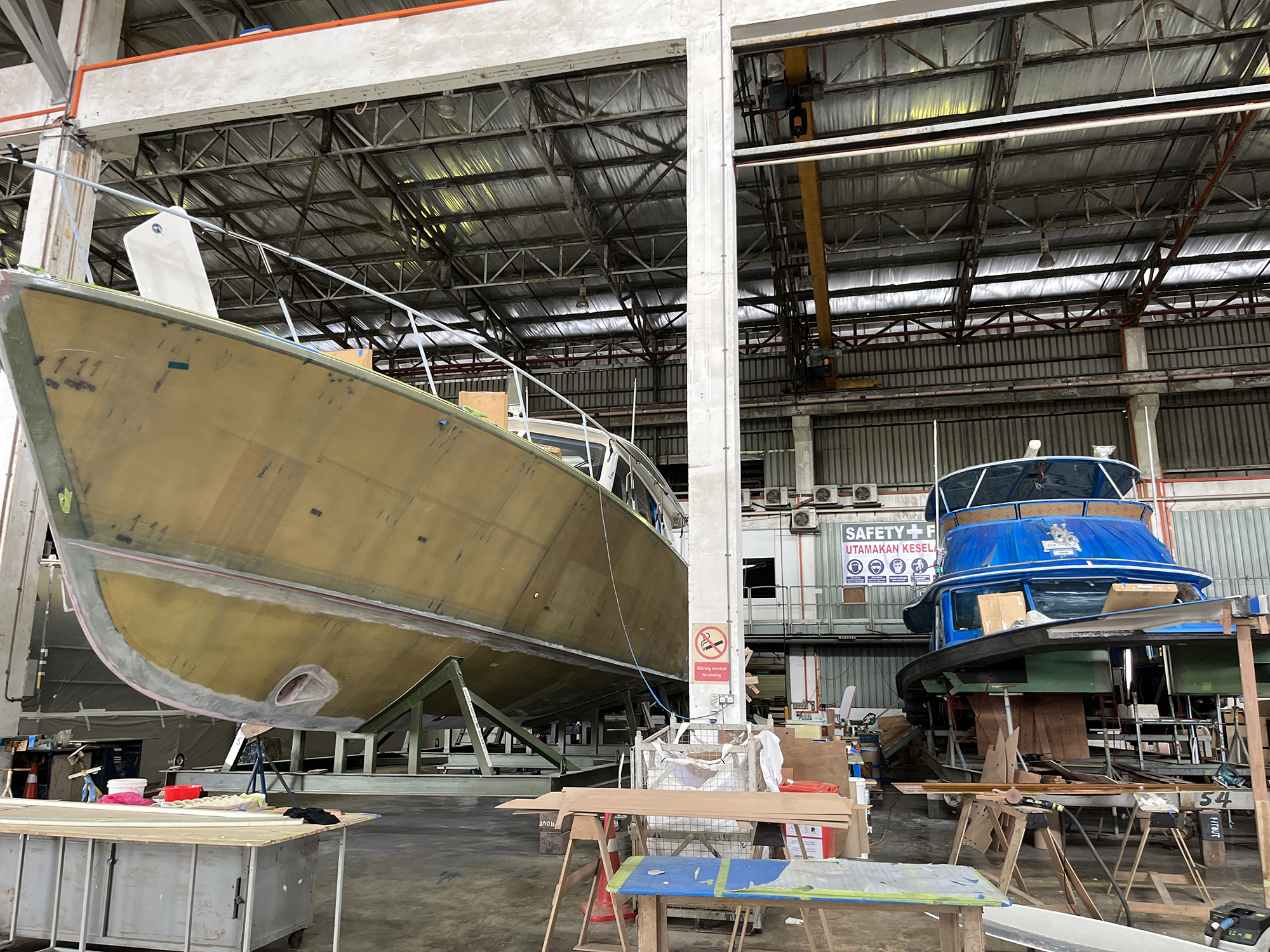
At the ribbon-cutting ceremony, amidst a host of dignitaries and a floor filled with a full house of cheering workers Richards and the execs at Grand Banks have expanded that factory to over 2 million square feet—with nearly 1,000 employees. The team has added massive banks of solar panels and planned factory layouts to catch and amplify the prevailing breezes and the company has plowed money made on its boats back into operations. “Every piece of equipment, every mold, everything you see in there, we’ve created and bought and purchased with our own money, right?” he said. “We’ve invested $100 million in the last ten years—without borrowing much money.”
A substantial portion of the investment has also, he hopes, benefited his workers. His crew—male and female—comes from Malaysia and all across Asia: China, India and neighboring Myanmar. When Richards first came in, around 450 workers were housed six to a room in squalid company-owned hostels. Millions have been spent on upgrades that now house 400 in private suites—and millions more are to be spent on new housing construction. All of this, he said, is to keep workers happy—and retain them as their skillsets improve and evolve. “You look after the people,” he said, “they look after you.”
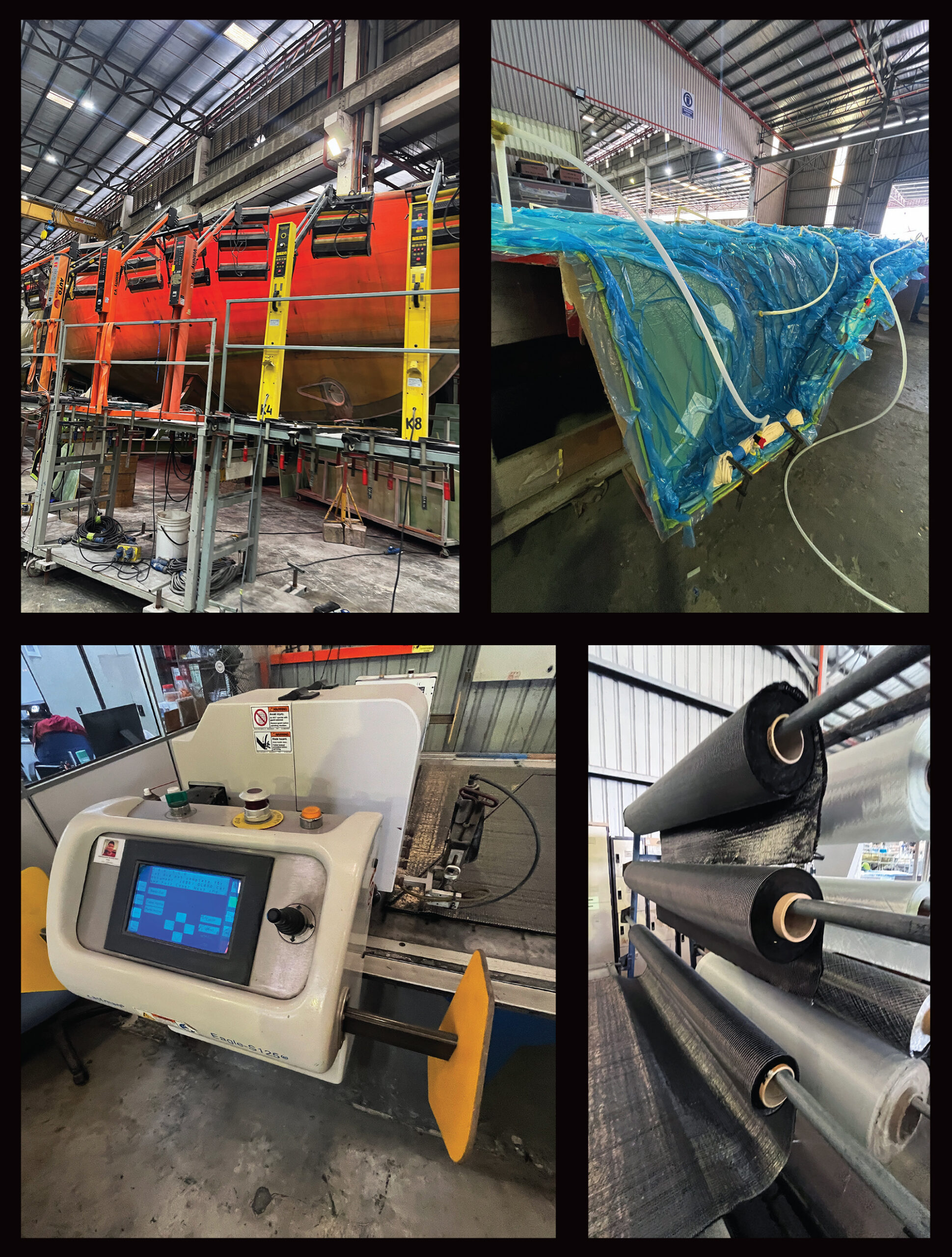
During our day on the floor, I would get smiles and fist bumps from several of those workers. They’re learning computer-aided design (CAD), high-end woodworking, sophisticated vinyl-ester and carbon-fiber infusions and operating a remarkable new eight-plane robotic router that can, Richards says, reduce the build and shape time on a mold from weeks to a few days. They’ve also immaculately organized a factory that holds around 45 boats in various stages of build—and every one, save one, is pre-sold. Because Grand Banks and Palm Beach yachts are so customized, panels, consoles, bulkheads, platforms, flooring—everything is specifically laid up or hewn for a specifically contracted build. That means every component must be properly labeled for that boat, for where it’s going on that boat, and for where that part sits in the factory awaiting its placement. For an obsessive-compulsive overseer like Richards, it’s an obsessive-compulsive level of organization.
Construction-wise, Grand Banks and Palm Beach boats use the same V-Warp hullforms (meaning a GB 60 would ride on the same hull as a Palm Beach GT60) and build their different models atop those hulls. They’ve opted to build those hulls out of good old, infused GRP, but nearly everything else above and inside that hull—bulkheads, supports, decks, roofs—is done in carbon fiber. Up until this trip, I’ve never seen a vinyl-ester infusion of an entire deck mold in carbon cloth; one is being laid up while we’re there. It looks just like any GRP infusion, with vacuum tubes sticking out like Keanu Reeves in his Matrix pod. The difference, of course, is that the carbon layup is 20 percent stronger and 70 percent lighter. This not only helps fuel economy, Richards says, but keeps a boat’s center of gravity lower. On some panels, holes are strategically cut out to reduce weight even further.
There’s another remarkable aspect of the plant that the ever-frank Richards called both good and bad—a huge stockpile of beautiful finished and unfinished teak in the factory’s mammoth woodworking section. Most of that teak, Richards says, comes from Burmese teak plantations in Myanmar, but due to deforestation impacts, teak is a controversial wood. Importation of Burmese teak is illegal in many countries including the U.S., Australia and across Europe—but not here in Malaysia. “It’s becoming an issue,” Richards said, “So we’re working pretty hard on evolving some cool techniques that minimize the waste. And obviously looking in new directions of not using Burmese teak. It’s definitely in the cards in the next 10 years. If you don’t embrace it now, you’re going end up in trouble.”
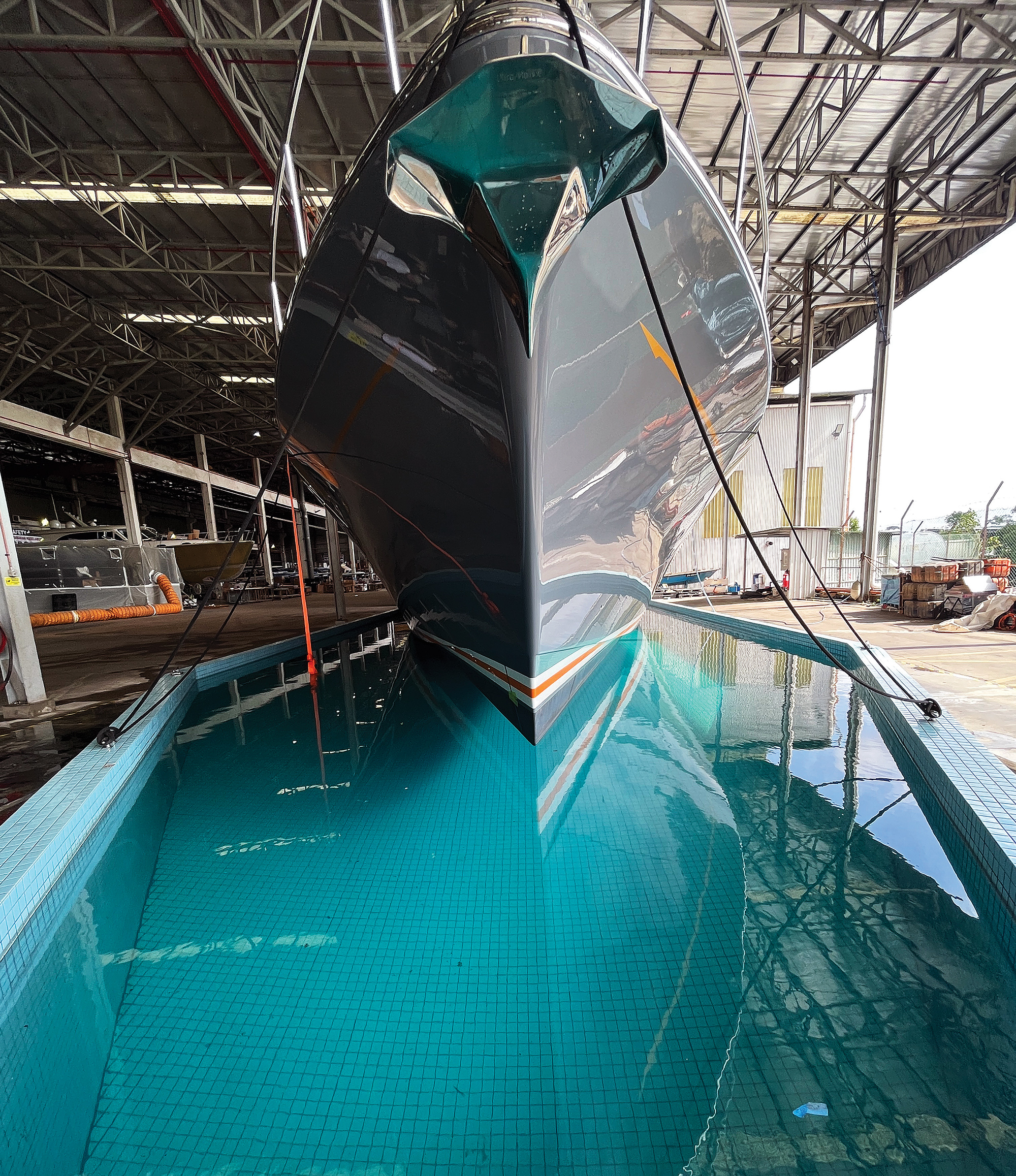
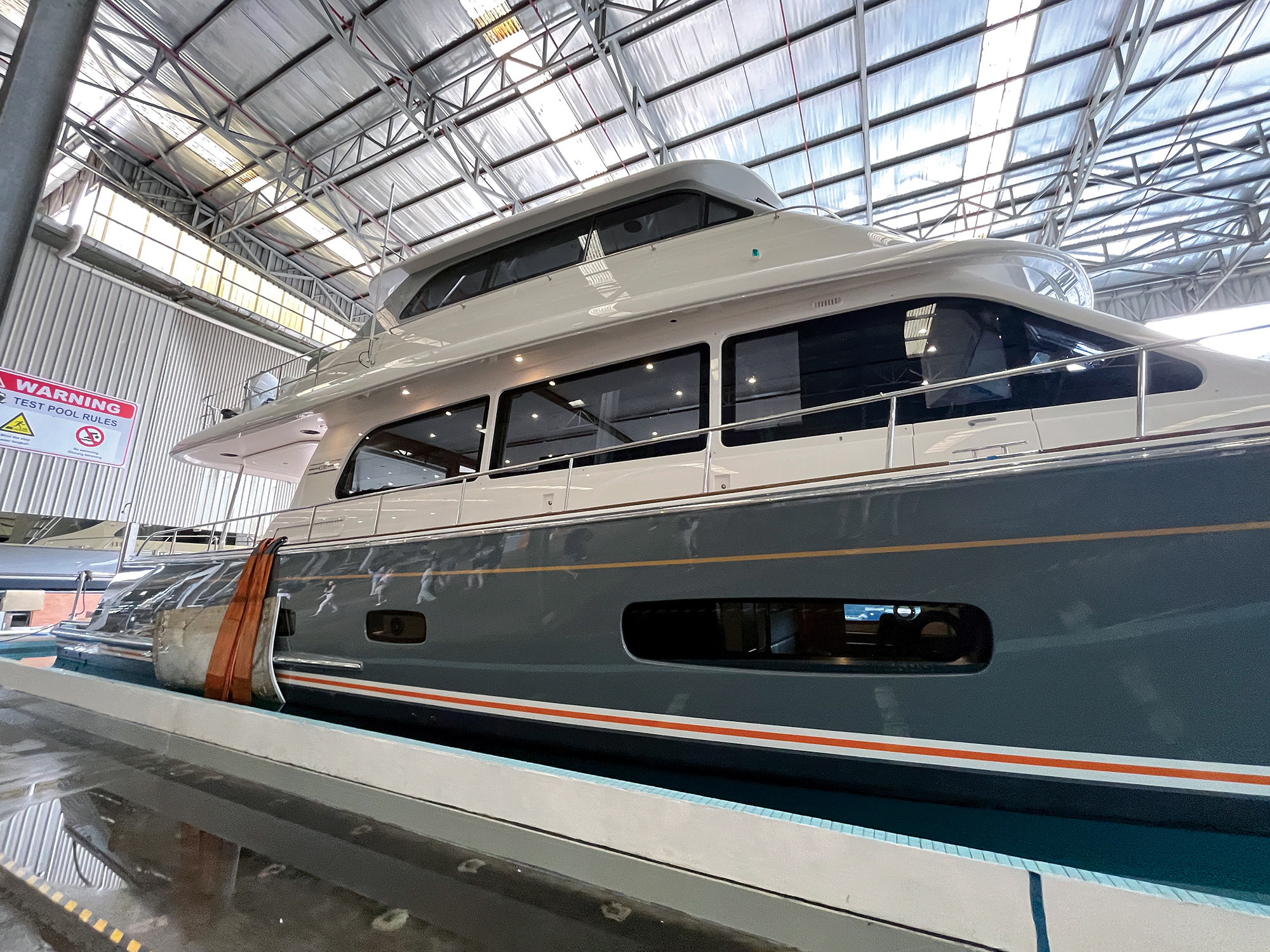
Just off the woodworking area, Richards invited us aboard the pool-floated Grand Banks 85. Dan Harding, our Editor-in-Chief, reviewed Grand Banks first 85-foot flagship back in 2022 and I’d have to agree with his sentiment that the 85 “feels like a small superyacht.” Yet hull three is quite different from the model Dan tested. First off, it’s being partially floored with a hardy faux teak. Second, the electrical and climate systems feature game changing new technologies. Third, this yacht’s purchaser is Tom Whidden. He’s not only the CEO of North Sails, but a competitor in eight America’s Cups and a lifelong mariner every bit as experienced as Richards. Whidden was perhaps the first person to recommend Richards to the folks at Grand Banks 11 years ago and fortunately for us, he happened to be in town for the near final survey of this, his fifth Grand Banks yacht. “I’ve known Mark a long time, through sailing,” Whidden said. “And then I followed his beginnings at Palm Beach—I love the little boat that he built, originally, the 38—and, you know, I’ve never sailed with him, but I have a world of respect for his sailing ability. And I always thought he was one of the really good guys, not only in the in the sailing world, but also in the business world. It’s incredible what he’s accomplished.”
Whidden said that Richards’ experience as a sailor directly transfers to the use of GRP in the hull and carbon fiber everywhere else. “When I say he thinks like a sailor, that’s what we would do on a sailboat,” Whidden said. “So the hull is wicked strong. Carbon is not very good on impact—but it’s very good in weight and stiffness … So from the deck up, it’s all carbon fiber and the stringers and reinforcing in the hull are carbon fiber. Those are the places for it.”
“You know,” he adds. “I think if every power boat maker came with a sailing background, they would make better power boats.”
As an example, he cited Richards’ combined use of Humphree’s new stabilizer fins and interceptors. “The end result is a very sea-kindly boat. It doesn’t yaw. It doesn’t pitch a lot. It’s dead solid.”
Fit- and finish-wise, Whidden’s boat is a stunner. Door and cabinetry hardware is sturdy and beautifully cast. Hydraulics are perfectly adjusted to gently open and close doors and hatches—with sturdy clicks and thunks. The tiny gaps between door and cabinet openings are lined up with millimeter precision. The woodwork is sheer art. It’s mostly teak, but for much of the flooring, Whidden has chosen a durable non-wood composite. “This composite is quite a bit harder,” he said. “So if you drop something on it, or if you scratch it, you can repair it pretty easily. It doesn’t dent very easily—and teak dents very easily.”
The thing Richards says he’s most proud of with this 85 is its efficiency, power management and silence. With the soundproofing and double-padded mounting systems, the running generator and air conditioner are essentially unnoticeable. “This is the first big boat of ours with the new Victron load-sharing seamless shore-power systems, which is a really cool thing for the future,” Richards said.
That system can seamlessly combine shore power with the powerful alternators on the boat’s twin 1,300-horsepower MAN V12s, solar panels, generators and the 8kVA of lithium batteries. The yacht’s Dometic Voyager variable speed air-conditioning system, Richards says, is about 70 percent more efficient than previous systems. This allows much smaller 19kVA gensets than a normal 50kVA system you’d find on a boat like this—and to only run one, or none, if that’s what’s needed. “Underway, with main engines running, with upgraded alternators, you can run your whole ecosystem,” Richards said. “So, for CO2 emissions, it’s a big deal, because you’re basically reducing your generator usage by 85 percent. It’s impressive and it works unbelievably well. Most big boats, they are totally reliant on generators and will be for a long time. This boat’s not.”
Another invisible contributor to the boat’s efficiency is a new glass formulation. It’s said to reduce heat transfer by 55 percent. “A massive number,” said Richards.
Whidden has watched Grand Banks evolve from a time before Richards. “Mark is a great idea guy,” he said. “He’s got a great eye for aesthetics and a great eye for knowing how to make a boat go through the water. But what his biggest strength is, is hiring of the right guys. You know, I give him shit every once in a while, for being a little bit of a micromanager, but he’s got good people in there. The degree of change from my first 60 that I bought in 2018 or so, and the level that my new 60 is—you could see the progress. It hasn’t just been people, it’s been facility. It’s been materials. It’s been knowledge. It’s procuring better products to put on the boat. Mark is always thinking about what’s the latest good product, like the new fins and the new air-conditioning unit. And the really good thing that Mark does is he reinvests in the company. So it isn’t just, ‘Hey, we’re doing a good job.’ It’s ‘Let’s keep it rolling.’”
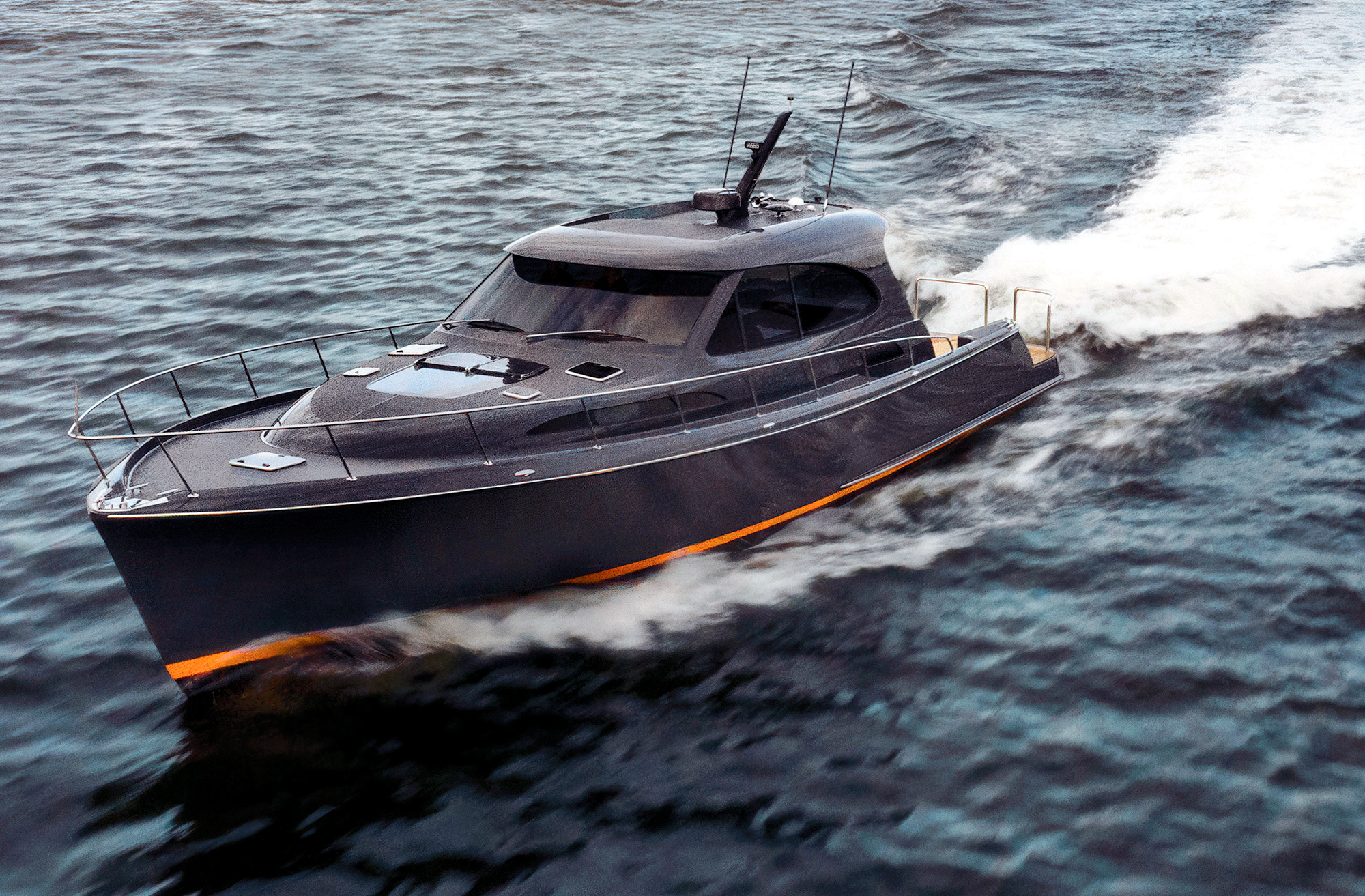
The next day, our team assembled at a Malaysian marina where Richards was excited to take us out for a trial of a new 65-footer that Palm Beach calls its “Alpha Model.” It’s a shapely and somewhat sinister-looking speedster called the GT60 and it’s destined for the States. Like all Palm Beaches, there’s what I’d call a timeless E-type Jaguar quality to her downswept, Down East lines and beautifully curved cockpit windshield. Slathered in a deep blue-gray Awlgrip and with an aggressive band of orange along her lower hull, she’s the perfect yacht for a brooding Bruce Wayne and looks to be running 30 knots just standing still. This one’s been built for an owner with a couple of Palm Beaches and a few TV shows under his belt. He plans to cruise Northeastern waters, especially passages in Maine that can be lousy with propeller-entangling lobster traps. So, he’s opted for a Hamilton HJ403 Waterjet drive system linked to a pair of twin 1,000-horsepower Volva Penta D13s via what else—carbon-fiber driveshafts. With this setup, the 51,000-pound GT60 draws a mere 2.9 feet.
Before we pulled away, I took a walk around the GT60 with my friend and colleague, Passagemaker Editor-in-Chief Jeff Moser. This single forward-master suite build is a somewhat unusual configuration that’s more set up for entertaining a throng of guests than multiple families overnighting. The rear deck can be configured with a variety of seating and entertainment console options, but aside from a small folding table and a three-person sofa, this model is simply adorned with a huge leaning post-equipped rear deck covered in tight-grain teak. It could probably hold 15 drink-bearing guests with no problem. The (wisely) railing-served foredeck is reached by a pair of port and starboard walkways. You can get around up there, but there’s no forward lounge or sunpad—though that could be spec’d out.
Normally the GT 60 is a two-stateroom yacht. But this owner opted to devote the space for the VIP suite to an expanded full-service galley with a U-shaped dinette and a high-luxe separate head with a massive shower room to port and sink and toilet to starboard. The master suite features a bowed, Awlgrip-painted ceiling and is swathed in glowing hardwood.
Pulling away from the dock with her joysticks, and then rotating 360 degrees around her center axis, Richards demonstrated the maneuverability of this jetboat setup. This jetdrive GT60 isn’t as fast as the prop-driven version, which Richards said will hit 43 knots. Still, carrying 16 people and with her 845-gallon fuel tank half full, we would top out at 36.5. Cruising out of the marina where we’d feasted on sushi the night before, this part of the Johor Strait was really more like a broad, industrialized river. The weather was a bit gloomy and with a calm wind, we’d be forced to manufacture our own sea state. Still, I was eager to see how Richards’ sleek spaceship handled. He had said that it can be a challenge to get jet-driven vessels to run straight, but with the boat in the slings at the factory the previous day, I noted a pair of big, fixed, surfboard-style Humphree skegs at the stern. Pegging the throttle, her track was straight and acceleration was smooth and level. One aspect you do notice with a jetboat is that there’s simply more sturm and drang out back with those huge jets spewing out thousands of gallons a minute. The other aspect is that when the boat is turned, the huge plume off her stern turns, too—like a mammoth jetski.
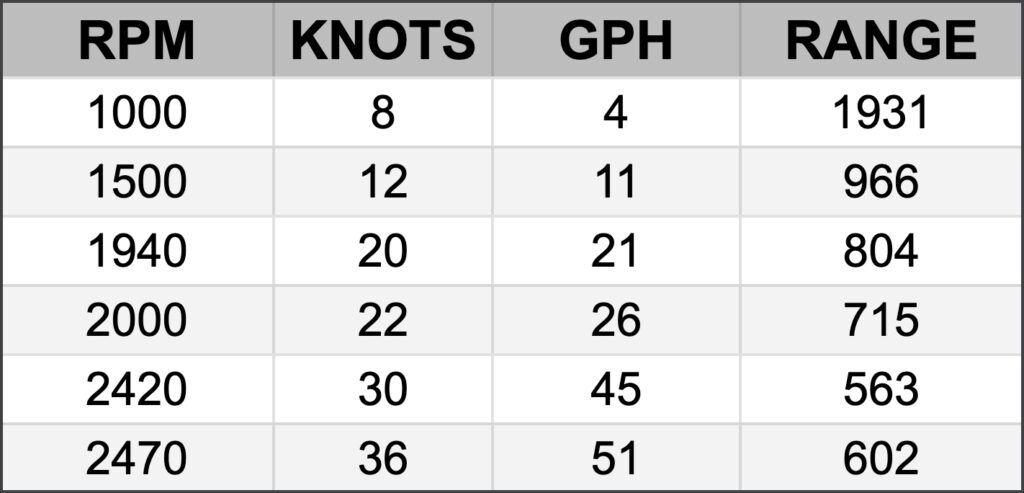
Consumption-wise, propellers are simply more fuel efficient than jets—in some cases by up to 30 percent. Still, this shallow-draft yacht managed 3.5 gph at 8 knots, 17 at 16 knots, and 26 at 22 knots. At her optimal 28-knot cruise, she was up to 37.5 gph, for a fast cruising range over 500 NM. By her 36.5-knot top end, a touch faster than Richards was predicting, she was at 50 gph. Turns at that 36.5-knot top end were amazingly tight and sharp. If you’ve ever watched a small jetboat on the Colorado River, you’ve seen drivers spin 360 degrees at high speed. I wasn’t the only journalist who deliberately tried to see if I could spin this big jet out. Nope, those skegs held her firm. I also worked fairly hard to get her stern to decouple by running her back hard through her three-foot wake. That wasn’t happening either. She ate up the chop.
When I asked Richards what his main challenges are with running the business, he said that a big one is simply channeling his own energy. Not only is there a ton of day-to-day to oversee—but a ceaseless brainstorm of new ideas. “The frustrating thing for my team is just keeping up with stuff,” he said. “New designs, I mean. I’ve got 13 new designs. We’ve got new Grand Banks—a 70 and 73 and a 42 coming out. A new Palm Beach 107 and a 101—and a new GT70. And it’s all been designed.”
With the opening of the new factory space and all those designs, you’d think Richards would be planning to ramp up production numbers. He insisted, though, that the new factory is all about simply getting more space to build boats. “A lot of boatbuilding companies got too big,” he said. “This factory, 25 boats a year. Volume-wise, compared to our competitors, it’s very low volume, but it’s high quality and obviously a reasonable price, right? So, the good thing about it now is we don’t want to get any bigger. The thing for us now is perfecting this facility in every regard. Processes for design, processes for construction—having a process for everything. Every nook and cranny perfect. Everything in place. So that even if I get hit by a bus—we keep going.”
Palm Beach GT60 Sea Trial Numbers:
Palm Beach GT60 Specifications:
LOA: 65’1”
Beam: 17’2”
Draft: 2’10”
Displ.: 51,260 lb.
Fuel: 845 gal.
Water: 251 gal.
Power: 2/1,000-hp Volvo IPS 1350S
This article originally appeared in the June/July 2025 issue of Power & Motoryacht magazine.