“This is one of the prettiest boats I have ever seen.” – Feadship CEO Henk de Vries
Thanks, Henk. I knew I liked you.
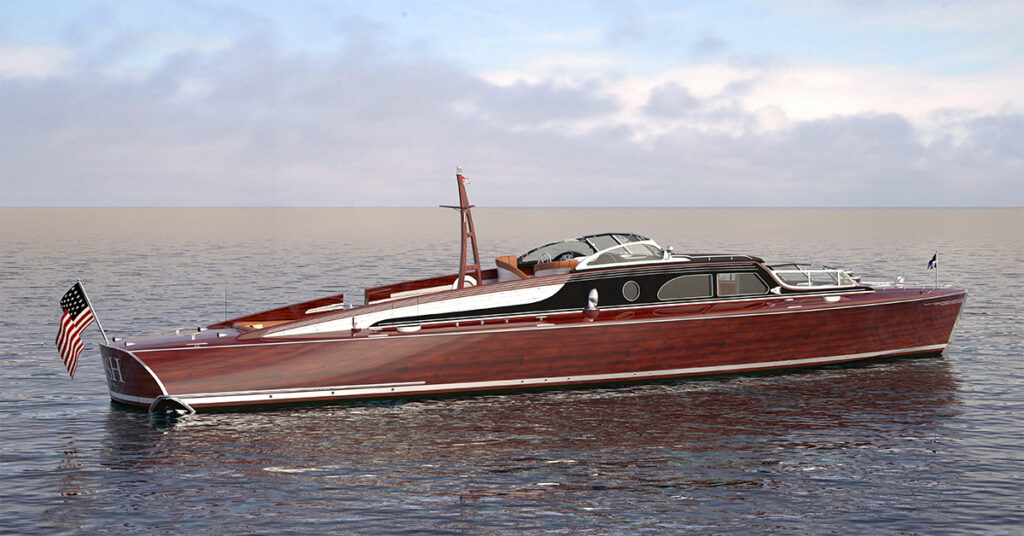
A decade ago my office designed a boat, which captured global attention, the 54-foot mahogany commuter Posh. Much ink has been spilled noshing over Posh. But this column is called Inside Angle and I, dear reader, have that angle on the story of this boat.
First, the background: John Hacker was widely considered to be the greatest American powerboat designer of the 20th century. The hull shapes he developed were derived from lessons he learned designing floats for the Wright Brothers’ airplane in 1911 and boats, which claimed more than 20 world-speed records.
Hacker designed three very special boats, each built by Huskins Boat Works in Bay City, Michigan, in the 1930s: Tempo, owned by Guy Lombardo; Thunderbird, still a Lake Tahoe legend; and Posh. (It may have been the Great Depression but not everyone was poor.) These American icons, considered the Triple Crown of the golden age of wooden boats, survive today.
Prior to our involvement, the original 52-foot Posh had been owned by Canadian newspaper magnate Conrad Black. His imprisonment led to a sale to collector Todd Warner, and today the boat is owned by collector-car auctioneer Dana Mecum.
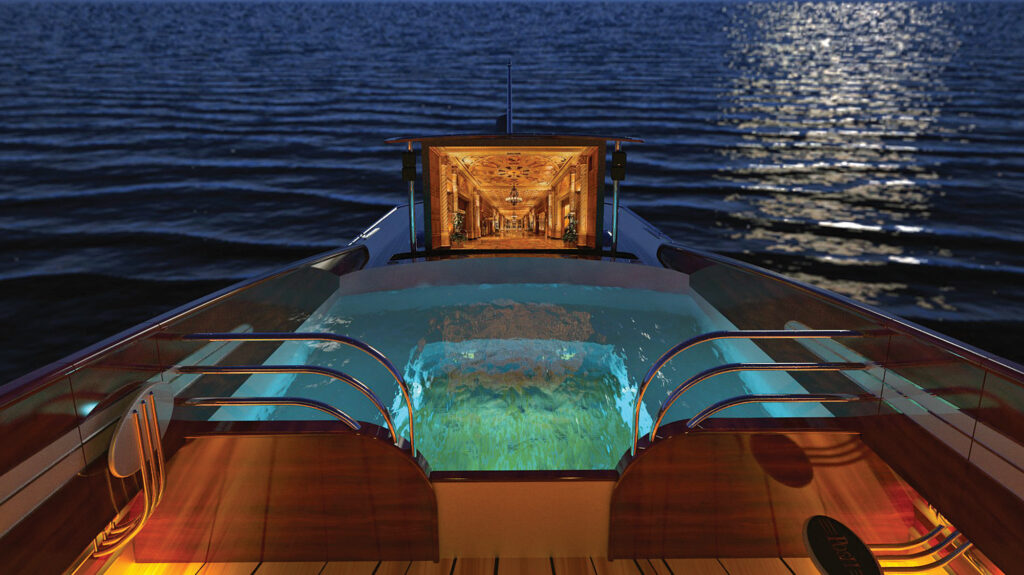
So what did we do to create a 21st century POSH for the ages? A lot. We were given a brief by the original boat’s owner to take a “blank check” approach to design. Create something fabulous, and faithful to the Art Deco era.
Since we had access to the original boat, we had her laser scanned to capture the original hull and deck shapes.
The design brief in the modern era called for a Seakeeper, twin V12 Rolls-Royce engines, air conditioning, and all the other stuff, which was fairytale material in the 1930s. And these BMW-derived Roller V12s would give the new sister more speed than Hacker’s original could ever dream of. Then we needed a new hull.
This new hull design is 2 feet longer and 9 inches beamier than the original. We hid 4 more inches of freeboard to accommodate today’s taller people. We dialed up the deadrise to provide more of a blue-water ride for our Monaco clients. Most importantly, her displacement was increased by 2,650 pounds to carry that Seakeeper, air conditioning, etc. We tweaked the hull’s waterlines and buttock angles for these higher speeds. And so I could write “buttock angles” in a national magazine lo these many years later.
I was tasked with securing a contract from Rolls-Royce for the engines. So I reached out to BMW North America with our brief. It took great effort to make it clear that we did not want replacement engines for two cars, but engines stripped of all their automotive sensors like steering angle input and speed limiters. BMW finally agreed to provide “dumb” engines for our use, but with no warranty whatsoever. Surprisingly, at the price they quoted us we could simply afford to buy two more as backups.
The client went to great lengths to promote this new modern classic. He had the precious original Posh trailered from Minnesota to Ft. Lauderdale to serve as the VIP tender to a party where the America’s Cup was the centerpiece on the hors d’oeuvres table in the lawn of a waterfront palace.
A trailer axle snapped somewhere in Georgia. So weld repairs were performed under the dry wooden vessel.
As I wrote at the time, the owner and I thought Posh was going to be a no-show until, what to my wondering eyes should appear, but a shiny wood yacht floating across the South Federal Highway overpass at 595, visible from the cab I was in at that precise moment.
I volunteered to help prep the mahogany classic for the evening’s festivities. This 8-hour process concluded with the sound of a dozen champagne bottles shattering on the teak sole moments before showtime. Engine hatch open. Glass shards and ice shoveled into bilge. Engine hatch closed. Exactly 87 seconds later we picked up our first VIPs.
I guess you could call that your Inside Buttock Angle.
This article originally appeared in the March 2026 issue of Power & Motoryacht magazine.