Julius, Louis, Harry Johnson, and brother-in-law Clarence Conover. Without these four “Brothers Johnson,” the world of today’s marine combustion engine would be very different. And while the Johnson name is still plastered across thousands of vintage outboard cowlings, how those outboards came to be in the first place is one fascinating tale.
Born in the late 1800s, these inveterate Indiana inventors designed their first internal combustion engine in 1903 because they loathed paddling their lumber-hauling 18-foot rowboat up the Wabash River. After carving a wooden mockup, they forged a 150-pound, three-horsepower, single-cylinder, two-cycle inboard. It was crude, but did the job, so in 1904, a modestly more refined version followed. By 1905, Johnson began offering a three-inch bore, two and four-cylinder inboards to the public.
In 1908, the Johnsons opened a brick-and-mortar Terre Haute factory whose power was supplied by the first motor they ever built. The mechanical geniuses then created a series of lightweight, V-block, water-cooled, two-stroke marine engines. They were awed by the Wright brothers, so in 1910, despite never having actually seen an airplane, they built a flying test mule. The result: America’s first single-wing airplane—a taildragger powered by their aquatic 60-horsepower V4. The cumbersome machine thankfully failed to kill anyone, so a more robust mono-wing followed in 1911. This 750-pound, 90-horsepower “Johnson Aerial Motor” airplane was outrageously ingenious—tricycle landing gear, real brakes, aluminum construction, and a hollow airframe that doubled as an engine radiator. They barnstormed accident-free for three years. A replica today hangs in the Smithsonian.
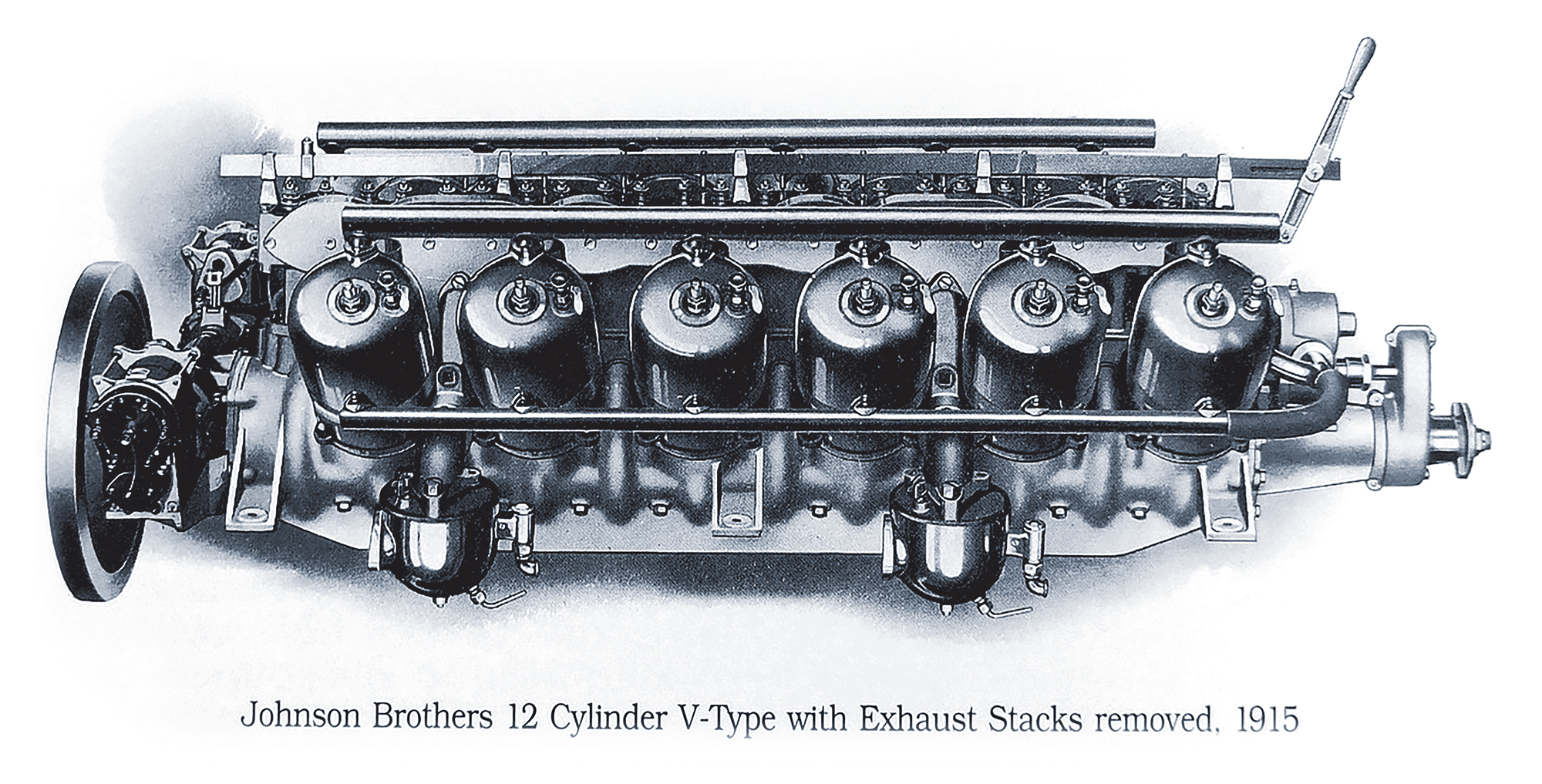
Johnson aircraft were ahead of their time, but the bread and butter still lay in marine engines. So in 1913, after their uninsured factory was destroyed by a tornado, the brethren bet the farm on a series of V-4, -6, -8 and -12s. They built the blindingly fast 23-foot Black Demon III. Her twin 180-horsepower V-12s were a mere five feet nine inches long and weighed only 620 pounds apiece. Rather than a typical carburetor butterfly, throttle control came via valves that shut off individual cylinders. Demon won several races and then, in 1914, she was set against the fastest boats on earth, including Disturber IV, a 40-footer driven by two 10-foot-long, 750-horsepower, 32-liter, 132-gallon-per-hour straight-12 Duesenbergs. Over 30 Lake Michigan miles, The New York Timesreported the boats ran neck and neck, with Disturber narrowly eking out victory after 31 minutes.
Despite racing success, financial bounceback from the tornado was proving insurmountable until the day Clarence cobbled together a super-light 1.5-horsepower engine intended to drive a boat with an air propeller. When Lou and Harry mounted a chain drive to it, they created a wildly popular bicycle add-on. By the late teens, Johnson Motor Wheel Company engines had sold in the tens of thousands, pushing bicycles to nearly 60 miles an hour. When their popularity began to be eclipsed by the Model T, Lou’s Eureka moment came after Conover said he wanted to mount a motor on his old canoe. Lou barged in on Conover and his wife during dinner and according to a 1979 story in Antique Outboard magazine, shoved everything off the table to unroll plans for a repurposed bicycle powerplant. “The very first Johnson outboard. And it was not much changed until several thousand were built.”
The rest is history.
This article originally appeared in the March 2026 issue of Power & Motoryacht magazine.