Over the years I’ve come to believe there’s something more than chance in the way water restores us. My wife Dori and I have noticed it countless times: Whatever mood we bring aboard—tired, restless, preoccupied—changes as soon as we cast off. The motion of the boat, the sound of the water against the hull, even the smell of salt air always work together to rinse away whatever baggage we were carrying.
Writers knew this long before researchers proved it. Ishmael, Melville’s narrator in Moby Dick said that whenever life became unbearable, it was “high time to get to sea.” He was on to something. These days researchers talk about the “blue mind,” a calmer, healthier state triggered by being on or near the water. This “blue mind,” as late marine biologist Wallace J. Nichols called it, is more than poetry—it’s biology, but we don’t need scientific studies or brain scans to convince us. We only need to sit in the pilothouse on a quiet morning.
If time on the water puts us in a blue mind, then life ashore has a way of turning us red-minded—anxious, over-connected, and too often tethered to screens. I’ve caught myself in that trap, phone in hand, checking things that didn’t really need checking. But the water doesn’t tolerate divided attention. It pulls your eyes up and out. Even on the calmest day, there’s a world of detail to see: a line of pelicans flying in formation, a tug easing a barge through a narrow pass, the sun laying down a molten path of glare.
We like our life aboard because it gives us something land life rarely can—a steady, natural antidote to all that noise. On the water, I find myself less interested in screens and more interested in the sounds and sights of harbor life. When we’re cruising, there’s always something tangible to do—top off water tanks, check oil levels, secure things for sea, or plot the next day’s route. These small, necessary routines keep our hands busy and our minds present. There’s satisfaction in knowing the day’s comfort depends on our own care and attention.
There’s another kind of danger in modern life too, in what Nichols called the “gray mind,” the lethargy that comes from too much time indoors, too many hours dulled by conditioned air and artificial light. Our boat has no patience for that either. Even the smallest task on board—tending a line, setting the anchor, dropping the dinghy—pulls us back into awareness. It is impossible to drift through boat life passively. The tides and the weather insist you stay awake and alive to your surroundings. That awareness is part of why we like our life aboard. It sharpens us, but gently, like a whetstone.
Scientists now tell us awe itself is good for our health. We didn’t need them to tell us that either. We’ve felt it enough when dolphins are swimming in our bow wake, in the quiet dignity of the osprey tending to the chicks in their nest, or in something as simple as the symmetry of a sunset at anchor. Life aboard means awe isn’t reserved for vacations or rare getaways. It’s stitched into the fabric of our daily lives. Some days it’s dramatic, some days subtle, but it’s always there, ready to remind us that the world is larger, wilder, and more generous than we sometimes remember.
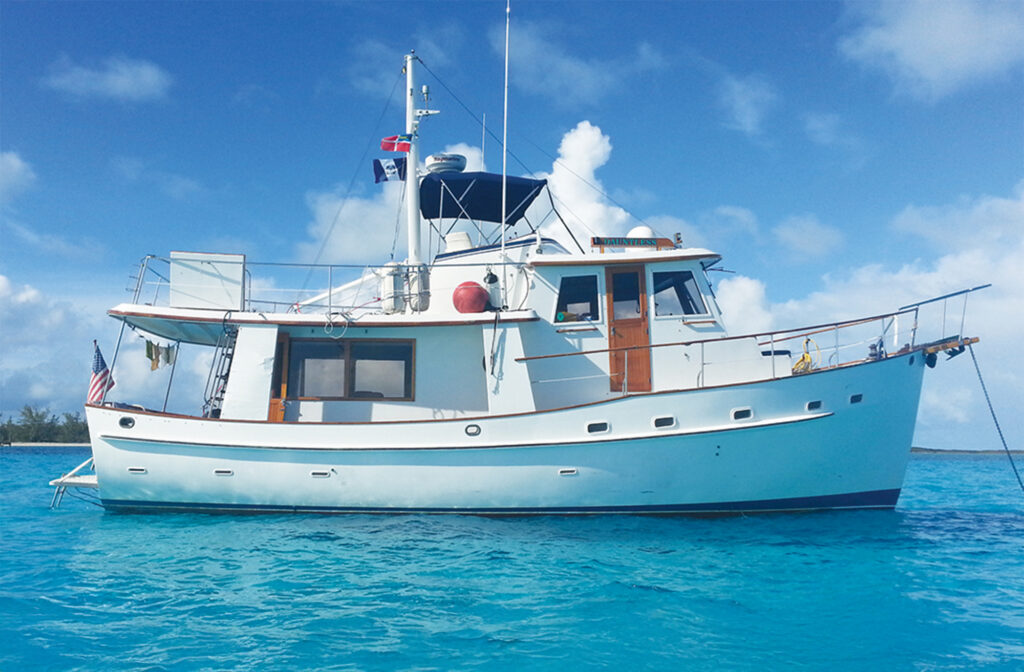
Governments now fund research on “blue health,” hoping to design cities with more rivers, canals, and access to coastlines to improve the quality of life. Dori and I smile at that. Our boat Liberdade is our own blue health project, already underway. Each season when we head north or south, we can feel the changes happening inside us; stress falls away, patience lengthens. Even our conversations change. They grow deeper, lighter, more joyful.
People we meet in our travels will occasionally ask why we’ve chosen this life. The answer is in the water itself—water makes us well. It keeps our bodies healthy, our minds calmer, our creativity alive, and our spirits grounded in awe. When we drop anchor in a quiet harbor, we aren’t escaping life—we’re entering it more fully. It doesn’t take much. Sometimes it’s just the sound of rain on the deck or the first sip of coffee while the world outside the cabin is still gray with dawn. Those small moments are what make this life so rich. The reason we like our life aboard is simple—water works.
This article originally appeared in the January 2026 issue of Power & Motoryacht magazine.