It’s taken 26 years for Dori and me to connect the beginnings of our life together with our current life aboard. It was 26 years ago that I asked her to marry me, while we were riding my motorcycle to Nova Scotia. Riding thousands of miles together, living happily out of two small saddle bags, more than proved we were compatible. Since then, we’ve observed numerous times the similarities between our life riding and our life aboard Liberdade. But it wasn’t until we were visiting the Smithsonian Museum of American History, during a recent stay at Washington D.C.’s Capital Yacht Club, that I realized just how similar they are.
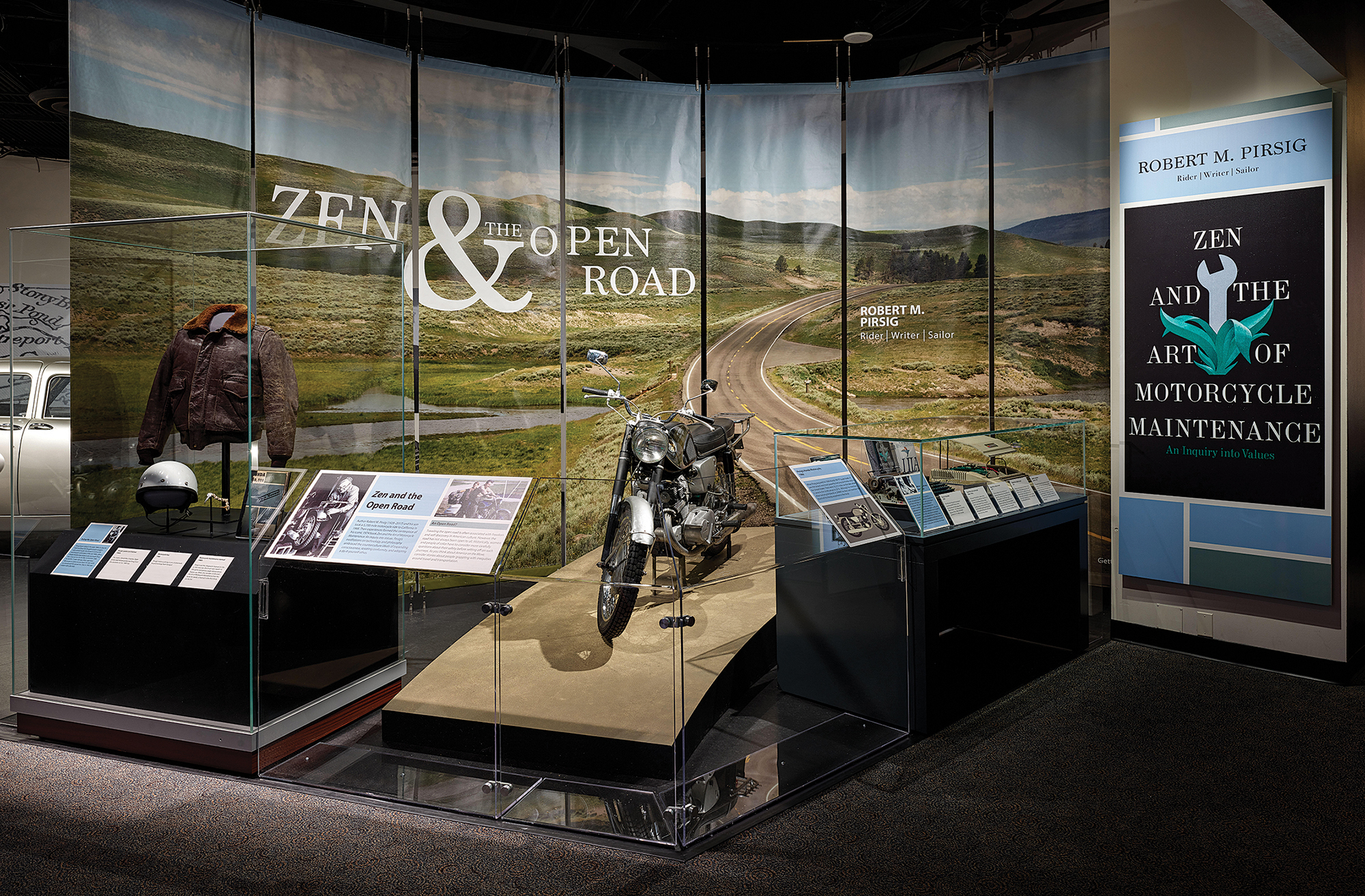
While touring the museum, we came across Robert Pirsig’s motorcycle that was the inspiration for his 1974 best-selling book Zen and the Art of Motorcycle Maintenance. In thinking about his book today, I can’t help but feel a kind of loss—an ache for a world that was. Pirsig’s unhurried road trip across the American plains is an ode to a way of moving through the world that was already at odds with modern life. His slow, deliberate pace, his visceral awareness of the changing air and landscape, and his hands-on relationship with the machine beneath him all stand in stark contrast to today’s seamless, frictionless, and increasingly virtual existence.
Pirsig’s journey very much resonates with our life aboard. His motorcycle was not just a mode of transportation but a companion—something to be understood, maintained, and trusted. If you’ve read my past columns, you’ll know this is equally true for my relationship with Liberdade. It is not simply a vessel that moves us from one destination to another; it is an extension of our awareness, a machine, that when properly tended, allows us to inhabit the world fully, without the filters and buffers that insulate so much of modern life.
Pirsig’s motorcycle trip was not about the destination. It was about the experience of travel—about the difference between driving a car and riding a motorcycle, where exposure to the elements forces engagement with the natural world. Similarly, cruising is not about getting from Point A to Point B as quickly as possible. Liberdade is not a speedboat or a jetliner; cruising does not skim the surface of life, but instead moves at a pace that allows for real connection with the sea, the sky, and the self.
Like a motorcycle on a two-lane twisty mountain road, the boat requires us to be fully present. When standing watch at the helm, adjusting course to shifting wind and waves, the boat demands attention. Autopilot and digital charting may assist, but they can’t replace instinct any more than a GPS-guided motorcycle ride replaces the feel of the road or the shape of the curves.
Pirsig’s book is, in many ways, a love letter to the act of maintenance—to the philosophy of caring for one’s machine as a way of engaging with reality. In a world where technology is increasingly disposable, where cars and boats alike are filled with systems too complex for their owners to repair, there is something deeply satisfying about understanding the mechanical heart of our boat.
A cruising trawler, like Pirsig’s motorcycle, demands this kind of care. The diesel engine, the fuel system, the electrical components—all of these require us to continually learn, to troubleshoot, to work with our hands. Because we personally perform most of the work on our boat, we are not just passengers on a voyage but active participants.
This is more than mechanical knowledge, it is a philosophy. Pirsig argued that quality is not an inherent trait of an object but a relationship, a way of interacting with the world. Likewise, a well-maintained boat is not just a functional machine; it is the embodiment of care, attention, and respect. The act of maintaining it is not a chore but a meditation, a way of deepening one’s connection to the boat and, by extension, to the sea itself.
One of Pirsig’s most prescient observations was that modern life tends to buffer us from reality. In the 1970s, he already saw a world where people were becoming estranged from the machines they relied on, where technology was designed to be used rather than understood. Today, this trend has only accelerated. Cars no longer come with repair manuals, and smartphones are sealed shut, discouraging owners from understanding them, much less fixing them.
Our life aboard offers us a rare refuge from this insular existence. It forces us to engage directly with the elements, to understand the forces of wind and current, to interpret the subtle signs of changing weather. It is a world where knowledge still matters, where the ability to tie a proper knot, to read a tide table, or troubleshoot an engine failure in the middle of nowhere is not just a matter of convenience but of necessity.
And yet, even in our life aboard, the temptation to insulate ourselves from reality is ever present. Modern yachts are equipped with sophisticated navigation systems, digital weather forecasting, and satellite connectivity that can make even the most remote anchorages feel connected to the world. These tools are invaluable, but they also risk distancing us from the experience itself. Just as a motorcyclist who relies entirely on a GPS may miss the pleasure of seeing where an unknown road leads, a cruiser who trusts only in digital readouts may lose the ability to read the sea.
At its core, Zen and the Art of Motorcycle Maintenance is about a way of being—one that values mindfulness, engagement, and the pursuit of quality in all things. Our life aboard is a natural extension of this philosophy. It is about slowing down, about being present in the journey rather than fixated on the destination. It is about the satisfaction of self-sufficiency, the pleasure of knowing the boat inside and out, and the quiet joy of an anchor well set.
In a world that is increasingly defined by speed, convenience, and disconnection, both Pirsig’s motorcycle journey and our life aboard stand as counterpoints. They remind us that there is value in slowness, in craftsmanship, in paying attention. They remind us that true freedom is not found in escape, but in engagement, in the willingness to be fully present, whether on a winding road or a rolling sea.
Pirsig feared that the kind of experience he described was vanishing, that the world was moving in a direction that made deep, unmediated engagement with life increasingly rare. Perhaps he was right. But for those of us who cruise, who still take the time to feel the wind, to maintain our vessels, to navigate by something more than a screen, his vision remains alive. And in that, I find hope.
This article originally appeared in the August/September 2025 issue of Power & Motoryacht magazine.