Photos By Owen Burke
By the time you step aboard the 136-and-a-half-foot ferry Yankee, it becomes clear that this is not a boat that merely carries people. She carries time.
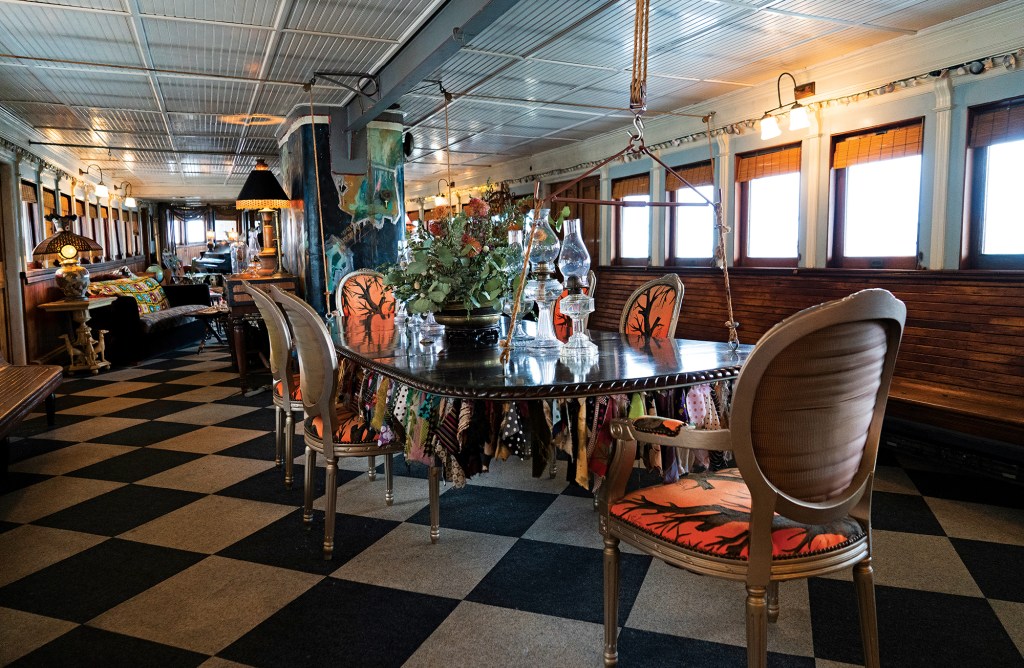
She does so heavily, visibly—10,000 square feet and 289 net tons of steel, wood, memory, and improvisation—her decks worn smooth by a century of footsteps that once moved with purpose: immigrants arriving at Ellis Island, soldiers heading to war, families commuting home to Block Island on Friday afternoons. Today, those footsteps belong to artists, children, visitors, and friends who know how to look slowly. The boat insists upon it, now as ever.
“It seemed like this boat was kind of everywhere for every historical event, but it needs a new place. It needs a new chapter of its life,” Heather MacKenzie-Chaplet told me from what was once the main passenger deck of Yankee on an arthritic morning this past November where she sat tied up in the upper reaches of Arthur Kill, which separates New York City’s borough of Staten Island from eastern New Jersey. MacKenzie-Chaplet and her husband, Nils Chaplet, were there visiting the former’s mother, Victoria MacKenzie-Childs and her husband, Richard, and lending a hand aboard the centenarian passenger ship.
Strange and sprawling as she and her almost-as-storied current owners and occupants, the MacKenzie-Childses, are, the respective and intertwined histories almost leave one fumbling at where to start. But for the sake of these margins, let’s start with the boat.
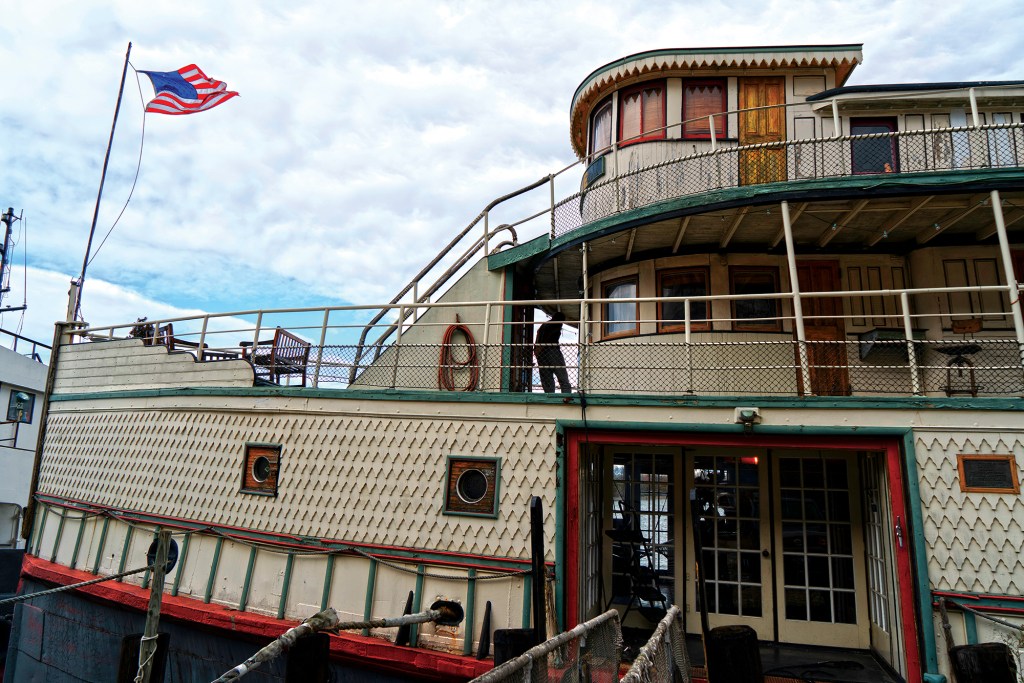
Built in 1907 in Philadelphia, Yankee entered the world as a steam-powered side-loading passenger ferry, a vessel of leisure. Her first life was an elegant one, designed to carry wealthy summer passengers from Portland, Maine, out into Casco Bay. Machigonne—named for a Native word meaning “bent knee,” referencing the shape of the coastline—wore her luxury openly: arched ceilings, polished woodwork, broad promenades where sea air and conversation mixed freely, if intermittently interrupted with belches of coal smoke—but indeed, those were the times. In photographs from that era, she looks less like transportation than a floating hotel, a mansion that happened to move.
War, as it so often does, changed everything.
During World War I, the Navy took her over. She patrolled Boston Harbor, scanning for U-boats, her elegant lines suddenly tasked with vigilance. A gun was mounted on her deck. A cannonball was later found aboard—an object that feels almost mythic now, as if it might roll out from beneath a bench when no one is looking. After the war, she returned to civilian life, only to be drafted again during World War II, when her turtle deck was cut away and replaced with steel to carry troops and equipment. The wooden staircases gave way to metal. Opulence bowed, briefly, to necessity.
Between wars and afterward, Yankee seemed to appear everywhere history needed a witness—“if Forrest Gump were a boat,” I jotted down in my notes during my tour of the century-and-change-year-old floating compendium of post-industrial history. Yankee is no idiot-savant—the mere fact that she’s afloat today refutes any such suggestion—but both by incident as much as by design, she’s been and remains present in one way or another for a staggering array of boldface affairs. She ferried immigrants at Ellis Island—the wealthier, elite set of European arrivals who bypassed the processing halls altogether. She carried visitors to the Statue of Liberty when it first opened to the public in the 1930s. She welcomed William Randolph Hearst home from Europe. She became, improbably, a kind of civic utility for American arrival, aspiration, and spectacle.
Her longest and most beloved chapter, however, came after the war, when she began running between the mainland and Block Island. Renamed Yankee, she became the “daddy boat,” the one that brought fathers back on Fridays to families who summered on the island while work remained onshore. Islanders learned to tell time by her arrival. Children grew up with her silhouette fixed in memory. When she was later damaged in a fog-shrouded collision with an oil tanker—just weeks before the America’s Cup, for which she had been named an official mascot—it was that affection that saved her. Insurance money repaired her. Sentiment extended her life.
By the 1980s, though, sentiment was no longer enough. She was retired and sent to a scrapyard in Providence, a fate that seemed final until an antique dealer named Jimmy Gallagher intervened. Gallagher dragged her—in tow—back to New York, docking her in Tribeca at a time when Tribeca was not jockeying for position as the priciest five-digit permutation in the U.S., but still a place where such things could happen. Artists lived aboard. Her (by then) diesel engines were turned occasionally by members of the Steamship Historical Society. There were wild parties. Improvised hot tubs made from salvaged rooftop water tanks. The boat, though no longer working, was alive as ever.
It was there that Victoria and Richard MacKenzie-Childs found her. The duo of artists and craftsmen who were once described by The New York Post as “Mary Poppins meets Alice in Wonderland,” once held the eponymous home-furnishings storefront of empirical proportions amidst (and for a time within) Bergdorf Goodman and Neiman Marcus on Madison Avenue. Despite their own remarkably propitious and prosperous history, Victoria and Richard had also found themselves facing something of a decommissioning.
After MacKenzie-Childs, Ltd. declared bankruptcy in 2001 and bitterly losing their brand to a quick (and reportedly underhanded) bidder during Victoria and Richard’s attempt to regain control of proprietorship, they were left reeling. They needed space. They needed possibility. They needed somewhere that could hold both grief and imagination. They ultimately made the drastic decision to relocate from their highfalutin digs of Manhattan to the financial capital of the world’s still decidedly undistinguished riverfront. But they needed to find the right boat.
Their meeting with Yankee was accidental, almost absurdly so. Victoria, then in her mid-50s, was rollerblading along the piers when she saw the ferry. She climbed aboard, met Gallagher, asked if the boat was for sale—and bought her, Richard would later learn.
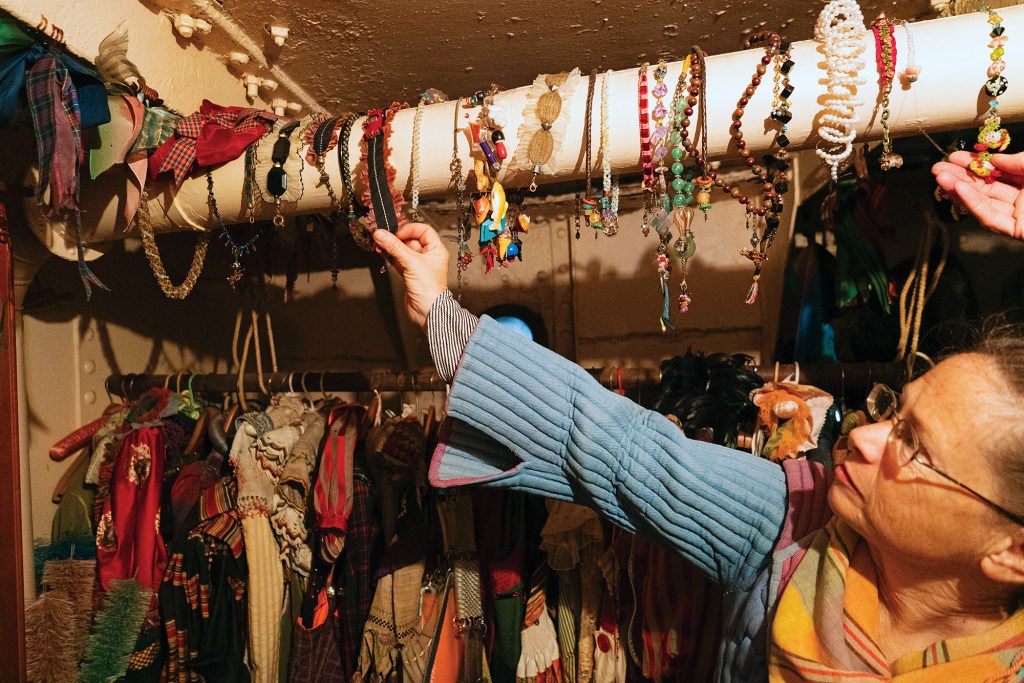
Neither of the MacKenzie-Childses were boat people. They were home people. What they saw in Yankee was not a restoration project in the nautical sense, but a vessel vast enough to become a life. They moved aboard in 2004 and began the slow, intuitive process of turning a working ferry into a floating domestic artwork. Engines remained, polished lovingly but no longer central. The focus shifted upward and inward—to rooms, rituals, and gathering.
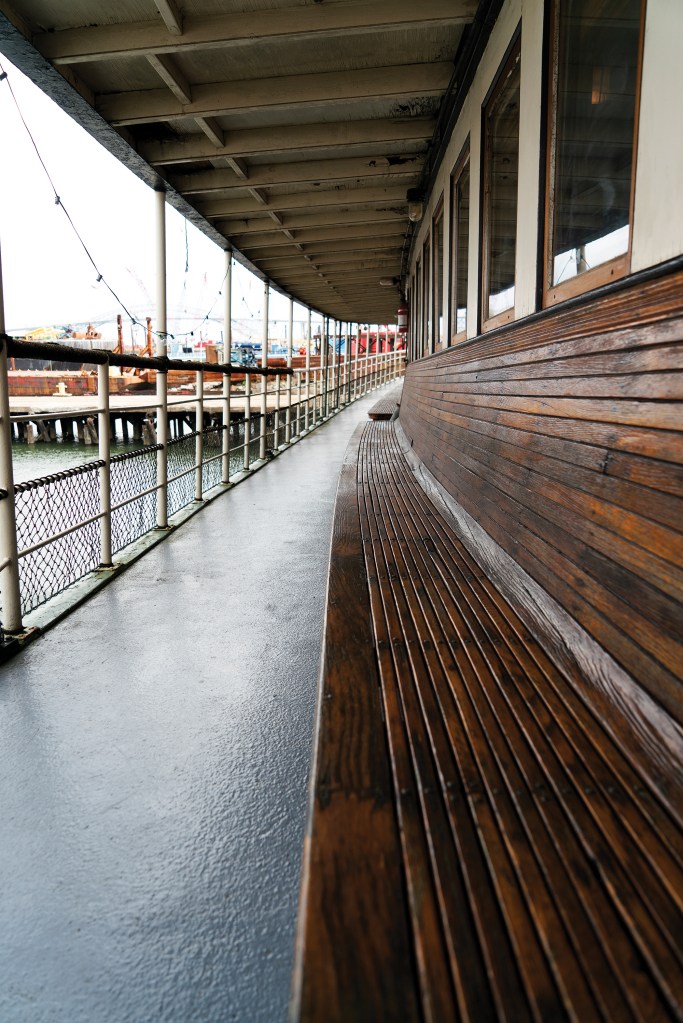
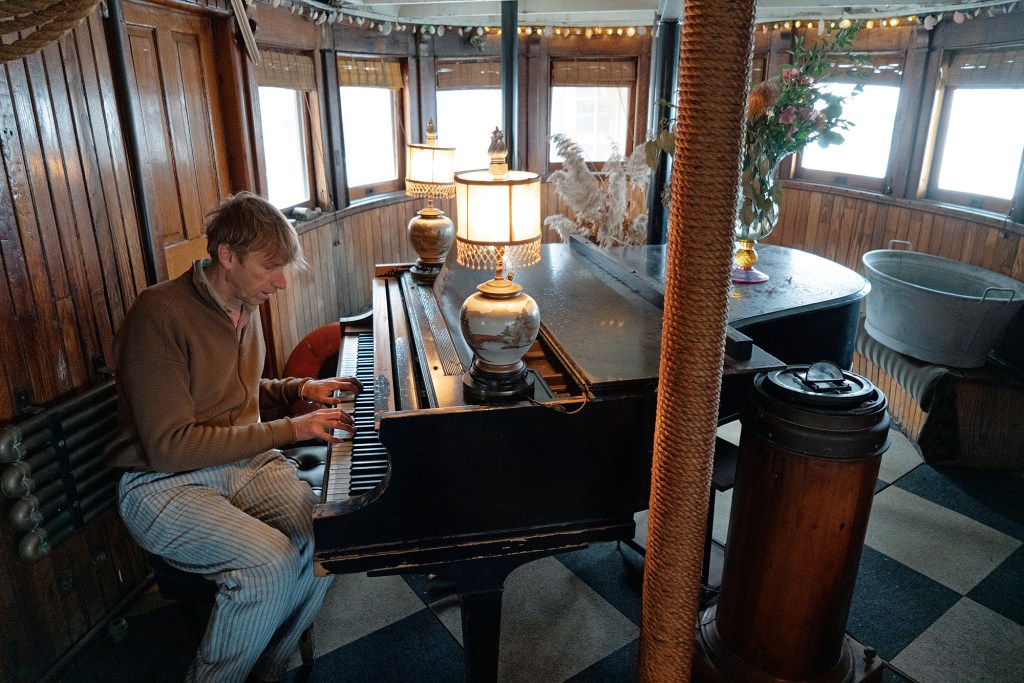
Beds were built where hot-dog stands once served passengers. A galley became a kitchen again. Passenger benches remained, still bolted to the deck, now framing dinner parties and performances. An upright piano appeared on the upper deck and—against all logic—stayed in tune. A pump organ still plays hymns when friends visit. Chickens once lived behind the kitchen, providing eggs for the MacKenzie-Childses as they housed a revolving revue of characters while docked in the Brooklyn neighborhood of Red Hook—until raccoons intervened. Workaway volunteers—“boat boys,” and later “boat girls”—came from around the world, trading labor for room, board, and immersion in this improbable ecosystem.
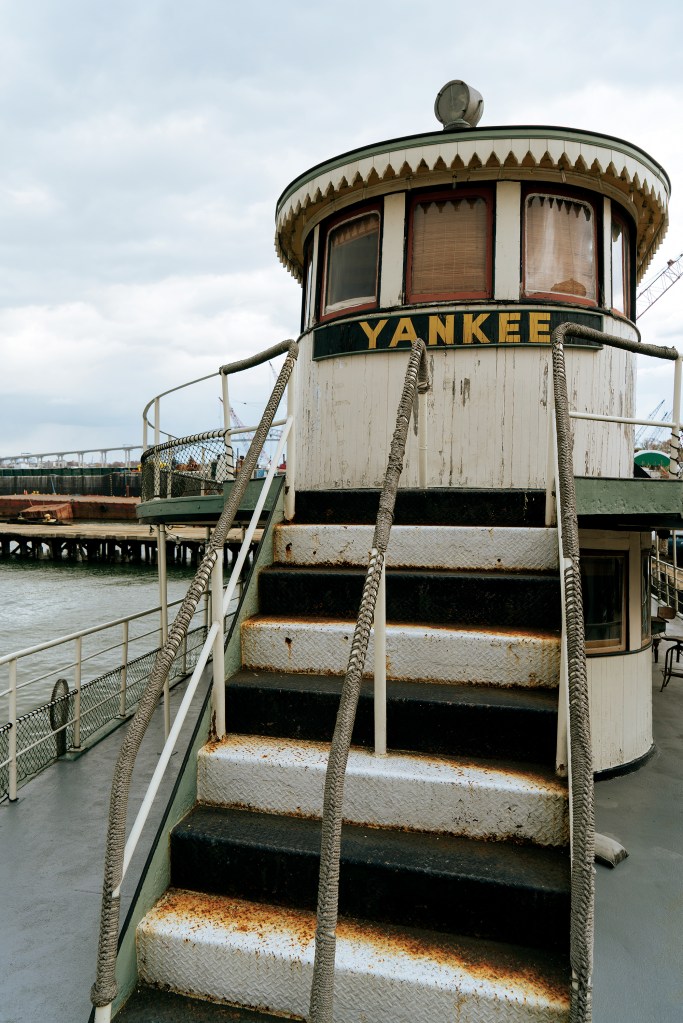
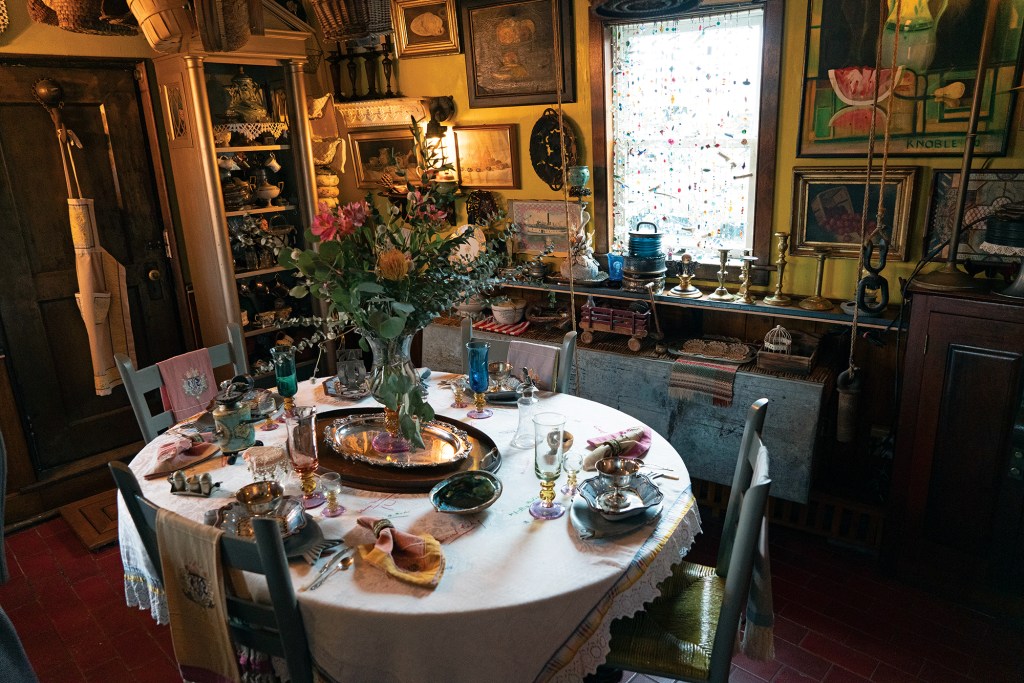
Victoria’s immediate, headlong approach to living aboard was at once deeply humorous, meticulously theatrical, and musical—among other large musical instruments preposterously positioned and still somehow maintained (and in-tune) throughout Yankee, a baby grand piano takes up the fore section of the bridge deck (now a dining hall), beneath the pilothouse. Dinners became performances. Food was clipped to clotheslines and dropped into soup like laundry. Salad bowls were hung overhead so guests had to eat like giraffes, hands forbidden. Epiphany parties included (the aforementioned) chickens. Everything was playful, but nothing was casual. Humor, after all, requires rigor.
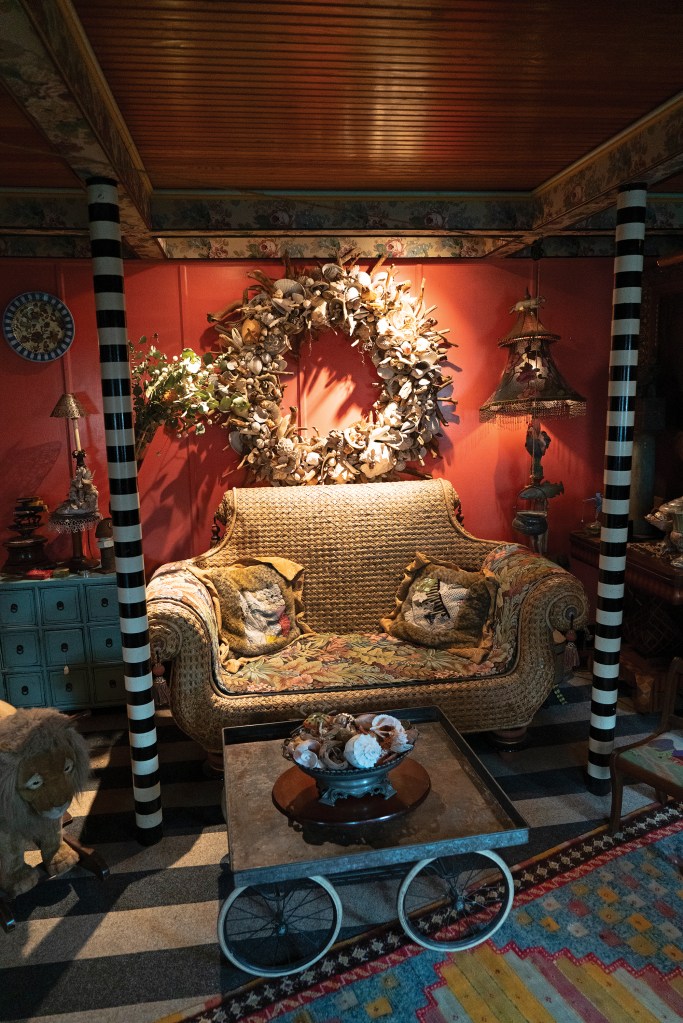
Richard, meanwhile, collaged. He made wreaths from found objects. He treated the boat as a surface on which time itself could be arranged. Their shared aesthetic—already known to the world through ceramics and furniture—expanded here into architecture, choreography, and daily life.
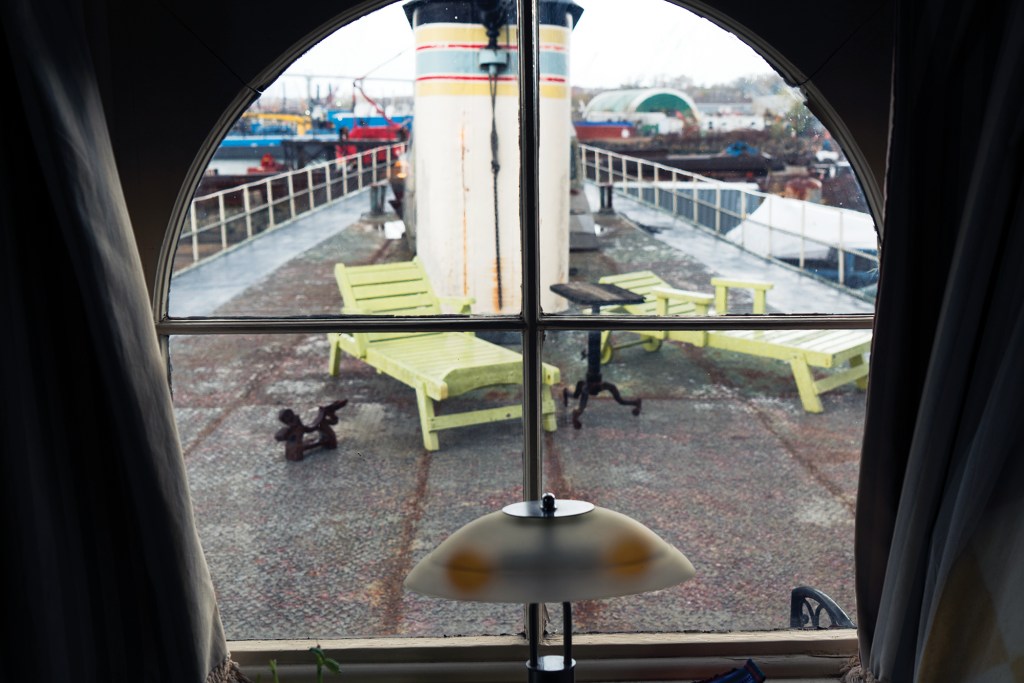
The ferry moved as New York changed. First, across the lower Hudson from Tribeca to Hoboken, New Jersey, where the boat rocked in ferry wakes and storms, and then from Hoboken back across the Hudson and the mouth of the East River to Red Hook, and most recently from Red Hook to Staten Island. Each move was forced by circumstance—development, zoning, economics. Each took a toll. Living aboard an aging steel vessel is not romantic in the practical sense. Windows leak. Heat escapes—despite a labyrinthine (and horrifically expensive to operate) system of electric baseboard heaters and the odd wood stove. Maintenance is relentless. At a certain point, even vision must bow to exhaustion.
And yet, for two decades, Victoria and Richard made it work.
Children grew up here. Grandchildren slept in bunks beside century-old walls. Friends came and went. Concerts filled the upper deck. The ferry was present for September 11th, docked near the towers, its silhouette caught in photographs of that terrible morning. It absorbed joy and catastrophe with the same stoicism it always had.
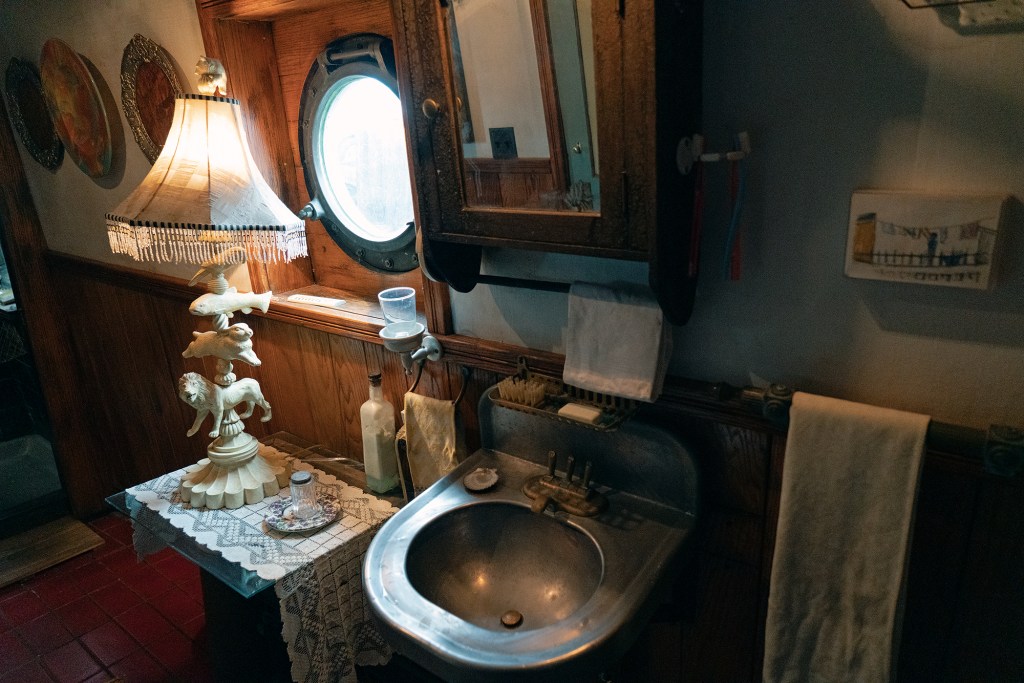
Now, as Victoria and Richard’s health declines and the boat again faces displacement, Yankee stands at another threshold. “She needs a new life,” as MacKenzie-Chaplet says. A new steward. Someone who understands that owning her is not about possession but participation—because Yankee has never been a static object. She has always been in motion, even when tied fast to a pier. She is a vessel that has carried the hopeful, the weary, the playful, the determined—as a matter of fact, she was home to a Ukrainian refugee at the time of my visit. She has carried war and peace, work and leisure, loss and reinvention.
For Victoria and Richard MacKenzie-Childs, she carried them home—at a moment when home had been taken away.
And that, perhaps, is her most enduring service of all.
This article originally appeared in the March 2026 issue of Power & Motoryacht magazine.