Right now, in my newly adopted village on a volcano-studded island in the middle of the Caribbean, things are eerily quiet. Tourists have vanished almost overnight. Businesses are shuttered. Streets and usually impossible-to-find parking spots sit empty. It’s late in the high season, sure, but never like this.
And it’s noxious.
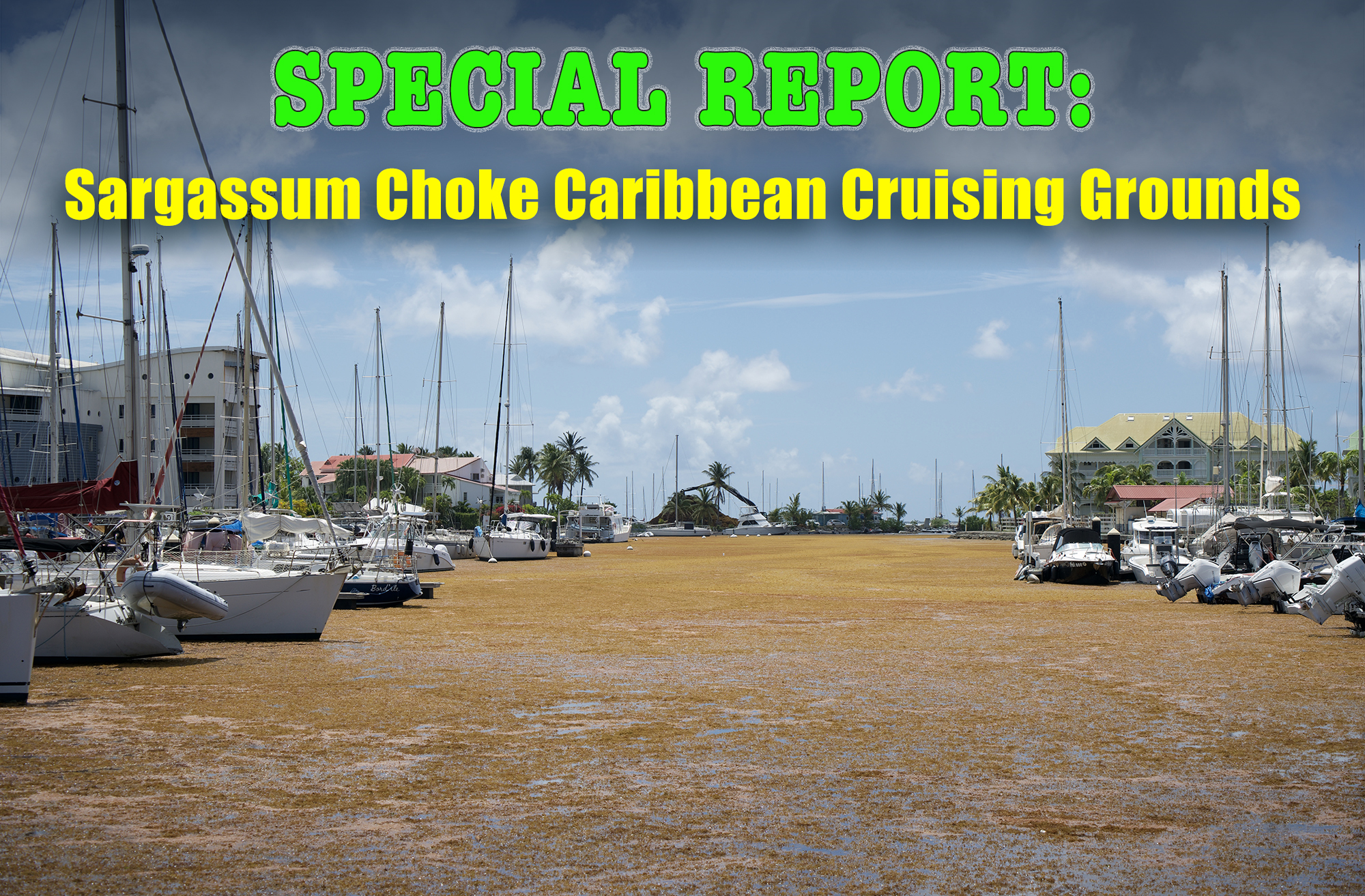
As I write this, a half a mile from shore, my eyes and throat burn. The marina where I’d hoped to keep my boat is nearly inaccessible. The vessels lying motionless in their slips look abandoned, stranded in a thick brown soup without even the faintest ripple to suggest there’s still water beneath them. The only signs of life are a lonely green heron stalking rocks for prey and the constant growl of excavators clawing at the shoreline.
The reason, in a word: Sargassum.
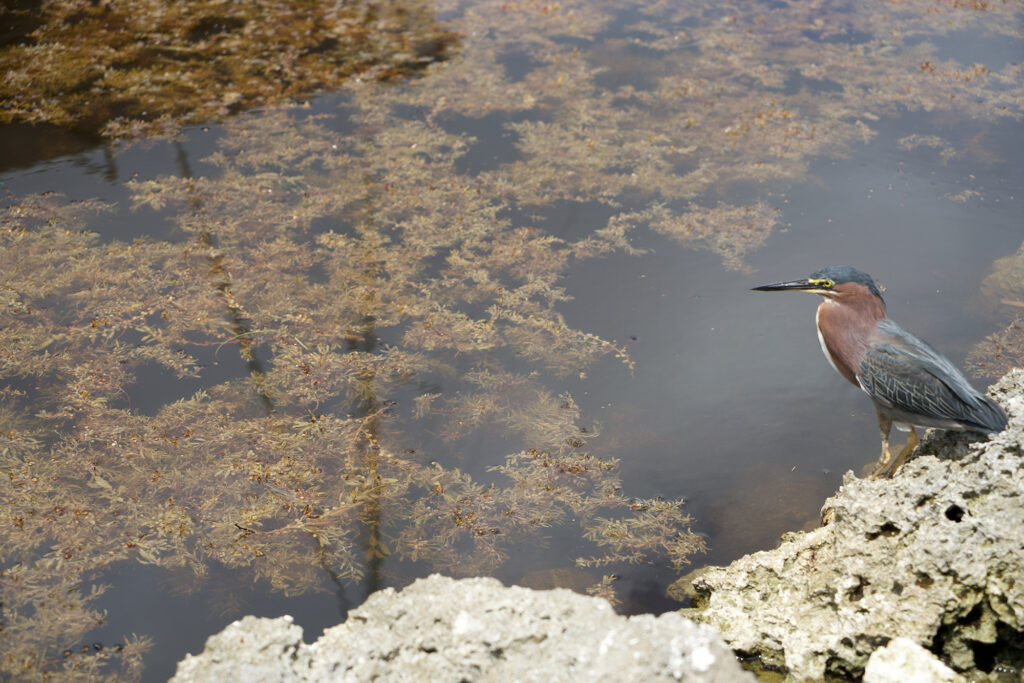
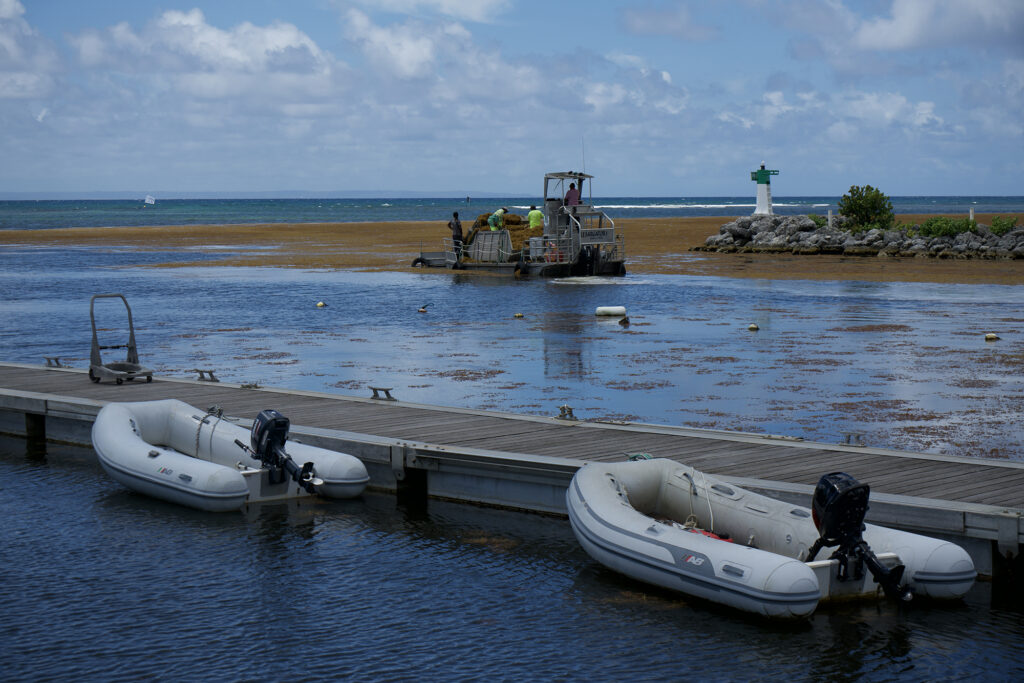
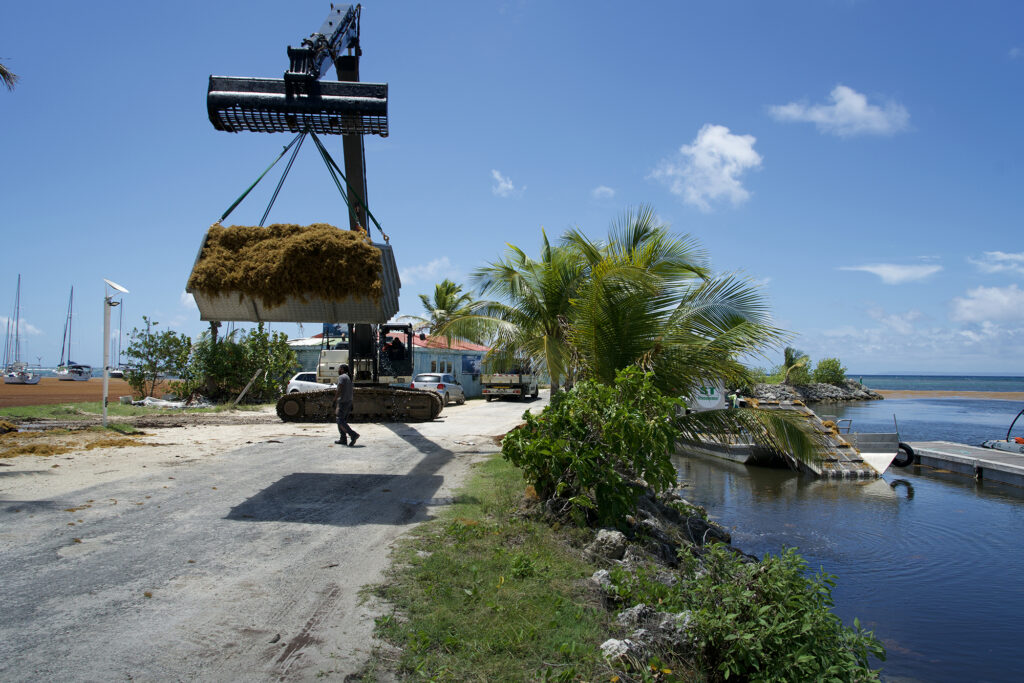
Golden-brown mats of this hardy algae now stretch across lagoons, beaches, and harbors throughout the Caribbean basin. From a hillside overlook, I can see still more drifting in from offshore, pushed relentlessly westward by wind and current in staggering quantities. What was once an occasional nuisance has become something far larger and more ominous. ‘This island is finished,’ a couple of retiree-passersby stopped to tell me as I snapped photos of a backhoe working in tandem with a Sargator—a barge with a steel conveyor belt specifically designed for fishing the stuff out of waterways—to build a pile three stories high atop what was once the village’s preeminent sugar-white sand beach.
NOAA, the EPA, and other official agencies are calling the massive bloom spanning thousands of miles across the tropical Atlantic, from the Gulf of Guinea to the Caribbean and Gulf of Mexico, the Great Atlantic Sargassum Belt (GASB). Since 2011, these blooms have appeared with increasing scale and persistence, at times forming a ribbon of floating algae more than 5,000 miles long.
Increasingly, many fear it’s here to stay. In April, NOAA even went so far as to develop a tracking tool with daily risk updates—a quick glimpse at which might serve you well ahead of any upcoming Antillean cruising or fishing plans.
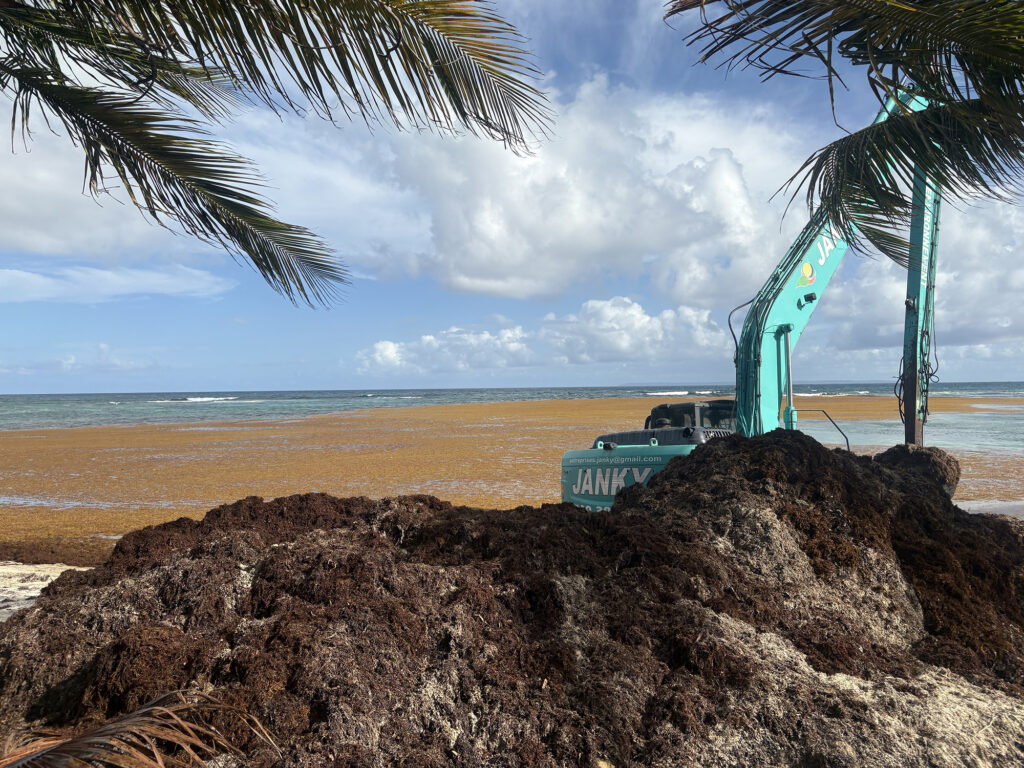
Across the region, from northern Brazil to South Florida, entire communities are grappling with the consequences. Mexico’s Riviera Maya has become one of the most visible battlegrounds. Authorities there have deployed naval vessels and military personnel to intercept the algae before it blankets beaches and clogs marinas. It sounds absurd until you see it yourself. Then it starts to resemble a war of attrition—with miserable workers shoveling decaying sargassum into piles to be carted away.
Scientists are still debating exactly why the blooms exploded when they did. Some researchers point toward nutrient-rich runoff from the Amazon and Congo River systems. Others suggest shifting ocean temperatures and currents tied to La Niña events creating ideal growing conditions in the eastern Atlantic before the algae drifted westward. There are even lingering theories tying it to the historic Sargasso Sea farther north.
Whatever the cause, the effect is undeniable.
In moderation, Sargassum is not only natural but essential. Floating weedlines are among the richest ecosystems in the open ocean. Anyone who’s spent time offshore trolling the Gulf Stream knows this well. Weedlines hold life. Beneath mats of golden grass gather baitfish, triggerfish, filefish, and crustaceans, followed by mahi, tuna, wahoo, and marlin. Sea turtles shelter there during vulnerable early stages of life. Offshore anglers have long regarded Sargassum as a beacon of productivity.
Life brings life.
But there is clearly such a thing as too much.
Once these massive blooms make landfall, the equation changes fast. The algae piles up along beaches and inside harbors, where it begins decomposing in the tropical heat. The result is a thick, sulfurous stench often compared to rotten eggs, caused by hydrogen sulfide gas. Fish kills follow. Seagrass beds suffocate. Waterways stagnate. Tourism evaporates. Waterfront businesses lose customers overnight.
For boaters, the consequences can be immediate and expensive.
Marina entrances become impassable. Cooling systems clog. Intakes foul. Anchors disappear beneath mats so thick they resemble sodden peat bogs more than seawater. Running through dense Sargassum can overheat engines quickly, especially on outboards and smaller inboards dependent on clean water flow. Even where navigation remains technically possible, it often becomes deeply unpleasant.
The irony is hard to ignore. The same weedlines offshore that signal productive fishing grounds become ecological and economic hazards the moment they make landfall.
And yet, even amid the crisis, there’s a strange duality to it all. Sargassum can protect coastlines from storm surge, helping stabilize and even build beaches and dunes, much like mangroves or reefs. Farmers have long used it as fertilizer. Researchers are investigating potential uses in biofuels, pharmaceuticals, and construction materials. Some entrepreneurs see opportunity where others see catastrophe.
Still, none of that changes the day-to-day reality in places living under constant inundation. The Caribbean has always existed in delicate balance with the sea, but the scale of these blooms feels different. More permanent. More systemic. The ocean that once represented freedom and abundance increasingly arrives carrying warning signs.
Locals adapt as best they can. Bulldozers scrape beaches at dawn. Fishermen alter routes and schedules. Charter captains chase cleaner water farther offshore—if they’re operating at all. A local dive operation’s owner told me he’s been dealing with fried electronics, and the hulls of his boat are an off-putting hue of brown that makes me think further still about buying (and berthing) a boat here. Homeowners shut windows against the smell. Some simply wait and hope for a change in wind direction.
Others try to laugh about it.
Lately, I’ve started calling the phenomenon “Dr. Strangebloom or: How I Learned to Stop Worrying and Love the Blob.” Gallows humor feels appropriate when your turquoise anchorage begins resembling an overfertilized estuary.
And, truthfully, there are still silver linings if you look hard enough. Yellowfin tuna have been prowling closer to shore than I’ve ever seen here, shadowing the nutrient-rich currents. Fresh tuna loin can suddenly be bought for a song. Empty surf breaks sit untouched for anyone brave enough to paddle through the murk. And perhaps, for the first time in years, a marina slip might actually be negotiable.
Still, it’s impossible to shake the sense that this is a preview of something larger. The Great Atlantic Sargassum Belt isn’t merely an environmental curiosity anymore. It’s reshaping coastlines, economies, and boating culture throughout the western Atlantic in real time.
For now, the boats remain still in the marina basin, waiting beneath a film of brown gold that, depending on where it drifts, can signify either extraordinary life offshore or wholesale suffocation ashore.
The sea, as ever, both giveth and taketh away.