
How AI in Boating Is Transforming Life on the Water
As artificial intelligence continues to permeate every aspect of our lives, how is this technology poised to transform boating?
While there is debate about whether HAL 9000 introduced the concept of artificial intelligence to the public, it is widely recognized that HAL played a significant role in raising awareness about AI and sentient machines. HAL 9000 also brought forth the idea that intelligent machines could possess malevolent tendencies. If you stick with me through this journey, we’ll explore the possibilities and potential pitfalls of AI on the water. However, those pitfalls won’t include the computers we rely on attempting to take over.
Artificial intelligence is a broad term with various definitions and classifications. Its amorphous nature leaves it open to myriad interpretations—especially by marketing departments. I spent 20 years in corporate technology infrastructure, during which time cloud computing became all the rage. I vividly recall the confusion that accompanied the sudden rebranding of long-standing services. Technologies we had used for years were suddenly introduced as brand-new cloud offerings.
AI gives me a strong sense of déjà vu. Technologies we’ve seen in both general and marine applications are now being rapidly renamed to stake a claim in the AI revolution. What we might have called an algorithm or machine learning just a few years ago is now broadly grouped under the AI umbrella. In many cases, familiar systems are simply being rebranded as AI, often with little or no change to their actual capabilities or functions. At the same time, however, we’re also seeing the emergence of genuinely exciting new technologies and capabilities.
Understanding the Terminology
First, let’s take a stab at defining AI for the purpose of our discussion. This definition comes with the caveat that there are numerous others out there—and they don’t all agree. Many definitions of AI break it down across different dimensions, including technology, capability, functionality, and purpose. For boating applications, looking at AI by purpose makes the most sense.
Microsoft breaks AI into two major types: Generative AI and Traditional AI. Generative AI uses deep learning to create content in response to natural language prompts. That content may be text, images, or video. Traditional AI, often referred to as narrow or weak AI, is rules-based and relies on more rigid algorithms. It excels at automation and making decisions based on fixed parameters.
Within Traditional AI, two subcategories describe the vast majority of implementations: Predictive AI and Conversational AI. Predictive AI uses existing datasets to forecast the outcomes of new events—examples include streaming service recommendations, bank fraud detection, and predictive maintenance for equipment. Conversational AI understands natural language and responds in a way that mimics human speech. Siri, Alexa, Google Assistant, and customer service chatbots are all examples.
The AI systems we’re seeing on the water rely on neural networks, deep learning, and Large Language Models (LLMs) to make decisions, understand requests, and provide information to boaters. These same technologies also underpin much of the AI dominating today’s headlines.
Neural networks are composed of artificial neurons that process data in a way that mimics the human brain. They learn from data—the more they process, the more they improve. Deep learning systems link multiple layers of neural networks, enabling advanced processing and richer functionality. Large Language Models (LLMs) are often the first interaction people have with AI. They use deep learning to ingest large volumes of information, understand user prompts, and generate text-based responses.
AI on the Water
Okay, enough jargon—let’s dive into how these systems are actually being used on boats and what that means for you. If you’re reading this, you’ve surely noticed the surge in companies putting “AI” in their name or highlighting it in their marketing. In one form or another, AI is now being employed in everything from boat monitoring and security to fully autonomous vessel operations. But not all of these systems use AI in the same way—or even use the same type of AI. Let’s see if I can help you navigate some of the differences in marine AI technologies. And while we’re at it, I’ll dust off my incredibly cloudy crystal ball and try to make some predictions about the future.
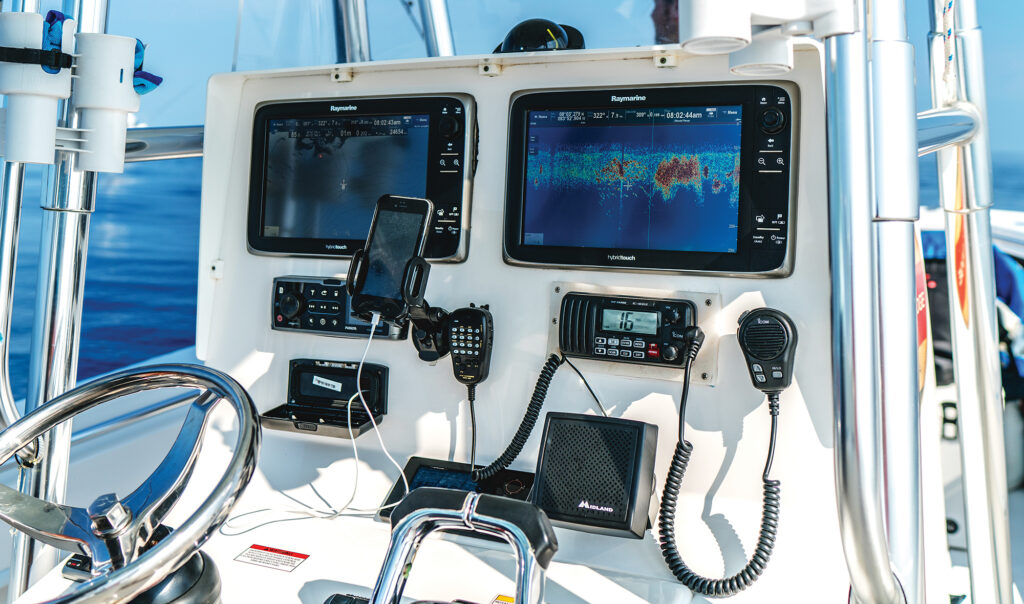
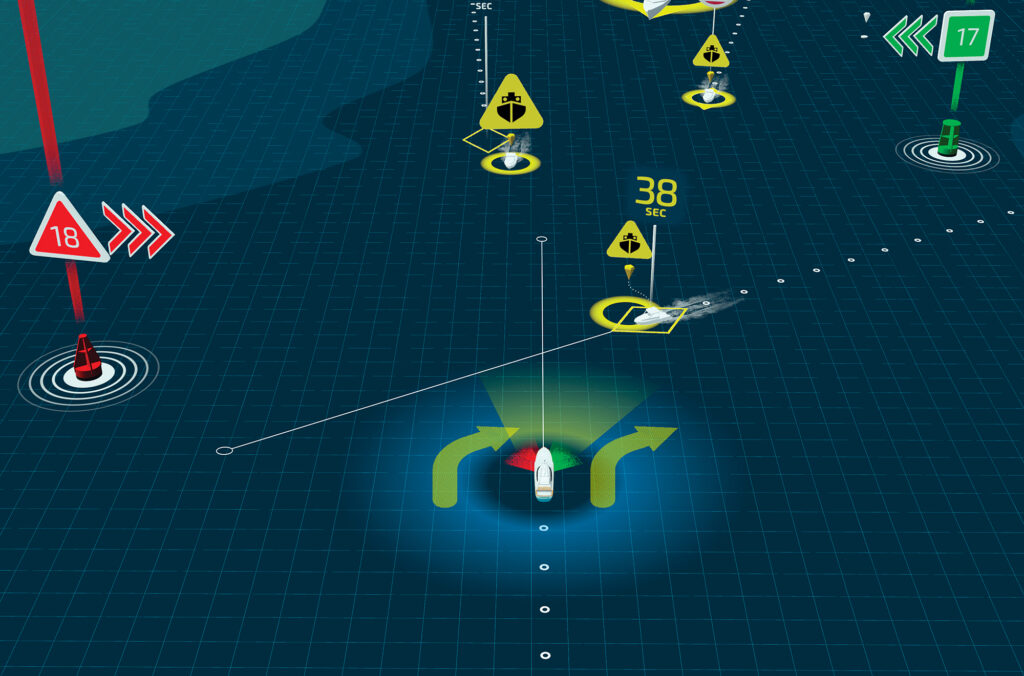
AI can make quick—and I mean extremely quick—work of pattern recognition. Train a neural network with a few dozen pictures of kittens, and it can identify kittens in new images with surprising accuracy. So, it makes sense that a company like GOST would use AI in their new Spectre.AI security system with facial recognition. The system can be trained to recognize authorized and unauthorized faces and send alerts accordingly. AI is also making big waves in safety and situational awareness underway. SEA.AI and Lookout both use visible light and night vision cameras, along with AIS, to monitor the waters around a boat. When potential threats or points of interest are identified, the systems alert the operator. Lookout focuses on safely navigating crowded waterways, while SEA.AI is designed for all phases of boating: underway, at rest, search and rescue, and maritime surveillance.
Both systems can identify boats, aids to navigation, floating obstacles, inflatables, and persons overboard.
Tocaro Blue’s Proteus system uses radar and AIS to offer similar situational awareness. Proteus has been trained on countless radar returns, enabling it to identify vessels and navigation aids based on radar signature alone.
Cameras excel at identifying objects in close quarters, while radar extends detection range. It’s no surprise that partnerships are forming. For example, SEA.AI and Tocaro Blue recently announced a collaboration where SEA.AI leverages Tocaro Blue’s radar expertise to enhance detection range.
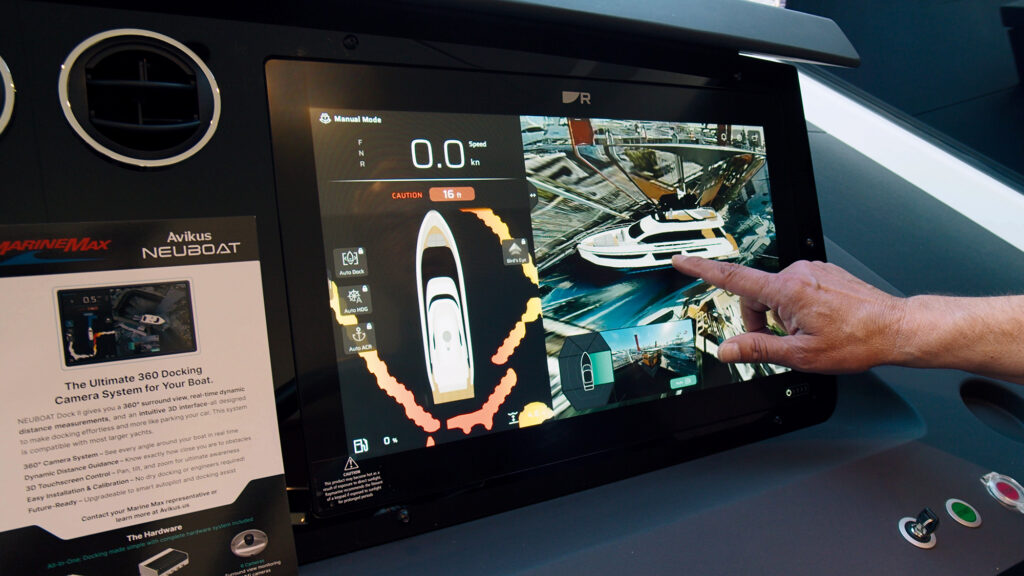
Avikus, HD Hyundai’s autonomous vessel operations subsidiary, has previewed Neuboat Control, which autonomously maneuvers a boat from dock to dock. They’ve been demoing this capability since the 2022 Ft. Lauderdale boat show. I’ve experienced it a few times myself—and let me tell you, it’s both impressive and eerie to be on a boat that drives itself. I asked Sangwon Shin, Avikus’ VP of Recreational Marine, how they use AI. He explained, “We use CVML (computer vision machine learning) as our main AI technology. But currently, control decisions are made by procedural code. Like Waymo’s autonomous cars, we use conditional statements to determine control. In the future, we plan to shift to AI-driven decision-making, similar to how Tesla operates. But Tesla has a large user base to train their models—we need to build ours to gather enough data.”
Autonomous operations—whether for a car, bus, truck, or boat—are a herculean task. It’s one thing to handle expected scenarios, but as any boater knows, the water is full of unexpected and often unimaginable situations. Designing systems to operate vessels through those situations is an enormous challenge. Avikus systems are installed on all new HD Hyundai ships and are designed for autonomous operations in open water. Somewhat counter-intuitively, running a massive ship on a long ocean voyage may be easier than safely navigating a recreational boat in busy weekend waters.
Looking Ahead
Back to that cloudy crystal ball: I see huge potential for AI-driven autonomy and assistive technologies to reduce the workload on recreational boaters. But I’m less confident that we’ll see full autonomy anytime soon. There are simply too many corner cases that current technology can’t yet handle. And honestly, I’m not convinced recreational boaters want to give up full autonomy—they’re more likely looking for assistance rather than a total hand-off.
Companies like Avikus, Lookout, SEA.AI, and Tocaro Blue share a critical trait: Their systems are trained on real-world data. The more data, the better the performance. Andrew Rains of Tocaro Blue shared that Proteus has been trained on over two million radar images. According to Rains, “Half a million blobs is what you need to even get started. A million is a good number, and by two million, the classifier is getting really confident.”
David Rose, founder of Lookout, added, “We train a new model almost every week. Using high-performance cloud GPUs to crunch video data, we generate a lightweight model file that’s pushed out to every boat via OTA (over-the-air) updates. The onboard Lookout modules then perform inferencing at the edge in real-time.”
That inferencing—detecting, classifying, and tracking objects in the video feed—happens locally and instantly.
Rose also shared a great example from the Maldives. A distributor there asked if Lookout could detect sea turtles. They had no prior data for that species in the region. But with their Tap2Train feature, users could tap the screen to flag examples. Those annotations were sent back via OTA and incorporated into training. Within days, Lookout was redeployed with a model that could detect sea turtles fleet-wide.
Getting back to HAL, you might assume systems like Proteus can learn to identify new objects on their own—but that’s not quite the case yet. Rains explained, “The classifier might start by assigning a confidence level to an object. As it sees more radar returns, it may adjust its confidence. But it’s not learning anything truly new until we deploy a new software version.”
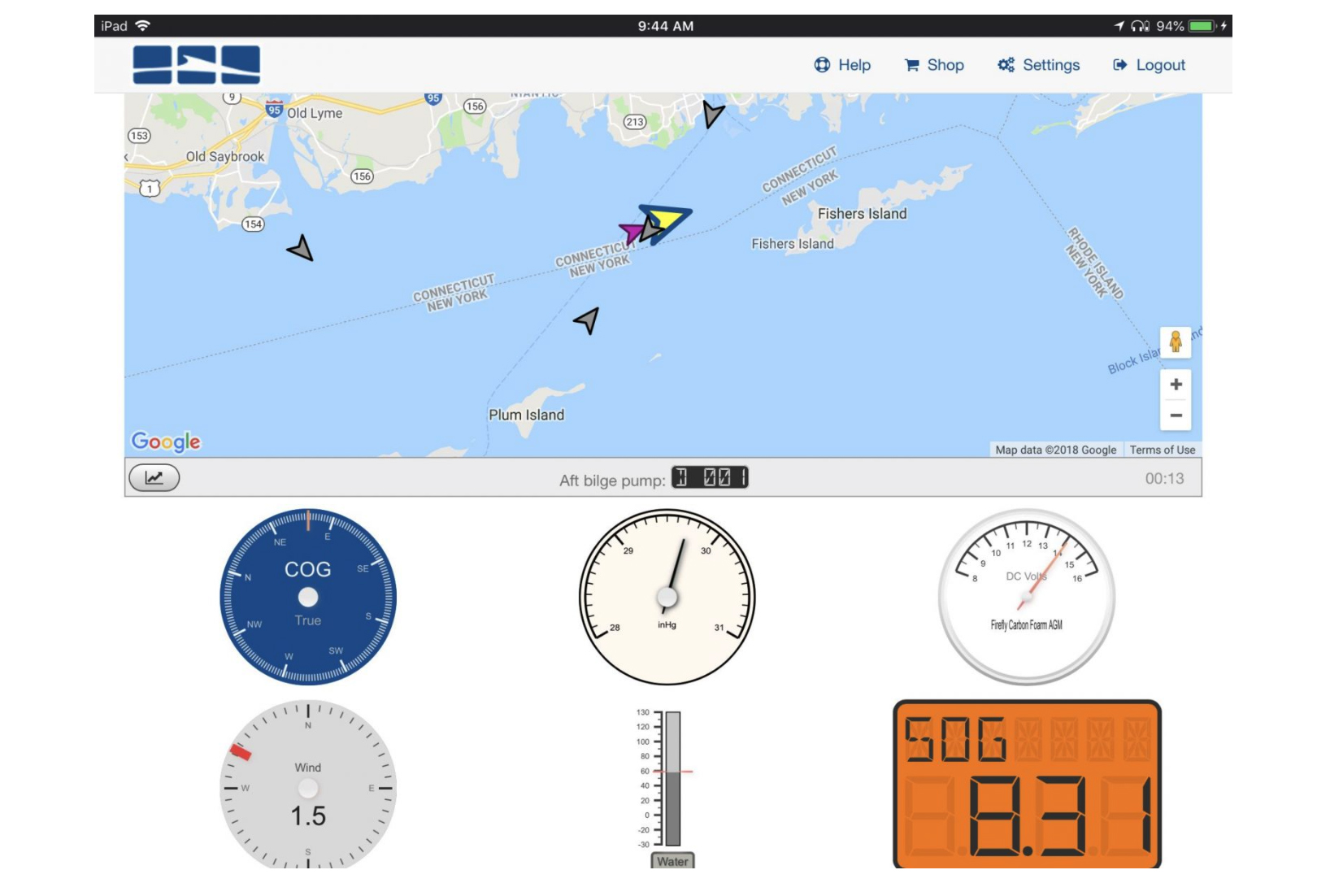
Let me make one more prediction: AI’s greatest strength is recognizing and correlating patterns. Our boats are full of sensors collecting vast amounts of data. AI can take that data—everything from charted depth, tide tables, GPS, and historical performance—and draw useful conclusions.
Here’s an example: I boat on the west coast of Florida, where shallow waters are the norm. Sometimes there’s only a few inches under the keel. We all have tide tables, but wind and tide can conspire to create unexpected variations. That can mean the difference between smooth sailing and being stuck in the mud. An AI system that combines real-time depth, location, tide data, and historic logs could give you far more accurate insights than any tide chart. It could even warn you before you enter problematic areas. That’s just one example. We’re already seeing marine-specific chatbots and LLMs being used for boater support. One thing is certain: We’ll continue to see more AI on our boats.
Hopefully, none of it will resemble HAL’s descendants.
This article originally appeared in the November 2025 issue of Power & Motoryacht magazine.