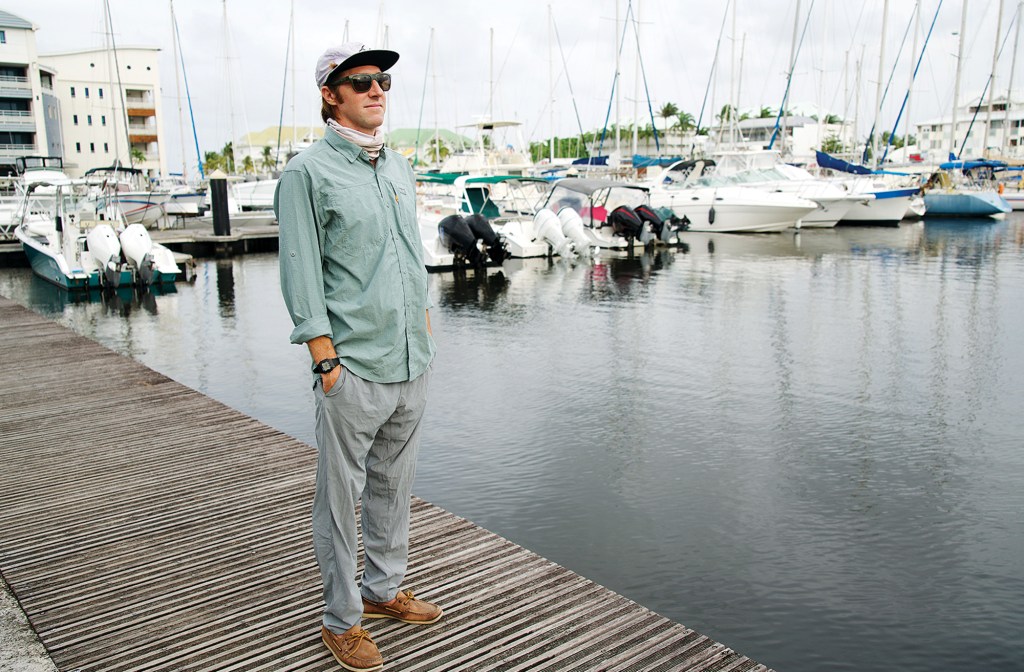
Pale as I am, with a predilection for tropical waterways and an aversion to stained clothing and greasy fishing equipment and skin, I’ve worked up a hard-won but finally, dare I say, Bedouin-grade regimen for keeping my dermatologist at least one beach house poorer.
Hats
I have a three-tiered approach to my hat lineup depending on breeze, whether I’m fishing, how much direct sun I’ll bear, and space.
A wide-brimmed straw hat with a dark underbrim and a strap, not unlike the hats you might encounter in an East Asian rice paddy, tends to do the best work and can, in a pinch, preclude much sunscreen and cloth. However, a good breeze, tight quarters, and lack of durability are detractors to that argument. A breathless day out in the middle of a lake or in a backwater on, say, a bowrider? There’s no better choice. Sunday Afternoons is a company that makes a few impressively pliable models that do the job well and stand up to the test of time and travel.
A little sportier and better in a stiff blow, a wide, flat-brimmed baseball cap is hard to beat. I find Bajío’s offerings lightweight with a formidable (dark) brim that lends good damage control—and helps me spot bonefish and permit more easily.
And for full-on excursion wear (note: you will not be wearing this to the bar or any sort of social engagement whatsoever afterwards), this DDYOUTDOOR fishing hat is cheap as chips at about $12, and does as thorough a job as a kefiyeh or a shemagh and then some—without scaring the daylights out of my fellow mariners (or drawing the attention of the Coast Guard). This is a three-part hat (and there are many like it) but this one is so lightweight and protective—I can ball it up and toss it in my pocket at the drop of a dime—I don’t know why I’d spend any more. It has a tail end that tucks into your shirt or snaps forward to protect your neck and shoulders, a face piece with mesh for breathing so you don’t fog up your lenses, and a brim large enough to guard the brow.
Shades
Sunglasses are highly personal, but if you’re going to invest, ophthalmologists say the base tint should range between gray, amber, and brown to offer the best protection. And I’ll implore you to always choose glass. Why? I have a drawer full of scratched plastic lenses ranging in retail price from $4 to $400. Empirically, I contest that no one has developed a plastic lens scratch-resistant enough for the occasional brush with a boat deck.
Regardless of material and lens tint, the color of the lens is another hotly contested matter, but my favorite rule of thumb that fly-fishing guides mostly seem to agree on is to match the color of the water you’re trying to see through (or deflect). In other words, cobalt for bluewater excursions, amber for backwaters, and green for clear grass flats. Purple, on an overcast day, is a good backup color to keep on hand.
As far as brands go, I’m currently using glass from Bajío, a brand born from Costa alumni. The glass holds up well—I’ve been fishing (and dropping them) for six months straight—but the reason I recommend any one specific brand here is that unlike other shades designed for sportsmen, which tend to be on the large side, Bajío offers a wider range of frame sizes (that still provide decent peripheral coverage), and it’s good to have lenses that actually fit your face.
I’ve tested no less than 100 pairs of polarized sunglasses, and my general recommendations are to find a frame that fits your face, and, again, invest in quality glass.
UPF 50 Shirt
From the basic tee to the sun hoody to the collared button-down, take your pick. Me, I like the versatility of being able to go anywhere in one of these puppies—and I do.
If you want to look a little more presentable, Marsh Wear’s Lenwood Tech is on the thicker side but more wrinkle-proof, has plenty of low-key pockets, and is what I put to work most, especially on 90-degree boat-show days. .
Having tried countless UPF button-up shirts, I can also add that the clandestine pockets come in handy without making me look like a NASCAR rally driver or a birdwatcher on safari—too many, to my humble taste, border on gaudy with pockets and logos galore.
I don’t hit a boat show without at least half a dozen of these, and for the aforementioned reasons, keep a variation..
This article originally appeared in the August/September 2026 issue of Power & Motoryacht magazine.