I read an essay recently about maintaining a “beginner’s mind.” It was written by an artist who refused to be labeled by a particular style of work. She always wanted to feel like a beginner, in every piece she painted. Reading it brought to mind something I’ve always tried to maintain in our life aboard: the willingness to see each experience not as a repeat of our past cruising, but as something happening for the first time. I believe the sea invites that kind of mindset, and maybe even demands it. After all, the sea is never the same, so why should I be?
There is a momentary feeling I get every time we leave the dock aboard our trawler Liberdade. Even after all these years, I feel a flicker of something hard to describe—part anticipation, part nervousness, part discovery. It’s a small piece of the same feeling I had the very first time we took the boat out. Sometimes it’s as if, for all the lessons learned and all the miles traveled, I want every day on the water to hold something new—something we’ve never seen before.
Most fellow cruisers we’ve met slip into routines repeated so many times, they’re almost automatic. Yes, there is a benefit to the experience we’ve gained in our time aboard, from how we hang the fenders to how we set the anchor. But here’s the truth I’ve come to appreciate: if you let yourself believe you’ve “mastered” anything at sea, you’re already drifting into trouble.
Currents shift. Channels shoal. Weather changes in ways that defy any forecast. And even in a place we’ve been a dozen times—say, entering the slough at Frying Pan Shoal or easing through the tight entrance of a favorite Shelter Island harbor—the details are always new. The winds are different, the light is different, and I’m different.
A beginner’s mind doesn’t erase experience; it simply keeps you from letting experience blind you. It allows you to say: “This place deserves my attention today, not just the memory of yesterday.”
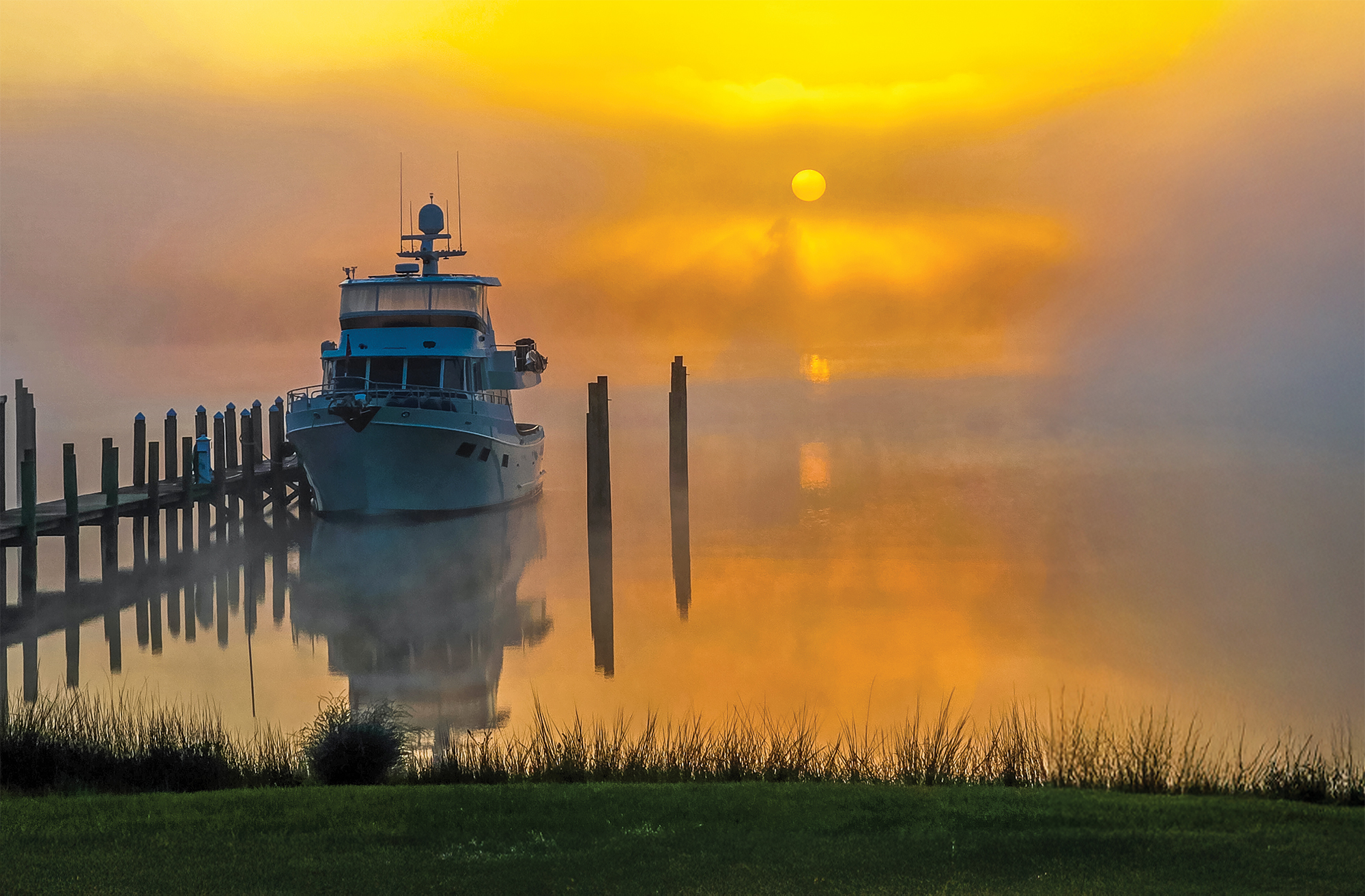
I felt it again not long ago, approaching an anchorage we’ve used a dozen times. The sun was low with a slight glare off the water. We knew exactly where we wanted to drop the hook. And yet, as the depth sounder ticked down and we eased our way closer to the shoreline, everything seemed different from the last time we were here. So instead of pushing that thought aside, I invited it in. I made a conscious decision to feel the heightened awareness I felt on our very first time in this cove.
Where’s the wind truer—off the point or bending around the treeline? How is the current running right now, not last time? What’s changed since we were last here? Who else is in the anchorage, and how are they set?
If you stay in a beginner’s mind, it sharpens your senses. It keeps you in the present tense and turns a routine task into a moment of discovery. If you let those feelings in, instead of saying “Relax—we’ve been here before,” it can turn even the most familiar anchorage into a new adventure.
In a recent column, I described how curiosity is necessary for exploration, but I’ve also discovered curiosity makes for better seamanship. Somewhere along the way, I realized something important: Staying curious doesn’t just make our life aboard richer—it makes it safer.
A beginner asks questions. A beginner notices details. A beginner double-checks systems, assumptions, and charts. A beginner has humility, which may be the most underrated piece of seamanship there is.
I’ve seen the opposite too. Overconfidence is as much a hazard on the water as a submerged log or an unlit marker. The boater who believes they’ve “seen it all” is the one most likely to discover something they haven’t—at exactly the wrong moment.
When I think back on the most challenging moments we’ve had underway, the ones that went best were the ones where we stayed curious, even cautious. Moments where we didn’t rely solely on what we thought we knew. A good example is last spring when bringing the boat back to our marina from a stay in the yard. Coming into Broad Creek, off the Neuse River, on a route I should know like the back of my hand, I missed a green marker and ran hard aground. My experienced self, who thought he knew where he was and didn’t need to pay such close attention, got into trouble. Suffice it to say the beginner would have been more vigilant.
Of course, staying a beginner isn’t all about vigilance and problem-solving. It’s also about joy. It’s about noticing the way morning light cascades through the pilothouse windows as you get underway, or how the smell of salt air changes with the direction of the wind, or how a small town’s dockmaster greets you like he’s known you forever. Experienced cruisers, in their best sense, remember to stay beginners—seeing the wonder in every new day.
After all these years, Dori and I still turn to each other at unexpected moments—a dolphin surfacing beside the bow, or a sudden opening between clouds revealing a beam of light—and one of us will say, “Look at that.” And the other will reply, “I know.” We say it like we’re seeing it for the very first time.
And in a way, we are. Every time we return to the boat after time away, I feel the same sense of re-entry. The boat looks the same, but it also feels new. Systems forgotten during months ashore come back one by one. Procedures that once felt familiar are lost until memory catches up. Rather than fight that sensation, I’ve learned to welcome it. The beginner in me wakes up again, and it’s a gift.
Life aboard isn’t about perfecting a craft. It’s about letting the sea keep teaching you. It’s about discovering what’s new in what you thought you knew. It’s about returning, season after season, with eyes that haven’t grown dull to wonder.
The philosopher Shunryu Suzuki wrote: “In the beginner’s mind there are many possibilities; in the expert’s mind there are few.” Our life aboard reinforces that truth every day.
Experience gives you tools. A beginner’s mind gives you an open door.
And when the clouds part above us, and we ease into another stretch of water, new or old, I rediscover why we keep doing this, because every voyage is the first voyage. Every day is the first day, and every departure is the beginning of something we haven’t yet learned.
This article originally appeared in the March 2026 issue of Power & Motoryacht magazine.