James Phelps Moores, Jr. passed away last October (2024) in the yard near his boat shop in Beaufort, North Carolina—at the too-young age of 69. To many in the boating community, he was a friend, a mentor, a storyteller and an eternal fountain of wooden boat knowledge. To all, he was a legend at keeping floating legends alive. His answers to straightforward questions often began: “Let me tell you a little story …” They were seldom little, but all found their mark.
In the mid 1980s Jim Moores was one of a small handful of carpenters who’d taken up saw and chisel and block plane in the interminable war against rot and wood-boring teredo worms in south Florida. Back then neither of us knew he would go on to restore many great works of art and engineering from yachting’s golden era.
Framework
“It all started with Errol Flynn,” Jim began. As the pandemic wound down, I was in Beaufort photographing the just-restored 100-year-old launch carried aboard each of John Pierpont Morgan’s 300-foot megayachts, Corsair III and Corsair IV. Jim recounted swashbuckling in a wooden pram around the summer lake house in Michigan, or avoiding his sisters (Jim was the fourth child and first boy of six siblings). He would hide from the girls within the confines of the family’s covered Lyman ski boat,
studying its construction, at home in Carmel, Indiana. Their father, a lumber broker, passed away in 1966 when Jim was 11. The family moved to Coconut Grove, Florida where they lived on a houseboat at the end of Monty’s docks, right on Biscayne Bay, and his mother, Jackie, sold boats at the brokerage there.
After high school, adventuring continued through the Bahamas and Caribbean aboard Jim’s 36-foot Hillyard sailboat, Solan Goose. When his dinghy was stolen in Dominica, he traded long hours and short cash with a local, deaf boatbuilder, Momo, to learn to build his own boats through example and gestures. “I’ve always appreciated craftsmanship,” I remember Jim telling me, “but never thought I could build a boat.”
In Martinique, his story continued: “I met a hot French girl living in Boston.” They sailed together to Rockport and later Tenants Harbor, Maine where he apprenticed in traditional wooden boatbuilding and repair. In 1978, with $20,000 saved, the then-newlyweds bought a 100-year-old boat shop and home in Lubec, Maine, on the Canadian border for $12,000 and lost it all due to a building fire and a dying industry. Through the ‘80s, Jim, along with Nicole and their sons, Alexandre and Andre, lived aboard their 36-foot Stonington motorsailer, Sirius, over winters in Florida, and then migrated back north as Maine warmed.
Business and Passion
“In the spring, the beach behind my shop would be littered with boats in need of repair,” with operations at the mercy of 19-foot tides, Jim recounted in a poignant, meandering blog post just a month before he passed. “The tide was the best task master. You have six hours of work time. I was chased by cold water many times.”
“In Florida, there were all these boats people had taken apart and didn’t know how to put back together, but I could,” he continued while I photographed Corsair. “I could never have gained the knowledge, working in a boatyard in Maine, that I did in Cracker Boy”—that was the yard adjacent the Port of Palm Beach, chosen for cool ocean breezes that didn’t reach yards up the rivers in Miami or Ft. Lauderdale. Jim’s “shop” was an 8- by 16-foot workbench built atop a boat trailer, fitted with a table saw, planer and workstations. “This was not fancy stuff. This is how you keep these boats alive,” he said of wooden boats built on assembly lines—old enough to need major work, but too new to scrap or fully restore, with owners who could afford neither. Repairs were often budgeted a thousand dollars at a time.
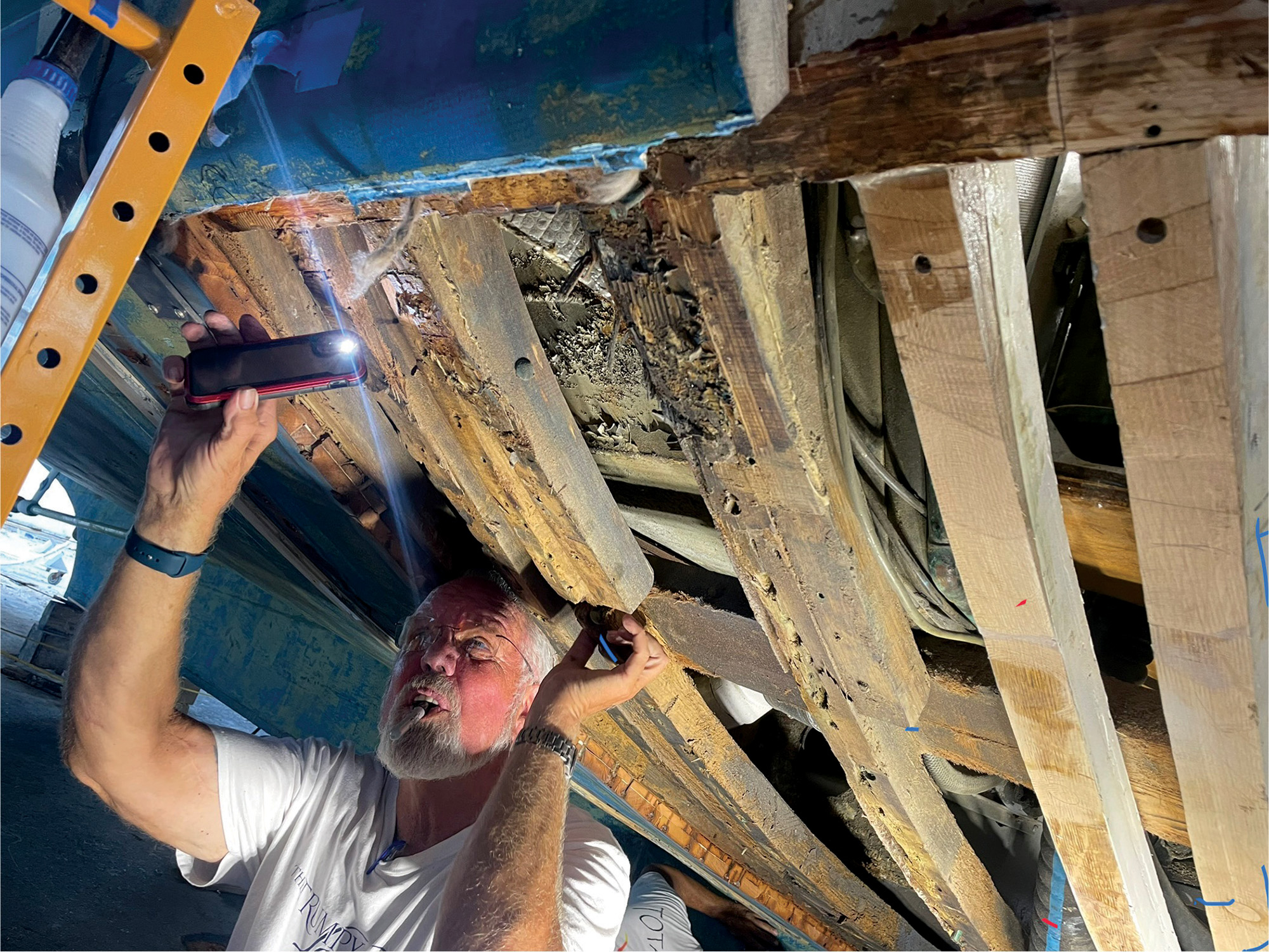
“The problem was people wanted to do the minimum,” he said while we discussed his work on the presidential yacht Honey Fitz. “Just put in a little dutchman,” they’d say, “instead of replacing the plank. My brother was lost at sea on a wooden boat that was poorly repaired.” [Jim was 18 years old and his brother, John, just 12]. “I didn’t want to endanger lives.”
At Cracker Boy, Jim worked on his first Trumpy, replacing a worm-eaten garboard plank on the 46-foot cruiser built in the ‘60s. “I realized how well these boats were constructed, the level of craftsmanship. It pushed me to raise my game, to want to do something better. I decided I wasn’t going to do it if it wasn’t done right. That philosophy changed my whole company.” With that decision, budgets grew from four figures to six or seven for the restoration of classic yachts. This would come to include more than 30 Trumpys at Moores Marine Yacht Centers in Riviera Beach, Florida and Beaufort, North Carolina.
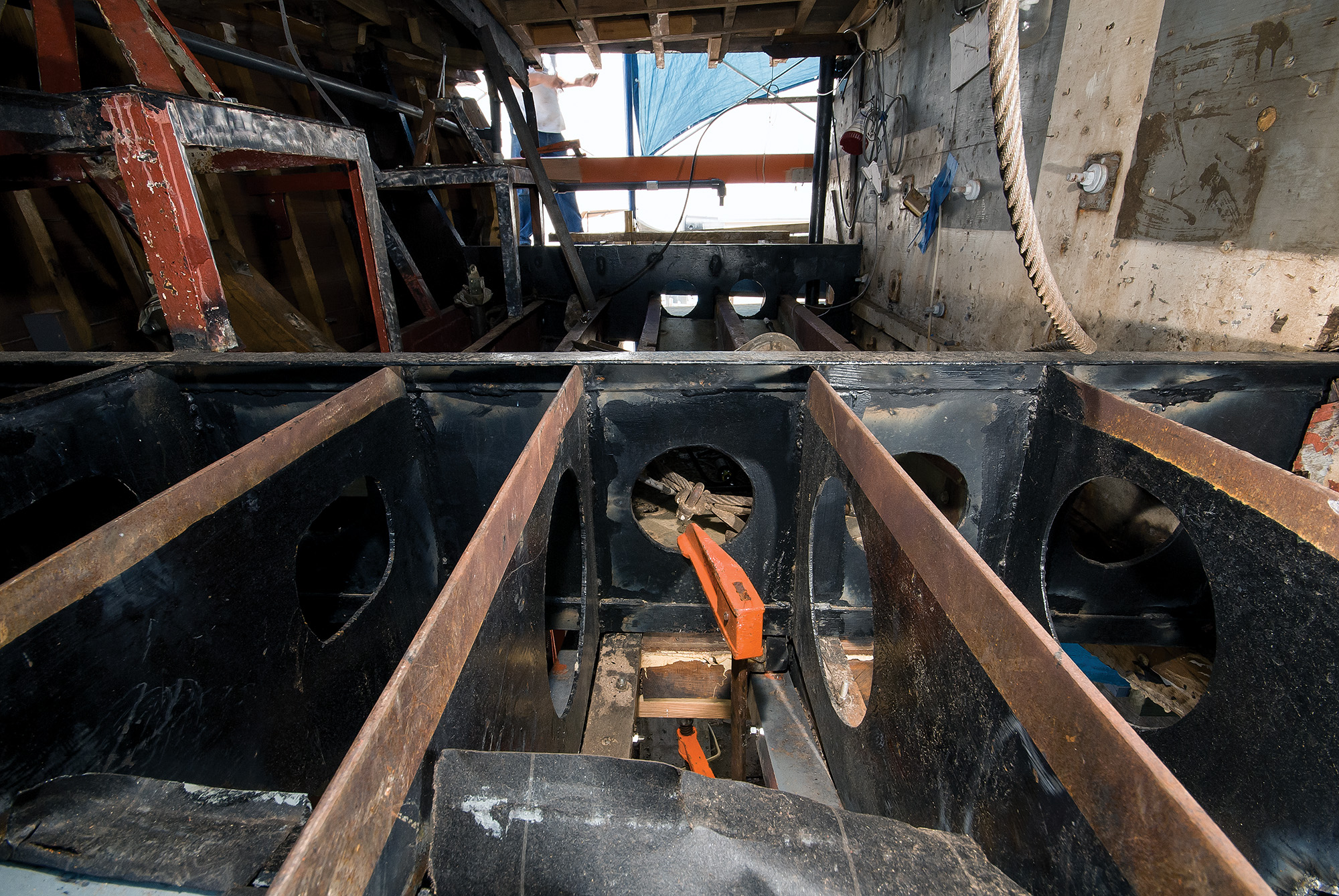
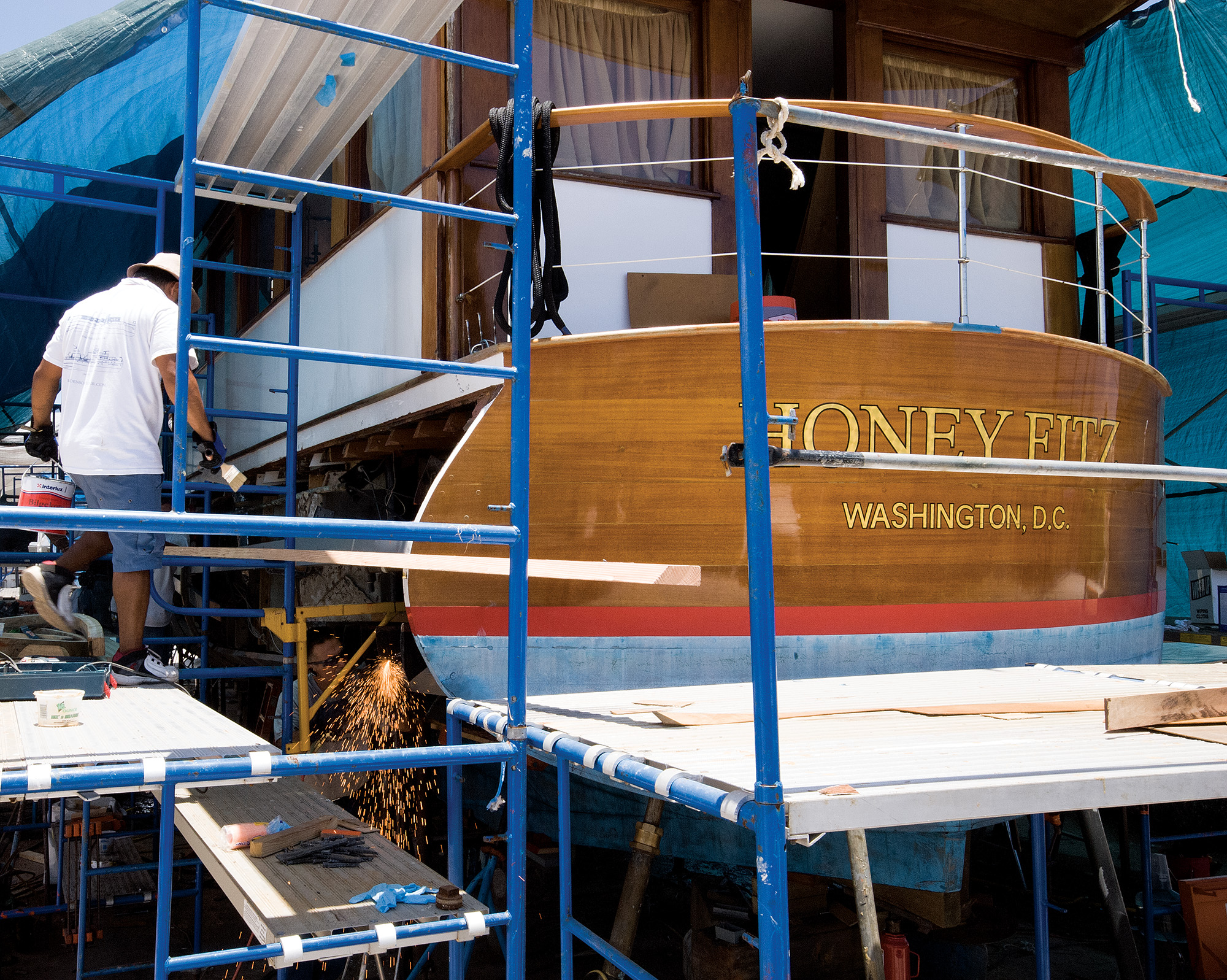
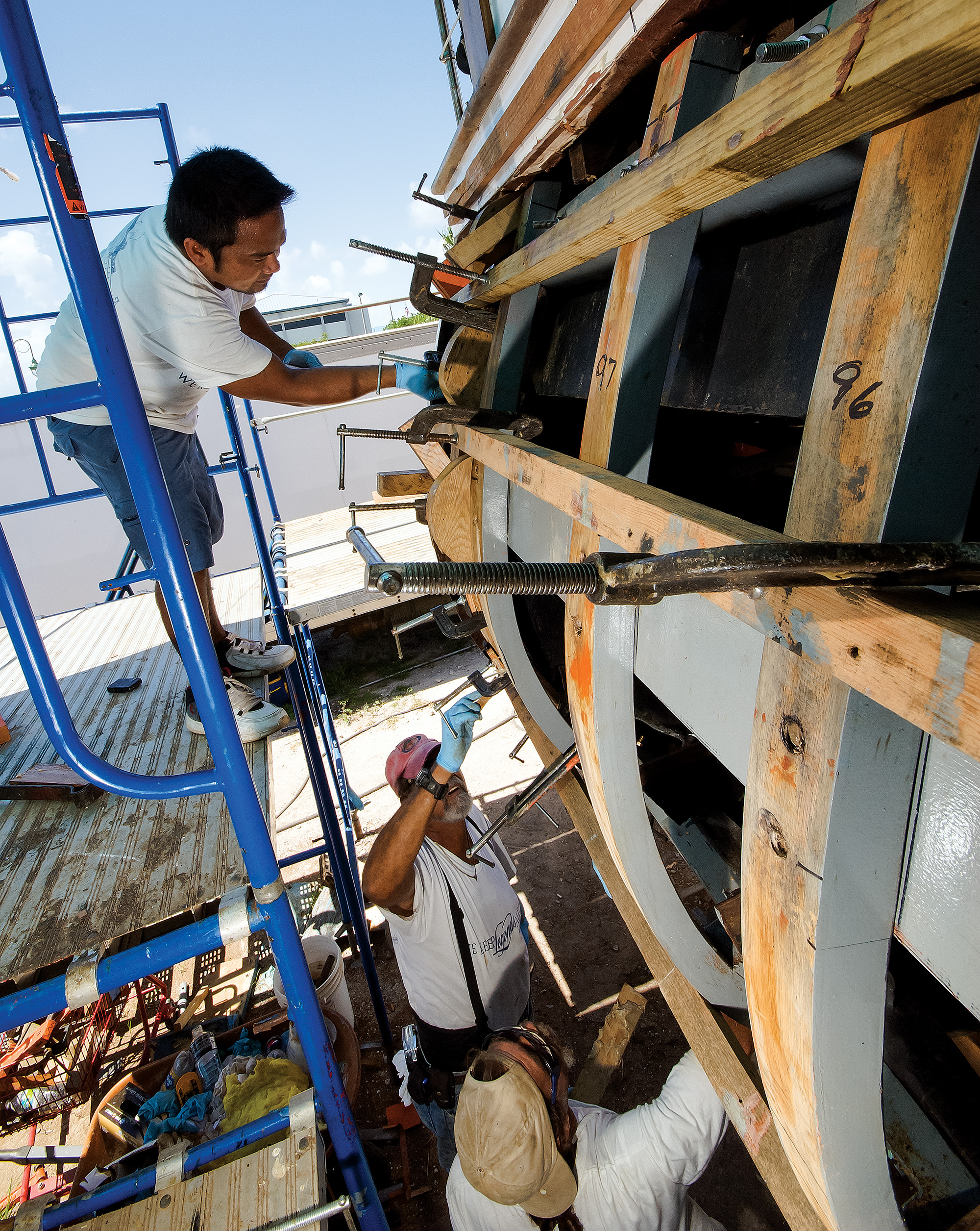
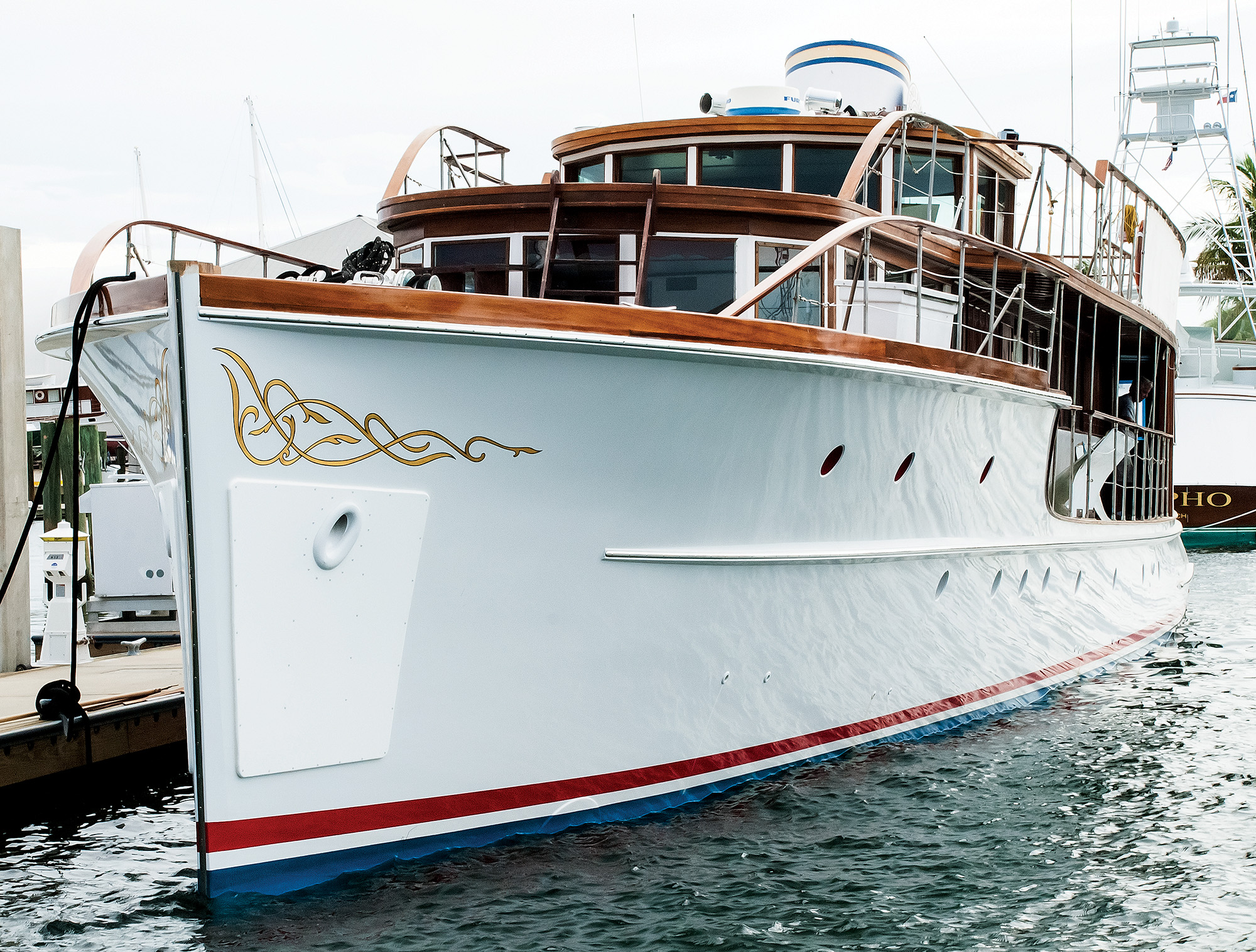
Below: During the Honey Fitz 2010 hull restoration, Moores’ crew replaced much of the wooden hull and repaired original steel framework, which was cutting-edge composite construction when the boat was built in 1932.
Understanding His Vocation
“These boats don’t just sit in front of grand mansions,” Jim told me. “The key to their survival is function. Boats that don’t work, don’t serve a purpose, end up dying by chainsaw. I break up the work so the owners can digest it, and it doesn’t kill the dream.” His crew came to minimize a yacht’s downtime and expense by supporting boats with steel columns and beams to work on large sections of inner framework. “On Honey Fitz, we replaced all her clamps, her ribs, her stem, everything, without disturbing the interior. We shaved 8 months off the construction.”
Jim was known as a hard boss, yet he fostered respect and loyalty. “Jim had an uncanny ability to bring people together and make things work,” said Cory Belschner, who worked for Moores Marine and later became captain and restoration manager aboard two Trumpys, the 1965 67-foot cockpit cruiser K 2, and Innisfail, a 1935 92-foot Mathis-Trumpy. “Very talented people would disappear and show up months later, and Jim would say, ‘I have work for you if you want it.’”
Worthy Yachts
“I only have a certain number of projects in me. I want to do boats that count,” Jim said, regarding his work on the grand yachts of the ‘20s and ‘30s. “Between the wars, the technology that made these boats glide through the water effortlessly was incredibly high tech. From the angle of the propeller shafts, to the position of the weight, to reducing surface drag, naval architecture was 60 percent calculations and 40 percent art. Conversation swirled from one topic to another on blissfully quiet open aft decks. Narrow bows cut through a head sea without rising and falling on each wave. Boats were built to go fast without perceived motion. It took months to do all of the load calculations for these incredibly refined, elegant, efficient designs. I focus my energies on saving the greatest hand-made pieces of art in the United States.”
Honey Fitz had her aft deck enclosed to facilitate charters long after President Kennedy enjoyed time aboard. Under a new owner, and completed in the summer of 2023, Capt. Greg Albritton, First Mate Katelyn Kiefer and Lead Carpenter Brad London enlisted dozens of marine carpenters and tradesmen to return the boat to her Kennedy-era glory, down to the blue upholstery with white piping for replicated furnishings on the now-open aft deck.
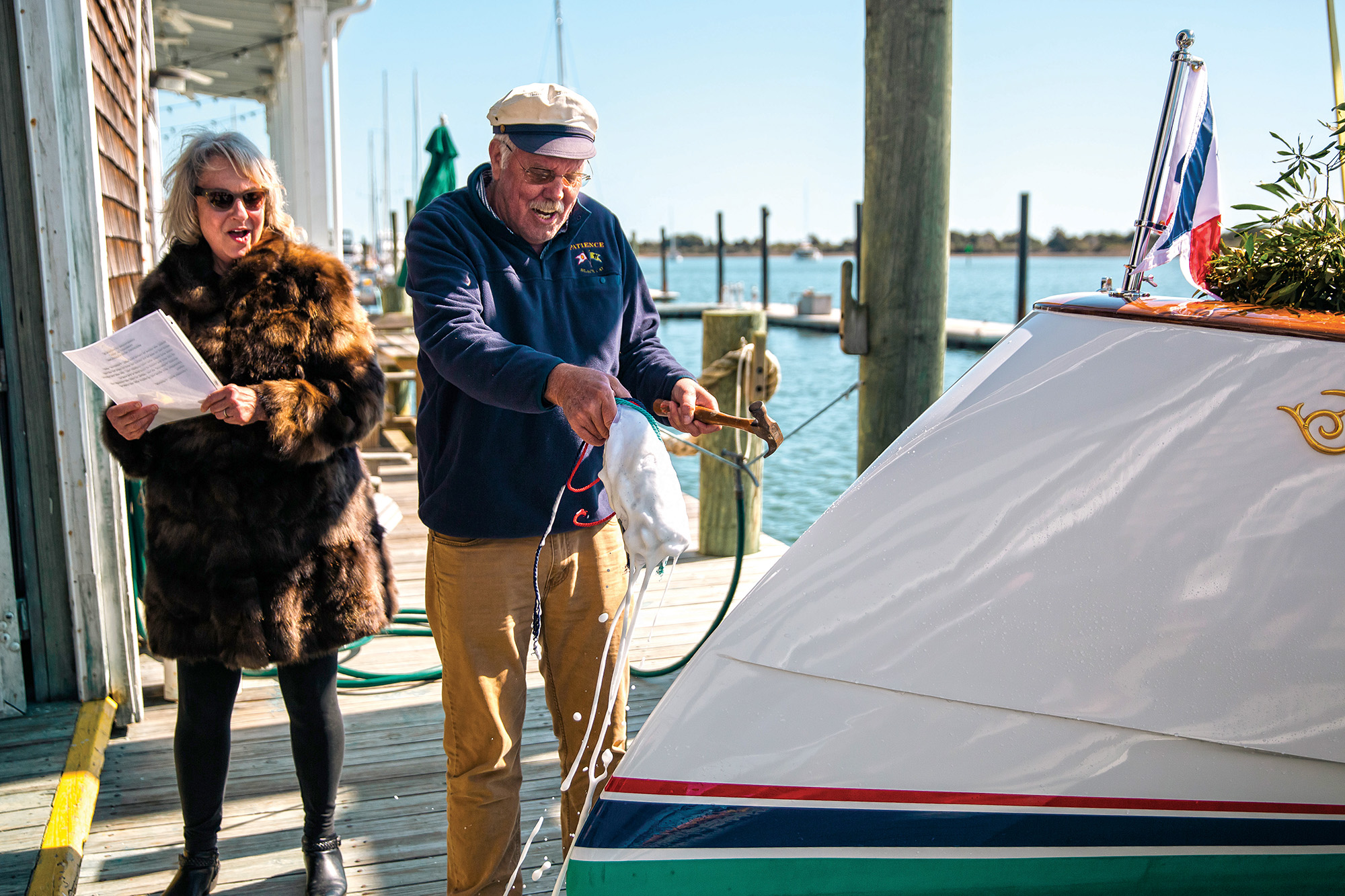
This past July, the boat stopped in Beaufort. “That was the first time Jim was aboard since the restoration was complete,” Kiefer said. “He didn’t rush. As we made our way through the boat, Jim would stop and start a story. We ultimately found ourselves conversing on the aft deck.”
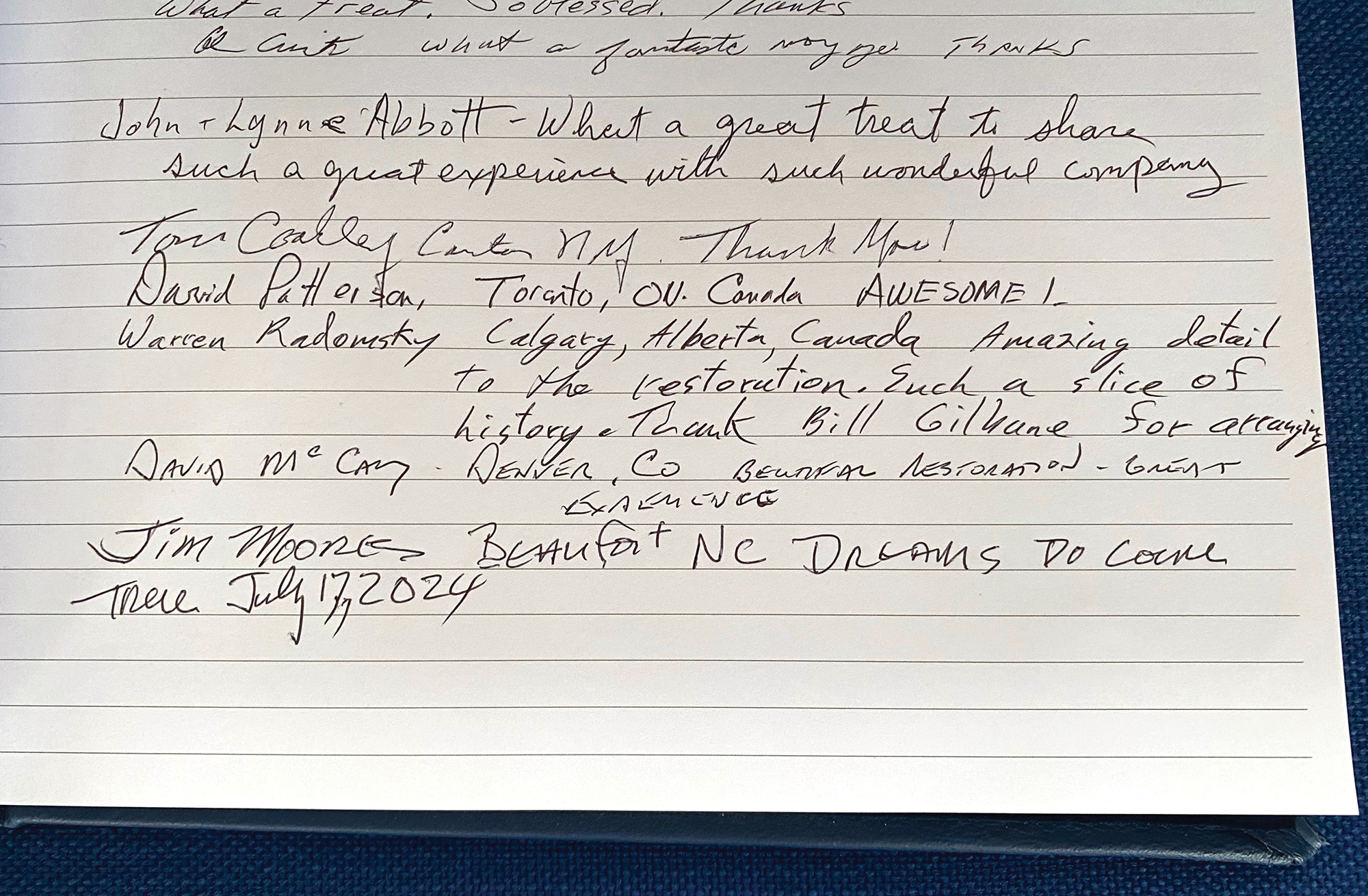
“Dreams do come true,” he added to the yacht’s logbook that day, just a few short months before he passed.
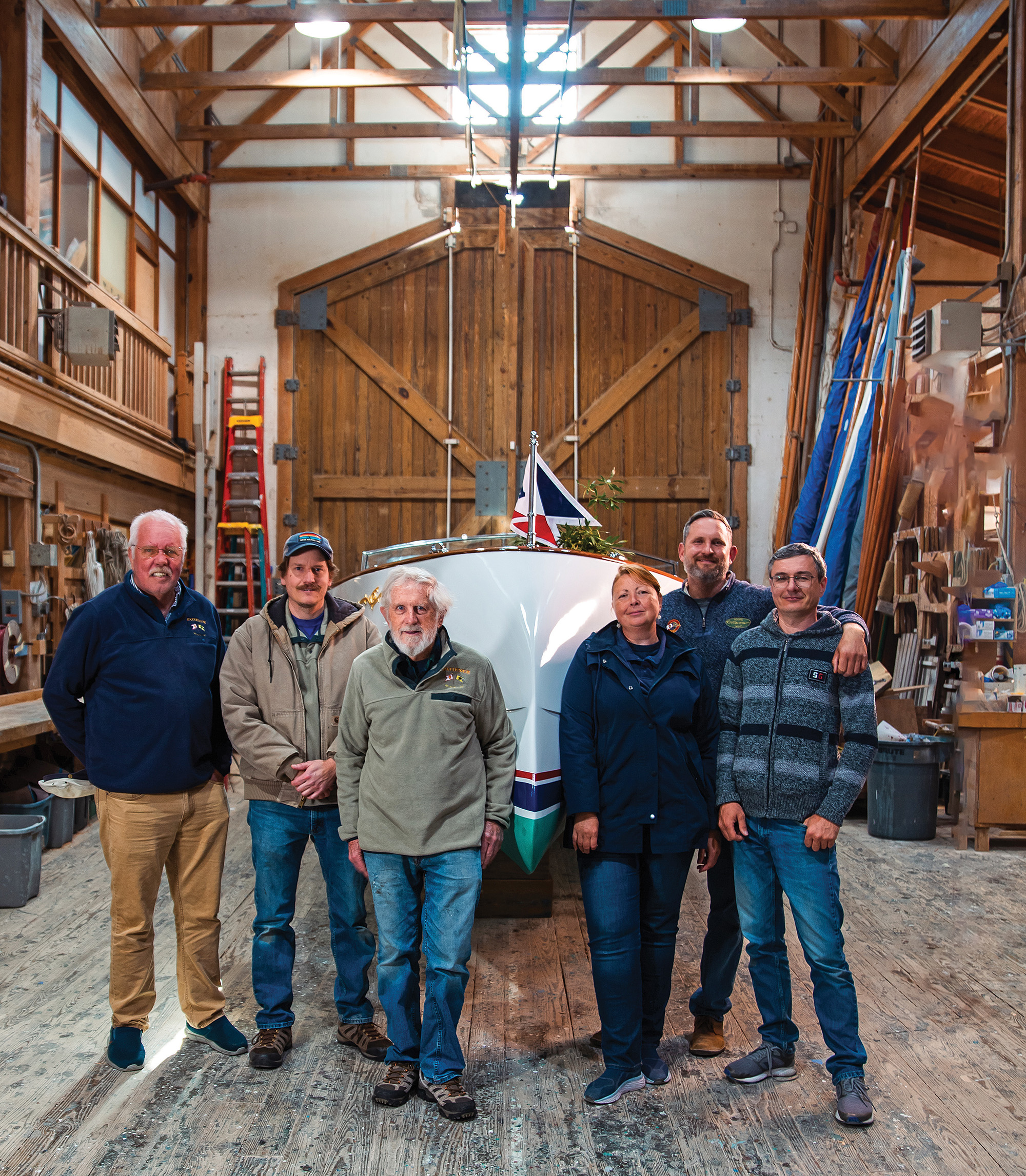
Brad London’s company, Total Refit, restores classic yachts at Cracker Boy, where Jim repaired that first Trumpy four decades ago. “Jim wouldn’t give you the answer,” London said. “He’d tell you a story. His life experiences, his knowledge, all the things he had already seen. He’d give you enough information that you could figure it out—to understand why that was the best way to go. Jim had a unique passion for the old, and for boats. He was immersed in it, and filled with knowledge and experience. He instilled that in me—that it’s more than just a boat.”
Restoring Right
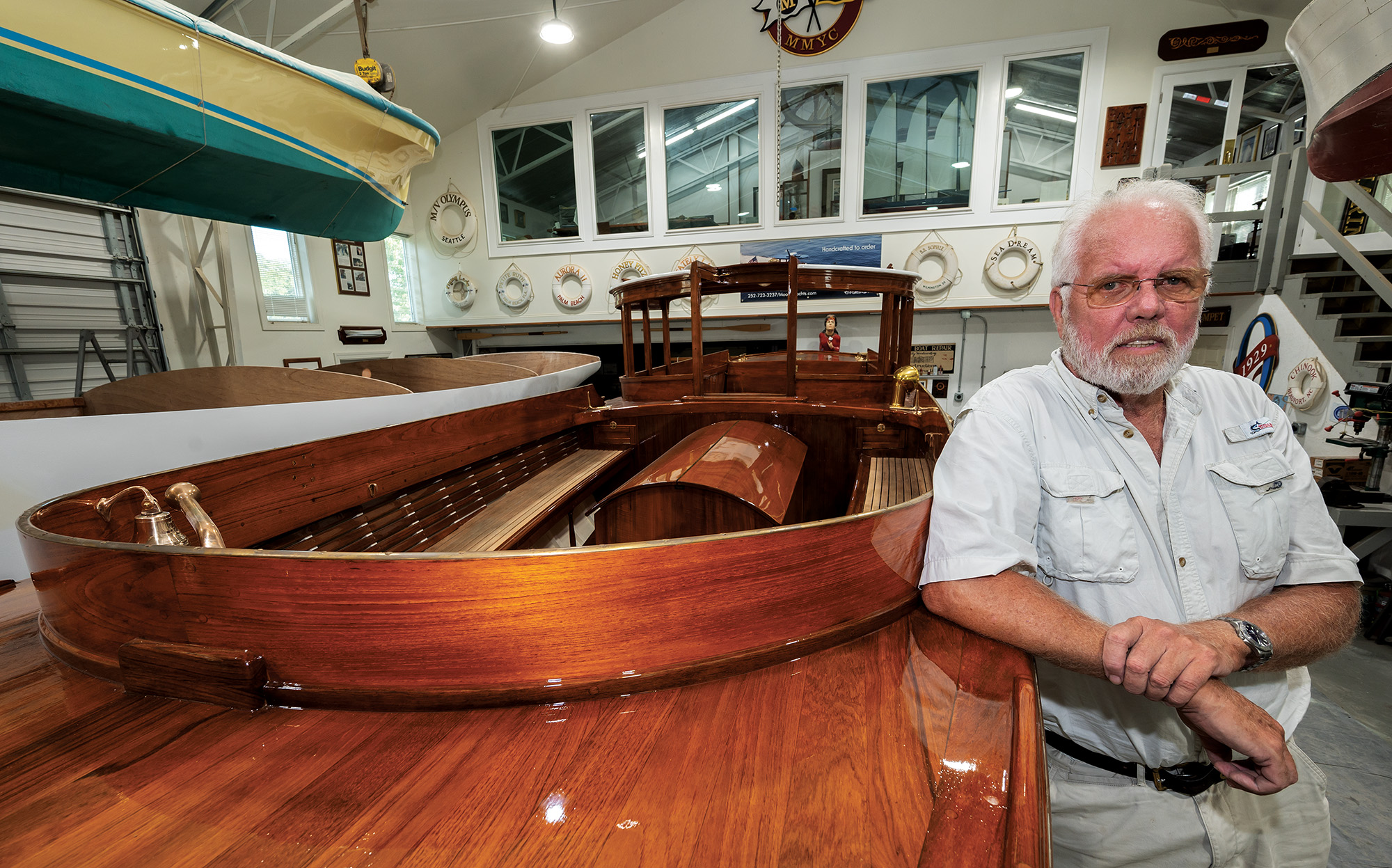
“I could have replanked Corsair,” Jim said. “But I have a 100-year old boat designed by a premier naval architect, Nathaniel Herreshoff, and owned by one of the most famous rich guys in history—J.P. Morgan. How am I going to restore this boat? Just taking new pieces of wood and making a boat look like new—that’s not restoration; that’s boatbuilding. My job is to put the boat back to as original as possible, but also as close to brand new as possible.”
Jim’s devotion to wooden boatbuilding and restoration permeated our discussion. “Every screw is bedded in Dolfinite,” he explained. “Wood and metal heat in the sunlight at a different rate. As the metal cools, it pulls water into the wood. That stains the wood, can corrode the fasteners and deteriorates the wood. I use new products where it makes boating more user friendly. Modern paints last eight years, instead of repainting enamel every season. But sometimes the old products are still best. Dolfinite doesn’t stain varnish and it doesn’t harden over time. Those are the details that help to preserve a boat’s life.”
Full Circle
That drive began long before boatyards in Maine or Florida or Beaufort, back when he swashbuckled in Indiana and sailed from the Caribbean to Canada. “The reason to go boating is the pleasure of being on the water, putting hands on the wheel, waking up aboard the boat,” Jim said.
His last planned restoration, still on the trailer that hauled it from Maine to North Carolina shortly before he passed, began as one of his first. In classic Jim storytelling in that final blog post, what started as a quest to replace caulking irons lost to the tide in 1978 meandered across five decades, bookended by his Nova Scotia scallop schooner. “Up and around a corner I had to stop. Right in front of me was the most beautiful 25-foot boat I’ve ever seen. From the clipped-nose stem to the reverse-tumblehome transom, it had all the appointments of the Bluenose, the most famous fishing schooner ever.”
The Tancook scalloper he fell in love with was built as a “baby Bluenose” in 1940, but she was never rigged to sail. That “little gem of a boat” sat in Jim’s shop in Lubec through the fire and hard times, between excursions to Florida, across two marriages and into a third. Of the long drive, alone, trailering the boat back to Beaufort, he wrote: “I looked back and questioned if I really had the knowledge to do this project right at the age of 22. Probably not. Now, I do. I already came up with her name—Perseverance will do fine.”
Perseverance … a fitting final name for a project touched by a man with no shortage of it himself.
Have a look at the Moores Yachts M30 here ▶