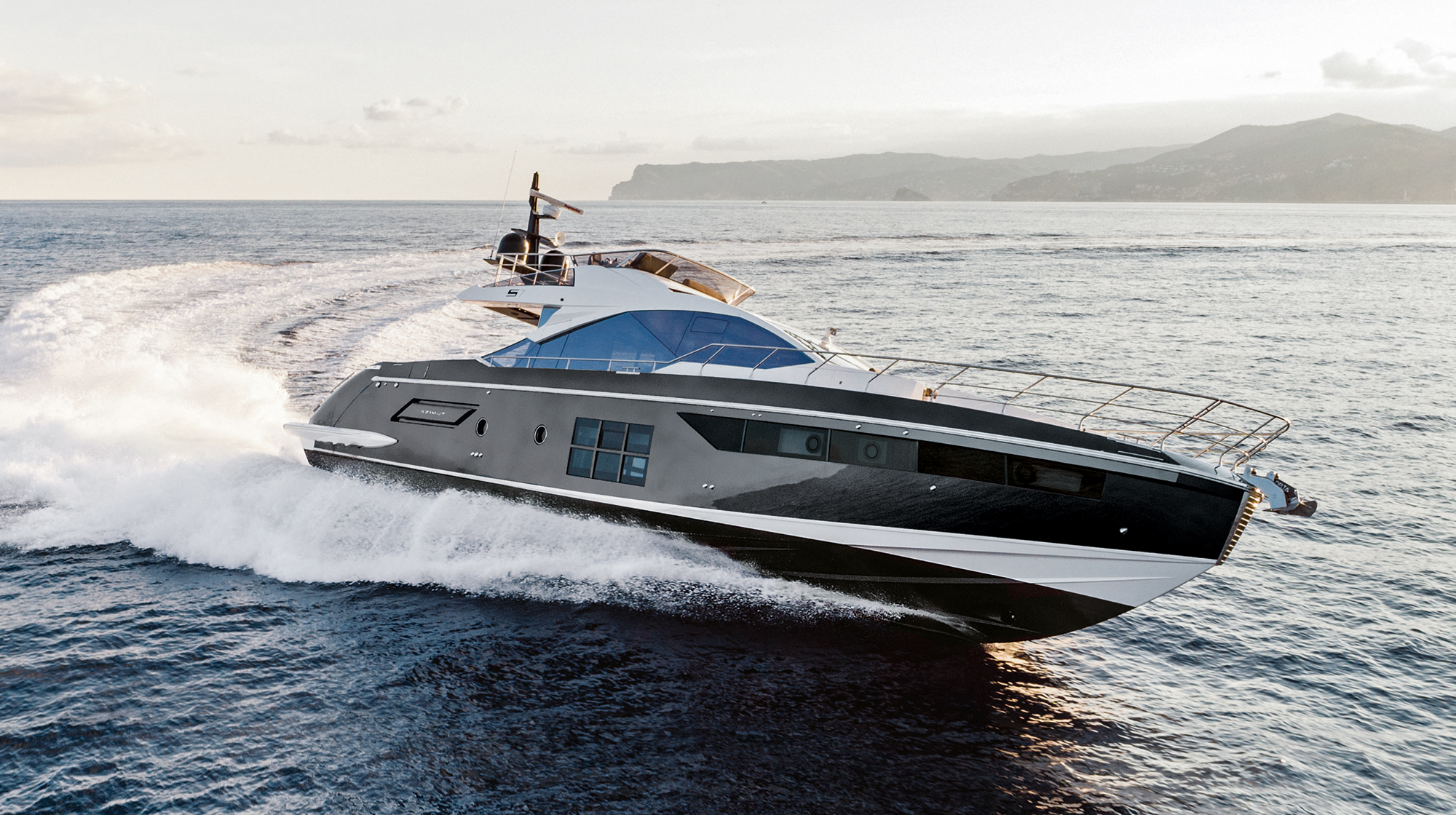
Waiting for the bridge to Hillsboro Inlet off Pompano Beach, Florida, required about ten minutes of jockeying in a determined cross current. There was little wind, but the approach to this bridge is short, and it doesn’t leave a lot of room for error—a situation that could’ve quickly
become “interesting.” I felt the current catch my sleek, lowprofile,
Euro-style test boat, the Newport 71 SS4, and wondered
what would happen next.
Trey Beasley, a principal at Newport’s dealer, American
Global Yacht Group, nonchalantly discussed the matched grain
of this vessel’s standard cherrywood interior (teak is also available
as standard) as he glanced at the Volvo Penta IPS joystick
and engaged not two or three, but four 435-bhp Volvo Penta
IPS 600s and nudged the 71 back on track. He then slid this
massive express cruiser sideways to the current, centering her as
the bridge opened. We motored through the span without a hint
of drift to one side or the other. The virtues of IPS shone
through, reducing what could’ve been a tense moment to a
pleasant discussion about satin- and high-gloss interior veneers.
To further drive home the point, consider that this is a 71-
foot, 74,000-pound boat, which, when turned beam-to, would
just about measure the width of the bridge. I couldn’t wait to get
a hand on her wheel.
The ocean was nearly glass calm as Beasley prepared to show
me the sporty side of this cruiser. I set up my radar gun to shoot
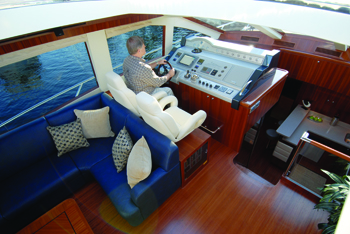
from starboard as he ran the vessel from the twin-seated, portside
helm station, complete with standard Raymarine electronics
package (radar, plotter, autopilot, and VHF), as well as
Volvo Penta’s electronic shifters and the aforementioned joystick.
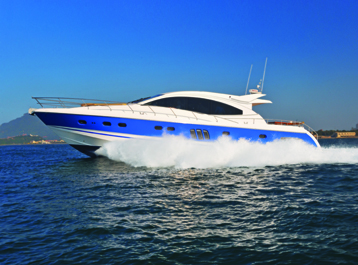
In less than 12 seconds, the 71 was on plane and rapidly
moving to WOT. Bow rise was minimal, and the view out the
three raked, superstructure-spanning windows remained clear.
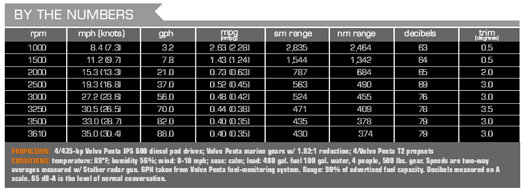
I was recording solid numbers, like a 31-mph cruise speed at
3250 rpm, while the combined fuel burn of all four motors was
a mere 70 gph. At this speed, my test boat could make 417
statute miles based on her standard 1,200-gallon fuel capacity.
She ran silent, too: About the only sound my decibel meter
was picking up was water impacting the hull. At cruise speed, I
got a top reading of 78 dB-A (65 is the level of normal conversation),
but even when the 71 was on her pins at 35 mph (see “By
the Numbers,” for full test data), decibels never rose above 79.
This boat’s smooth-running and quiet.
The smooth-running part is helped by the fact that my test
boat sports an 11-degree transom deadrise with a relatively fine
entry (a nearly flat ocean didn’t hurt). Supporting this design
and adding to the silence is a hull of solid fiberglass below the
waterline, while above it’s vacuum-bagged Divinycell foam
coring, as are the stingers, which are bonded to the hull and encapsulated in layers of cloth and resin. All bulkheads and subfloors
are also cored and vacuum-bagged to help reduce weight
while adding strength. The lack of propshafts and the potential
vibration they would transmit through the hull is another factor
in keeping engine-born noise to a minimum.
In fact, the only real “noise” I heard all day was from the
optional ($79,000) retractable sunroof in the helm area as it
opened and closed. It moved slowly and sounded a bit creaky,
but when open, bathed the helm in light and air. Equally cool
was the fact that the boat was just as quiet underway with the
roof open as she was with it closed.
,
All that light did a lot to open up this already-voluminous
interior. The saloon, which is accessed from the teak cockpit via
a sliding-glass door, has a standard L-shape settee to port that
easily sits six adults and offers the best view of the Toshiba LCD
TV across from it.Worth noting here is that the saloon bar is
just to starboard of the sliding-glass door and protrudes into the
the area; entering from the cockpit requires you to side step it.
Beasley says this will be corrected on future models.
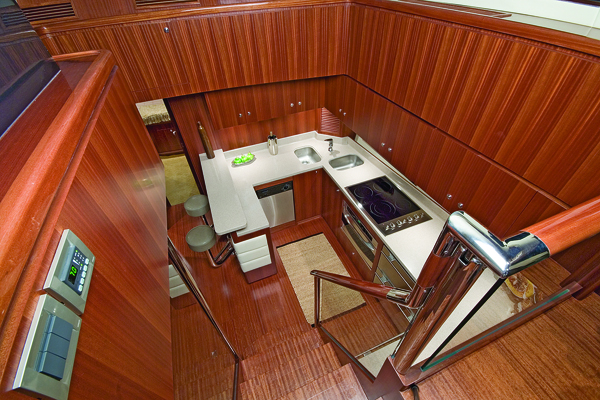
One place with a flawless entry is the galley down, which
benefits from those raked windows 12 feet above its Corian
countertops. The open steps leading down here and the abundance
of ambient light eliminate any cave-like feeling. The
galley is more than a showpiece; it’s totally functional with a complete assortment of GE appliances from the standard
Profile convection oven to the trash compactor. If you’re into
long-range cruising, four drawer-type Sub-Zeros (also standard)
will keep lots of provisions cool, be they fresh or frozen.
As spacious as the saloon and galley are, the 71’s engine room
is elbowroom-challenged. Your initial reaction might be, “Of
course it is, there are four motors in there.” But that isn’t the
reason. In fact, I was impressed that these engines could be positioned
in this space with room to slide in between them. There’s
even blue LED rope lighting around them, which doesn’t add
much in the way of functionality but sure does look nice. The
space issue is actually related to the large and optional ($39,500)
tender garage extending into the area and over the powerplants.
When I stepped into the ER, which is accessed via seven
nearly vertical steps to the port side of the cockpit just aft of the
saloon bulkhead, the initial head room was about 6’3″. But to
get to the motors, I had to crawl on my knees (I’m 5’7″). And
access to the collars and pod drives is better achieved through
the hatch in the aft section of the garage.
Beasley says the garage can accommodate a tender of nearly
11 feet LOA if its nose is slightly deflated. Given that the 71’s
optional hydraulic swim platform ($44,000) spans a majority of
the vessel’s 17’6″ beam, I’d rather add some removable chocks
and mount the tender there, in which case the ER would
become as open as the galley and saloon and much more consistent
with this vessel’s mission of being a spacious express cruiser.
And interestingly, just forward the ER are the crew quarters,
which offer two wide, six-foot-plus-long athwartships bunks,
and an en suite head with shower stall and MSD. This is one of
the largest crew quarters I’ve seen on a vessel of this size.
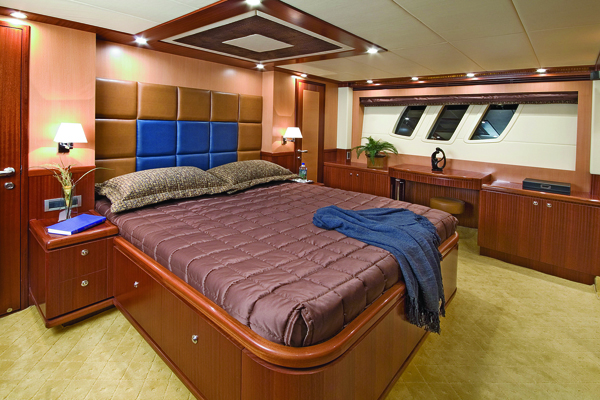
The full-beam master stateroom is also quite large with its
standard king-size berth, walk-in closet, and en suite head. The
forepeak VIP offers guests a queen, and the port guest cabin aft
of it features a double berth.
While a nap in the master seemed tempting, I wanted that
wheel time. After getting it, I can say that the 71 felt just as
seamless under my fingers as she appeared during the speed
runs.With the joystick, I could easily spin her within her length
and slide her sideways with just a finger’s input. When I flattened
the throttles, she smoothly came up on plane, and with
minimal tab (less than half), her trim angle never exceeded 3.5
degrees. She did lean into hardover turns at speed, which
required a little ducking to the see what was to the inboard side,
but nothing too dramatic.
The Taiwan-built Newport 71 SS4 offers a solid turn of
speed, spectacular handling in both close quarters and open
water, spacious accommodations, and a fine fit and finish. Add
in her respectable cruising range and you get a yacht whose
travels should keep your logbook full while adding a library of
on-the-water memories.
Noteworthy:
Easy Docking
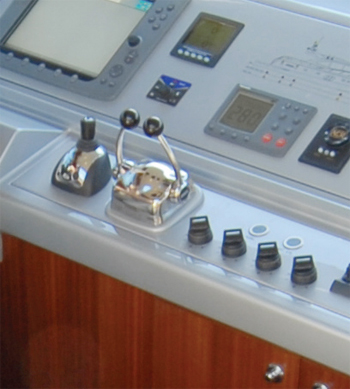
One of the well-documented benefits of
an IPS-equipped boat is maneuverability
in close quarters. With 1500 rpm
available at the helm when the 71’s
joystick is engaged, beating back
currents, sliding in side-to, and backing
in without a piling bump are almost
guaranteed with only minimal practice.
To further ease handling, Newport
offers an optional ($12,000) joystickequipped
cockpit docking station.
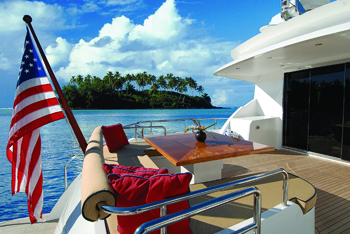
Since you can’t really see beyond the
cockpit table from the port-side helm
area, it’s well worth the money for the
peace of mind it provides. From this
position, you get a clear view of the
vessel’s swim platform and starboard
side. We used this station when
backing the 71 into a skinny slip and
were able to flawlessly creep her past
a broken and submerged piling one
inch at a time. —P.S.
Contact: Newport (954) 767-8305. www.powerandmotoryacht.com/newport/.
The Boat
Standard Equipment
4/435-hp Volvo Penta IPS 600 diesels;
Volvo Penta electronic controls; GE
appliances: microwave/convection oven,
dishwasher, trash compactor, Spacemaker
stacked washer and dryer;
4/Sub-Zero (2/freezer, 2/‘fridge) undercounter
drawer-type units; Raymarine
electronics package w/ 10″ E120
multifunction display, ST7002 autopilot,
VHF; teak decking on cockpit sole and
swim platform; Maxwell windlass; 80-
lb. s/s self-stowing anchor w/ 250-ft.
high-tensile galvanized chain; LED deck
lights; sunlounge pads on foredeck; aft
deck wet bar w/ Gaggeneau grill;
Toshiba LCD TVs in all staterooms;
radar arch; 2/Glendinning Cablemasters
w/ 2/75-ft. 50-amp shore-power cords;
Groco sea strainers; dual chromeplated
horn; 20-kW Northern Lights
genset w/ soundshield; s/s swim ladder;
indirect rope lighting under valances in
saloon, galley, and all staterooms;
Marine Air A/C; Sea-Fire auto. fire
extinguisher system; carpet on soles in
master and guest staterooms;
4/Sealand VacuFlush MSDs
Optional Equipment
Electrically retractable sunroof; hydraulic swim platform w/ tender lift; tender/PWC garage; aft deck engine controls; 5/Aqualuma underwater lights; crew cabin; upgrade saloon sole to cherrywood; Awlcraft colored hull paint; interior fabric upgrade; 2/swing-out bar stools
Specifications
- Optional Power: None
- Water Capacity: 300
- Overall Length: 71’11
- Beam: 17’6″
- Fuel Capacity: 1200
- Year: 2009
- Type: Product+boattest
- Standard Power: 4/435-hp Volvo Penta IPS 600s
The Test
Test Boat Specifications
- Price as Tested: $3,139,895
The Numbers
This article originally appeared in the October 2009 issue of Power & Motoryacht magazine.
The Photos