The 2013 Seattle Boat Show was a transformative experience for Brian Krantz. A towing and salvage captain by trade, Krantz was looking to hang a shingle as a boat broker. He saw some promising models at the show, but it was the event’s sole European offering, the Sargo 28, that really got his attention.
Krantz liked the protected, walkaround decks, enclosed pilothouse and accommodations package on the 28. The boat reminded him of the rugged workboats he ran as a professional captain. A few months later, he inked a deal to become Sargo’s North America dealer. He also founded Inside Passage Yacht Sales in Anacortes, Washington, to handle sales and service.
Until now, Sargo has matched its boats, which run from 28 to 45 feet, with Volvo Penta diesels. The Sargo 31 Outboard is the builder’s first offering with power packages from Yamaha.
“We lost sales by not offering an outboard-powered model,” Krantz says, adding that the Sargo team was cautious about converting to outboard power and did not want to modify the hull. “It took three tries to get the pod correct,” Krantz says of the custom mounts that hold the engines to the swim platform.
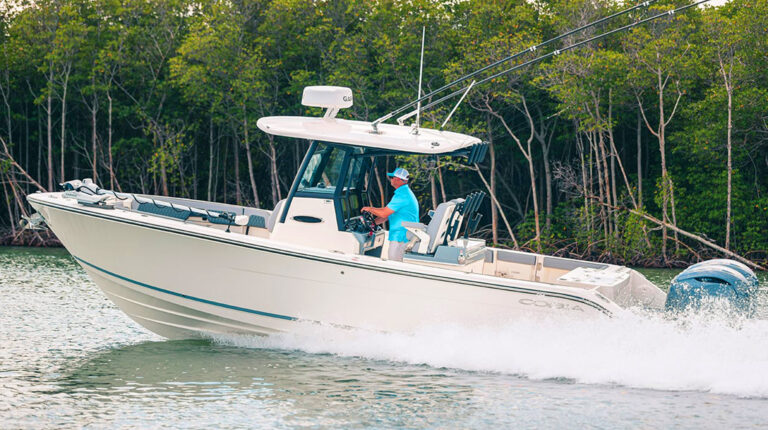
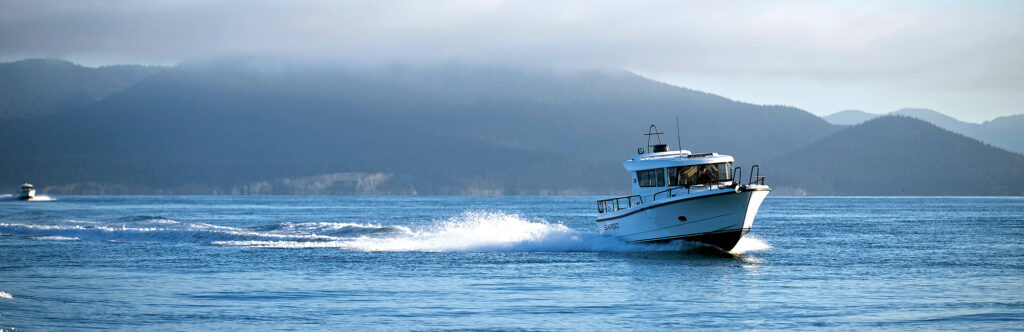
Judging from the 31’s sprightly performance, the outboards are a fine match. Hull one has a pair of 300-horsepower Yamaha F300s that give the boat a 32-knot cruise speed and a top end of 42 knots, according to Krantz. He’s been using the 31 as a commuter to the mainland from Lopez Island in the San Juans. Other engine options include twin 250- or 350-horsepower Yamahas.
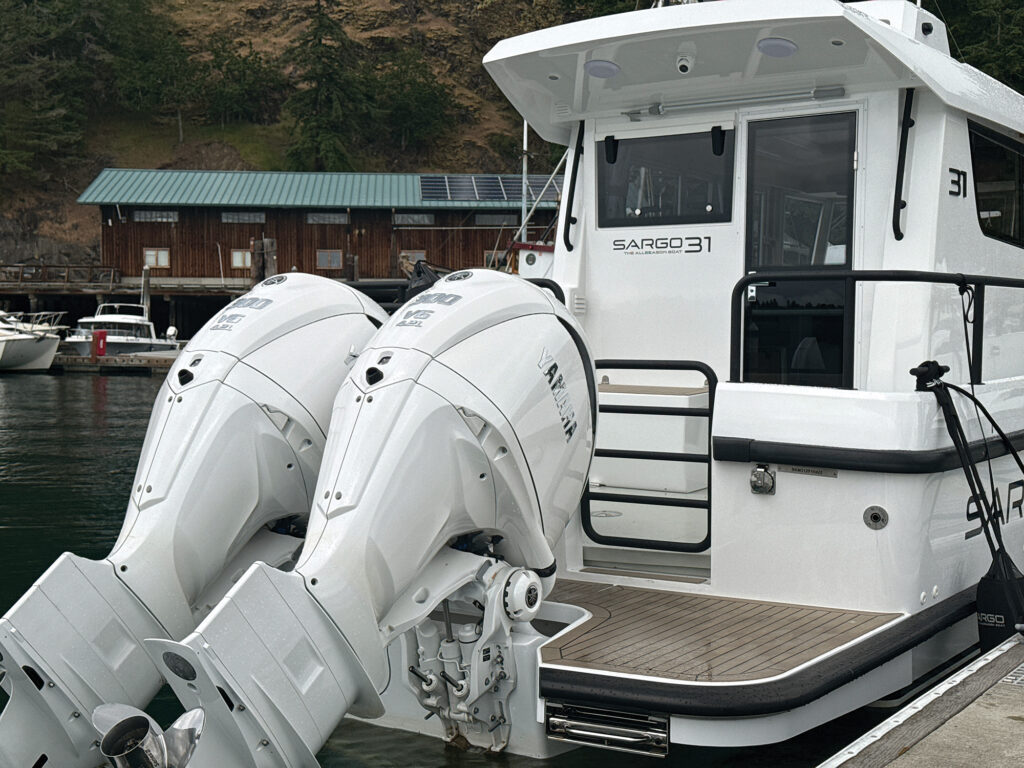
Besides her power package, the 31 Outboard is essentially the same boat as the diesel-powered 31. She shares the rugged profile, deep-V hull, walkaround side decks, reverse-rake windshield, and long, gracefully angled hardtop. That hardtop’s aft end partially shades the cockpit. The boat does, however, gain a roomy lazarette in the space where the Volvo Penta engines would be.
I boarded the 31 on a misty afternoon at the Anacortes Boat and Yacht Show. There was plenty of room on the swim platform to maneuver around the outboards and through the starboard boarding gate into a cockpit, which was ringed with built-in, teak-topped bench seats. All of the seating has stowage for lines and fenders (there is also a fender rack mounted on the transom). The forward bench is insulated, ready to be filled with ice and cold drinks.
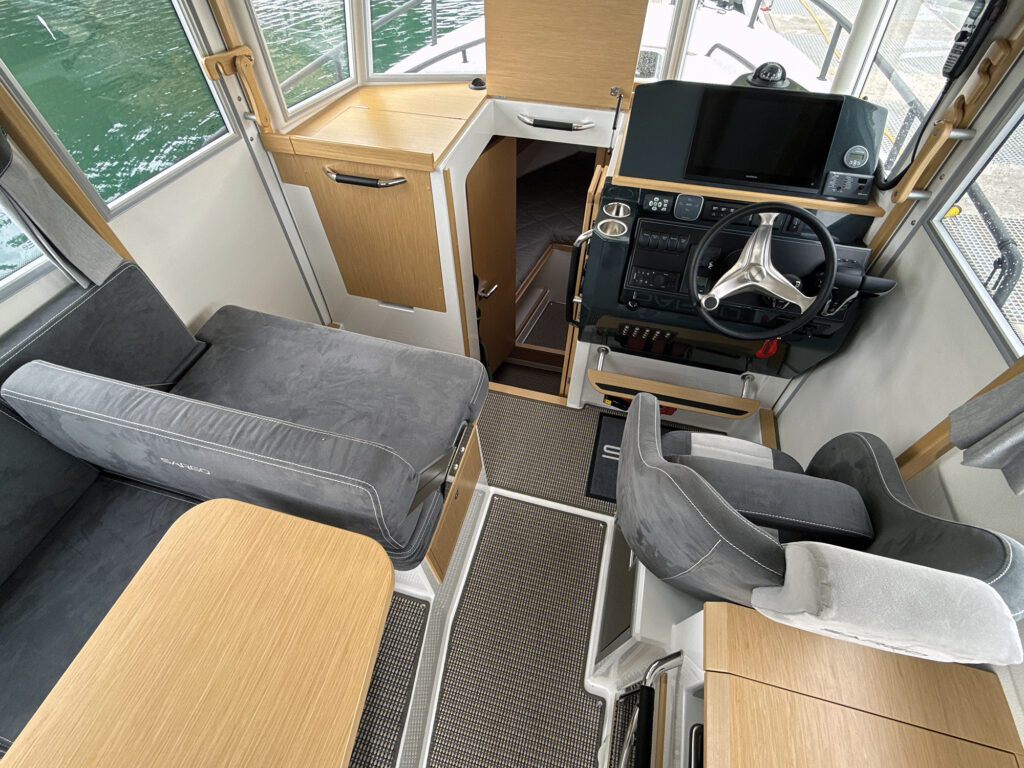
Entering the pilothouse via a glass door, I took a seat at the portside, L-shaped settee, which is raised for excellent views out the side windows. The blonde wood interior (a maintenance-free, manufactured product Sargo calls “Scandinavian teak”) is a nice contrast to the soft goods and the starboard helm’s anthracite gray console. Abaft the helm is the galley with a convection oven, cooktop and fridge that, when not in use, can be covered with a folding wood countertop.
As I looked around the 31’s pilothouse, a theme started to emerge. The centerline companionway that leads belowdecks to the master stateroom and head can be closed off. Likewise, the after section of the settee folds up to reveal a passageway to the second stateroom and its double berth. This transformative ability gives the pilothouse two identities.
In daytime mode, this boat has the attributes of a fleet, four-season coastal cruiser. In warm-weather mode, for extra airflow, I’d open the sliding doors that flank the pilothouse, the manually sliding roof—which is nearly 4 feet wide by 4½ feet long—and the aft-facing window. If it gets too warm, close it all up and use the air conditioning. Conversely, an optional 4-kW diesel heater will keep you cruising in the colder months. When docked for the evening or on the hook, the open companionways to the accommodations connect both spaces.
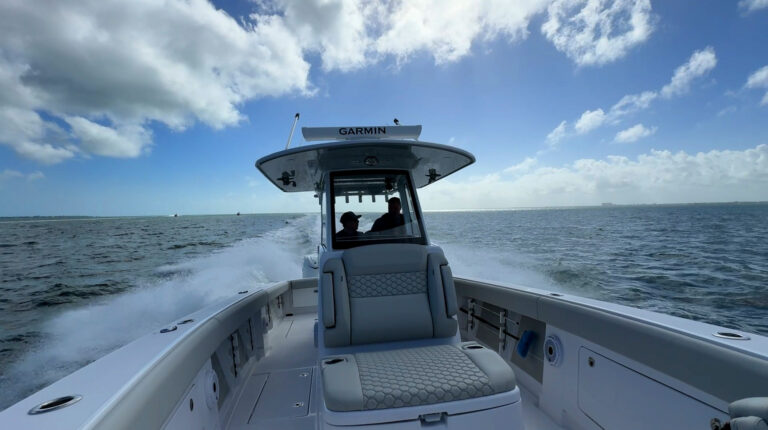
I had unobstructed views from the helm seat via five forward and side windows. With an adjustable chair, tilt wheel, and built-in footrest, I could really dial in standing and seated helm time. After testing a similar setup on Sargo’s flagship 45-footer, I’d add the optional Grammer suspension seating when fitting out my 31. I’d also opt for Yamaha’s Helm Master EX with a joystick and features such as station-keeping and bow thruster control. They’re all valuable tools for short-handing or cruising couples.
Hull one looked sharp with her matte black, bead-blasted, powder-coated stainless-steel rails, an option from the builder’s Explorer models. I also liked the blacked-out Garmin dome and Vision-X light bar on the hardtop. There is space left on the hardtop for Starlink or a factory-installed, 300-watt solar package, also smart options.
Following the 31, the builder introduced a 28 Outboard.
Sargo 31 Outboard Specifications:
LOA: 33’9”
Beam: 10’8”
Draft: 2’6”
Displ.: 11,905 lb.
Fuel: 237 gal.
Water: 31 gal.
Power: 2/300-hp Yamaha F300
This article originally appeared in the December 2025 issue of Power & Motoryacht magazine.