A driveway Seakeeper Ride install on a 1974 Bertram 28 proves that with the right technology, you can teach an old boat new tricks.
You can also find this video–and hundreds of our other videos–here ▶
Sitting at a hole-in-the-wall bar outside Seakeeper’s former Mohnton, Pennsylvania, facility several years ago with then-newly-minted CEO Andrew Semprevivo and Head of Marketing Kelsey Barrett, we glanced through the menu and swapped stories over glasses of tap water. We talked about our own smaller boats—boats that, frankly, weren’t gyro-worthy. Barrett joked that the company didn’t offer anything for her small Whaler. To that, Semprevivo said that one day there would be a Seakeeper for every boat. I laughed. Kelsey laughed. Andrew didn’t.
Looking back at his comment now, I realize what I originally wrote off as the brashness of a new leader was, in fact, a glimpse at the cards he was keeping close to the vest: the Seakeeper 1, which fits aboard boats as small as 23 feet, and the Seakeeper Ride system, which debuted in August 2022.
I vividly remember being invited to test the Ride system before its official debut. Details about what Seakeeper was unveiling were classified at the time and information was scant, but I was told that if I came down to New Jersey for the test, it would be worth my time. Sufficiently intrigued, I braved Jersey traffic and met the team in Atlantic City to run what appeared to be interceptor-style trim tabs.
About a mile offshore in snotty conditions, it became rapidly apparent that the company’s new gamble was coming up aces. Ride made the 3-to-4-foot seas feel like 1-footers. Semprevivo, with the excitement of a kid with a new Christmas present, turned the system on and off to drive home the full effect. It was clear this was no simple trim tab system but a 100-movements-per-second (a speed that’s almost incomprehensible) “Attitude Control System,” as the company calls it.
After hours of testing on multiple vessels, I finally turned to Semprevivo and said, “OK, you win. I get it; leave that thing on.” Semprevivo smiled and turned back to the barn. As with the gyro before it, Ride, I learned, was something that had to be felt to truly be believed.
Ride would explode onto the scene, in part, thanks to several blue-chip boatbuilders adopting it as standard equipment. In the years since my test off Jersey, Ride has been installed on more than 7,000 boats. Within just three short years, Ride was ready to enter a new arena: the used boat market.
When Kelsey Barrett first offered me the opportunity to have Ride professionally installed, I did what I normally do when I’m uncomfortable and laughed off the offer. Professionally persistent, she wanted me to see how easy the installation of the Ride system was. Again, with Seakeeper, she explained, seeing was believing. As impressed as I was with Ride, I often try—and fail—to keep my personal and professional lives separate; I offered excuse after excuse as to why I couldn’t do it.
“I don’t know, the boat’s over 50 years old now.”
“The transom is solid. The age doesn’t bother us.”
“You know, the boat’s electrical system is outdated. It would probably be best to wait until I address that.”
“Not necessary. We’ll find a place to pull power.”
“My electronics are older too. Isn’t that a problem?”
“No. We have a small Garmin here we’ll install that talks to the system.”
“Damn, you’re really not worried? I love this boat, but she’s not a yacht. That system costs nearly what I paid for the boat.”
“We’re not. We’ll install it in a day and come with you for a sea trial when it’s in the water to make sure you’re comfortable with it.”
That was it. Still nervous, I said, “Let’s do it.”
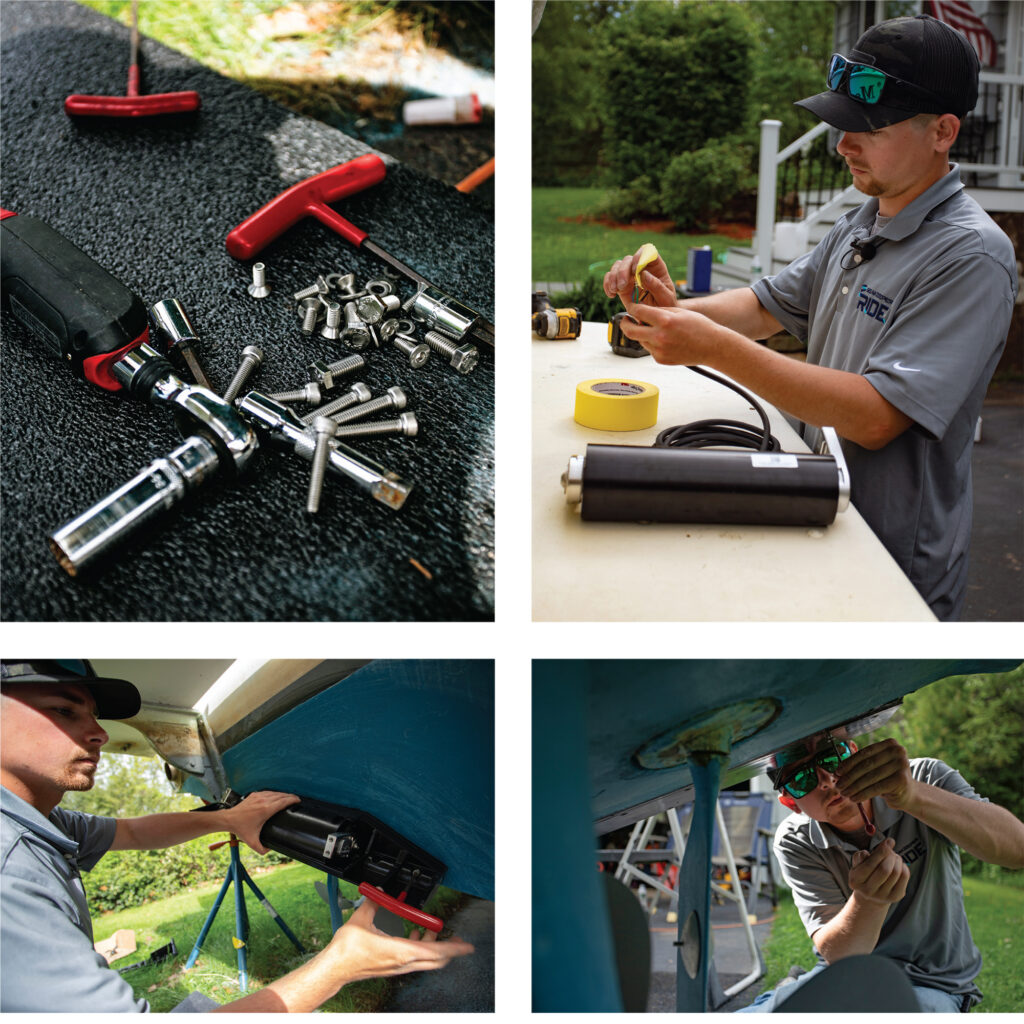
Brandon Mack and George Penna rolled up to my house bright and early on a late spring morning for the install. Compared to the new boat builders they’d been traveling the world to perform installs for, I can’t imagine a trip to my driveway for a 1974 boat was a highlight on their calendar—but they took the project in stride. Making small talk as they readied their tools and unboxed the system, I asked what the oldest boat they’d ever installed a system on was. Penna stopped, thought for a moment, then said, “You know, I guess this one.”
“Oh boy,” I thought.
But with the quiet smoothness of a duo that has worked together for years, they began the install. George started in the flybridge, where he mounted the manual control display, connected it to my Garmin MFD, then connected the system to my batteries, complete with a fuse block.
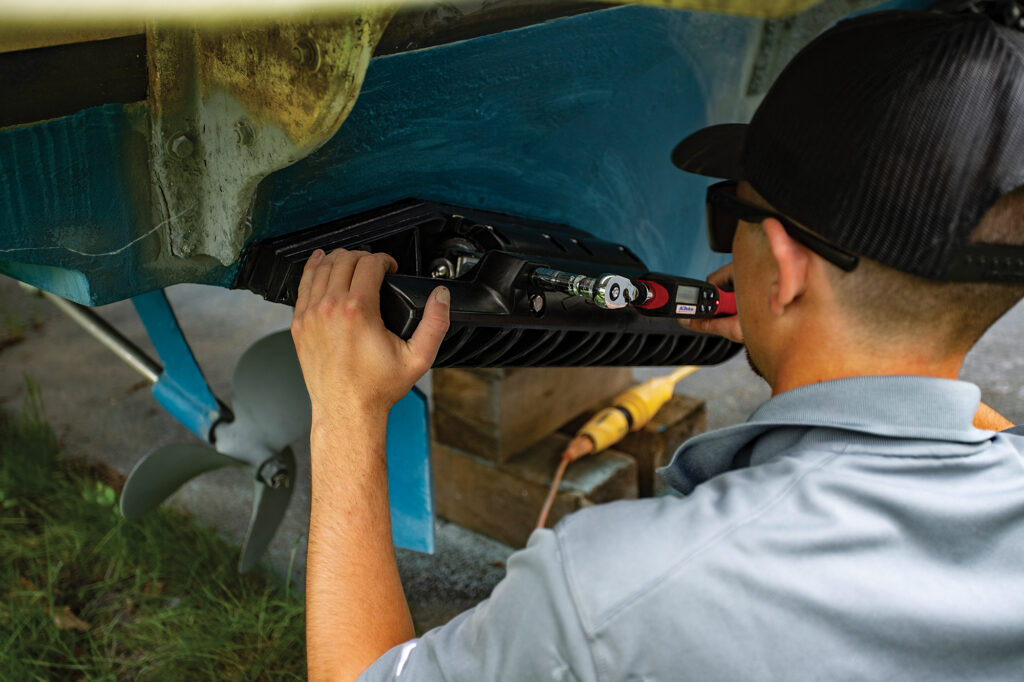
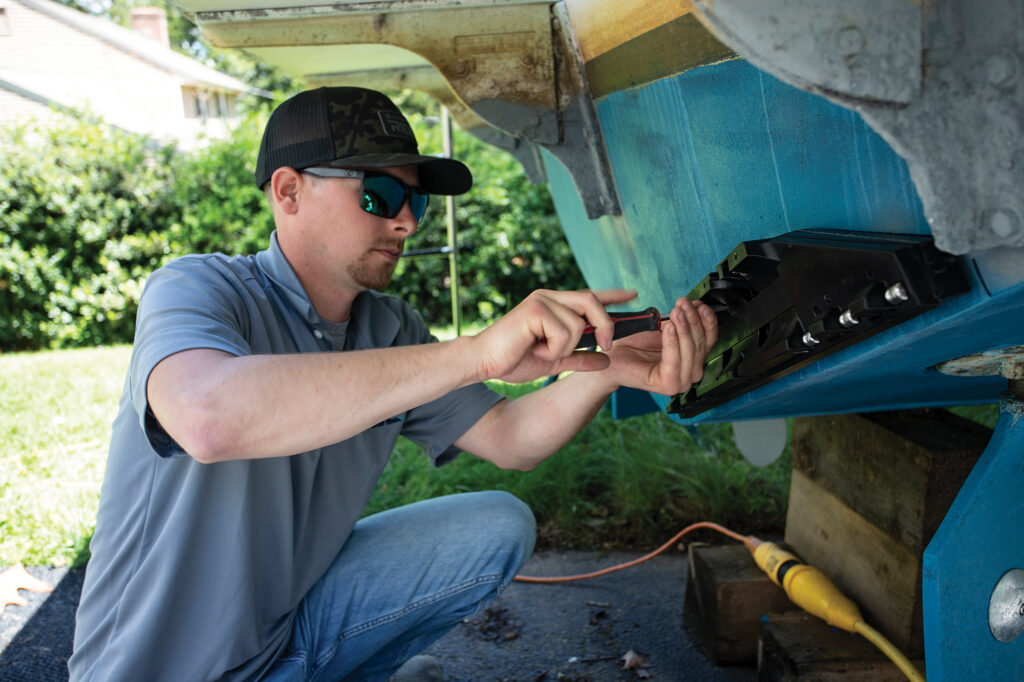
Brandon had the dirtier job of prepping my transom for the actual Ride install. He moved with a quiet confidence as he took measurements of the transom angles so, using included wedges, he could ensure there’d be no drag when the system wasn’t in use.
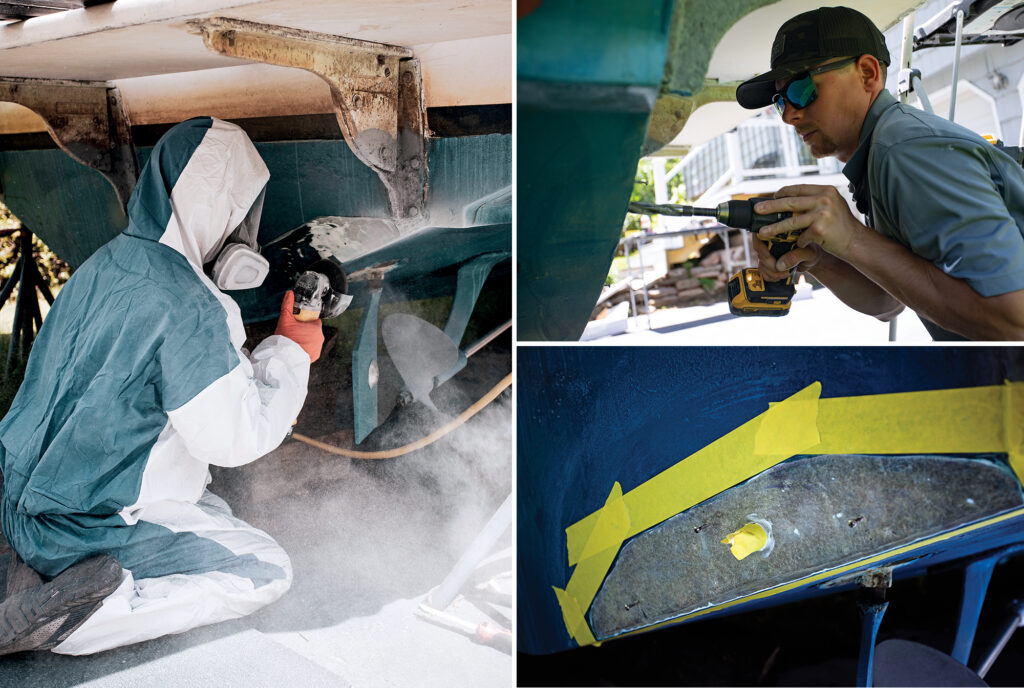
After the dry fitting came the big drill bit and the part I feared most: drilling holes in the transom for the wiring to pass through. The internet loves to talk about how older Bertrams were built “like a tank.” I can tell you from experience—the fiberglass isn’t as thick as you’d think. Still, the holes, hull prep, and gluing—while messy and itchy (Tyvek suits and gloves are not supplies I would skip if you’re thinking of tackling this install solo)—came together seamlessly.
Meeting in the middle, George and Brandon installed a distribution module in the stern of my boat, completing an install that took about seven hours, including a lunch break, me asking 100 questions, and shooting a complete video of every step (found at pmymag.com/ride or on our YouTube channel). Had I not been getting in the way, they estimate the total install time would’ve been about half a day. George says weekend warriors looking to tackle this project themselves should budget for a full weekend of actual work, not including time spent acquainting themselves with the manuals.
After the install, time seemed to slow to a crawl as my launch day loomed weeks away. Like a kid being forced to wait until February to play with his Christmas presents, I was impatient. After a few painfully slow weeks, I was at my summer home on the Connecticut River and rejoined by Brandon and George.
To bring the Ride system to life, all I had to do was push the center button on the manual display.
“That’s it?” I asked.
“That’s it.”
So long in the making, it felt almost anticlimactic—no countdown, no big celebration.
We headed out onto the river on a hot summer morning for two reasons: one was confirming I knew how to use the system (push the button, check); they also wanted to run the system through a protocol that would allow them to collect data for future customers of similar boat types and sizes. I was driving straight ahead on a placid river, and the system began deploying at various intervals for data collection that had my old Bertram rocking hard from side to side. Rolling around while on a mirror-flat surface was truly bizarre—but it displayed just how much control the system had over the boat’s attitude underway. I suppose when it comes to trim and boat control, it really is a game of inches.
The true test was yet to come.
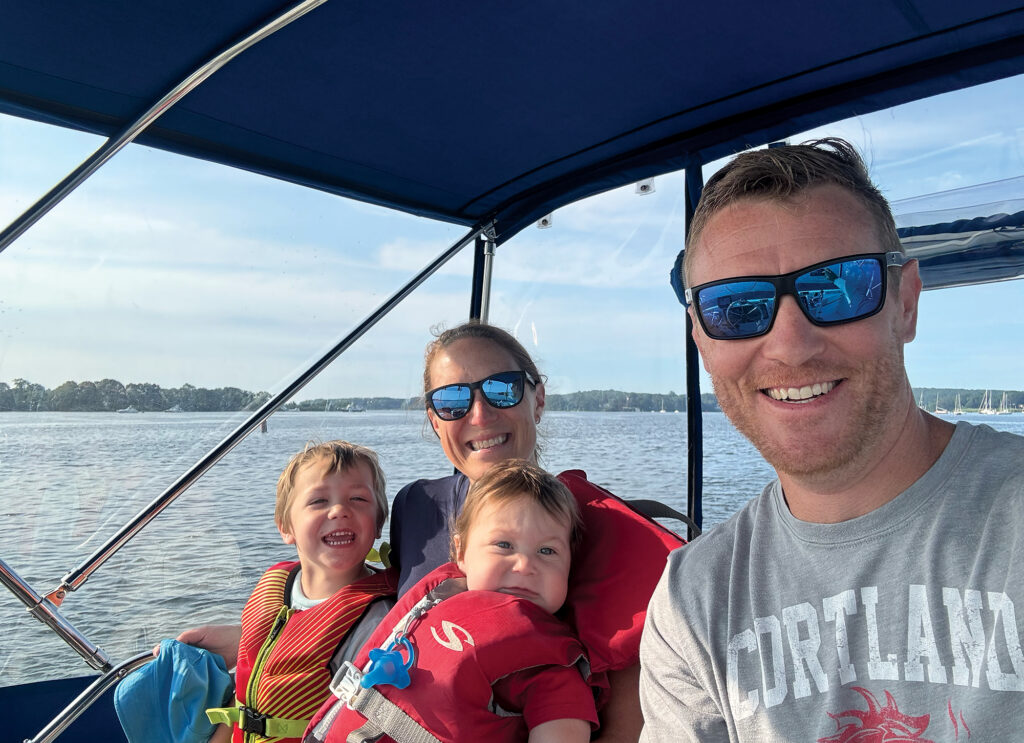
A couple of weeks later, I had the family out for a cruise on a busy summer afternoon. Salty lay down in the cabin, Connor sat in a small folding chair, and Karen held Caleb, who happily smiled at the wind in his face. Looking down on them from the flybridge, I had one of those moments you want to freeze forever—smiling faces and our first boat ride as a family of four (plus Salty). While I would typically shout down “Hold on!” when cutting through a boat wake, I instead pressed the middle button, and Ride took the bite out of every wake on the stirred-up river. When I turned for home, Connor sighed and said, “Ohhhhh, I don’t want to turn around.” He took the words right out of my mouth.
For me, boating is all about family. It’s about bringing Karen and the boys to places I first discovered as a boat kid. I’ve heard so many horror stories over the years about wives and kids who no longer want to spend time on the boat because of seasickness or rough seas that scared them.
Seakeeper Ride comes at a cost—my system retails for $14,000 with professional installation, which, again, isn’t far off from what the boat itself cost me. The question I get a lot since becoming a Ride customer is: Is it really worth it? A calmer and safer ride that keeps the smiles on my family’s faces and makes them want to keep cruising? Oh yeah—it’s more than worth it.
To me, the Ride system—like boating itself—has been priceless.
See our test of the Seakeeper Ride here >>
This article originally appeared in the November 2025 issue of Power & Motoryacht magazine.