A quarter century. Half my life at this point. I’m talking about September 11. Where were you? I was designing a motoryacht for Ted Hood that morning.
Everyone over the age of 35 remembers that Tuesday. Our young and fearless editor Dan probably does not, so here’s the boat-guy version of the story for him. Fear not, Dan. This is also a yacht-design tale. One of those inside angles.
Ted Hood was such a household name in the sailing world in the 20th century that plenty of powerboat people know who he was in the early 21st. He founded Hood Sails in Marblehead, Massachusetts in the early 1950s. In 1959 he founded Little Harbor Yachts, which would go on to build those cool waterjet-powered Down Easts before the Hinckley Picnic Boat was born. In ‘74 he won the America’s Cup. He sold Little Harbor to Hinckley Yachts in 1999. This is where I come in.
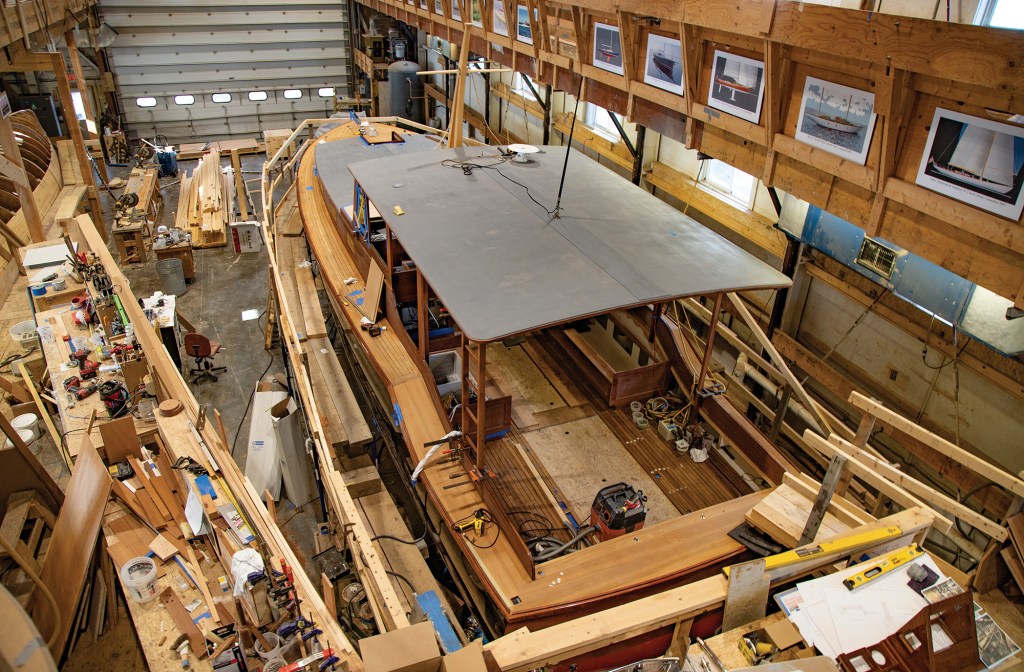
Hinckley bought the Ted Hood Design Group as part of the deal. Primarily involved in engineering custom sailing yachts from 80 to 150 feet, the Design Group needed a “powerboat guy” on staff to bolster its presence as the sailing market kept shrinking. So they poached me from Michael Peters’ office.
I worked on my share of 100-foot sailing yachts for sure, but any time a new powerboat project came along I was the guy. Ted Hood himself was retired but maintained an office on the second floor of the Portsmouth, Rhode Island yacht yard. He had been collaborating with Selene at the time and was in the middle of creating the Selene 53. So on the morning of September 11th, I was at my desk interpreting Ted’s scribbles on a large printout.
Ted Hood was 75 at the time and he wasn’t a computer guy. Our iterative design process went something like this: Create a profile or arrangement plan or whatever in CAD, print it on 24-inch x 36-inch paper, roll it up, and walk it down the hall to Ted’s private office.
Minutes or weeks later Ted would appear with that slightly crinkly rolled-up drawing, improved by his red Bic pen. He’d raise the height of a dinette table an inch and a half by way of scribbly note. (His penmanship could go toe-to-toe with the best doctor’s handwriting. I once asked him to write me a script for Hydrocodone.) But then he’d wave both hands in front of him and decide to lower that same dinette table three quarters of an inch. Thus appeared Wite-Out. After a long day of back and forth that drawing was nearly impossible to roll up due to the many layers of Wite-Out, sometimes approaching the thickness of spackle. Eventually, perfection was achieved as Ted saw it. I’m still a little high from the fumes.
While we were perfecting that dinette table we had no way of knowing the magnitude of the crimes happening on a flight path 35 miles away.
Around 9:15 the late Gerry DiSchino, who would go on to become President of Hinckley Yachts before his untimely death, came into the design office and said a plane had “crashed into” the World Trade Center. Gerry wheeled a TV cart into the middle of the second-floor lobby for all of us to view. By that time we watched in horror as both towers were ablaze. Another guy named Ted (no relation to Mr. Hood) who was the day-to-day manager of the design group said, “we’re at war.”
I went home to my wife that evening and invited a co-worker in the design office to our house. I had just bought said house, which was built in 1932, from the original owners. I remarked to my co-worker over a stiff drink that people a lot like us were likely sitting in front of the same fireplace on the evening of December 7th or 8th, 1941, having similar conversations and concerns.
The design tasks went on as normal on Wednesday morning. More Wite-Out. I think we lowered that forking dinette table an eighth of an inch. Odds are zero that the Taiwan-built POS table was installed with the slightest reference to that drawing. On September 12th I can’t say that I cared.
This article originally appeared in the August/September 2026 issue of Power & Motoryacht magazine.