
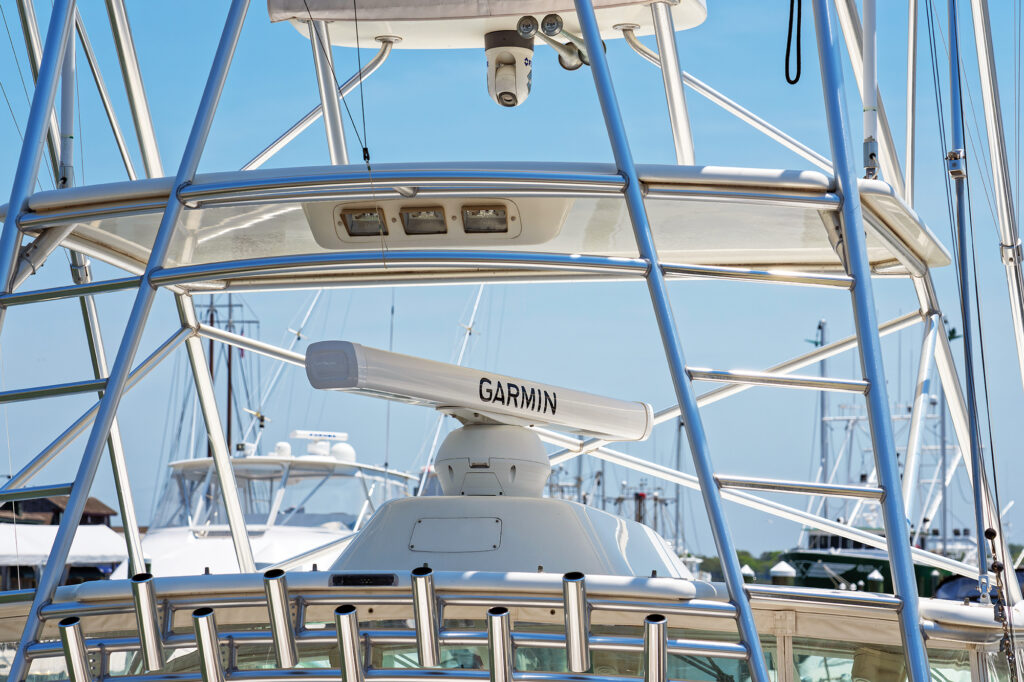
Lots of things can ruin a day on the water, but maybe none so thoroughly as being run down by another vessel. Collisions can happen on a sunny day with unlimited visibility—they’re usually caused by poor seamanship, inattention, or just stupidity on the part of one or both crews. There’s nothing you can do about someone else’s stupidity. But you have a much better chance of being T-boned when visibility is compromised—at night, in fog or heavy rain, when sometimes the helmsman literally cannot see past the bow of his boat. In those conditions, radar is your best friend: You can see trouble coming before it arrives. If you don’t have radar already, get it; you’ll thank me someday when it helps you get home safely.
Radar isn’t always the answer, though; you still need good seamanship. In July, 1956, the Stockholm rammed the Andrea Doria in dense fog south of Nantucket when each liner had the other one on its radar. The crews on both bridges made errors, maneuvering the ships together rather than apart. The Stockholm limped into New York Harbor; the Andrea Doria is on the bottom of the ocean. Forty-six people were killed. In poor visibility, be prudent, slow down, stop if you’re in doubt. Practice good seamanship.
Most fiberglass and wooden yachts produce weak radar echoes, especially at long distance: Radar signals pass through the glass structure and bounce off metal components—engines, metal fuel tanks, deck hardware, aluminum masts of sailboats, etc. Signals that reflect off those irregularly shaped items are sent caroming into space and not back toward the radar that transmitted them. Thus, the radar return, or “blip,” that appears on the transmitting vessel’s screen can be barely discernible even though the target is well within range. This is especially hazardous in areas with lots of commercial traffic: Ship’s officers pay attention to other vessels with strong radar returns, and can easily miss a weak blip. Radars with ARPA (Automatic Radar Plotting Aid) can’t lock into a weak signal, and will neither plot your boat’s course on another vessel’s radar, nor warn if a collision is threatening. When the fog is thick or the night is dark, this is not the situation you want. Do something about this now, before you’re drifting blind in a pea-souper with the rumble of big engines all around.
Invisible-Boat Syndrome
The best cure for invisible-boat syndrome is to buy an aluminum or steel boat, but if that’s too radical for you, there are other options. First, add AIS (Automatic Identification System) to your electronics package so you show up on the nav screens of AIS-equipped vessels—and they appear on your screen, too. If you don’t have AIS, you can use a smartphone app to see other boats around you, but it’s not the best way because that app does nothing to make you visible on AIS plotters. Invest in proper AIS, like the big kids do. A class B AIS transceiver that’s fine for most yachts will cost about $1,500, plus installation. The class A transceivers required on commercial vessels, and carried by most oceangoing yachts, cost more, but have more powerful transmitters, longer range, and more sophisticated features than class B systems. For most of us, class B is all we need.
AIS is cool, but not everyone wants to drop a couple grand on another piece of electronics. A less-expensive option is to invest in a radar reflector that’ll focus return signals back toward the transmitting radars, and the resultant blips on those radar displays will be strong enough that someone on watch on the other vessels will take notice—you hope. While researching this column, I read several test reports and very detailed scientific analyses of the performance of different radar reflectors. Most of them were less than impressive in their performance, making me think that AIS is really the way to go if you have the cash. The reflectors mentioned below were the best ones all-around based on my research, but none of them is a magic bullet when it comes to alerting other vessels to your presence via radar.
The U.S. has no requirement for yachts to carry radar reflectors, although many other countries do, especially aboard vessels built of non-metallic materials. SOLAS (Safety of Life at Sea) regulations require all vessels under 150 gross tons, “if practicable,” to carry a reflector for detection by radars operating in both the X-band (9 GHz) and S-band (3 GHz) frequencies. (Most vessels operating near-shore use X-band radar because of its higher target resolution; S-band is used mostly at sea.) Given their low cost and ease of use, why not carry a radar reflector, whether required or not? Most experienced skippers have one aboard, even if it’s not permanently rigged.
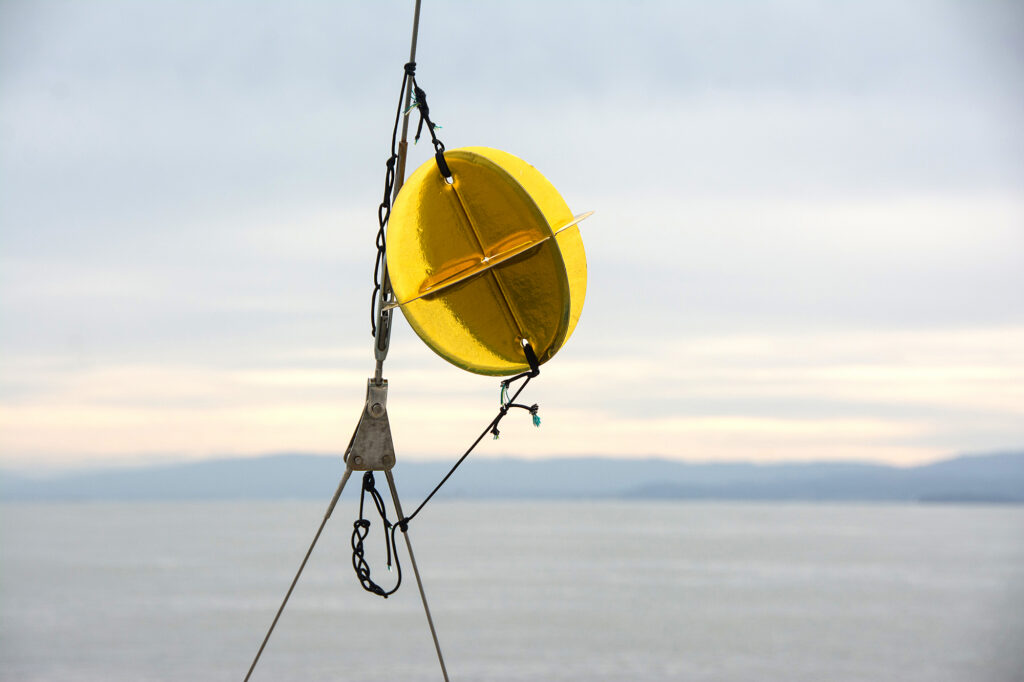
Radar reflectors come in passive and active models. The Davis Echomaster (about $130), for example, is an effective passive reflector; it consists of three metallic discs that slide together to create a skeletal metal sphere. It’s a design that’s been around for decades. If your boat has a mast, the reflector can be hung from a flag halyard when needed—that’s how sailboats usually do it. But it’s better to mount the reflector permanently. Davis makes a surface-mount system, which can be bolted to a flat surface or clamped to a rail. The highly rated but more expensive Echomax reflectors from the U.K. have both deck- and mast-mount brackets (prices vary widely; figure about $295 and up, depending on model).
If you have a friend in the U.S. Navy, you might ask him to get you a TriLens radar reflector, which uses a different technology than the common octahedral reflectors like the Davis, and outperforms them at every level. The Navy mounts a TriLens on each of its Trident submarines, to make them immediately visible on radar when surfacing. A large-size TriLens is heavier than most reflectors, weighing about 12 pounds—not an issue when permanently mounted aboard a larger yacht. They maintain effectiveness when the boat heels, unlike octahedral reflectors—even small angles of heel degrade octahedral performance. This is a concern to sailors and also to skippers of displacement-hulled cruisers that tend to roll in certain sea conditions. TriLens manufacturer, Rozendal Associates, in Santee, California, doesn’t sell to the general recreational market, so if you want one, you’ll have to hunt around. Or maybe the skipper of a Trident submarine will sell you his spare.
Once mounted, a passive reflector requires no attention: It needs no maintenance, requires no power, and works when you’re underway and at anchor. An active reflector, or Radar Target Enhancer (RTE), on the other hand, does a much better job than a passive reflector at boosting your boat’s radar return, but needs electricity to operate. An RTE amplifies radar signals it receives before sending them back to the originating radar transmitter. RTEs operate only when they’re powered up, so they don’t take the place of passive radar reflectors. Some skippers install one of each, which is good practice if you often navigate in heavily trafficked waters, especially at night, or in the open sea. Most skippers opt for AIS over an RTE because of the cost of the latter, but if you want one, the EchoMax Active XS ($1,750) is a good choice, and works with both X-band and S-band radar signals.
Whatever style reflector you choose, if you have a choice of sizes, buy the largest one your boat can handle. Radar reflectors are classified by their radar cross-section (RCS); higher RCS means improved performance. RCS increases by a factor of four vs. the size of the reflector: One that’s just 20 percent larger than another has twice the RCS and, at least theoretically, greatly improved performance. Larger reflectors are more effective with X-band radar used by most vessels in coastal waters. The larger reflector will also compensate, at least somewhat, for performance loss due to the vessel’s rolling or pitching or, in the case of sailboats, heeling.
Mount the reflector as high as possible, and where it has a clear “view” of radar signals coming from all directions, including overhead—so it shows up on rescue aircraft radar. (Let’s hope you don’t need that.) Keep it away from signals from your own radar; ideally, mount it above your transceiver. Experts recommend placing the reflector at least 13 feet above the waterline. Radar is essentially line-of-sight, so taller targets show up from farther away: A reflector mounted 10 feet above sea level has a horizon about 4 NM away; raise the reflector to 20 feet and the horizon increases to 5.5 NM. To estimate how far away a radar can detect a target, add the height of the radar to the height of the target, e.g., a radar mounted 20 feet high will pick up a radar reflector mounted 10 feet high at around 9.5 miles range, in ideal conditions. (These are calculated ranges; real-world ranges will usually be shorter.)
The bottom line is, a radar reflector makes your boat a better target, but isn’t a magic bullet. Your best bet is always to keep a sharp lookout, sound your fog signals, reduce speed, and stop if necessary. Invest in AIS so commercial vessels will spot you on their plotters. And nothing beats having radar yourself, so you can see what’s closing in on you—just hope the other guy has a radar reflector, so you see him before it’s too late.
This article originally appeared in the January 2026 issue of Power & Motoryacht magazine.