No skipper worth his captain’s hat wants to admit he needs skilled help on the boat. But, occasionally, we can all use a hand on board. When that day comes, it’s time to hire crew. This is not easy: Not only can it be difficult to find qualified people, but when cash changes hands and someone becomes your paid crew, even if only for a day, they bring along a Pandora’s box of possible problems, a box that you need to make sure stays closed. Here are a few tips on how to keep yourself protected.
When might you want, or need, to hire crew? If you’ve bought a new boat substantially larger than your old one, your insurance company might insist on your carrying a qualified captain until you prove your skills. Or maybe you’re entertaining some business associates on your boat and want the freedom to attend to them during the trip, so you hire a captain to run the boat just for the day, and maybe a steward/deckhand, too. It could be that you want to go fishing but don’t have a clue where to drag your lures, so you hire a local fisherman to guide you. Or your spouse might be tired of the abuse s/he endures from being your deckhand, and insists you hire someone, often a boaty kid on school break, to handle lines, fenders, and underway chores. Many professional captains, including this writer, started their careers this way.
No matter why, when you start looking for crew, especially for a captain, the first thing you’ll find is this: No profession or pastime has as many “experts” as boating—many of them experts at holding down a stool at the marina bar, and not much else. But they’ll tell you they’ve sailed around the world singlehanded, dodged a hundred waterspouts, and fought off the kraken with a rusty fillet knife. Fortunately, you probably won’t encounter a kraken that needs repelling, or a waterspout, either. What you need is to weed out the barstool admirals, B.S. artists, and beachcombers from the real pros. But first, make a phone call to your insurance broker.
Note: None of what follows applies to chartering your boat, or carrying paying passengers, even on day cruises. That’s a different situation. You need to talk to a lawyer with maritime expertise, with your insurance agent, and with the U.S. Coast Guard before setting out on that course.
Are You Covered?
“Sometimes it’s a good idea to hire a captain, but it’s a better idea to have insurance,” said James E. Mercante, head of Admiralty, Transportation, and Marine Insurance at Gallo Vitucci Klar LLP, in New York City. A graduate of the U.S. Merchant Marine Academy and a retired Captain in the U.S. Navy, Mercante has 40 years’ experience as a maritime litigator. In short, he knows a thing or two about what can go wrong at sea. Catching up with Mercante isn’t easy: When I spoke with him, he was working on several complex cases, including a nationally known incident in New York Harbor.
If you’re planning on hiring crew, Mercante’s advice is simple: Call your insurance broker to be certain of your liability coverage with a paid crew aboard. Some marine-insurance policies specifically exclude coverage if there’s a paid captain, while other insurers will want to see the captain’s resume and U.S. Coast Guard license, will do a background check, and so forth. (You’ll want to do your own checking when you hire the captain, too. More on this in a minute.) You also want to ensure you’re covered if the captain or crew is injured: Say the college kid you hired as deckhand for a day slips on worn nonskid, tears his ACL, and loses his full football scholarship to USC. Think his parents will sue? But he’s paid crew, so are you covered? Better make sure ahead of time.
Read your policy, and read it again every time it’s renewed. Sometimes there are changes. Even if you understand it, contact your broker and the insurance company to verify you’re covered, Mercante said. “Let your broker know you’re considering hiring and paying a captain. Ask him, ‘Will there be coverage if there’s an incident and the captain is at the wheel?’” Marine-insurance brokers know their business and will steer you on the proper course. Brokers who tack watercraft coverage onto your home, car, or other policies might not be as sharp. “I hope you have traditional marine insurance,” added Mercante.
In each case, speak to someone in a position to give you valid information, and “memorialize” each interaction in case something goes awry and there’s a claim. (“Memorializing” in insurance-speak means to formally record a communication with detailed notes, written or emailed confirmations, etc.) In case something goes south, you want proof that the insurance company assured you of coverage.
Some captains, but not many, carry their own liability insurance, and some placement services for captains provide liability coverage, said Mercante. (Hull insurance is the responsibility of the vessel’s owner.) “If the service provides coverage, ask to be included as an ‘additional insured’ on their policy.” Then you’ll receive some liability coverage under the placement service’s policy, he explained. (Many marinas require you to include them as additional insureds on your boat’s policy, for the same reason.)
All of the above doesn’t mean the vessel’s owner is the only one permitted at the helm for insurance reasons. Some policies allow “permissive operators,” people the insured owner lets operate the boat occasionally, even if the owner is not aboard. (You loan your boat to your unemployed brother-in-law, for example, while you slave in the office to pay for it.) Paid captains may be specifically excluded from coverage, as are marina employees, repair persons and so forth—they’re covered by their employer’s insurance. Most, if not all, marine insurance policies cover a “permissive operator” in the definition of “insured.” Once again, read your policy and check with your broker to get the details straight. And don’t forget to memorialize it.
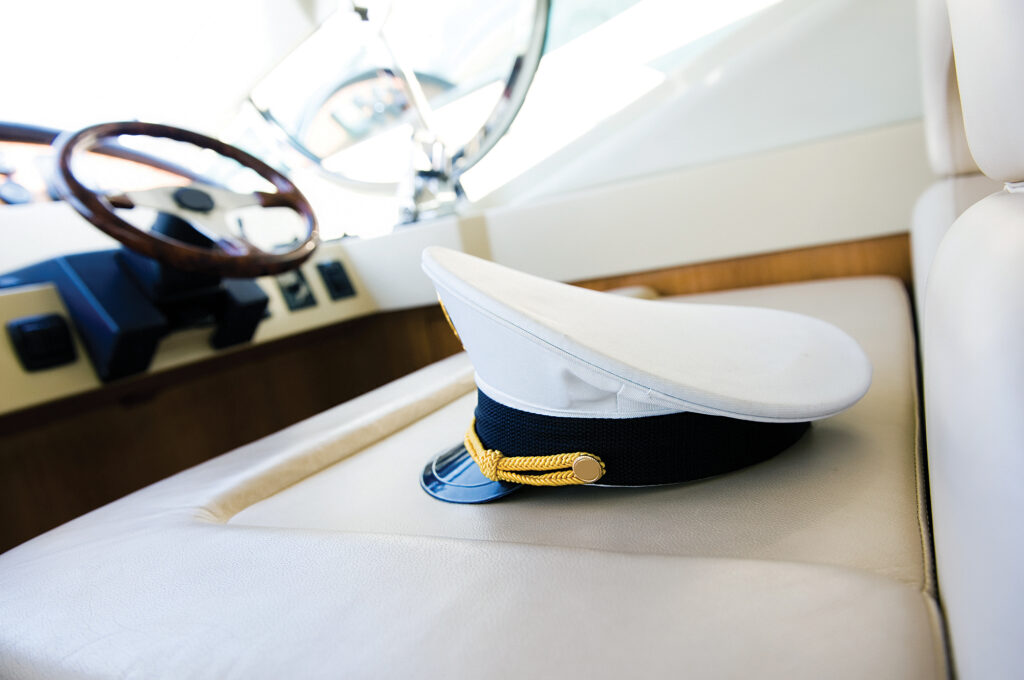
A Captain, or Just a Guy with the Hat?
Once you have your insurance coverage worked out, you’ve got to find a suitable captain and/or crew. There’s no crew license or credential for deckhands, so you might just ask around the marina to find out whose kid is both handy aboard a boat and not a teenaged trial to deal with. Boaty kids are usually pretty decent, I’ve found. Or maybe there’s an older guy with salt water under his skin who’d like to earn a few extra bucks while spending a day on the water; I usually learn something from those guys. When looking for a fishing guide, find the one who brings in their limit most days. If you’re wrong, in either case not much harm is done; you’re still running the boat. You’ll just find someone else for next time.
Hiring a captain is different: They will be running the boat while you’re doing whatever it is that keeps you away from the helm, so you’d better be sure they are up to the task. One day with a poor captain can cause a lot of problems. If there’s a placement service in your area, try them first; they will have done much of the vetting for you. If not, ask around, collect some names, get resumes and references and check them. You might even know a couple of skilled guys from your marina who would do the job, who have boats like yours who can skipper for you for a day. Your captain doesn’t have to be a “professional,” just able to handle the boat safely underway and in close quarters, as long as they meet your insurance company’s requirements. When they check their credentials, they’ll do a lot of your work for you.
For insurance purposes, insist on a Coast Guard license. Yeah, while there are lots of great boathandlers out there who aren’t licensed for one reason or another (maybe they just didn’t want to fill out the paperwork), a license is the best credential for a captain—although it’s not a guarantee of expertise: There’s no hands-on test when getting a license in the U.S.; it’s based on sea time, which the applicant can document themselves, and a written test. So don’t neglect your due diligence when considering even licensed captains.
Any serious professional will have a license of some kind, even an OUPV (Operator Uninspected Passenger Vessels). It requires the least amount of sea time (360 days, 90 in the past 3 years) and is good for vessels up to 100 gross tons. It’s usually called a “six-pack” license, because its holder is limited to vessels carrying no more than six passengers, and it’s really all the license captains of most pleasure boats need. (Check with the U.S.C.G. for the requirements.) Maybe a guy trying to make a few extra bucks running other people’s boats on weekends doesn’t have a license, but anybody who’s serious about skippering does.
More important than the class of U.S.C.G. license they possess is the experience your prospective captain has. It should be aboard boats as close to your boat as possible: If you have a sterndrive express cruiser, you want a captain with many hours driving stern-drive or outboard boats; if you own a single-screw trawler, look for someone with that kind of experience. The former handles much differently than the latter, which will be apparent in close quarters, especially if there’s wind and current. While a skilled boathandler will soon get the hang of a new vessel, it doesn’t happen immediately, and you don’t want a captain who’s learning on your dime, with your guests or your family on board.
After all that, hiring crew doesn’t sound like so much fun. I feel the lid of Pandora’s box getting more and more ajar. You might be better off strong-arming one of your kids, or a respectable friend, to handle lines and hand out food and drinks, while you sit at the helm and regale your guests with sea stories. The guy at the end of the bar has some good ones that you can purloin from him. Watch out for the kraken.
This article originally appeared in the October 2025 issue of Power & Motoryacht magazine.

So,You Want to be a Captain?
What does it really take to get your captain’s license? And is it worth the effort? Chris Dixon takes the classes, marks the charts and breaks it all down.