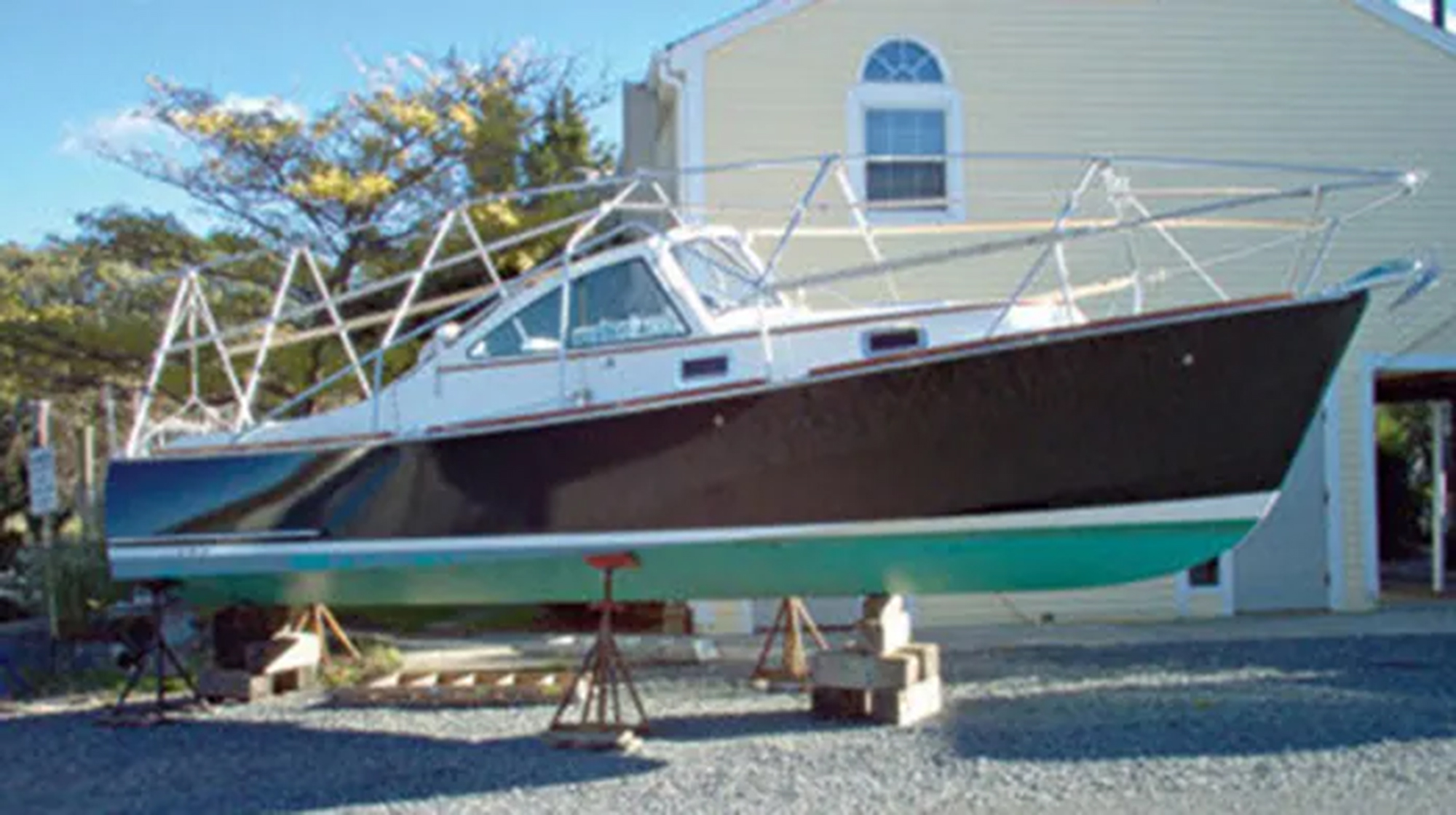

A couple of weeks ago, a friend showed me the contract for storing his boat at a local yard. Like all storage contracts, it included a checklist of work items, things that might need doing aboard the old ark that the yard could schedule for the dark days of winter. The list was divided into time periods: Maintenance chores that should be done every year, every two years, three years and five years. Five years? Who thinks that far ahead?
We all should, when it comes to taking care of our boats. Stuff that breaks down after five years or more of loyal service usually puts your boat out of service for a while, and it’s good practice to head trouble off at the pass. If you have an outdrive, for example, replace the bellows and related components every five years, even if it looks OK. If that’s two years down the road, plan for it now. Replacement doesn’t cost much when amortized over half a decade, and is certainly a lot cheaper than watching your boat slip below the surface while you’re treading water because the bellows gave out on an otherwise perfect summer boating day.
Another item on the five-year list, one that’s applicable to any freshwater-cooled engine, is servicing the heat exchanger. Most people don’t do this. Several years ago, the late Richard Thiel, one of Power & Motoryacht’s most respected editors and an experienced mechanic, noticed that his diesel engine was losing coolant, but he couldn’t find any leaks and there was no coolant in the bilge. The lube-oil level wasn’t rising, and the oil wasn’t getting lighter in color, which would have indicated coolant getting into the oil, maybe through a blown head gasket. Then Thiel saw a sheen on the water near his exhaust.
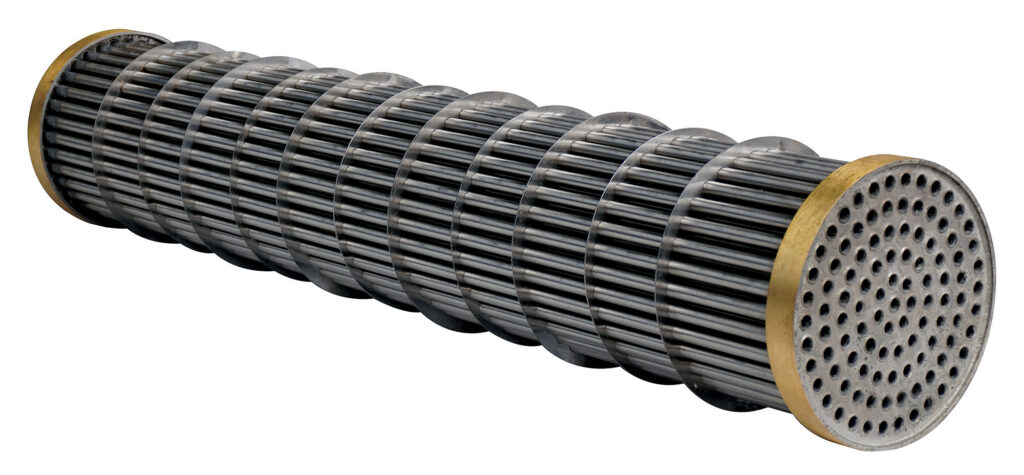
The sheen was the clue: Coolant was coming out with the raw water, and the most likely place coolant and raw water will mix is in a damaged heat exchanger. The heat exchanger is basically a metal tube with a core and a collection of smaller copper tubes, inside it. The cold water, in this case seawater, passes through the core, while the hot coolant, the freshwater mix that directly cools the engine, flows through the larger tube. The coolant exchanges some of its heat with the cold core; the now-heated seawater discharges overboard, usually via the boat’s exhaust plumbing, while the less-hot coolant continues to circulate through the engine. Damage to the core that cracks or splits some of the smaller tubes can let the two liquids intermix, so some of the coolant will flow out with the exhaust water, creating the sheen that tipped off Thiel to his problem.
Thiel’s engine was more than 20 years old, so it’s likely that vibration and/or galvanic corrosion finally took their toll on the heat exchanger. Vibration damage is more likely when flexible engine mounts start to wear out after years of service: Vibration increases very slowly, so most people won’t notice it, but the heat exchanger does, and eventually its core tubes will crack and leak. If the mounts are really worn, more weight of the engine will be transferred onto the prop shaft—in a worst case, this can bend or even break the shaft. So here’s another five-year job: Check and, if necessary, replace your engine mounts. It’s not a cheap job, but costs less than repairing whatever falls apart from excessive vibration. Budget for it now.
Galvanic corrosion will eat away metals inside the heat exchanger very quickly, so inspect the anodes regularly and replace them when they’re half gone, or sooner to be safe. I overlooked this minor chore once, when, as a young captain, I spent six months cruising the Mediterranean. I didn’t know that the Mediterranean is saltier than the Atlantic Ocean. The higher salinity increases the rate of galvanic corrosion of various components, including the anodes in my heat exchanger, which were eaten up by sea water much faster than usual. Once the anodes were gone, the Med water soon consumed the innards of the heat exchanger. The coolant level in the header tank kept rising as seawater mixed with coolant, the overflow leaving salty trails down the surface of the tank—that was my tipoff that something was amiss. By the time I replaced the heat exchanger I had a seawater-cooled diesel. (It ran fine, nevertheless.) The Mallorcan mechanic who repaired it said, “We see that a lot in boats from the U.S.” Now I replace my anodes every year.
Care For Your Cores
The mechanic who repaired Thiel’s leaky heat exchanger suggested to him that, in the future, he remove the core every five years, clean it with acid and inspect it for cracks or pink metal, the sign of galvanic corrosion. In addition, he added, every year or two remove the exchanger’s end caps to see what’s inside. The core can get clogged with salt deposits, corrosion, and general gunk, which impairs the function of the heat exchanger even if there’s no leakage. When a raw-water impeller loses a vane, it’s likely carried in to fetch up against the core, adding to the flow restriction. So regular maintenance of the heat exchanger is important. “It costs very little, only a new gasket.” You can clean out the tubes with a thin brush; McMaster-Carr and T.C. Wilson are good sources.
Every five years, flush the system and change the coolant. Servicing the heat exchanger will include changing the coolant, but even if you omit the complete service, at least change the coolant. Coolant will get acidic if left in the system too long, and damage the soft metal in the heat exchanger, so opt for shorter usage periods rather than longer, if in doubt. Coolant is cheap, so don’t skip this one.
Your engine probably has other heat exchangers, too. There are oil coolers, transmission-oil coolers, fuel coolers, intercoolers on turbochargers—some engines have all of these, some might only have a transmission-oil cooler. On most engines, the oil and fuel coolers are part of the closed cooling, i.e., freshwater, system, and less prone to fouling or corrosion, while the turbo intercooler is cooled by seawater. It depends on the design of the engine, so check your manual. But all of these are heat exchangers and need occasional inspection and maintenance. Check for fluid leaks when you do your engine inspections too. Open each oil cooler periodically for cleaning and inspection; check your engine manual to find recommended service intervals. Taking the coolers apart isn’t difficult, but it might be a job for your mechanic.
An intercooler, sometimes called an aftercooler, cools hot, high-pressure air from the turbocharger before it’s forced into the combustion chamber. Cooler air is denser, and the added oxygen allows more fuel to be burned which increases horsepower. Treat your intercooler like you do your engine’s heat exchanger: Replace its anodes regularly and open and clean it periodically—check the manual or ask your mechanic for its service interval; it’s probably shorter than every five years. You definitely don’t want the water side of the intercooler to leak into the air side, since that air goes into the intake manifold of the engine. A little bit of water will probably burn off without doing any harm —that’s one way to clean a turbocharger: Trickle water or a cleaning solution into the air intake while the engine’s running—but salt water getting into the turbocharger and the cylinders isn’t good. Have your mechanic do this job, since he/she can clean and service the turbocharger at the same time.
• • •
Speaking of water getting where it shouldn’t be, let me say once again: Replace your exhaust elbows and risers every five years, before they corrode and let seawater, which should flow overboard, leak back into the cylinders through the engine’s exhaust manifold. Not good—when you crank the engine with water in the combustion chambers, something expensive usually gives way. We’ve mentioned this many times, but once more doesn’t hurt: Spend the money to change the manifolds and risers every five years; if you don’t, you’ll pay more should they fail.
Scrupulous skippers pull the exhaust hoses off the elbows every couple of years to check for corrosion; it’s not a bad idea, but use new hose clamps when you put things back together. If you don’t have a pyrometer to measure exhaust temperature, consider adding one. If there’s a blockage in the cooling system, it’ll show up first in exhaust temperature; by the time the engine’s temperature sensor shows overheating, the exhaust might be hot enough to damage the hose.
While you’re working on the raw-water cooling system, inspect and clean any anti-siphon valves. Not all boats have them—they’re mostly found on boats with engines mounted at or below the waterline, e.g., deep-bodied single screw trawlers, or sailboats. The purpose of the anti-siphon valve is to prevent sea water from siphoning through the raw-water system when the engine’s not running. This isn’t a problem if the water can flow overboard through the exhaust, but a waterlift muffler—and many inboard boats have them—will fill up without the engine running and thus expelling exhaust gases that force the water overboard. Eventually the water will back up into the engine. Keep the anti-siphon valves clean and this shouldn’t happen. Seawater-flush heads often have anti-siphon valves on the intake plumbing; clean these, too. It’s a simple job you can do yourself.
And that reminds me, have you checked the belt that drives your raw-water pump? That’s a five-year replacement item. And what about your cutless bearings? Stuffing box? Rudder seals? Need I go on? Bottom line is, get with your mechanic or yard manager and work up a plan to keep your boat running problem-free for many years, or at least as problem-free as possible. It’ll cost a few bucks, but over the long term, maintenance is cheaper than repair. Think ahead.
• • •
Keep Good Time
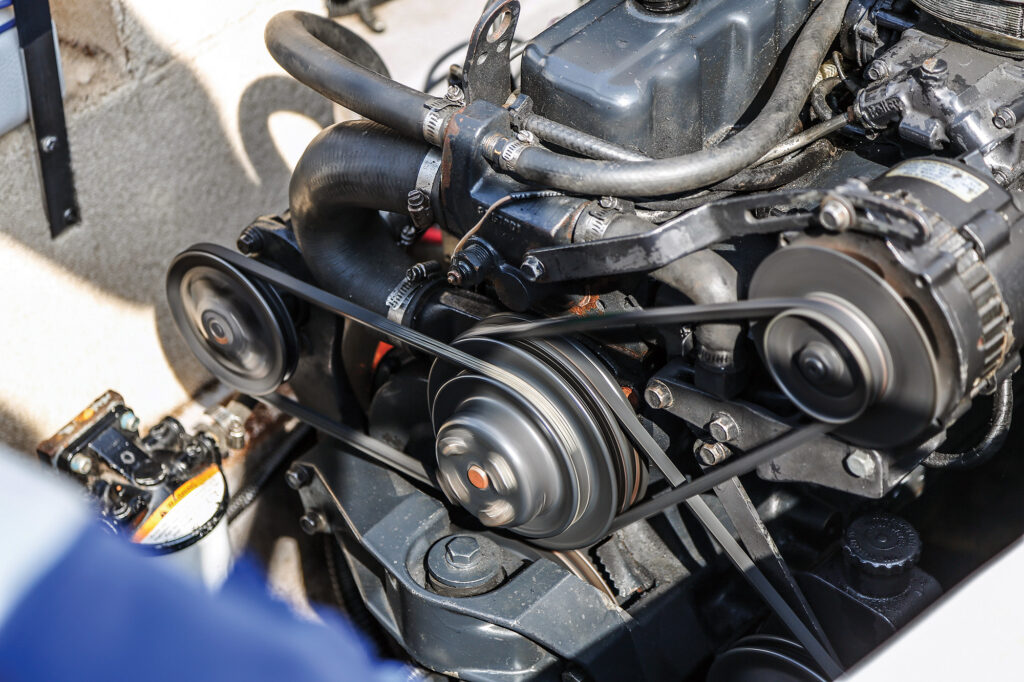
Another item on my buddy’s five-year plan, one that had nothing to do with cooling, was to replace any timing belts in the engines. Today most engines have metal timing chains that last for the life of the engine, but not so long ago engine builders used fabric timing belts. Timing belts don’t last forever: I had a turbocharged Volkswagen Passat whose service manual said to replace the timing belt every seven years or so-many-thousand miles. It was an expensive job, and I decided from then on to buy cars only with timing chains. But if your boat’s, or your car’s, motor has a timing belt—your maintenance manual will tell you, or you can ask your mechanic—you want to change it before it breaks. The timing belt coordinates the movements of the pistons and valves, so when the piston is at the top of its stroke, there’s no open valve in the way. At best, a broken timing belt will stop the engine; at worst, the failed timing belt will leave an intake or exhaust valve open when the cylinder comes up, causing serious damage when the two collide. Next time, buy engines with timing chains; in the meantime, pay the money and replace the timing belt.
This article originally appeared in the February 2026 issue of Power & Motoryacht magazine.